Story: Late

March 22, 2026

Ezekiel 37:1-14
John 11:1-45

The Manu-o-Ku chick was hungry. Of course he was hungry. Mom and Dad had fed him, then flown off to find more food. He sat on the branch where he’d hatched, and waited for them to come back.

He was hungry.

He got hungrier. The sun kept moving across the sky, but as it did no white wings appeared. He saw no black beaks carrying fish. There were plenty of other birds about, but not the ones he looked for.

He was hungry.

He was hungrier.

Where were they? They were clearly late. When you’re hungry, a late meal is the next one you have, because you want to eat when you’re just starting to be hungry, and not when you’ve been hungry for a while.

He’d been hungry for a while. At least so it seemed to him.

The sun really wasn’t moving that fast across the sky, but it was moving. He shuffled along the branch for a bit and that didn’t help. Now he was hungry in a slightly different place. It wasn’t really any different from being hungry in the place he’d been.

Where were his parents?

The ocean wasn’t that far away. He could hear the waves breaking sometimes. How far did you have to fly to find fish in the ocean? He didn’t know. He couldn’t fly yet.

What if they had to fly to a completely different island to find fish? That didn’t make sense, but sometimes when you’re hungry, you think things that don’t make sense.

Where were his parents? Did they get lost? Were they feeding some other chick? Had they decided that he was too much trouble?

No, he was sure they were coming back. If they could. If they hadn’t been blown off somewhere by a high wind…

He was so hungry.

He closed his eyes to focus on worrying and feeling sorry for himself and feeling hungry.

He opened his eyes a moment later to the sound of fluttering wings and the scrape of claws on bark. It was his mother. She had food for him. She was late – at least as far as he was concerned – but she was there.

But she didn’t have a fish for him.

She had two fish.

Not one, but two. She’d fished a bit longer to fill him up a little more.

He ate the first fish, and he felt less hungry. Then he ate the second fish, and he felt very good indeed.

“Thanks for being late, Mom,” he said. She gave him a funny look.

“Thank you for bringing two fish,” he said.

“Of course, son. You’re welcome,” she said, and she took off again for the next fish she’d bring back to him.

by Eric Anderson

Watch the Recorded Story

I write these stories in full ahead of time, but I tell them from memory and inspiration. The story as I wrote it and as I told it are not precisely the same.

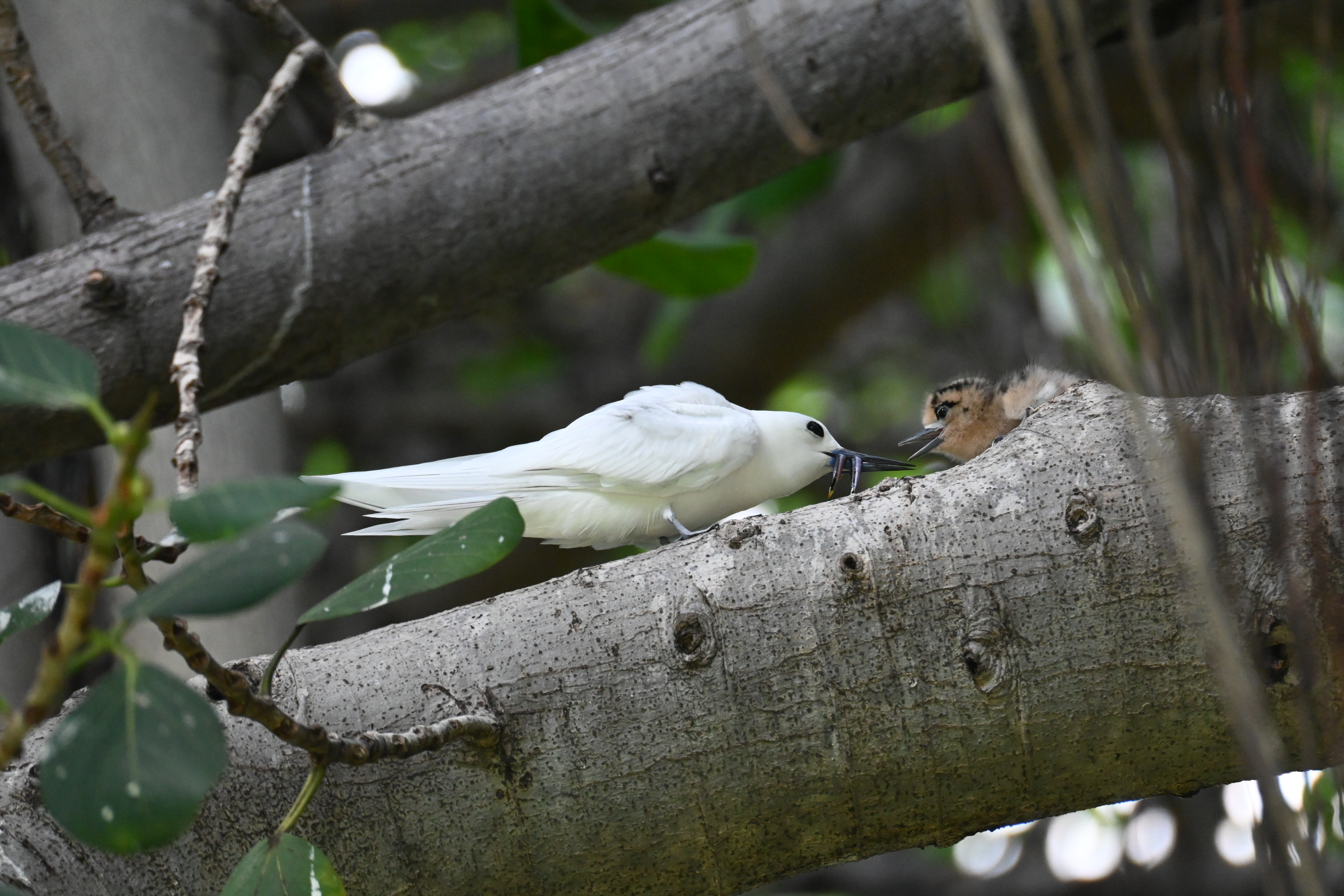
Photo of a Manu-o-Ku parent delivering two fish to a chick by Eric Anderson.
I Fear I am not God

There is no fear in love, but perfect love casts out fear; for fear has to do with punishment, and whoever fears has not reached perfection in love. – 1 John 4:18

Fear is not just about punishment, John.
Fear is also about being hurt.
Fear is about taking a risk.
Fear is about the unknown.

I fear punishment, of course.
The pain is not just the harsh words,
hard tones, spoken to me.
I punish myself as well.

I fear as well the hurt
that is not punishment,
but comes from accident
or malice done around me.

I fear to take a risk, of course,
because, deserved or not,
if risk turns into failure,
I will feel the pain.

And I fear the unknown
because who knows (I don’t)
what dangers lurk for me,
what hurts I’ll face and feel?

So John, I know that God is love,
rejoice that God loves without fear.
I live in love and fear.
I fear I am not God.

A poem/prayer based on 1 John 4:7-21, the Revised Common Lectionary Second Reading for Year B, Fifth Sunday of Easter.

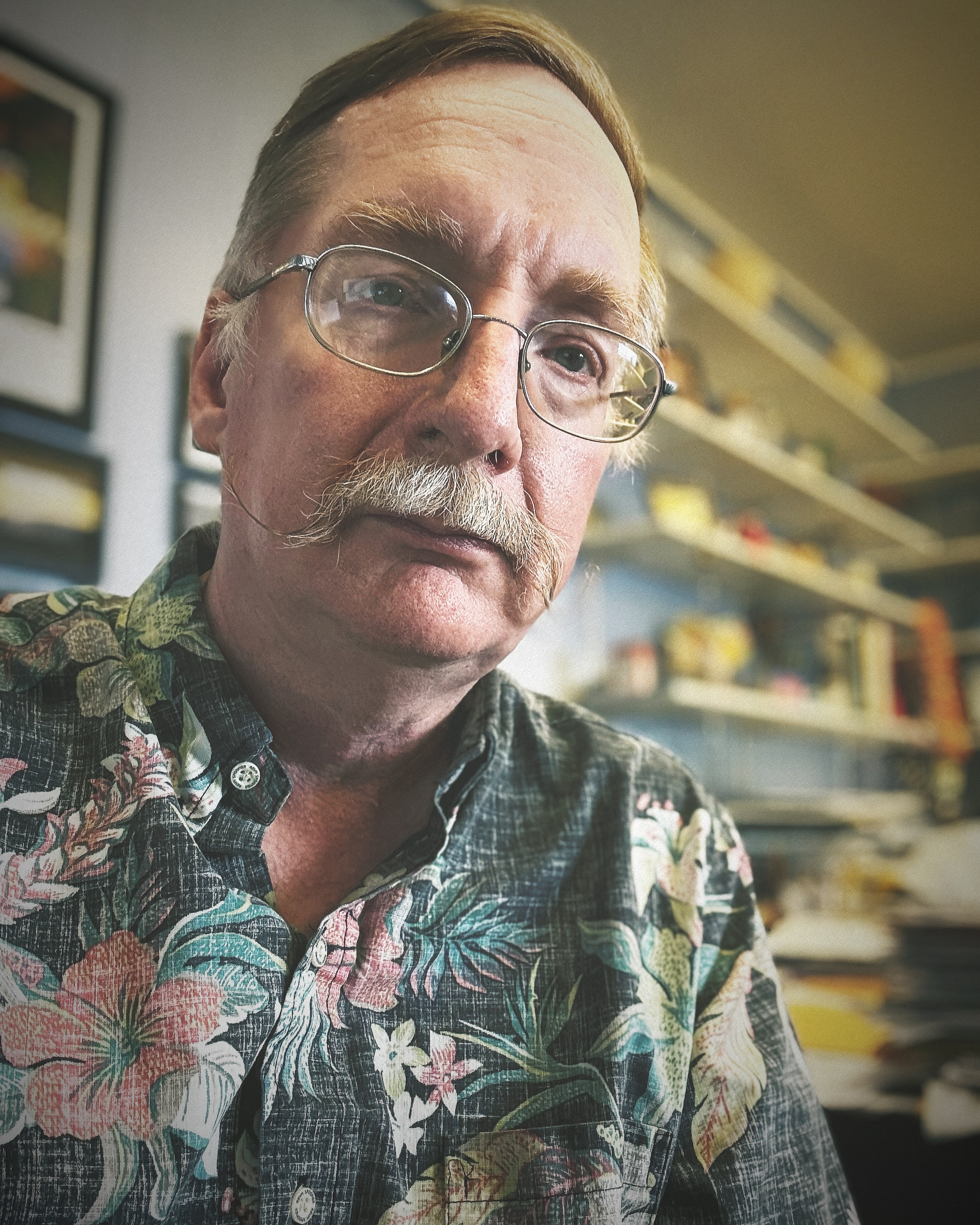
Self-portrait by Eric Anderson.

Christmas Eve 2021

Such fear upon that blessed night:

The fear of Joseph, who had failed
to find a shelter proper for the birth.

The fear of Mary, who had never birthed
a child before, nor known her body to take charge.

The fear of neighbors, who awoke
to sounds of labor echoing.

The fear of stable owner, wondering
if father’s stormy brow meant violence.

The fear of midwife, all experienced
with healthy births – and infant deaths.

The fear of all, when mother’s screams
went silent, and the universe was hushed.

The fear of mother, marveling to hold
a newborn who would not be comforted.

The fear of angels, asking if a band
of shepherds was their audience.

The fear of shepherds, so the messenger
said first, “O do not be afraid.”

The fear of singers in the heavens’ choir,
lest heaven’s song lack harmony.

The fear of watchmen at the gate,
confronted by the shepherd band.

The fear of seekers for the infant Christ,
uncertain where to find the stable bed.

The fear of parents, shocked to see
the hillsides’ wanderers had come.

The fear of parents, hearing angels’ words,
which would the fear of monarchs generate.

The fear of monarchs, which would bring
no celebration, only tears like rain.

The fear of sleeping child. Who can know
what infants know? And who can say
what infant Jesus knew of dusty days
and stormy seas and quiet conversations
by the water’s edge, of questions over meals
and by a paralytic’s cot and in the shadows of
the night, of lepers leaping thanks unspoken
save for one, of baptism and Satan’s snares
and stories told and proverbs taught
and so much more, and so much more,
all leading to an agonizing cross
and to a tear-swept joyful dawn.

A poem/prayer based on Luke 2:1-20, the Revised Common Lectionary Gospel Reading for Year C, Nativity of the Lord, Proper I.

The image is The Adoration of the Shepherds (ca. 1612-1614) by El Greco, 1541?-1614, from Art in the Christian Tradition, a project of the Vanderbilt Divinity Library, Nashville, TN. https://diglib.library.vanderbilt.edu/act-imagelink.pl?RC=48042 [retrieved December 24, 2021]. Public Domain. Original source: https://commons.wikimedia.org/wiki/File:El_Greco_002.jpg.

Reassure Me

It’s dark.

This is a valley of shadows.

This is a valley of death.

My grief and not my cup runs over.

Too many earthly shepherds flail
with rod and staff;
they maim and kill their flock,
and leave the predators untouched.

My enemies enjoy the feast
that I will never taste.

This is place from which I cry,
“De profudis clamavi ad te!”
“Mimma’amaqqim qeratika!”
“Mai loko o na wahi hohonu,
ua kahea aku au ia ‘oe!”
“Out of the depths I cry to you!”

Reassure me with your implements
of protection, Holy Shepherd,
for the night is long. I am afraid.
I turn my prayers to you.

A poem/prayer based on Psalm 23, the Revised Common Lectionary Psalm Reading for Year A, fourth Sunday of Easter, Good Shepherd Sunday.

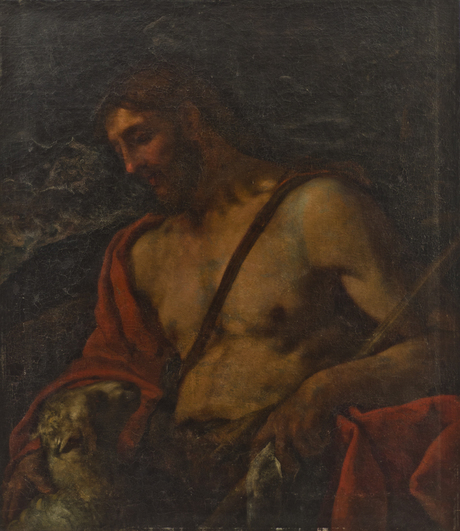
Image of The Good Shepherd by Luca Giordano – http://www.gallery.am/hy/database/item/6772/, Public Domain, https://commons.wikimedia.org/w/index.php?curid=20019538.

Whom Shall I Fear?

The Lord is my light and my salvation; whom shall I fear?
– Psalm 27:1a

Well, God, how about I make a list?

  • Zealots with guns.
  • Leaders of nations unrestrained by law, compassion, or mercy.
  • A changing climate.
  • Greedy self-interest unrestrained by regard for neighbor.
  • Greedy self-interest empowered by injustice.
  • Greedy self-interest.
  • “We can win this nuclear war.”
  • I’m OK with heights, but please don’t drop me into the depths.
  • Greedy self-interest.
  • An asteroid on a collision course with Earth.
  • A plugged snorkel tube.
  • Routinized injustice.
  • And… Greedy self-interest, including my own.

With so many and so much to fear –
including the greed of my own heart –
let me take courage in your light.
May I find strength in your salvation.

Do not cast me off,
do not forsake me,
O God of my salvation!

Psalm 27:9c

A poem/prayer based on Psalm 27:1, 4-9, the Revised Common Lectionary Psalm reading for Year A, Third Sunday after Epiphany.

“Earthrise” photo by NASA/Bill Anders – http://www.hq.nasa.gov/office/pao/History/alsj/a410/AS8-14-2383HR.jpg, Public Domain, https://commons.wikimedia.org/w/index.php?curid=306267.

Martha’s Prayer

Worried and distracted
by many things?
O, Jesus, if you knew!
Yes, if you only knew!

It’s not the bread and cookies
or the trays of snacks,
nor the fraying linens
or the dusty sills:

It’s the wailing children, Jesus.
It’s the hopeless refugees.
It’s the pain-wracked sufferers.
It’s the justice-denied and hungry.

It’s the comfortable oppressors.
It’s their eager lackeys.
It’s the ones determined
that they will not see injustice.

Worried and distracted
by many things?
O Jesus, if you knew!
But then, you did; you knew.

Breads and cakes forsaken,
I will shed my tears upon your feet.
How will we dry the moisture
lavished there from streaming eyes?

Hold me, Mary, as we weep
together for the long-awaited reign of God.
Unbind your hair, to wipe away
betraying symbols of our grief.

A poem/prayer based on Luke 10:38-42, the Revised Common Lectionary alternate first reading for Year C, Proper 11.

The image is Christ in the House of Martha and Mary, by Johannes Vermeer. Public Domain, https://commons.wikimedia.org/w/index.php?curid=21865869