June 16, 2024
1 Samuel 15:34-16:13
Mark 4:26-34
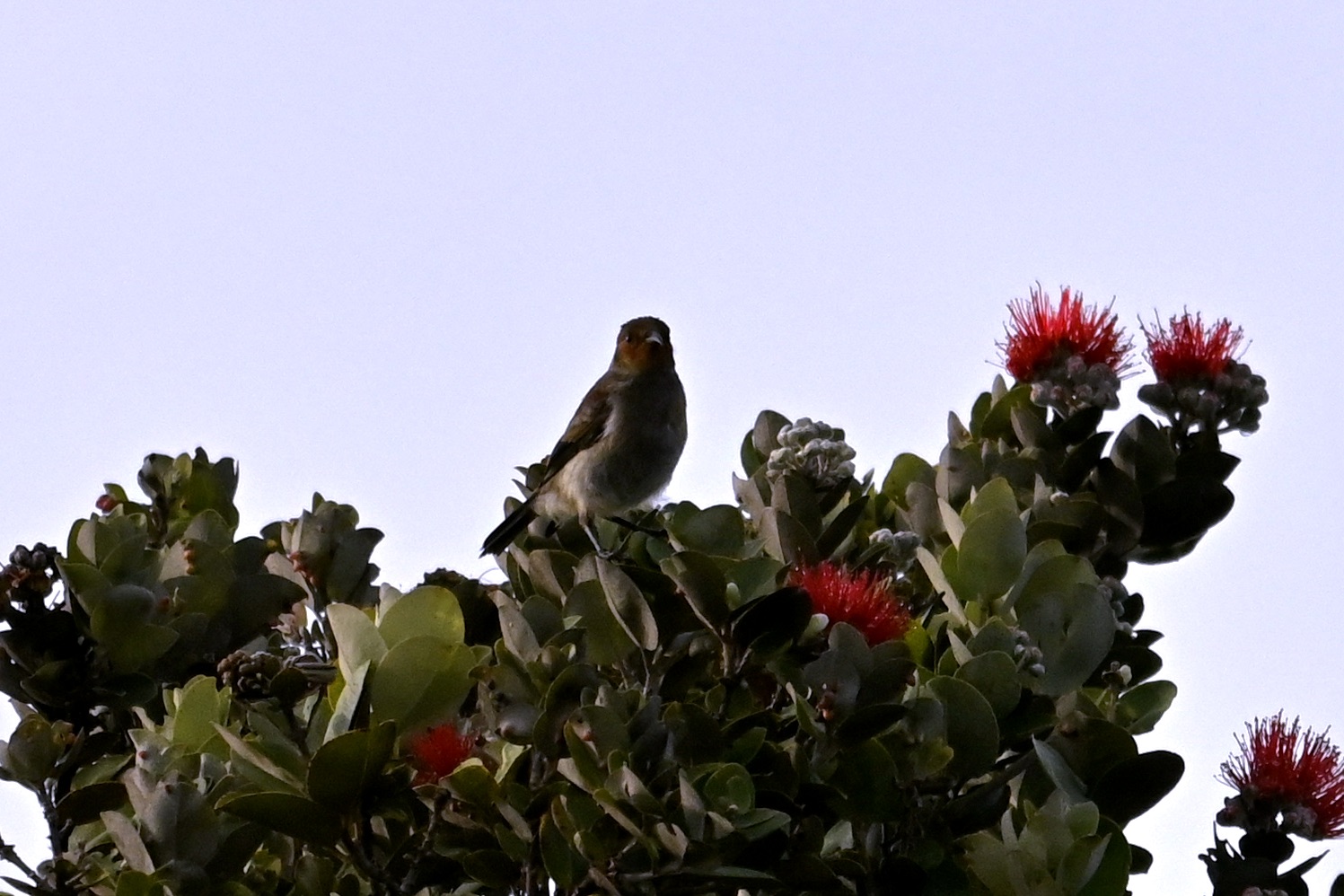
The ‘apapane was still young. So young, in fact, that his feathers were black and brown, rather than black and red. He had another month or two to go before he’d wear red feathers.
So he was still young. It turns out that he was old enough to have had something very scary happen to him, and he still thought he’d had a very narrow escape. He’d been perched in a tree eating bugs and nectar from ohi’a flowers when he heard the rush of air moving quickly over big wings. He immediately hopped along the branch toward the tree trunk.
Sure enough, he saw an i’o had swooped down to a neighboring tree, where he landed. The i’o just sat there for a few minutes, looking all about. The young ‘apapane was absolutely certain the i’o looked directly at him at least three times. He stayed absolutely still. Then the i’o stretched his broad wings and climbed into the sky, where he vanished a minute later.
Now the ‘apapane started to tremble. Truthfully, the i’o probably hadn’t even noticed he was there and had just landed to catch his breath and consider where he’d go next. That never occurred to the ‘apapane, of course. He was convinced that the i’o had seen him, tracked him, and stooped down at him, and that he’d escaped in the nick of time.
He had to find a way to be more aware of potential dangers. Obviously sitting in a tree he was more distracted, but on the other hand he was only a hop or two from safety. The dangerous times, he decided, were in flight. How could he look all around?
I’ll just mention that an ‘apapane’s eyes are set on the sides of their heads, so they already can look all around. He wasn’t quite thinking about that.
Instead, he decided to fly with a series of barrel rolls.
That’s when a bird (or a plane, or Superman, I suppose) rolls over as they fly. If you or I did it, we’d be spinning. It did allow him to see above, below, and to each side. To that extent it worked.
The problem was that it made him dizzy. If you or I were to do a lot of spins, we’d get dizzy. When this ‘apapane did a lot of barrel rolls, it made him dizzy.
Dizzy enough that his next landing in a tree looked rather painful.
Still, he kept trying it. “Eventually it will work,” he told himself, so he did exactly the same thing in exactly the same way. And exactly the same thing happened. He got dizzy, and he landed badly.
He couldn’t really see what was in the sky around him, because when his head cleared after his latest rough landing, he saw his father perched on the branch beside him.
“What are you doing?” said father.
“Watching for i’o,” said his son.
“Is it working?” asked father.
“I’m sure it will,” said his son.
“What are you doing differently?” asked his father.
“Nothing,” said his son. “I’m doing the exact same thing every time.”
“And leads to the exact same problem every time, doesn’t it?” said his father.
“I have to watch for i’o,” mumbled his son.
“Try turning your head rather than your whole body,” said his father. “Try weaving your flight from side to side. Try anything that’s different – because, my son, what you’re doing right now isn’t working, and doing it over and over again the same way won’t make it better.”
You may sometimes see an ‘apapane do a barrel roll as it flies about the ohi’a forest, but when it does, it’s to pull off a fancy landing or just to celebrate the joy of flight. He’d learned something from the wisdom of his father: try something different.
by Eric Anderson
Watch the Recorded Story
I write these stories in advance, then tell them from memory and improvisation. As a result, what you’ll see and hear in the video recording does not match what you’ve just read above.
Photo of an immature ‘apapane by Eric Anderson.

 ordainedgeek