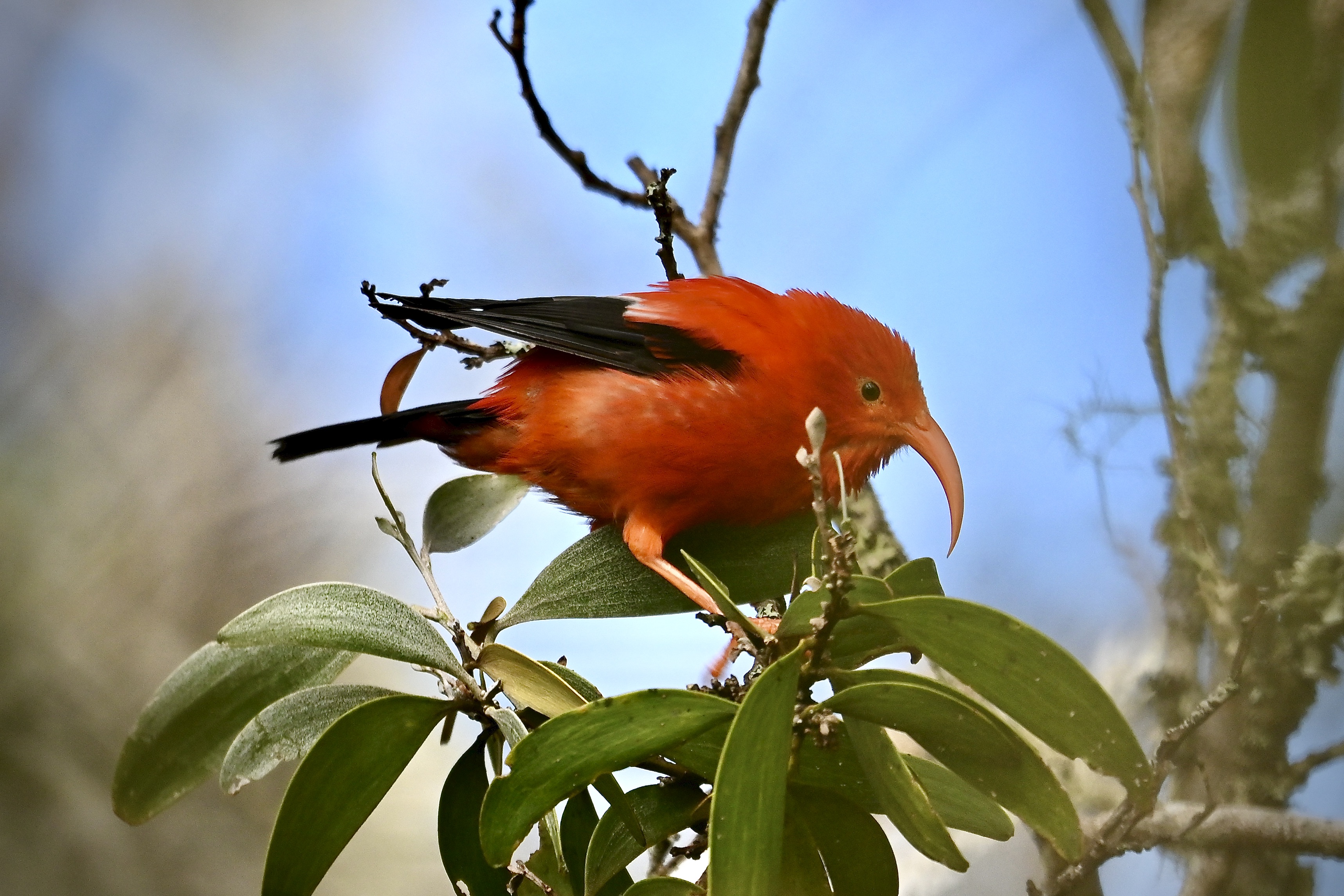
Story: Following the I’iwi

August 17, 2025

Jeremiah 23:23-29
Hebrews 11:29-12:2

During the summer, plenty of the forest birds form small flocks which may include ‘apapane, ‘amakihi, ‘akepa, and so on. Plenty of those birds may fly about and forage by themselves as well, but one little flock on the slopes of Mauna Loa was having a bad day. They just weren’t finding much in the way of food.

“I’m hungry,” complained an ‘amakihi.

“We all are,” replied an ‘apapane, and the other birds agreed.

“What are we going to do about it?” asked the first ‘amakihi.

“Does anyone have any good ideas?” asked another ‘apapane, looking around at the other birds. From the shaking heads, nobody did.

That’s when the heard they heard the squeaky sound of an i’iwi. They watched as he rose from a nearby tree – one which didn’t have much in the way of flowers on it, circled once or twice, and flew off.

“What was that about?” asked an ‘apapane.

“I don’t know,” said an ‘akepa.

“How about we follow him?” said the first ‘amakihi, the one who was hungry.

Nobody could think of a good reason not to, so the little flock took to the air and flew in the same direction the i’iwi had taken. For a little while they just flew over flowerless trees, but then a few ohi’a blossoms appeared. Things were looking up. Eventually the i’iwi settled in a tree just dripping with flowers, surrounded by plenty of other blossoming trees as well.

The i’iwi squawked a little unpleasantly at them – they’re not great singers, the i’iwi – but didn’t come out to chase them away as they settled into surrounding trees and began checking the flowers for nectar and the branches for bugs. There wasn’t much sound for a while other than some satisfied songs and wing flutters as they shifted from branch to branch.

“How did you know?” said an ‘apapane to the ‘amakihi.

“How did I know what?” said the ‘amakihi.

“How did you know that the i’iwi would lead us to flowers?”

The ‘amakihi shrugged. “I didn’t know,” he said, “but as sad as it is that the i’iwi isn’t a great singer, and as nasty as they can get when they’re upset about something, they’re really good at finding trees in blossom. I’d trust them to find food any day of the week.”

“You’d trust an i’iwi?” said the ‘apapane in wonder.

“I trust an i’iwi to do what an i’iwi does,” said the ‘amakihi. “And look. This one did.”

The i’iwi, who had overheard all this, let out a contented squawk, hopped to another flower, and settled in to sip the sweet nectar.

by Eric Anderson

Watch the Recorded Story

I write these stories in advance, but I tell them from a combination of memory and improvisation, so what I wrote and how I told it do not match.

Photo of an i’iwi by Eric Anderson.
Story: Perfectly Picky

April 14, 2024

1 John 3:1-7
Luke 24:36-48

I believe I mentioned a few weeks ago that if there’s something edible up in the ohi’a and koa forests – bugs, berries, fruit, sap, nectar, caterpillars, and so on – there’s an ‘amakihi eating it. They’re not picky eaters. They’re enthusiastic eaters.

Except for one young ‘amakihi. She was perfectly picky.

I don’t know how it got started, but I do know that early on she’d only eat bugs that she’d seen fly. I guess that meant they were fresher, somehow? Which meant that she would no longer eat the crawling bugs or the caterpillars, and there would be no spiders in her diet.

I know. You’re thinking, good choice. Along with you, I am pretty happy not to eat bugs at all. We are people, though, and not ‘amakihi.

Then she wouldn’t eat tree sap that came from cracks in the bark. I know – again, it sounds like a good choice for a human. But if you’re not going to eat tree sap that comes from cracks in the bark, how are you going to get to it at all? An ‘amakihi beak isn’t a good shape for making holes in bark. She’d removed another entry from her diet.

Then she decided not to eat fruit or berries unless it was perfectly ripe. That cut out a whole lot of fruit that was almost ripe, and it cut out a lot of fruit that was just past ripe, all of which feed other ‘amakihi perfectly well.

Her family started to notice that she was maybe getting a little thinner.

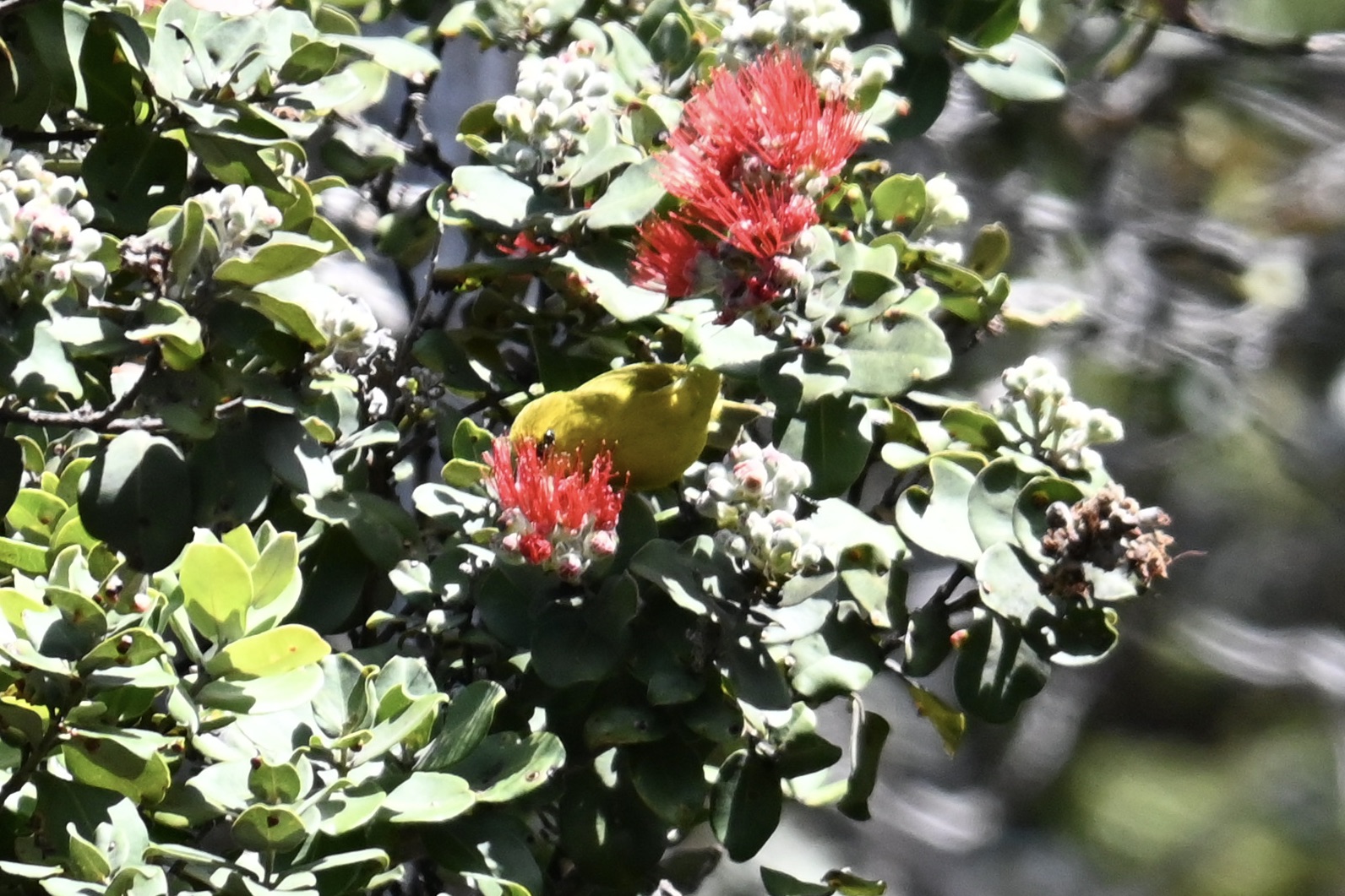
When she decided that the only nectar she’d sip would be from perfectly formed ohi’a flowers, that really did it. Go up to the ohi’a forests and you’ll find plenty of flowers on the trees. But are they perfectly formed into red puffballs? Not exactly. Some flowers show just a few scarlet tendrils. Some form ovals or just plain look squashed.

She wouldn’t eat from them. She wouldn’t even eat the flying bugs that landed on them.

She was hunting through an ohi’a tree that was bright red with blossoms – but very few of them perfect blossoms – when the branch jumped with another bird landing. She looked up and saw her grandmother watching her. Grandmother watched her pick over a big bunch of lehua, sip from none of them, and hop over to another, and sip from none of them.

“What are you doing, granddaughter?” asked grandmother.

“Eating,” said the picky ‘amakihi. “I’m hungry.”

“Eating what?” asked grandmother, who hadn’t actually seen her granddaughter eat anything.

“Nectar,” said granddaughter.

“Where?” asked grandmother.

“From the good ones,” said her granddaughter. “I only eat from the perfect flowers, Tutu.”

Grandmother looked at the tree full of blossoms and didn’t see many perfect ones. “You won’t find many perfect ones, granddaughter,” she said. “Not here, and not anywhere.”

She watched the picky ‘amakihi skip perfectly good (if imperfectly formed) ohi’a flowers for a little longer and said, “I think you should eat from some of the imperfect ones, young one.”

Granddaughter, who was annoyed, poked her beak toward a flower that basically had two red tendrils and no visible nectar, and said, “You mean like that one?”

“No, child,” said grandmother. “Not like that one. There’s nothing there. But the question isn’t whether a flower is perfect or not. The question is whether it feeds you.”

The picky ‘amakihi thought about this a while. And she really was hungry. With a glance at her grandmother, she put her beak into a bright red ohi’a flower which, to be honest, wasn’t perfect, and fed.

by Eric Anderson

Watch the Recorded Story

I write these stories ahead of time, then tell them in worship without notes. As a result, they change in the telling.

Photo of an ‘amakihi feeding at imperfect ohi’a flowers by Eric Anderson.