Story: Flying Time

'Apapane in flight

February 11, 2024

2 Kings 2:1-12
Mark 9:2-9

One of the themes that tends to pop up in my stories is something like, “When is it a good time to fly?” Sometimes the birds asking that question are chicks wondering whether they’re ready for their first flight. Sometimes it’s older but still young birds trying to figure out how far they can go. Sometimes it’s older birds trying to balance the needs of nest-building and chick-feeding. Sometimes it’s just a bird thinking, “What does the world look like over there?”

A little group of ‘apapane decided to discuss the question in some detail. They thought that they’d like to become wise birds, wise ‘apapane, wise creatures that would have some good reasons to choose to fly at some times, and not to fly at other times.

“When is a good time not to fly?” asked one of the little flock.

“When there’s an ‘io overhead,” said one.

“Or a pueo,” added another.

“Or the shadow of something big and you’re not sure what it is,” said a third.

“It’s not a good time to fly in a big wind,” put in one.

“I’m not crazy about flying when there’s lightning,” said another.

“What about if you’re lost?” asked one of the ‘apapane. “Is that a good time to fly?”

They thought about it. “If you just stay in place when you’re lost,” said one slowly, “you don’t see anything different than what you’re seeing. I think you have to fly at least a little bit so that you can see new things, which might be the old things you’re trying to find.”

“If it’s a high wind and the tree is breaking, that’s a good time to fly,” added an ‘apapane who had been thinking about this for a while.

“What is a good time to fly?” asked the first bird.

“When the tree is breaking,” said the bird who didn’t want anyone to forget that.

“When the tree you’re in is out of bugs and nectar,” said another.

“When your wings and feathers are ready, and not before,” said one of the younger ones whose first attempts at flapping his wings hadn’t gone well.

“When you want to sing with the birds in another tree,” said a particularly musical ‘apapane.

“When it’s naptime and everybody is singing in your tree,” said an ‘apapane who liked to rest after a meal.

They fell silent for a bit at this point. Suddenly the first bird, the one who’d been asking the questions, the one who really wanted to be a wise ‘apapane, laughed out loud.

“When you feel like it!” she sang, and soared up into the sky.

Flying is all about the practical things, and there are plenty of times when flying is a bad idea, when it’s dangerous. Human beings don’t fly, at least not without an airplane, but we have our own times to stretch our wings, as it were. Be careful and don’t take off when it’s dangerous, friends, but make sure to appreciate the joy when you do.

by Eric Anderson

Watch the Recorded Story

I write these stories ahead of time, but during worship I tell them from memory plus improvisation. So what you hear in the recording does not and will not match what you’ve just read.

Photo by Eric Anderson.

Sometimes You’ve Just Got to Fly

The koa’e kea (or white-tailed topic bird) lives on the cliff sides around Kilauea. Well, some of them do. Some of them lives elsewhere around the islands.

White-tailed_tropicbird by YooshauThe koa’e kea flies down to the ocean to search for fish in the tossing waves. It is a strikingly beautiful bird, with bright white feathers set off by jet black ones. Plus, it has a long, narrow tail – the tail is longer than its body! It streams out behind it in flight.
This one koa’e kea was a serious kind of bird. He wanted to be certain to take care of things that were important. That meant, first of all, keeping himself properly fed, so he was often found scanning the sea for signs of fish or squid (sorry, calamari). He did not want his energy to flag because he’d skipped a meal.

He also paid a great deal of attention to making sure he had a proper nesting place. He looked carefully for the best place, where the nest would be safe from predators (or from accidentally falling down the cliff side).

He paid attention to other important things, too. He knew the importance of friends. So he joined in the conversations and the controversies, and he was always there with a joke.

(I’m afraid I’ve never been able to properly appreciate the humor of the koa’e kea. It mostly sounds like “SQUAWK!” to me.)

He found himself puzzled by his friends, however. Sometimes, for no apparent reason, everybody would take off and start to circle around Kilauea’s summit. They’d dip and dive, and climb and soar. They weren’t hunting anything (food was four thousand feet below in the ocean), they weren’t telling jokes (since every conversation went something like, “SQUAWK!” “What did you say?”), and they certainly weren’t tending nests.

It was all rather baffling.

Worse, he seemed to be the only one who didn’t understand it. His friends did it, but so did their parents. So did their parents’ friends. So did his parents. Everybody, from time to time, would just soar about the volcano.

Everybody except him.

He asked his friends about it, but they were just vague. “Why fly about the volcano? Well, no reason, I suppose,” they’d say. He swallowed down his annoyance. And finally asked his mother.

“Son,” she said, “you’re a good son.”

He nodded his thanks.

“But sometimes I think you miss things from doing everything so seriously. Life is more than keeping fed; it’s also about enjoying the fish you caught. It’s more than having a nest; it’s also about rejoicing in the chicks you raise. It’s more than chatting with friends; it’s also about enjoying their company in silence.”

“Son,” she said, “I know you can use you wings to get from place to place. But did you ever just stretch them out and fly?”

He looked puzzled.

“Sometimes,” she told him, “you just need to fly.”

You and I, well, we don’t have hollow bones and feathered arms. We’ll have to fly in other ways. But when we do find those ways – a song to sing, or a hill to climb, or a picture to make, or a thought to think – that’s when we, too, can fly.

And I assure you that this koa’e kea: he learned to fly.

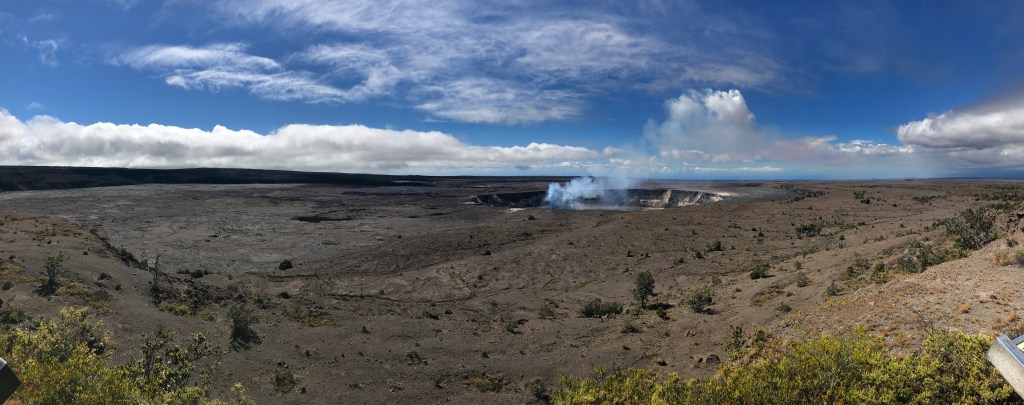
20170819 Kilauea panorama

Kilauea Summit (Photo by Eric Anderson)

Photo of white-tailed topic bird (koa’e kea) in flight by Yooshau – Own work, CC BY-SA 3.0, https://commons.wikimedia.org/w/index.php?curid=18333581.

Isn’t It Enough to Fly?

nene-201611There is a sad shortage of kites in this story. I’m afraid that the ‘apapane fails to make an appearance. There isn’t even a mongoose.

You were hoping for a mongoose? I’m sorry. There will be other stories with a mongoose, I’m pretty sure.

A baby? Well, sort of. It had been a baby, just not a baby human being. Actually it had been a chick, and now it was a gosling. A young nene.

And this nene: Oh, how he yearned to fly. He wanted to soar above the trees, and learn all the secrets he was sure lingered in the clouds, and to see the whole world changed when he took to the skies. He was sure that flying would make the sun shine more brightly, and the rain fall more sweetly, and make food taste richer and even make his dreams deeper.

But he had to wait. When he was born, well, actually, he wasn’t born. He was hatched, from an egg, exactly like all of you weren’t.

He was hatched with feathers that are completely unsuitable for flying. They were soft and fuzzy and very well suited for keeping him warm at night, but they wouldn’t move air when he moved his wings up and down. So he had to wait to grow the new feathers.

He also had to wait for his wings to grow. There’s a limited amount of space in an egg, so his wings were very small things at hatching. But as he got bigger, so did they, and took on the shapes of flight.

He also had to wait for his muscles to strengthen. Flying takes a good amount of strength, and his newly hatched muscles hadn’t had any exercise at all.

So he waited while feather grew and wings took shape and muscles hardened, and then came the day to fly.

What can I say? He flew round and about just like this (only not like this because my feet are touching the ground and his definitely weren’t), and looked down on the trees and creatures and the other birds and It. Was. Amazing.

But he found that the world really didn’t change. The sun didn’t shine any brighter, and the rain didn’t fall any more sweetly, than it ever had. His dreams were about the same, and as for food, it tasted just like he remembered. In fact, he found himself more hungry more often, because flying is hard work.

So he went to see his grandmother to ask why the world hadn’t changed when he became able to fly.

“Ah,” she said. “Learning to fly doesn’t change the world. It changes you.”

It changes you.

Plenty of moments will come in your life that are times when you’ll fly in new ways: when you graduate from one school and go to another; when you make a new friend; when you graduate from school and go to work.

In each of these times, though, the world will go on much as it has. It’s you that will change.

Mind you, each of your changes will change the world, just a little bit. But each of the times of flying: they make you into you.

nene-in-flight-201702

Nene in flight over Halema’uma’u