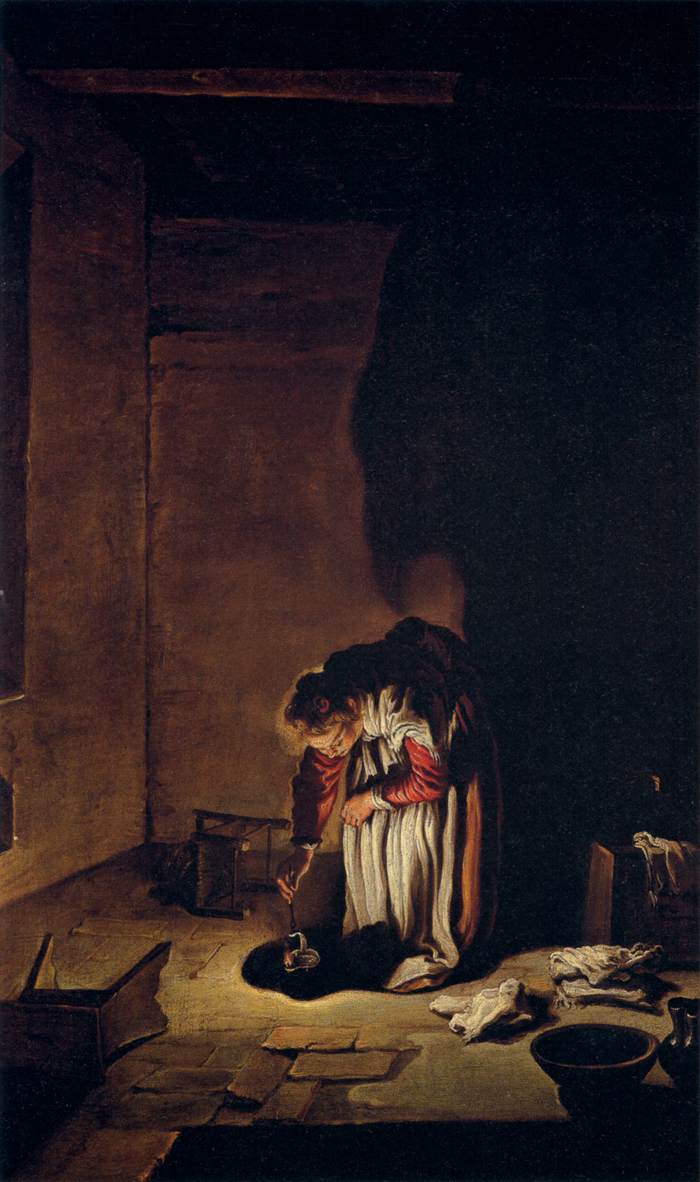
“[Jesus said,] ‘Or what woman having ten silver coins, if she loses one of them, does not light a lamp, sweep the house, and search carefully until she finds it?'”
What is the value of a single coin? Not much today, when we make money with printing upon paper, or with electronic imagination.
What is the value of a single coin? It might be little even in those ancient days, unless, of course, it was a tenth of everything she owned.
What is the value of a single coin? It might be food to take me through the day, or into a coming week, or possibly next year.
What is the value of a single coin? Enough to set me searching high and low, to bear the cost of burning oil in the lamp, to celebrate the sudden silver gleam amidst the dark.
What is the value of a single coin? A better question might be this: What is the value of a single human soul? Enough, said Jesus, for the heavens to rejoice.
A poem/prayer based on Luke 15:1-10, the Revised Common Lectionary Gospel Reading for Year C, Proper 19 (24).
“…Let us approach with a true heart in full assurance of faith, with our hearts sprinkled clean from an evil conscience and our bodies washed with pure water.” – Hebrews 10:22
There are mornings when I revel in the water which cascades along my form and carries off the aggravating dust and clinging grime.
In likewise do I cast my grateful soul into refreshment of a loving God, who takes away the grunge, the guilt, the shame.
And then I step upon the shower mat, to towel off the residue of cleanliness, prepare to wrap my form in clothing for the day.
In likewise does my soul release forgiveness’ bliss, replenished to the work which lies ahead, and clothed (we hope) in righteousness’ array:
Provoking those around to love, to acts of doing good, to mercy shared, to meet and raise the courage of those souls who’d do the same.
A poem/prayer based on Mark 12:38-44, the Revised Common Lectionary Gospel Reading for Year B, Proper 27 (32).
“[Jesus said,] ‘…there is nothing outside a person that by going in can defile, but the things that come out are what defile.'” – Mark 7:15
The awkward hour – well, not quite an hour – takes place each morn as I step in the shower. While water cascades on my form and soap dislodges clinging dust, my memory tunes to regret.
I sigh into the foam.
I’ve plenty to regret, and hope that you have less. I recall failed relationships, the ways I’ve failed my family and friends. I wonder how I’ve grieved my God – and wonder, too, how I can claim to wonder…
My feet shift with discomfort.
The exercise might be worthwhile if it prompted me to understandings new, new ways to make amends, repair what had gone wrong, but mostly I just grieve.
I close my eyes against the shampoo’s sting.
Symbolically, I’m doing all I can to cleanse, but in my spirit: no. These demons have not been expelled. They live quite happily within my memories and recollected thoughts.
Knobs turned, the water does not fall.
Yes, Jesus, it is from within these things emerge, defiling once again my spirit, laying low my joy in you. I ask myself, “Why do this to yourself?” and know I am not reconciled to me.
I pray that I am reconciled to you.
A poem/prayer based on Mark 7:1-8, 14-15, 21-23, the Revised Common Lectionary Gospel Reading for Year B, Proper 17 (22).
I wrote this essay on May 30, 2010, as a Facebook “Note.” Those Notes are getting harder to recover, and so when I’ve found one that I still appreciate, I’ve been adding them to my blog here. The original title was “Forgiving the Internet,” but I’ve revised that. I’ve also made revisions that reflect the intervening fourteen years since its composition.
My career in ministry has been marked with a consistent theme: I repeatedly find myself doing things that I either utterly failed to anticipate, or that I specifically said that I’d never do. I actually said aloud in seminary that I never wanted to serve as an interim pastor; I spent nearly ten years doing just that. For seventeen years I spent the vast majority of my time on electronic publishing and communication media that simply didn’t exist when I graduated from school over twenty years before. Today I serve a church on Hawai’i Island, a place I never imagined I’d visit, let alone live.
With the rise in social networking, I led a number of workshops on the Church’s relationship to social networking phenomena, and how to adapt ‘safe church’ practices to the virtual world. While these utilities were still very young themselves (Facebook was only six years old when I composed this essay), I was obviously just one step ahead of anyone in the workshop groups, and sometimes two or three steps behind…
But there’s a characteristic of the Internet that, I think, cries out for a word from the Church, from Christians, and from people of a wide variety of faiths. The characteristic is the longevity, the durability of information in the Internet. My workshop leadership partner successfully found the text of a paper she’d submitted for a class in the 80’s — somehow, it had been posted to a database, ‘spidered’ by Google, and there it was for anyone to find.
At the same time, we keep hearing of firms and institutions evaluating the applications of potential employees with searches of the Internet and, particularly, of their ‘personal’ social networking profiles. According to a 2009 Proofpoint study, 8% of US companies with over 1,000 employees had fired staff for misbehavior related to social networking. How many weren’t hired in the first place?
In the past, we’ve been able to leave our errors behind us. The indiscretions of youth, the sins of ignorance, and the painfully-overcome failures associated with addictions or with strongly-held, sadly mistaken beliefs. Graduation, change of residence, change of job, new affiliations all brought a New Start.
With the Internet, we’ve probably lost that, and it’s probably gone for good.
So we’re going to have to learn to forgive.
I can’t think of anything more counter-cultural, neither at the time I first composed this reflection or at this moment. This is a judgmental time. The ideological politics we bewail has deep roots in the inability to tolerate or forgive dissent. A political victory in one issue makes collaboration on another issue prohibitively difficult.
In 2008, the United States led the world in the percentage of its population which was behind bars. I strongly suspect that in prior years, and in other countries, at least some of those imprisoned offenders would have been confronted differently than they are today.
With the political mechanisms paralyzed, with huge numbers of citizens released from prisons and anticipating a short stay ‘outside’ before they’re returned, with all of our long-since-forgotten but electronically preserved peccadilloes waiting for us to find them again, we’d better learn to forgive.
Forgiveness is not the same as forgetting, and it never was. Forgiveness does not release anyone from responsibility. I’d argue that until there is repentance, there can be no forgiveness.
Forgiveness is the restoration of relationship; it is the acknowledgement of prior failure and the commitment to a new way of success. Forgiveness reinforces responsibility even as it relieves the offender from the consequences of offending.
Forgiveness has always been a foundational Christian value. It has always strengthened families and communities. It has always been praised when publicly displayed — remember Pope John Paul II and his attempted assassin, Mehmet Ali Agca — while simultaneously dismissed as a virtue with utility in the ‘real world.’
The real world and the virtual world now, I think, demand that we deliberately, systematically, and steadfastly employ this virtue of forgiveness. When forgetfulness will no longer permit new life, then forgiveness must take its place.
I think this is one of the central challenges for the Church of Jesus Christ in this age: to summon society to this new virtue, for its survival and salvation.
“[Jesus said,] ‘So my heavenly Father will also do to every one of you, if you do not forgive your brother or sister from your heart.'” – Matthew 18:35
I’ve done it, Jesus. I have granted my release to people who have hurt me. They confessed their fault, they offered restitution. I said, “I forgive you,” and I meant it. We reforged our peace.
I’ve done it, Jesus. I have bade farewell to consequences that I might have asked. Though truthfully, I’d never have received them from these ones who never owned their harm.
I’ve done it, Jesus. I have asked for true confession from the ones who’ve hurt me, though they’ve offered only their excuse and not acknowledged any harm.
And I wish that I could do it, Jesus. I wish that I could set aside the hurt that aches within, despite the glib assurance that they hurt me, “for the best.”
What is forgiveness offered when I’m told my hurt was for my good, my harm a temporary thing, when it has lingered on and on and on?
I’ve done it, Jesus. But I do not think I can do this.
A poem/prayer based on Matthew 18:21-35, the Revised Common Lectionary Gospel Reading for Year A, Proper 19 (24).
Were I to descend to the riverside, John, fiery prophet, baptizing fiercely, were I to descend to seek holy forgiveness: What would you call me? A viper? A snake? What would you call me? A coward? A hoax? What would you call me? Irrelevant? Dull? What would you call me, religious authority…
And would I descend to the riverside, John, fiery prophet, baptizing fiercely, would I dare to seek holy forgiveness of you: Not knowing if you would bring shame to my name. Not knowing if you would despise my remorse. Not knowing if you would discount my devotion. Not knowing how deeply you see in my soul…
A poem/prayer based on Matthew 3:1-12, the Revised Common Lectionary Gospel reading for Year A, Second Sunday of Advent.
The image is a 19th century wood carving of John the Baptist preaching at the riverside in the Church of the Assumption and St Nicholas, Etchingham, England. Photo by Poliphilo – Own work, CC0, https://commons.wikimedia.org/w/index.php?curid=80795653.
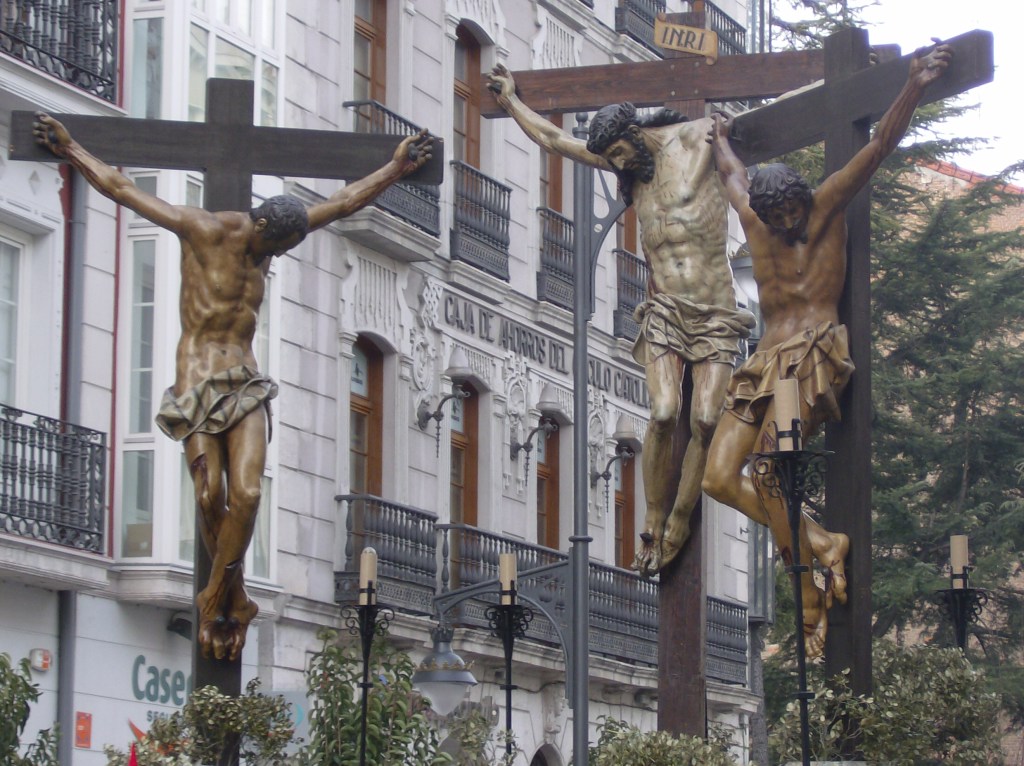
Today I am with you, dear Jesus, drenched with tears to see the shepherd-wolves, the ones who bay and scatter all the desperate flock, rapaciously defending their carnivorous pack.
Today I am with you, dear Jesus, looking for that so elusive Righteous Branch, and longing that the fear may fade in those who seek a refuge from the flood incarnadine.
Today I am with you, dear Jesus, though I hang not on a cross of my deserving, save as witness horrified at this: humanity’s appalling inhumanity.
I turn to look at you, dear Jesus, and I see your tortured arms, your blood-streaked face, and say, “Remember me, O Jesus, on that precious day you come into your holy realm.”
And then, O Jesus, pray: What do you say?
A poem/prayer based on Luke 23:33-43, the Revised Common Lectionary Gospel reading for Year C, Proper 29, Reign of Christ Sunday.
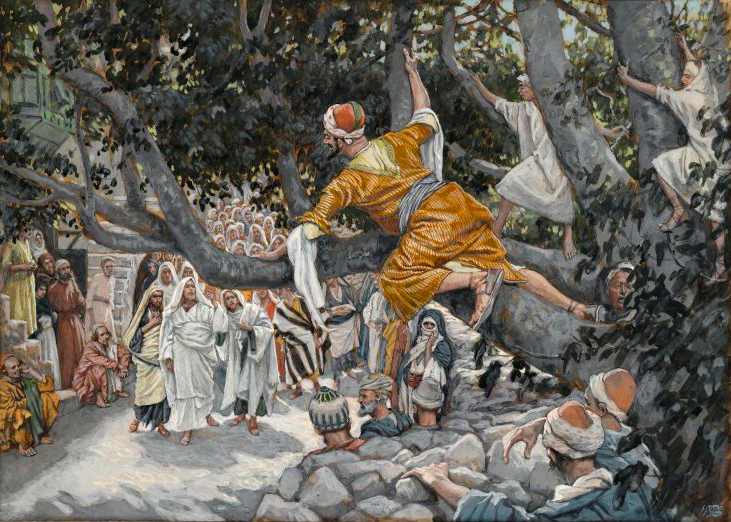
Who are you, Zacchaeus, you active tree-climber? As a child you scamper up into the branches. All eager you rattle the leaves with your grasping. Will you be the last and the least to see Jesus? Oh, no!
Hi, there, Zacchaeus, come down!
Who are you, Zacchaeus, you chief tax collector? We see through the leaves your elegant clothing. The gleam of the gold even now catches sunlight. What need has a wealthy man of this poor prophet?
Hi, there, Zacchaeus, come down!
Who are you, Zacchaeus, returned to ground panting? A sinner reformed, or the one we misjudged? Shall we read your salvation as urgent repentance or sudden reunion with those who rejected you?
Hi, there, Zacchaeus, come down!
Who are you, Zacchaeus, mystery of ages? Can I turn your lostness to my restoration? Can I swing from branches and catch Jesus’ eye? Will he call to me as to you on a limb?
Hi, there, Zacchaeus, come down!
A poem/prayer based on Luke 19:1-10, the Revised Common Lectionary Second reading for Year C, Proper 26.
The image is Zachée sur le sycomore attendant le passage de Jésus by James Tissot – Online Collection of Brooklyn Museum; Photo: Brooklyn Museum, 2008, 00.159.189_PS2.jpg, Public Domain, https://commons.wikimedia.org/w/index.php?curid=10904526.






 ordainedgeek
