Chains and Chains

“One day as we were going to the place of prayer, we met a female slave who had a spirit of divination and brought her owners a great deal of money by fortune-telling. While she followed Paul and us, she would cry out, ‘These men are slaves of the Most High God, who proclaim to you the way of salvation.'” – Acts 16:16-17

My soul was heaped with chains.

A demon claimed my eyes,
my mind, my tongue, to speak
of things beyond a mortal’s ken.
Or possibly to fill the air with lies.

Some businessmen had claimed
my freedom. For as long as people paid
to hear the demon’s truth or lies,
the money went to them, and chains to me.

I still don’t know who claimed my legs
and tongue those days. The demon knew,
as I could not, that these strange men
were also chained, but to the healing power of a god.

I followed, but I don’t know how.
The demon’s words leapt from my lips,
but would it risk its power in the face of God?
Regardless, my legs pushed me after them.

I saw the look upon the speaker’s face,
a look of one whose patience had been tried
beyond its limited capacity. Beyond my hope,
he spoke the words that broke the demon’s chains on me.

I fell into the street and saw the businessmen
seize him and his companions, chain
them for the magistrates’ displeasure. I
looked down and found their chains bound me.

I am not fully free,
but I am freer than before,
and even though it cost them chains like mine,
I would be pleased to wear the chains of God.

A poem/prayer based on Acts 16:16-34, the Revised Common Lectionary First Reading for Year C, Seventh Sunday of Easter.

The image is Paul Casts Out the Devil from a Slave Girl in Philippi, attributed to Pieter Fransz, between 1610 and 1652. From Scenes from the Acts of the Apostles (series title). Photo by Rijksmuseum – http://hdl.handle.net/10934/RM0001.COLLECT.520428, CC0, https://commons.wikimedia.org/w/index.php?curid=84964425.
Confused

Isaiah 43:16-21 with the reactions of the original author.

Maybe.

Thus says the LORD,
who makes a way in the sea,
a path in the mighty waters,
who brings out chariot and horse,
army and warrior;
they lie down, they cannot rise,
they are extinguished, quenched like a wick.

Ah! I hear you, LORD.
The army that destroyed Jerusalem
shall find destruction like
the chariots of Pharaoh overwhelmed
by falling walls of water,
extinguished surely like a wick.

Do not remember the former things,
or consider the things of old.

Wait. What? But you…
But you just brought it up.
And now you want me to forget
what you just said? I… No. I can’t.

I am about to do a new thing;

All right. A something new. But I don’t see
why I should spend the futile effort
to forget the thing you did before,
the thing you just recalled to mind
yourself. You did. You know you did.

now it springs forth, do you not perceive it?

Well, since you ask… No! I don’t perceive it.
It hasn’t happened yet. Um. Right?
For here we are in Babylon and scattered round
the circuit of its walls. We languish here
as exiles from our homes, and all we see
are walls and spears and brutal troops.

Now, we could do with a repeat of Exodus.
A plague or two or three or ten, or wait:
would you consider, for these Babylonians,
to raise the volume to eleven?
I have no doubt that Nebuchadnezzar will
exhibit his hard heart as Pharaoh long ago.

I will make a way in the wilderness
and rivers in the desert.

Well, that will be a thing. I see.
Instead of crossing water now,
a waste of desert lies between
the ill of our exile and the blessings of
our homeland far away.
So will you strand the Babylonians
in wasteland waterless as we
rejoice for lack of thirst?

The wild animals will honor me,
the jackals and the ostriches;
for I give water in the wilderness,
rivers in the desert,
to give drink to my chosen people.

Now just a minute there. That doesn’t sound
like rivers flowing just for us,
and not for them.

the people whom I formed for myself
so that they might declare my praise.

Now, are you sure this message is the one
you really want me to proclaim? Because
I see a central problem here with this “new thing.”
The old thing worked quite well, you know?
It got us out alive, and kept an army off our back.
These flowing rivers sound quite nice, except
that flowers and rushes will not slow pursuit.

Oh, bring us home and you can count on praise.
But LORD, I just don’t see it. Nor will they.
Call us weary of you if you like,
but what will freedom look like when it comes, and when?

A poem/prayer based on Isaiah 43:16-21, the Revised Common Lectionary First Reading for Year C, Fifth Sunday in Lent. 

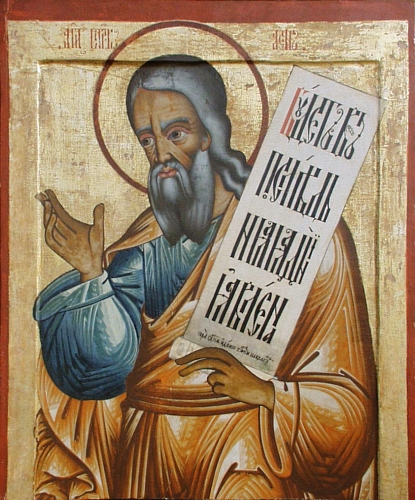
The image of Isaiah is by an 18th century icon painter – Iconostasis of Transfiguration church, Kizhi monastery, Karelia, Russia, Public Domain, https://commons.wikimedia.org/w/index.php?curid=3235458.

Liberated

When Jesus saw her, he called her over and said, “Woman, you are set free…” – Luke 13:12

Should you not have asked, O Lord?
“Without so much as a ‘By your leave?'”
as the ex-leper said. “Bloody do-gooder.”
Did she want to be healed, O Lord?

Well, I’ll take it as Gospel
(did you like the pun there?)
that Luke tells it right, and bound
she was, straining for freedom.

Loose the mule. Loose the ox.
Loose the child. Loose the sea.
Loose the woman. Loose the sky.
Set them loose! Loose the Creation!

Can today be a Sabbath I can let loose?
Can today bring a knot that I might untie?
Can today be celebration of liberty?
Can today hear the echoes of praise?

A poem/prayer based on Luke 13:10-17, the Revised Common Lectionary Gospel reading for Year C, Proper 16.

Thanks to D. Mark Davis’ reflection at Left Behind and Loving It for insights into Luke’s composition of the Scripture text.

The quote in the first stanza is from Monty Python’s Life of Brian (1979), written by Graham Chapman, John Cleese, Terry Gilliam, Eric Idle, Terry Jones, and Michael Palin, directed by Terry Jones.

The image is from a mosaic in the Duomo di Monreale, Sicily. Photo by Sibeaster – Own work, Public Domain, https://commons.wikimedia.org/w/index.php?curid=4470788.