I don’t know precisely why the ae’o was upset. I don’t know whether someone had squawked something at her, or if one of the fish she caught tasted bad, or whether the sun was too hot for her that morning. I suppose she might have been frustrated by a fish that got away, or by the sun’s glare in the sky, or by a friend who forgot to say, “Hi.”
It could have been any of these things or more. For whatever reason, she was upset and she let everybody else know it.
She squealed and she squawked. Ae’o can be very loud about that. She hollered at the fish she was hunting. She hollered at the ala’e ke’oke’o in the water. She screeched at ‘auku’u and the cattle egrets and the kolea and the akekeke. To be honest she yelled at so many different birds that I can’t name them all.
She was upset and everybody knew it.
Her family couldn’t get anywhere with her. Brothers, sisters, parents, even tutus all flew over to her and asked her what was wrong. She didn’t tell them anything – she just shrieked at them without words and they unhappily retreated. They didn’t like being yelled at. They also knew that as long as she was yelling at them she wasn’t getting less upset, so they went away.
“I don’t know what to do for her,” said a brother.
“I didn’t get anywhere,” said a sister.
“She even yelled at me,” said her grandmother.
“Let me try,” said one of her friends.
“Are you sure?” asked the ae’o’s mother. “She’s just getting more upset with everybody.”
“I think there’s one thing I can try,” said the friend, and she flew to be a little closer to her upset friend.
She didn’t get very close. She just settled onto the shore and started poking at the grasses for bugs and worms. Her friend huffed, but didn’t scream.
Gradually, the friend took one or two steps at a time toward her upset friend. Each time she poked her beak down to peck at a bug. Each time she paused before taking any more steps.
Eventually the two birds were standing much closer to one another. The upset one hadn’t screeched. Her friend hadn’t said anything. She just drew a little closer to her friend, so she could see she wasn’t alone.
Neither of them spoke for a long time. It was the upset bird who broke the silence.
“Thank you,” she said.
“You’re welcome,” said her friend.
“I’ve been so upset,” said the first bird.
“I know,” said her friend. “And you’re not alone.”
“That’s good,” said the first bird. “It’s good to know it, too.”
by Eric Anderson
Watch the Recorded Story
I write these stories in advance and tell them from a combination of memory and improvisation. The story as I wrote it is not precisely as I told it.
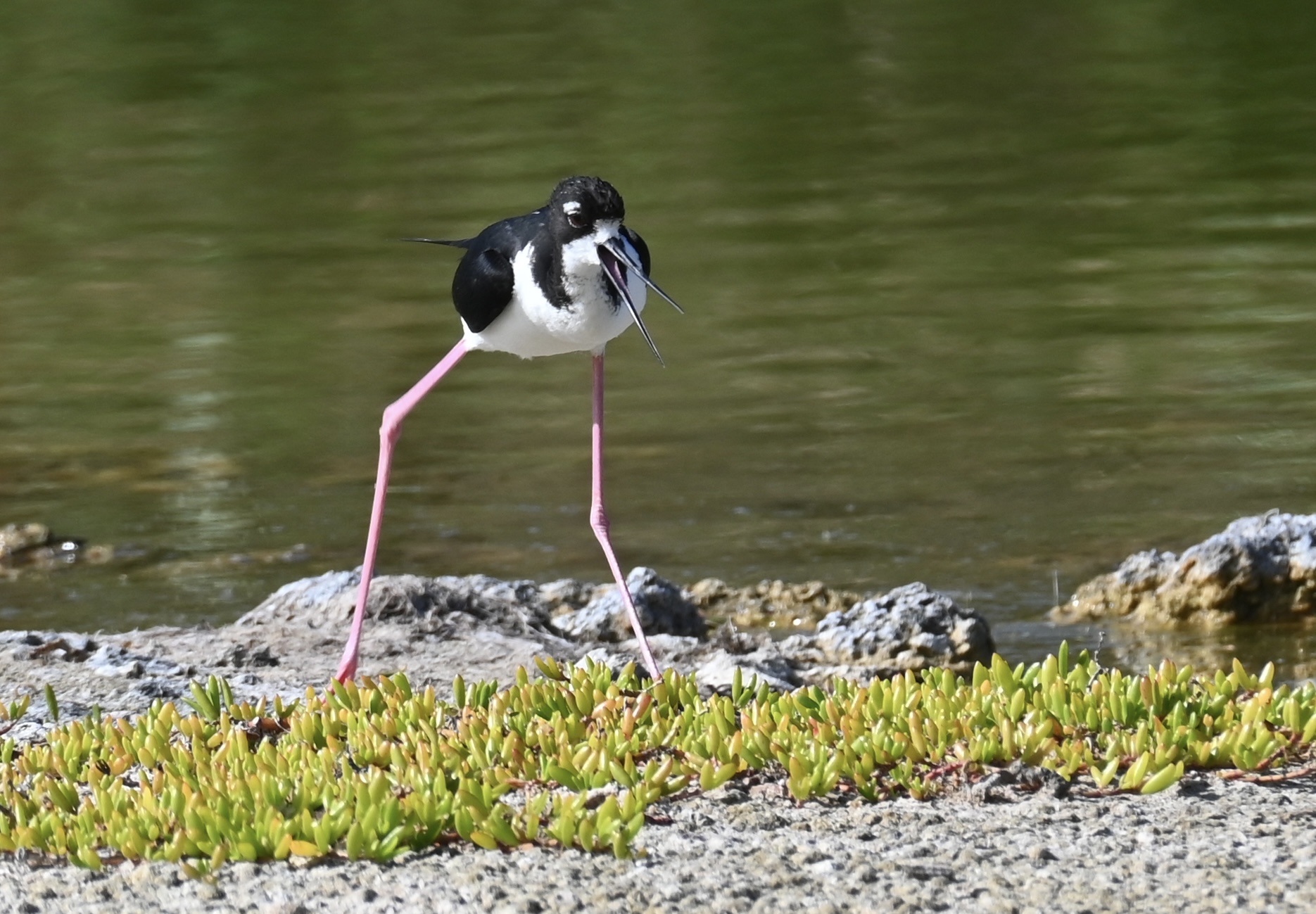
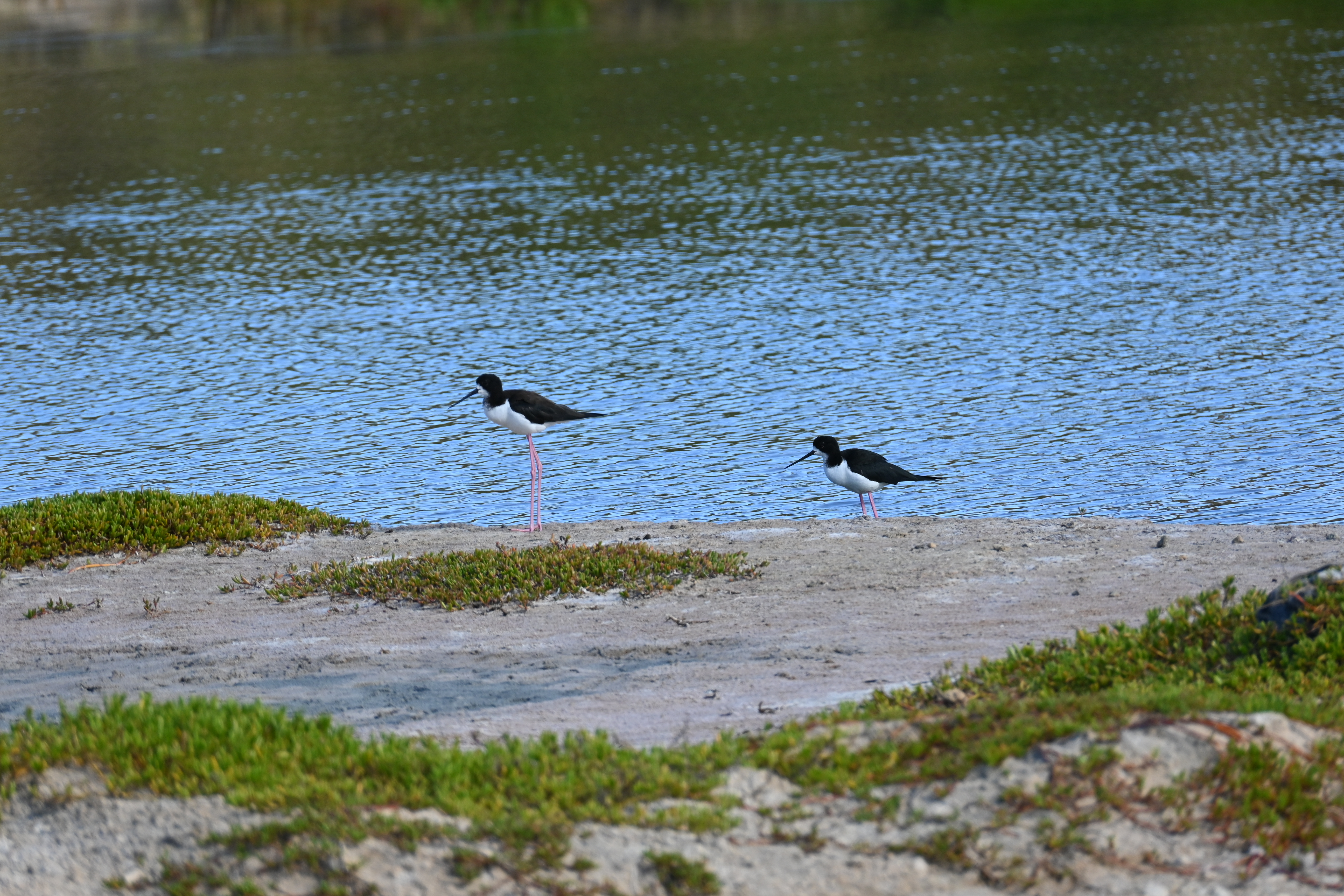
Photos of ae’o (Hawaiian black-necked stilts) by Eric Anderson.
The kolea is a pretty mellow bird. They’re not terribly skittish, though some will keep a sensible distance from people. We are a lot bigger than a kolea and probably look kind of scary to them.
The myna, on the other hand, is not a mellow bird. They sing a fair amount, but they also screech and argue. They’re pretty sociable with one another, and one moment everybody is happy and content, and the next moment everybody is hollering at one another.
Which makes them a lot like some people, now that I think of it.
Mynas fly, of course, but you could call them homebodies. They don’t tend to go very far. Kolea, on the other hand, fly long distances from where they nest in Alaska to where they spend the winter here in Hawai’i. If you’ve ever flown on an airplane to the North American continent, you know that’s a long flight. Well, kolea fly it with their own wings and they don’t go as fast, so it takes longer.
The mynas find it all rather puzzling and strange.
A myna was picking worms and seeds alongside a kolea one day. The two of them were quiet most of the time, because by chance most of the myna’s other friends had had a big argument and flown off to continue it somewhere else. So it was just the two of them.
“I’ve always wanted to know,” said the myna to the kolea. “Why do you fly so far?”
The kolea thought about it. “I’m not sure anyone has asked me that before,” he said.
“Well, I’m asking,” said the myna.
“I do like the change,” said the kolea, “and I know that it gets awfully cold in Alaska during the winter.”
“Then why not stay here?” asked the myna.
“There are different things there,” said the kolea, “and it just feels right to raise chicks there.”
“Then why fly all the way here?” asked the myna. “What do you come here to see?’
The kolea was quiet for so long that the myna was about to ask the question again, but then the kolea spoke:
“I come to see different trees, trees that blossom red and purple and gold. I come to see soaring mountains crowned with snow when there’s green all around the island. I come to see waterfalls that make rainbows. I come to see mountains with fire and beaches with black sand.
“I come to see birds that also live in Alaska, like ‘akekeke, and birds that don’t live in Alaska, like ‘apapane and nene and saffron finches.
“I don’t think I’d appreciated, though, that I also come to see mynas, and to be asked questions I was never asked. The next time I fly to Hawai’i, I’ll be coming to see you.”
“I’m glad,” said the myna. “Next time you fly from Alaska, I’ll be very glad to see you.”
by Eric Anderson
Watch the Recorded Story
I write these stories in advance, but I tell them from memory (and inspiration). The story you have just read is not identical to the story as I told it.
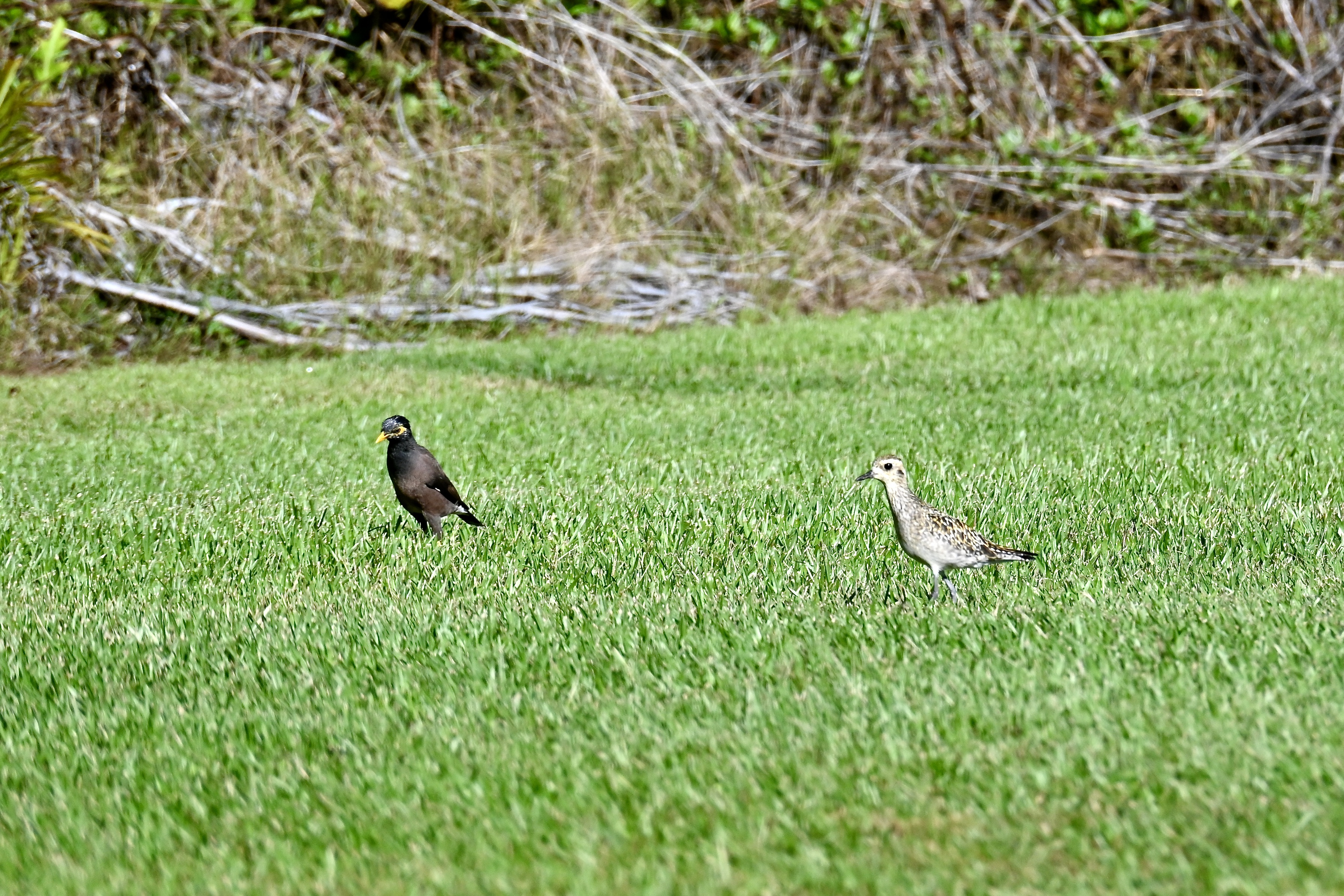
Photo of a myna (on left) and a kolea (on right) by Eric Anderson.
Life isn’t always easy in the mountain forests. Sometimes it gets really wet and uncomfortable, and while feathers are pretty good at keeping you warm and dry, they’re not perfect. Sit in the rain long enough, and an i’iwi will feel pretty cold and wet.
Worse, though, is when it gets dry, because the trees and the plants rely on water. When there’s been no rain for a good while, they have to save their energy. It’s like when you’ve been running around a lot and need to rest for a while. The way a tree rests, or another kind of plant rests, is to hold off on making flowers or fruit. When there’s more water, then it’s time to bloom.
The birds can mostly cope with that. The ‘elepaio eats bugs, and lots of the bugs eat things other than nectar. The ‘apapane and the ‘amakihi eat lots of nectar, but they can make a good meal from worms and spiders. They miss the nectar, but they can feed themselves.
The i’iwi has a rougher time. They will eat bugs, but they’re built to eat nectar, not bugs, and when the flowers aren’t blooming, they get hungry.
It was dry on the mountain. And the i’iwi were hungry.
As I’ve mentioned, while some i’iwi don’t get along with other birds, some i’iwi get along just fine. So there was a little flock of ‘apapane and ‘amakihi and ‘akepa that were worried about their i’iwi friend, who wasn’t saying much, but she was clearly getting hungrier and hungrier.
“What can we do?” an ‘amakihi asked an ‘apapane, who replied with a bird shrug, because he didn’t know, either.
“What can we do?” an ‘elepaio asked his friend the i’iwi, which was the same question but had the advantage of being asked of the right bird. Unfortunately, she didn’t know either.
“You’ve showed me where you’re finding some bugs to eat, and that’s helped some,” she said, “but I’m afraid I’m not as good at catching them as you. I don’t think you can get me more food any better than that.”
“I still want to help,” said the ‘elepaio, and all the other birds did the same.
“You know how you can help?” said the i’iwi. “Stay right where you ware. Stay close to me. Show me you care.”
“How will that help?” asked the ‘apapane, who had a very practical mind. “You can’t eat that.”
“Perhaps not,” she said, “but when you’ve done all you can to help me eat, I’m glad to have your company. It may not feed my stomach, but it feeds my heart.”
So they perched there together in the same tree. Sometimes one or the other birds would sing, and once the ‘amakihi caught a spider and gave it to the i’iwi, who ate it with a hearty “Mahalo.”
Mostly, though, they sat in friendship, friendship that fed the heart even better than flowers.
by Eric Anderson
Watch the Recorded Story
I write these stories in full ahead of time, but I tell them in worship from memory (and improvisation). The story when you watch it will not match the story when you read it.
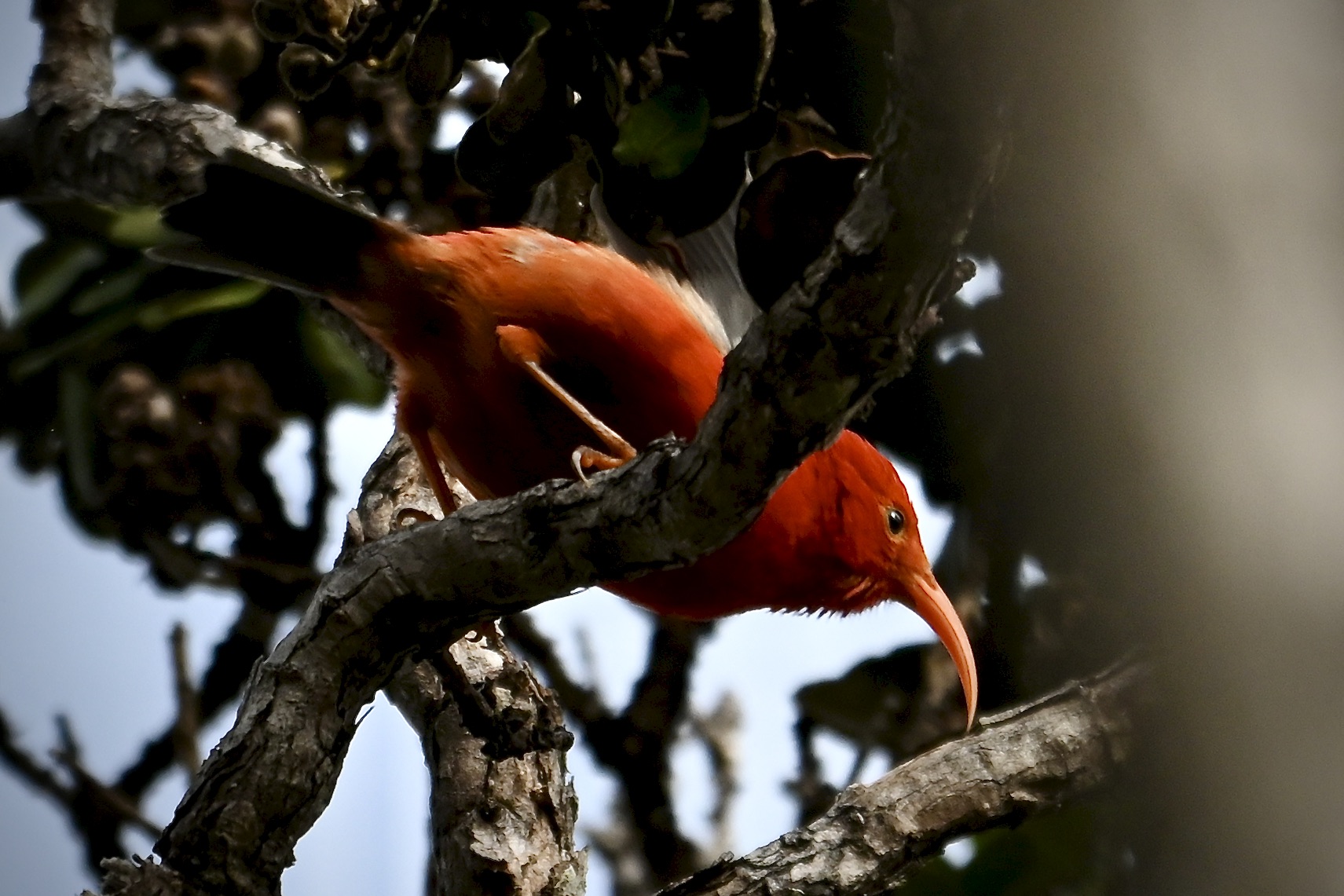
Photo of an i’iwi (who hopefully isn’t hungry) by Eric Anderson.
“[Jesus said,] I do not call you servants any longer, because the servant does not know what the master is doing; but I have called you friends, because I have made known to you everything that I have heard from my Father.” – John 15:15
Pedant that I am, I have to tell you, Jesus, that you’ve never called us servants. Students, yes, and followers. You’ve nicknamed some of us (and isn’t Simon just the perfect Rock (between the ears?)) but never servants.
To tell the truth, I can’t recall you’ve called us friends. It’s quite a lift from slave to friend you’ve given us. And all you’ve asked is that we love each other as you’ve shown your love to us. That’s your command: it makes us friends, not servants.
I wish I were as sure as you that I know what you’re doing, Jesus. I don’t think that I do. If I’ve been quicker on the uptake than our brother Simon Rock, he’s not the brightest lamp within the room. I hardly feel I know what friends would know, not servants.
If I let fall the barriers I’ve used to hide the things you’ve told us from my understanding, then I know the reasons you have called us friends. And I’m not comfortable with that. Friends are responsible for what they do in friendship. They have to think and act themselves, not wait for orders like a servant.
On sound reflection, Jesus, might you reconsider making us your friends? Might you not step forth majestically in power? Then we, your servants, rise with you, to rule with humble title but substantial privilege. Set our direction, Jesus, as your servants, not your friends.
A poem/prayer based on John 15:9-17, the Revised Common Lectionary Gospel Reading for Year B, Sixth Sunday of Easter.
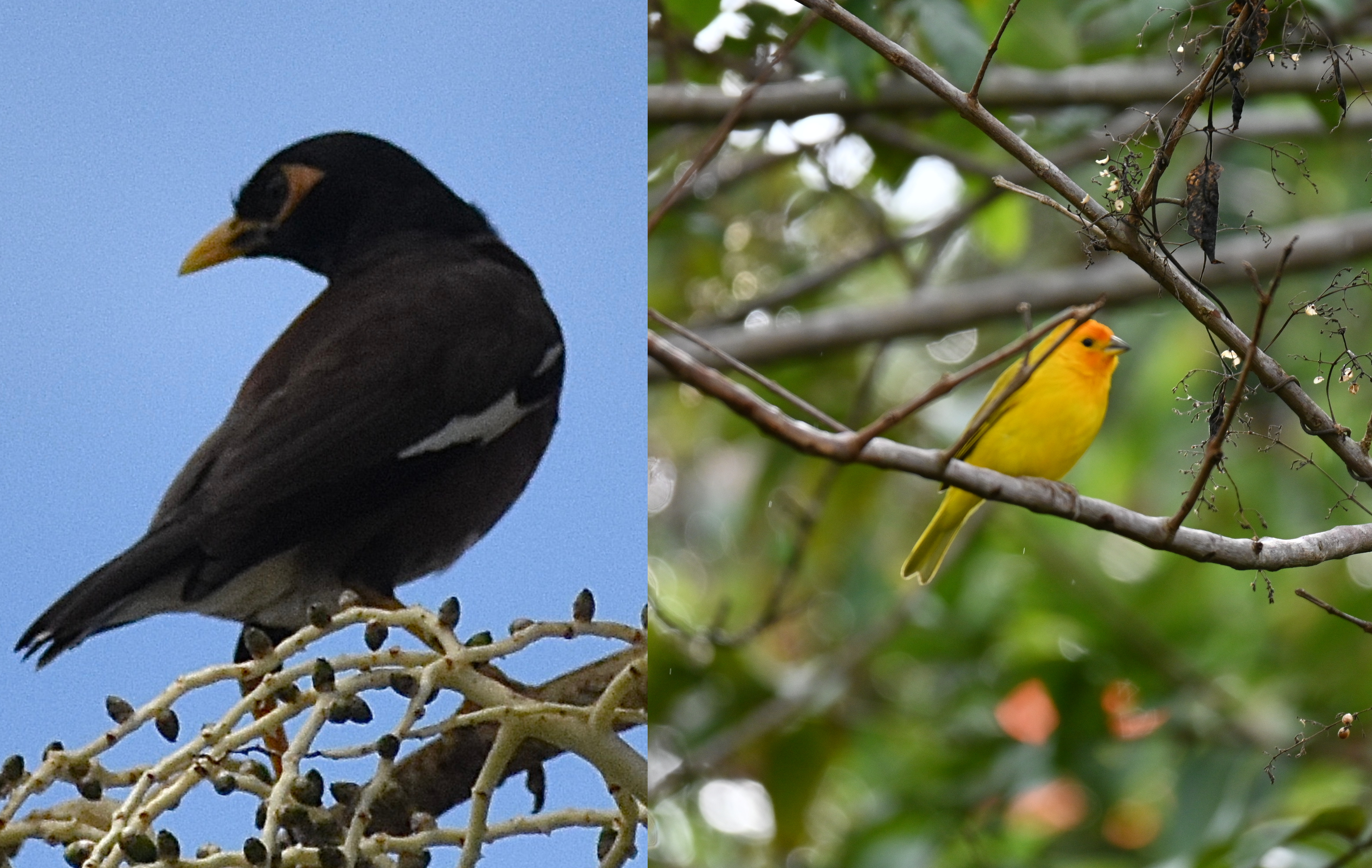
While they were young, a myna and a saffron finch struck up a friendship. It wasn’t all that unusual, to be sure. Mynas and saffron finches hunt and peck for seeds and bugs and so on side by side quite often. Along the way they chat about this and that, that and this, at least until the flock of mynas gets riled up about something and start an argument among themselves.
This young myna didn’t much care for the myna arguments and even less for the major arguments, so she would hop off to one side with her friend the saffron finch, and the two of them would talk about food, and bugs, and the silly things mynas do, and the silly things saffron finches do, and the completely undecipherable things that humans do.
The myna liked her friend a lot. The saffron finch liked her friend a lot. Even when they weren’t talking about anything terribly important, they loved their time.
One of the mynas in the flock became, if not the leader, one of the more popular mynas among them. He was often loud and boisterous, and he tended to win the arguments. But he also got the mynas together. When a cat came by, he was the one who organized everyone to screech at it and dive at it until it went away. He kept an eye out for ‘io overhead and for mongoose on the prowl. If one of the mynas was missing, he’d search until he found them (which rarely took long; they tended to be behind a bush or under the eaves of a roof).
As time went on, he became more and more the leader of the flock, and all the other birds came to value his time and attention. That included the myna who was friends with the saffron finch. One of the things she’d talk to her friend about was the times when he’d talk to her.
“He’s an important bird,” said the saffron finch, before they went on to talk more about which was the best flavored bug that day.
One day, however, the leader myna hopped over to the myna who was friends with the saffron finch. “Hey,” he said, only with more myna screech to it. “I hear that you’ve got a friend who’s a saffron finch.”
“That’s right,” she said.
“No, that’s not right,” he told her. “Your friends should be mynas, not saffron finches. It’s one thing to put up with them – after all, they’re so small they don’t eat much – but it’s another thing to be friends with them. It’s time you dropped her. Tell her to stay away from you.”
“Why would I do that?” said the myna with a saffron finch for a friend.
“Because it’s what you should do,” said the leader myna, “and if you don’t, we can’t have you in the flock.”
At this moment the saffron finch landed nearby. The leader myna told her, “Say goodbye to your former friend. She’ll have her friends among the mynas now.”
“There’s no goodbye,” said the myna. “You’re my friend as long as you want to be.”
“I told you to drop her!” he said.
“You can say that all you want,” she replied. “I choose my friends, not you.”
“We’ll see what the flock has to say about that,” he said, and called them over. “This sad bird has a friend who’s a saffron finch,” he sneered to them. “Are we going to put up with that in our flock?”
The myna looked at her friends. She didn’t say anything. They looked at her, and they looked at their leader.
Unexpectedly, the saffron finch spoke up. “Don’t you have a friend who’s a spotted dove?” she asked one, who nodded. “And aren’t you friends with a yellow-beaked cardinal, and you with a northern cardinal?” she asked two more. They nodded as well.
“Are you going to let this bird choose your friends?” she asked, and all the mynas shook their heads.
That was the end of one myna’s leadership, and the continuation of a number of friendships, because of one loyal myna, and then many loyal mynas, in that flock.
by Eric Anderson
Watch the Recorded Story
I write these stories in advance, then tell them with a combination of memory and improvisation on Sunday mornings.
Photos of a myna (l.) and saffron finch (r.) by Eric Anderson.
He’d had a long conversation with the kolea as they both searched for food in the grass. They were mostly looking for the same things: seeds, bugs, and so on. Fortunately there was plenty to be found, so the saffron finch’s dissatisfaction had nothing to do with how much or how little he was getting to eat. No.
It was that the kolea was preparing for the journey to Alaska, and the saffron finch thought this sounded like a bad idea. I mean, a Bad Idea with Capital Letters.
“Have you ever been in Hawai’i over the summer?” he demanded of the kolea between mouthfuls.
“No,” said the kolea. “Have you ever been in Alaska during the summer?”
The saffron finch had no reply to this. “It couldn’t be better than Hawai’i during the summer,” he insisted.
“It might not be,” agreed the kolea. “But it’s where I’ll be.”
“It’s such a long way!” moaned the saffron finch, “and your wings might be bigger than mine, but they’re nothing like a nene’s, and they don’t fly to Alaska.”
“I know how far it is,” said the kolea, who knew it much better than the saffron finch could, since he’d flown it and the finch hadn’t. “And I know it can be done.”
“What will you eat there?” demanded the saffron finch, who had just plucked some very tasty seeds out of the grasses.”
“Much the same as here,” answered the kolea, though it was a little hard to hear because his mouth was full.
“I say you should stay here,” announced the saffron finch. “Hawai’i is the place to be.”
“It’s a great place to be,” said the kolea, “but…”
“But nothing!” interrupted the saffron finch.
“But… said the kolea, “it’s where I was hatched, and where my parents were hatched, and where my grandparents were hatched. Other birds, even other kolea, lay their eggs in other places. I know it can be done. But this is how we do it, and we know it works for us.”
“It’s really strange, you know,” said the saffron finch.
“It’s not so strange,” replied the kolea. “There are other birds here that make much the same journey – the akekeke, for one – and I’ve met birds in Alaska that make long journeys to spend the winters in very different places than Hawai’i.”
“I’m not convinced,” said the saffron finch.
“You don’t have to be,” said the kolea. “It’s still something I have to do, even if you don’t like it or understand it.”
The saffron finch was quiet for a while and finally said, “I’ll miss you.”
The kolea gave a kolea smile – birds don’t have lips, after all – and said, “I’ll miss you, too, and I’ll be back in the fall to pluck seeds from in front of you again.” And he pulled a seed out right in front of the saffron finch’s beak.
“You’ll be welcome,” said the saffron finch, and he plucked a seed from in front of the kolea.
He remained unconvinced, but he remained satisfied, too, that his friend would come back once more.
by Eric Anderson
Watch the Recorded Story
The story in the recording was told from memory of this text – imperfect memory coupled with affection for improvisation…
Photos of a kolea (left) and a saffron finch by Eric Anderson.
Drew liked to tell the story of how we met. My daughter had signed up for a winter event at Silver Lake Conference Center, and I had asked if I could volunteer with the other age group that weekend. Drew and Debby led the group I wanted to work with.
Although it’s always useful to have adult counselors at these events, Drew wasn’t at all sure he wanted to include this unknown “helicopter parent” who might both distract the other group and leave him without a fully engaged counselor. I assume he got enough reassurance from the camp directors because he and Debby welcomed me with no signs of his reluctance.
I confess that I brought my own hesitations. Drew set off all sorts of alarm bells going back to my teenage years. He was tall with a booming voice. He was an athlete. His hair was closely cropped. He led the event with an air of confident authority. He reminded me of too many people I’d had painful relationships with many years before.
And… he was tall. He had a booming voice. He was an athlete, winning a bronze medal in his age group at the US National Fencing Championships in 2016. He did change the length of his hair, but it was never very long. He did carry himself with confident authority.
That weekend also demonstrated the incredible depth of his heart and soul. Drew had trained to be a public school teacher because of his passion for teaching and inspiring young people. He left the classroom because the administrative overhead frustrated him more than he would accept (my father, who worked many years as a public school administrator and teacher, would have sympathized). He poured that commitment to teaching into coaching. He founded a fencing school in Willimantic, Sword in the Scroll, which offered both modern fencing and German broadsword.
When we met, one of the other counselors for the weekend, a college-age student, was nursing some bruises from a mistake in her guard. Drew the coach was both sympathetic, making certain that she wasn’t doing things that would delay her recovery, and also evaluative, helping her understand what she’d done so that she could do it better next time.
It was a good weekend.
I didn’t yet know I’d made a friend.
Some time later the Silver Lake directors asked me to consider becoming a dean for a week-long summer conference. “We’ll set you up with experienced deans,” they said. So in summer 2008 I joined Drew and Debby Page as the third wheel dean for “I Learned it All in Volleyball.” Volleyball, incidentally, is an enthusiasm Drew and I shared. Among the trio, Drew was known as the “alpha dean,” Debby as the “beta dean,” and I was the “omega dean.” It worked so well that we did it again the next summer (and my son Brendan came along as a counselor).
In the meantime, Drew and I had started to spend a lot more time together. At the end of 2008, we offered him the position of Media Assistant for the Connecticut Conference UCC. It was not an easy choice. We had some really solid candidates who offered very different sets of talents and skills. The position was new and none of us really knew what it would become. In the end we settled on Drew because he was not only skilled, he was constantly adding to his skills. He would do so throughout his work with the Connecticut Conference and the Southern New England Conference over the next 13 years.
Drew joined me in a large but rather noisy and visually chaotic office on the “Garden Level” (basement) of United Church Center in Hartford. Noisy? Drew’s desk sat next to three servers and other network appliances whose fan noise varied but never ceased. Visually chaotic? Shelves around the room contained computer equipment, reference manuals, and stacks of storage media. I had a habit of retaining the packing boxes of computers we’d recently purchased in case a defective unit needed to go back. And I had an, um, elastic notion of “recently purchased.”
Drew settled in to maintain mailing lists, postal and electronic. He assisted with feeding various databases. He was a solid copy editor, cleaning up my more awkward constructions (and I’d rather like him to read this piece right now). He took on writing projects for our printed and online publications. His first byline, as far as I can tell, appeared in spring 2009. He stepped behind a video camera at Conference events, and like his boss (me), carried a still camera on his shoulder.
He’d done some of these pieces in other parts of his life before, but he learned new things incredibly fast, as well as combining these skills in ways that really served the ministry we were doing. Drew’s ideas rose from a deep understanding of what we were trying to accomplish, what benefit we were trying to bring to the people of the conference. We didn’t try everything he thought of. Not everything we tried worked. A couple things that I thought worked well took more time than we had for them – I really regret the video reporting we couldn’t do.
We gave Drew more hours. Drew took those hours and turned them into precious gifts.
We shared an office. I remember one spring when we had a very heavy workload. We were preparing for a spring meeting of the Conference. We were also filming and editing 32 brief videos in which Silver Lake deans invited young people to their conferences. Each one lasted a minutes, but – there were 32 of them!
The two of us recorded them together during a gathering of the deans. He’d film one group while I filmed another. When we were back to the office, Drew sat down at his computer and forged through those recordings, reviewing each take (there was always more than one), adding transitions, fixing the audio as best he could, and putting in the titles. It was hours of work – and he did it so well that Silver Lake has continued to do much the same in the eight years since.
Sharing an office isn’t just about work. You learn things about office mates that you don’t learn about the folks who work down the hall. When Drew was preparing for competition at the national level (this was before 2016), he changed his diet and work habits – by which I mean, he made sure to move around more and avoid stiffening up at the desk. When he suffered increasing shoulder pain from an old injury – and when that injury was aggravated – I was one of his companions in the journey to heal.
And then we started going out to lunch.
I have… irregular meal habits. I frequently skip lunch entirely. Drew, a much more careful person around health and diet, did not. It might be light, but he made sure his body was being properly sustained.
But then once or twice a week we’d go out to lunch along with Emily (then Hale) McKenna (who may have got this started in the first place). There were several places we enjoyed in that immediate West End neighborhood. We’d take the opportunity of workers everywhere to gripe about our workloads (I was formally Drew’s boss, remember), but mostly we talked about the important things outside of the working life of the church. We talked about music and kids and dreams. We told stories about our pasts and imagined things for our future.
In the office we were partners and collaborators. At the table we were friends.
I can’t remember more than a fraction of the stories. I can’t remember more than a portion of the dreams. What I remember was the assurance of friendship, or companionship, of faith in one another as well as in God.
Friends at a table – Drew is just behind me.
When I left the Connecticut Conference and moved to Hawai’i, Drew told me that he’d committed to making only three phone calls to ask me about a problem. Those calls, by the way, were more than fair. I’d left a working system, but I’d left a system that, for the most part, I’d built. There were a lot of things that, despite my best efforts to document them as I was leaving, I was probably the only one who knew. I expected that Drew would have to make more than three calls despite his best efforts and intentions.
He only made two.
In February 2020 Drew received a diagnosis of colon cancer. He went through radiation and surgery, writing about them quite frankly in his blog, Drew’s 2 Cents – and he did it during a global pandemic. He had a reassuring season, but in January of this year learned that the cancer had spread to lungs and lymph nodes. Though there were treatment options, none would have much impact on the course of the disease, and all would reduce his ability to enjoy the life he had. He chose to enjoy that life.
“In otherwise,” he wrote, “dream of the things you want to do, enjoy the life right in front of you, and try like hell to be good to other people. If you have the skill, knowledge, or talent to impact other’s lives, do it. If you have the opportunity to witness something amazing, don’t hesitate. And don’t underestimate what can amaze.”
Last week I wrote a song for Drew, performing it during my weekly live stream. Its formal title is “To the Banks of the River Jordan,” but truthfully it’s Drew’s Song to me. About four hours after I sang it, Drew went from our care to God’s.
When I heard Drew had died, my prayers were not suitable for human ears. God may be excused for not listening for a while. They weren’t coherent. I was not blaming anyone, not God or a person or even that demon “Cancer.” I was just blistering the metaphorical air with my hurt.
It didn’t take too long for me to be mad at the world. “Why aren’t you stopping?” I shouted (silently). “My friend has died! Stop! Just STOP!”
Neither the world, nor I (to be honest), stopped. When has it? When, to be honest, have I?
Drew was far more than my experience of him. We were co-workers and friends. Drew was also a husband. It was a joy to witness his relationship with Debby. He was a father, and over the years the only thing that grew faster than Duncan and Dani was his love for them. He was a teacher and coach, and I had only a glimpse of that. He was a musician, and oddly enough the two of us didn’t make much music together, though we played the same gig once.
In the end, what can I say but this: He was my friend, and I have rarely made a better choice than to enter this friendship. Now he is gone, and I am deeply sad. The memories remain in their precious fragility, but more than that the love endures, and will endure beyond the end of time.
First one leads, then one follows One aids, and one seeks aid. In the story of friendship You and I have made. But you’ve taken the lead this season And I cannot keep pace To the banks of the River Jordan, To your crossing place.
[Chorus 1]
There’s a time for work and progress, There’s a time for rest and play, But this time to say farewell to you: I’d have asked for a later day.
[Verse 2]
We shared in joys and sorrows. We put our hands to the plow. There were times of heartfelt sharing: May they comfort us now. As you walk to the bank of Jordan, As you near your crossing time, My tears flow with reason, My grief has so many rhymes.
[Chorus 2]
There’s a time to plant and nourish, There’s a time to harvest and store, But I’m lost in this time of farewell. I’d have asked for a little time more.
[Verse 3]
Bright days and thunder sounding, Our minds at work to shape words Telling others’ stories as sweetly As ever a story was heard. As you make your crossing of Jordan, Don’t linger, my friend, for me. You can lay aside life’s burden. In the crossing, my friend, you’re free.
You can lay aside life’s burden. In the crossing, be free.
[Chorus 3]
There’s a time to live and to flourish, There’s a time to shed life’s shell. Though I could have asked for later, my friend: Aloha o’e – fare well.




 ordainedgeek