The Year of the Lord’s Favor

“[Jesus read from the scroll of Isaiah:] ‘The Spirit of the Lord is upon me, because he has anointed me to bring good news to the poor. He has sent me to proclaim release to the captives and recovery of sight to the blind, to set free those who are oppressed, to proclaim the year of the Lord’s favor.'”

“Today this scripture has been fulfilled
in your hearing.” Your own words, Jesus,
amazing them with graceful speech.
Until they turned upon you.

Remind us once again of what is grace.
I’m told that grace is strength, is force.
I’m told that power is right, and might is good.
I’m told that what we want we take.

Where is the news that sounds good to the poor?
Where is the vision for the ones who will not see?
Where is the freedom for the ones who are oppressed?
Where are the prisoners released into the light?

You did not speak the words of grace alone.
You needled them, you did, O Christ, until they burst
in rage, and nearly did the work of Pilate three years
earlier, by casting you to break upon a rock.

O, can we learn the lesson that you tried to teach?
We claim your name but do not tread your ways.
We leave the poor uncomforted, we close our eyes
to the oppressed, and those we free are those who’ve flattered us.

May there be good news for the poor.
May there be vision which will pierce the shade.
May there be freedom for those who have been bound.
Bring quickly, Jesus, the favored year of the LORD.

A poem/prayer based on Luke 4:14-21, the Revised Common Lectionary Gospel Reading for Year C, Third Sunday of the Epiphany.

The image is “The Rejection of Jesus in Nazareth” (“Prophets are not without honour, except in their hometown”); 18th-century tile panel by António de Oliveira Bernardes in the Igreja da Misericórdia, in Évora, Portugal, Public Domain, https://commons.wikimedia.org/w/index.php?curid=97133284.
Inviting Questions

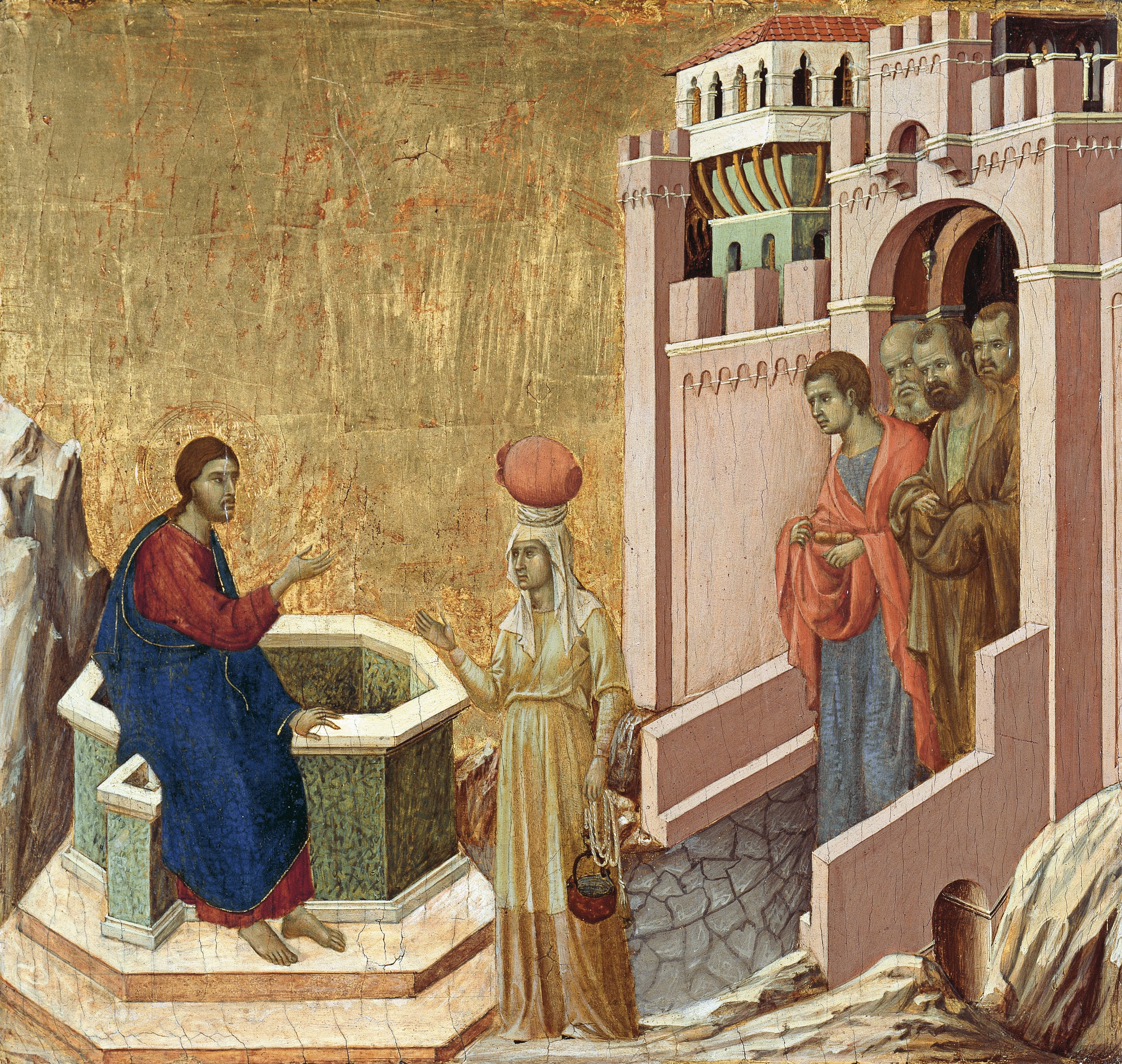
Duccio_di_Buoninsegna_-_Christ_and_the_Samaritan_Woman_-_Google_Art_Project

What would you ask of us, O Jesus, by
Our well of Jacob? How would you secure
Our trust, invite our glance to catch your eye,
Persuade us of your power by flesh obscure?

We keep the treasures of our souls at depths
Much like a well’s, and hide them even from
Ourselves. The treasures! Though our halting steps
You know from rising dawn to setting sun.

What may we ask of you, O Jesus, by
Our well of Jacob? What great secrets tease
From you, who’d see our downcast spirits fly
From mountain to the ever-rolling seas.

With questions let us comprehend your grace
That others may in you find, too, their place.

This poem was written for a sermon of the same title to be preached on March 19, 2017. As it happens, it didn’t make it into the sermon after all.

The image is “Christ and the Samaritan Woman” by Duccio di Buoninsegna, painted ca. 1311.

The Appreciative Goat

mauna-kea-from-the-air

Mauna Kea from the air. Photo by Eric Anderson.

A few weeks ago, I revealed that I didn’t know that there were wild goat living on Hawai’i Island. So I went to learn a little more about them, and thus today’s story is about…

Wild goats living on Hawai’i Island.

It’s not an easy life being a wild goat on Hawai’i Island. They tend to live up the slopes of the mountains, where the big lava flows have left a landscape of broad swathes of old lava rock, with just a few plants growing in crevices. If you’re a goat, that’s what you eat, and so you spend most of the day looking for something to eat.

If you’re the small goat in the herd, you get last place for everything: for a spot under a tree when it rains, or for water at the high lake or spring, and, of course, for food when the herd has found a patch of green.

Now, the herd thought this one small goat was actually rather peculiar.

You see, when the herd found something to eat, they’d shoulder him aside, and he’d stand and wait to see what was left for him. But as they looked up and saw him standing there, sometimes he’d be looking up to the sky, as if he were watching the clouds.

“What are you doing?” they’d ask, and he’d say, “I’m watching the clouds.”

“Do you see how they come and wrap around the mountain, and then tail off into feathers as they blow away downwind?”

“Not really,” said the other goats, and went back to eating.

A little while later they’d look up, and he was gazing down the mountain to where the sea glowed in the distance. “What are you doing?” they demanded.

“I’m looking down at the ocean,” said the goat, “with all its shades of blue, and I’m watching how it fades up into the blue sky, and how all those blues come together so beautifully.”

“Huh,” said the other goats, and went back to eating.

As day ended, and they were actually feeling full (they’d found a good patch), they glanced up and there he was, staring into the distance again. “What are you doing?” they sighed.

“I’m watching the sunset,” said the small goat. “Look at the reds, and the oranges, and the purples. They’re all over the sky and the clouds and even reflected in the sea.”

“Ah. Right. You’re just crazy,” said the other goats, ignoring this. “Come and eat.”

Now I’ll be honest. I’m not really certain that a goat can appreciate the sunset, or the ocean, or the clouds. I hope they can, but I really don’t know.

I do know that people can appreciate the sunset (or the sunrise!), and the ocean, and the clouds above. I know that people can. And I know that some do not.

I hope that you’ll be people who do look up at the clouds with wonder, and the ocean with amazement, and the sunset with awe. I hope that you’ll do it always.