Who Do You Say I Am?

“And he sent messengers ahead of him. On their way they entered a village of the Samaritans to prepare for his arrival, but they did not receive him because his face was set toward Jerusalem. When his disciples James and John saw this, they said, ‘Lord, do you want us to command fire to come down from heaven and consume them?’ But he turned and rebuked them.” – Luke 9:52-55

Did I not ask you, not so long ago, who you say I am?
James? John? Do you remember that?
I guess you thought I was Elijah, after all
(or that you were?), to call down fire
on the captains and the fifties, or onto their
Samaritan descendants in this village.

Did I not say that those who’ll follow me will bear
a cross, and lose their life to save it? And were
you listening to me, or to your glorious dreams?
No wonder that the heavenly voice which called me “Son”
demanded that you listen to me – since you weren’t.
And now you want to destroy lives with heavenly fire.

Well, no, my friends, we won’t do that.
We’ll make our way on by, and take our rest
where people offer welcome out of grace,
not out of threat, and we will tread
a Via Dolorosa, you and I and all our friends,
to show God’s love will not be bounded by

rejection much more thorough, drenched
in blood’s finality, a breath unfinished,
body broken, and forsaken by my friends.
No, James and John, the world is filled with fires;
no need to summon them from heaven’s vault.
What’s needed is to love, and love, and love.

A poem/prayer based on Luke 9:51-62, the Revised Common Lectionary Gospel Reading for Year C, Proper 8 (13).

Photo of lava fountains on Kilauea by Eric Anderson (May 25, 2025).

The Year of the Lord’s Favor

“[Jesus read from the scroll of Isaiah:] ‘The Spirit of the Lord is upon me, because he has anointed me to bring good news to the poor. He has sent me to proclaim release to the captives and recovery of sight to the blind, to set free those who are oppressed, to proclaim the year of the Lord’s favor.'”

“Today this scripture has been fulfilled
in your hearing.” Your own words, Jesus,
amazing them with graceful speech.
Until they turned upon you.

Remind us once again of what is grace.
I’m told that grace is strength, is force.
I’m told that power is right, and might is good.
I’m told that what we want we take.

Where is the news that sounds good to the poor?
Where is the vision for the ones who will not see?
Where is the freedom for the ones who are oppressed?
Where are the prisoners released into the light?

You did not speak the words of grace alone.
You needled them, you did, O Christ, until they burst
in rage, and nearly did the work of Pilate three years
earlier, by casting you to break upon a rock.

O, can we learn the lesson that you tried to teach?
We claim your name but do not tread your ways.
We leave the poor uncomforted, we close our eyes
to the oppressed, and those we free are those who’ve flattered us.

May there be good news for the poor.
May there be vision which will pierce the shade.
May there be freedom for those who have been bound.
Bring quickly, Jesus, the favored year of the LORD.

A poem/prayer based on Luke 4:14-21, the Revised Common Lectionary Gospel Reading for Year C, Third Sunday of the Epiphany.

The image is “The Rejection of Jesus in Nazareth” (“Prophets are not without honour, except in their hometown”); 18th-century tile panel by António de Oliveira Bernardes in the Igreja da Misericórdia, in Évora, Portugal, Public Domain, https://commons.wikimedia.org/w/index.php?curid=97133284.

Climbing

Then [Elijah] lay down under the broom tree and fell asleep. Suddenly an angel touched him and said to him, “Get up and eat.” He looked, and there at his head was a cake baked on hot stones, and a jar of water. He ate and drank, and lay down again. – 1 Kings 19:-6

I know just what you will say, LORD.
“What are you doing here?” you’ll ask.
Oh, I will have an answer, which
will not be any good as an excuse.

Still I climb the mountain, seeking you,
though you have never been so far before
amidst the labors and travails and trials.
Still now, yes now, I journey and I climb.

I’ll tell you I was running to you, and
we neither of us will be much deceived.
I’ll tell you I’m the only one, and yes,
I know as well as you the truth of that.

Amidst the carnage of the wind I’ll stand,
amidst the terror of the quaking earth the same,
against the roaring of the flames I’ll bare my face,
then hide it from you when your stillness comes.

How pointless is my journey and my climb!
I know full well the words I’ll hear: “What are
you doing here?” And I will have no answer
but to whine, and sigh, and wait for what come next:

Your next assignment, roles familiar:
enlist new friends and colleagues to the work
of justice-making, faith-inspiring,
community-building, righteousness-living.

You’ll send me back and chide me
that I thought I was alone, as there were not
countless people who, in their imperfect way
live humble, faithful, righteous lives.

But God, when I am humbled by
your so appropriate rebuke, I’ll cling to this
remembrance as I turn the journey from
the mountain and am homeward bound:

When I was running needlessly and weary
beyond thought or strength, you came to me.
Just like the angel fed Elijah when he fled,
you gave me comfort, solace, rest,

Before you pushed me down the mount again.

A poem/prayer based on 1 Kings 19:1-15a, the Revised Common Lectionary Alternate First Reading for Year C, Proper 7 (12).

The image is The Prophet Elijah in the Desert, a sketch by Alexander Ivanov (19th cent.) – Public Domain, https://commons.wikimedia.org/w/index.php?curid=9087568.

Poor Farmer

I don’t think much of your agricultural practice, Jesus.
“The kingdom of heaven may be compared to…”
a farmer who leaves the weeds amidst the wheat,
and only separates the two at harvest.

Well, let me tell you, Jesus, that the weeds
are not just growing peacefully beside
the wheat. They steal the water, hide the sun,
choke the grain. The wheat begs your relief!

“O that you would kill the wicked, O God,
and that the bloodthirsty would depart from me!”
“Do I not hate those who hate you, O LORD?
And do I not loathe those who rise up against you?”

I need a farmer who will bring me aid and comfort
from the spreading weeds of greed and folly
ravishing the struggling grain of your own planting,
LORD. “I hate them with perfect hatred,” indeed.

Unless…

Unless, of course, I let the Psalmist’s prayer
take root within my heart and blossom there:
“See if there is any wicked way in me;”
test me to see if I grow like the weeds.

Ah, now I am less eager for your justice
or your retribution or your weeding. Now
I am content to grow in peace however fragile,
to become, I pray, your wheat and not your weed.

“See if there is any wicked way in me,
and lead me in the way everlasting.”

A poem/prayer based on Matthew 13:24-30, 36-43 and Psalm 139, the Revised Common Lectionary Gospel Reading and Psalm for Year A, Proper 11 (16).

Photo by Eric Anderson.

Hold the Complexity

I asked the Holy One, not once but time
and time again, to tell me what is first
and prime. The sound of silence breathed to me,
“Grace. Grace is first, and last, and everything.”

I might have raised a voice in protest to
the silent breath, to claim the privilege
of suffering for faith, through faith, in faith.
“Grace. Grace is first, and last, and everything.”

Have I not traveled farther in my span
of years than Abraham in his? Might I
not claim the mantle of such righteousness?
“Grace. Grace is first, and last, and everything.”

But breathed the silent syllables: “Did you
devise yourself, beloved child? Did you
create the feet you set upon the road?
Grace. Grace is first, and last, and everything.”

Blessed be the Holy One who makes to be
the things that were and things that have not been.
Blessed be the One whose sound of silence breathes:
“Grace. Grace is first, and last, and everything.”

A poem/prayer based on Romans 4:1-5, 13-17, the Revised Common Lectionary Second Reading for Year A, Second Sunday in Lent.

Photo by Eric Anderson.

Today I am with You

Today I am with you, dear Jesus, drenched
with tears to see the shepherd-wolves, the ones
who bay and scatter all the desperate flock,
rapaciously defending their carnivorous pack.

Today I am with you, dear Jesus,
looking for that so elusive Righteous Branch,
and longing that the fear may fade in those
who seek a refuge from the flood incarnadine.

Today I am with you, dear Jesus, though
I hang not on a cross of my deserving,
save as witness horrified at this:
humanity’s appalling inhumanity.

I turn to look at you, dear Jesus, and
I see your tortured arms, your blood-streaked face,
and say, “Remember me, O Jesus, on
that precious day you come into your holy realm.”

And then, O Jesus, pray: What do you say?

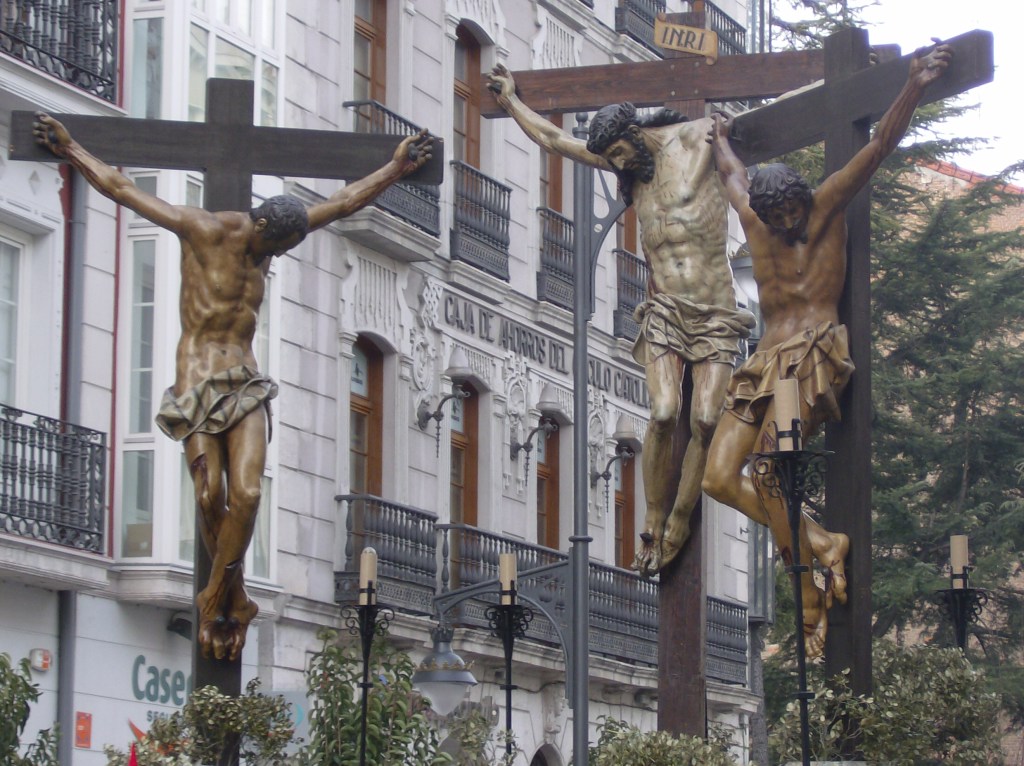
A poem/prayer based on Luke 23:33-43, the Revised Common Lectionary Gospel reading for Year C, Proper 29, Reign of Christ Sunday.

Photo of a Holy Week procession in Valladolid, Spain, by Porquenopuedo – Own work, CC BY-SA 3.0, https://commons.wikimedia.org/w/index.php?curid=2066881.

Grace Greatness

Ocean and shoreline.

Damn you for your folly.
Damn you for your arrogance.
Damn you for your violence.
Damn you for your pride.

You strut and march and shout
and call it greatness.
You harm and maim and kill
and call it greatness.

You entertain the wealthy,
set aside the sick,
refuse the refugee,
and call it greatness.

While I have known a woman
in whose presence every soul
received a lift. Every soul
was lightened by her gift.

Of greatness you know nothing,
and so you damn yourself.
Of greatness you know nothing,
and so you damn us all.

Photo by Eric Anderson.