Story: Feeding the I’iwi

August 24, 2025

Isaiah 58:9-14
Luke 13:10-17

Up on the slopes of Mauna Loa, where the forest birds gather into little flocks during the summer, there was one little flock that had decided to get itself better organized. They figured out who was the best in the flock at finding food, and other birds that were good at spotting bad weather. They found places to shelter when it was hot in the middle of the day and places to start foraging when it was cool in the morning. Each bird got a buddy to make sure nobody got lost. Each bird got a buddy to make sure that when they were feeding, everybody found out about it. Each bird got a buddy to make sure that everybody got fed and sheltered and safe.

The birds agreed that it was a pretty good system.

“One more thing,” said one of the birds who had been a big part of the organizing. “No i’iwi.”

“What do you mean?” said an ‘amakihi. “They don’t like to fly in flocks anyway.”

“What I mean is,” said the first bird, “that if we see any i’iwi, we chase them away.”

That didn’t sound good to most of the other birds, who were far more accustomed to flying away from a chasing i’iwi than chasing one.

“I don’t think that’s going to work,” said an ‘akepa. The other birds chorused their agreement.

“Well, all right,” said the first bird, an ‘apapane. “but we won’t encourage them, either. Make sure when you call that there’s no i’iwi listening. We’ve organized to feed ourselves, not them.”

And so it was. There was one ‘apapane in the flock, though, who thought that sounded a little unfair. Sure, she’d been chased by i’iwi more than once and hadn’t enjoyed it, but she didn’t see any reason for even a grumpy bird to go hungry.

It turned out to be a tough season in their area of Mauna Loa. It was dry, and the trees weren’t blossoming much. There were a few spots around where a small grove would bloom all once, but they were hard to find. The finder birds were a real blessing. Without them the flock would have been much hungrier.

One day the scout birds had to work really hard. They looked this way and that without finding much. Finally one pair spotted a little group of trees with blossoms, and they called the flock. The other birds followed gratefully.

That’s when one of them spotted an i’iwi. “Remember!” he shouted out. “Don’t tell the i’iwi where we’re going!” Most of the flock, in fact, detoured so that the i’iwi wouldn’t notice them.

But not the one ‘apapane. She couldn’t bear the thought of another bird going hungry, even a grumpy i’iwi. She took a turn over the tree where the i’iwi was and called out a quick, “Follow me!” As she flew along the i’iwi followed, and when they arrived at the little stand of blossoming trees, the i’iwi settled into a tree as far away from the others as it could.

“Why did you do that?” asked her buddy bird. “You broke the rule. You brought an i’iwi!”

“Of course I did,” she said. “Have you been hungry? Did you enjoy it?”

“Yes, of course,” he said, “and no I didn’t.”

“So was he,” she told him, “and I’m sure he didn’t like it either.”

“But he’s an i’iwi!” he told her. “He’s a bully and a jerk.”

“And he’s hungry,” she said. “Everybody should get help when they’re hungry.”

From the adjacent tree, the i’iwi let out an unpleasant chirp, but that’s because i’iwi aren’t great singers. The two ‘apapane, however, knew that he’d said, “Thank you.” Nobody likes to be hungry, and everybody should get help when they are.

by Eric Anderson

Watch the Recorded Story

I write these stories in advance, but I tell them without notes. Between the vagaries of memory and the impulse to improvise (not to mention the contributions of the congregation), what I’ve written and the way I told it are not the same.

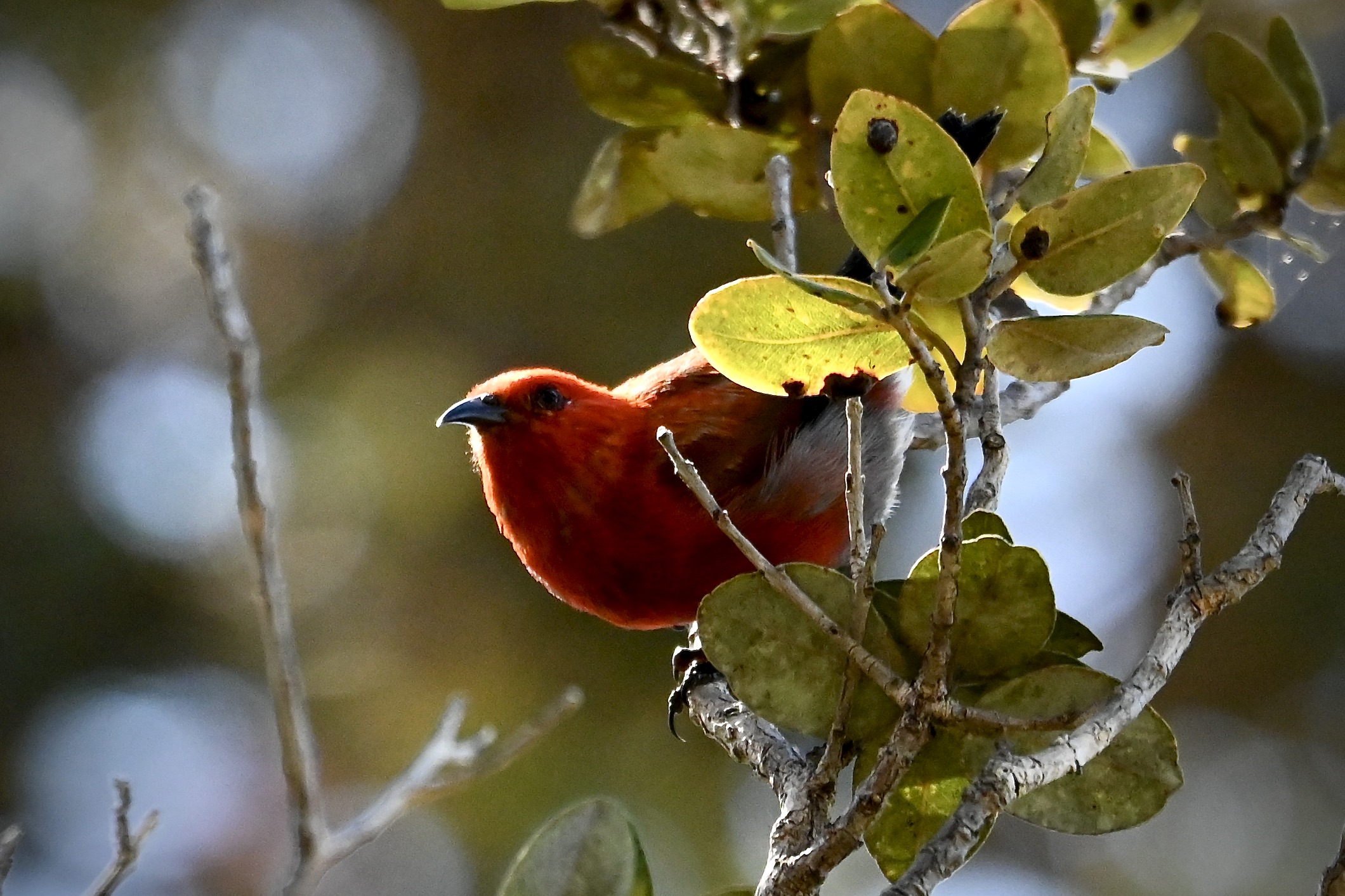
Photo of an ‘apapane by Eric Anderson.

Story: Following the I’iwi

August 17, 2025

Jeremiah 23:23-29
Hebrews 11:29-12:2

During the summer, plenty of the forest birds form small flocks which may include ‘apapane, ‘amakihi, ‘akepa, and so on. Plenty of those birds may fly about and forage by themselves as well, but one little flock on the slopes of Mauna Loa was having a bad day. They just weren’t finding much in the way of food.

“I’m hungry,” complained an ‘amakihi.

“We all are,” replied an ‘apapane, and the other birds agreed.

“What are we going to do about it?” asked the first ‘amakihi.

“Does anyone have any good ideas?” asked another ‘apapane, looking around at the other birds. From the shaking heads, nobody did.

That’s when the heard they heard the squeaky sound of an i’iwi. They watched as he rose from a nearby tree – one which didn’t have much in the way of flowers on it, circled once or twice, and flew off.

“What was that about?” asked an ‘apapane.

“I don’t know,” said an ‘akepa.

“How about we follow him?” said the first ‘amakihi, the one who was hungry.

Nobody could think of a good reason not to, so the little flock took to the air and flew in the same direction the i’iwi had taken. For a little while they just flew over flowerless trees, but then a few ohi’a blossoms appeared. Things were looking up. Eventually the i’iwi settled in a tree just dripping with flowers, surrounded by plenty of other blossoming trees as well.

The i’iwi squawked a little unpleasantly at them – they’re not great singers, the i’iwi – but didn’t come out to chase them away as they settled into surrounding trees and began checking the flowers for nectar and the branches for bugs. There wasn’t much sound for a while other than some satisfied songs and wing flutters as they shifted from branch to branch.

“How did you know?” said an ‘apapane to the ‘amakihi.

“How did I know what?” said the ‘amakihi.

“How did you know that the i’iwi would lead us to flowers?”

The ‘amakihi shrugged. “I didn’t know,” he said, “but as sad as it is that the i’iwi isn’t a great singer, and as nasty as they can get when they’re upset about something, they’re really good at finding trees in blossom. I’d trust them to find food any day of the week.”

“You’d trust an i’iwi?” said the ‘apapane in wonder.

“I trust an i’iwi to do what an i’iwi does,” said the ‘amakihi. “And look. This one did.”

The i’iwi, who had overheard all this, let out a contented squawk, hopped to another flower, and settled in to sip the sweet nectar.

by Eric Anderson

Watch the Recorded Story

I write these stories in advance, but I tell them from a combination of memory and improvisation, so what I wrote and how I told it do not match.

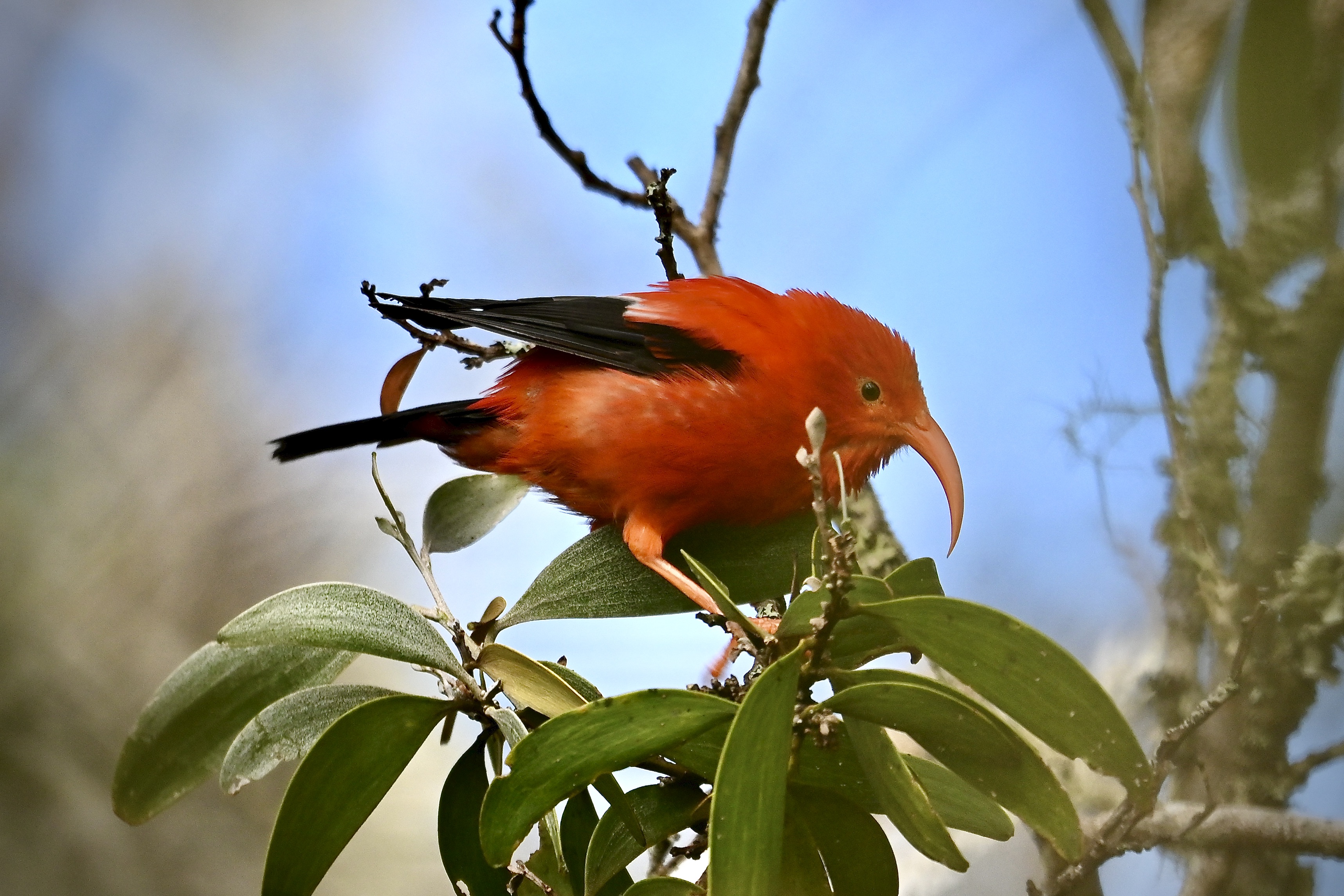
Photo of an i’iwi by Eric Anderson.

Myna Distraction

June 29, 2025

Galatians 5:1, 13-25
Luke 9:51-62

It had been hot and dry. Most creatures, including people, don’t get too surprised by warm weather in East Hawai’i. We get upset if the trade winds subside for very long, but let’s face it. We’re in the tropics. Hot weather comes with that.

Dry, however, was strange and uncomfortable. The grasses didn’t grow as well, so there weren’t as many seeds around. Bugs went looking in different places for their meals, so they were harder to find. As for the worms, well. They dug deeper into the soil, making it harder and harder for the birds to find a meal.

Some of the birds started getting anxious.

“We have to do something,” announced a myna as they hopped around a lawn, picking over the picked-over grasses for a seed somebody had missed, or a careless spider, or a worm that had, for no reason anyone could think of, taken a wrong turn and emerged on the surface.

“Yes, we do!” agreed the other mynas.

“What do we do?” asked one after it became clear that the first myna had said all he was going to say.

“We need to find more worms,” said one.

“We need to find more seeds,” said another.

“We need to keep the worms and seeds we find for ourselves,” said a third. And now, everybody listened.

“Yes!” said another myna. “We’ll drive other birds away and we’ll have all the food.”

“Great!” said yet another myna. “And who will do the driving away?”

“The biggest ones,” said a smaller myna. “They’ll scare the finches away.”

“And while we’re driving them away,” said a big myna, “what will you smaller ones be doing?”

“Waiting for you,” said a smaller myna innocently.

“Yeah, right,” said a big myna, and suddenly the whole flock erupted into an argument about who would guard, and who would eat, and who would wait to eat.

While they argued, a pair of house sparrows landed on the lawn nearby and started hunting for seeds and bugs. They didn’t find a lot, but they did find some.

“What are the mynas arguing about?” said one of the sparrows to the other.

“Who gets to eat,” said the second.

“Why?” asked the first. “While they’re arguing nobody gets to eat.”

“I don’t know,” said the second. “It seems like a distraction to me.”

“That’s what it is,” said the first. “It’s a myna distraction.”

The two of them ate together for a while, then flew off to another place, while the myna distraction went on.

by Eric Anderson

Watch the Recorded Story

I write these stories in advance, but I tell them from memory and with a certain amount of improvisation, so what you have just read will not match how I told it on Sunday.

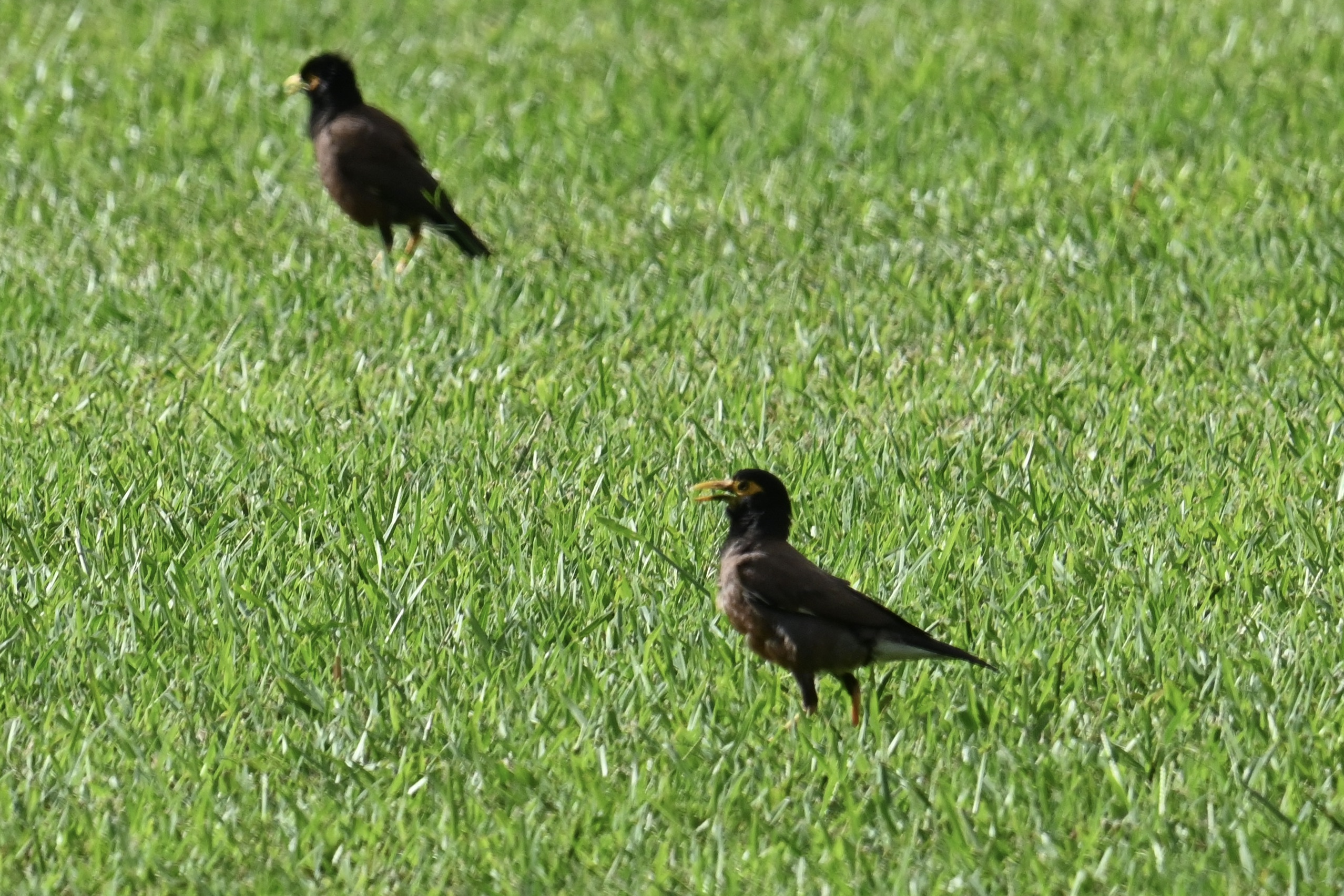
Photo of two common mynas by Eric Anderson.

Story: Fed Up

May 5, 2024

Acts 10:44-48
John 15:9-17

The noio (the English name is “black noddy,” but I like the Hawaiian “noio” better than “noddy”) – the noio was fed up. By which I mean that she was wet, and cold, and hungry. She circled over the ocean croaking unhappily as she looked for small fish and squid. She saw some. She swooped along, dipped her bill, then splashed into the water, and…

Missed.

For the eighth time.

Her mother was circling nearby as she lifted herself back into the air with her cold, wet, wings.

“That looked really good,” mother said. “You might try coming in behind the fish, so it’s less likely to dodge.”

That’s when she yelled at her mother.

She yelled about being wet. She yelled about being cold. She yelled most of all about being hungry. She yelled about being taught to do something that was plainly impossible. She yelled about being the most ignored daughter in her generation. She yelled that her mother didn’t love her. At all.

Then she flew back to the nest, because really, where else could she go?

She plopped herself down on the nest hard enough to make her feet uncomfortable. Her mother hadn’t flown back with her. She sat in the nest and cried with all the frustration of being young, and trying to do something that’s not easy, and failing, and being wet, and cold, and uncomfortable, and not being sure her mother loved her.

She was shivering and her eyes were closed when the nest rocked with someone landing in it. Whoever it was drew close and put their wings over her. Gradually her feathers dried and she started to feel warm. She was still hungry, though, when she opened her eyes to look at her mother.

But it wasn’t her mother. It was her father.

“Where’s mother?” she asked. “I thought she’d come here.”

“She had something to take care of,” said father.

“Did you hear what I said?” asked the daughter.

“Everybody heard what you said,” said father.

“Did I drive mother away?” asked the daughter.

“I don’t think so, but we’ll see,” said her father. She closed her eyes.

A little while later, the nest rocked again as another bird landed. Father’s wings lifted away from his daughter, and she opened her eyes again to see her mother.

“Why didn’t you come right back?” she asked her mother.

“Because it took some time to get you this. Those were sneaky fish you were trying to catch, daughter.” And mother served up some food, and daughter ate, and so she was fed, rather than fed up.

“I guess I’ll try again tomorrow,” said the daughter.

“Maybe they’ll be slower tomorrow,” said the mother.

“Will you help me learn?” asked the daughter.

“Of course,” said the mother, “because I love you.”

And her daughter gave a noio smile and said, “I know. I love you, too.”

by Eric Anderson

Watch the Recorded Story

I write these stories ahead of time (it’s the text you’ve just read) but I tell them from memory, anticipating some new creation as I tell them. So what I’ve written and what I say in the moment are not, cannot be the same.

Photo of a noio in flight by Eric Anderson.

Story: Show Me the Spiders

May 7, 2023

Acts 7:55-60
John 14:1-14

The ‘elepaio was hungry. He had been up and down, back and forth, and side to side on his favorite koa tree. He’d found a caterpillar, a few smallish bugs, and no spiders at all. This was unusual. His favorite tree was normally a favorite place for caterpillars, bugs, and spiders as well. On this day, however, they’d mostly decided to go someplace else.

He was hungry.

He searched the tree once more from top to bottom and all the way to the ends of its long branches. He found a couple more bugs, but no spiders at all. He was particularly fond of spiders, at least he was on this day when he couldn’t find any. He perched on a branch and sang a short, sad, “I’m hungry,” kind of song.

“What’s wrong?” came a voice from a neighboring tree. It was a friend of his, another ‘elepaio, and she seemed concerned.

“I’m hungry,” he complained, “and all I’ve found are a few bugs, one caterpillar, and no spiders at all.”

His friend was puzzled. She was not hungry. She’d been foraging in a couple of ohi’a trees all morning and had quite a nice breakfast from them.

“How strange,” she said. “I’ve been having a nice breakfast, myself.”

“I’m not sure I believe you,” he said. “It’s been such a miserable morning.”

Fortunately his friend decided not to be insulted. “Where have you been looking?” she asked. “Perhaps you’ve just been unlucky.”

“Right here,” he said, “here in my favorite tree.”

“Where else?” she asked.

“Where else would I look?” he said.

She was silent for a moment before she suggested, “Well, anywhere else, I would think.”

“How would I find spiders in anything but a nice koa tree?” he asked. “Why would they want to be anywhere else but this, their favorite tree?”

“There are plenty of them over here in this ohi’a tree,” she said.

“Show me the spiders,” he said, “and I’ll believe.”

For a moment his friend was offended this time – it feels bad when your friends tell you they don’t believe you. She decided to make allowances because he was hungry. Sometimes when creatures are hungry they get hangry, you know. She took a quick look around, made a hop or two to the side, and plucked something off a cluster of ohi’a leaves. Then she spread her wings and flew over to settle beside her hungry friend.

She said nothing because she had a spider in her beak. She set it down next to him. He looked at it.

“Sometimes you’ve got to look in more places than you expect,” she said.

“I guess so,” he said.

“Let’s have some breakfast together,” she said.

So they did.

by Eric Anderson

Watch the Recorded Story

There was a problem with the lavaliere microphone at the beginning of the story. Thanks to our technical crew I switched to a working microphone after a short time.

Photo of an ‘elepaio by Bettina Arrigoni, HarmonyonPlanetEarth – Hawaii Elepaio (male) | Pu’u O’o Trail | Big Island | HI | 2015-11-06at15-07-453, CC BY 2.0, https://commons.wikimedia.org/w/index.php?curid=45577718.

Untasted

The truth is that I’m pretty hungry now.
This walk from city to Emmaus has
been tiring, more than any walk I can
remember, since my heart is wrapped in grief
and fear because, you know, you’re dead and gone
and I refused to take much comfort from
the words the women shared (is it because
they’re women, now, I ask “enlightened” me?).

So I am famished when I sit to eat
with you (the you I do not recognize)
and my companion (oops, whose name I have
forgotten to report to history).
Can we get to it now? Just break the bread
and share it round, replenish my depleted
stores of stamina and strength of mind.
I’ll wait. You break. Then we can eat in peace.

Now hours and miles later, gasping with
the sweet exhaustion of a joy-filled run,
I find that you have traveled swifter yet
than I, to share the miracle of your
renewed and resurrected life. I share
the wonder that “The Lord has risen indeed;”
because I left the bread untasted on
the table when the Lord appeared to me.

A poem/prayer based on Luke 24:13-35, the Revised Common Lectionary Gospel Reading for Year A, third Sunday of Easter.

Image by RvdWeyer – Own work, CC BY-SA 3.0, https://commons.wikimedia.org/w/index.php?curid=27519876.

The Overburdened Albatross

Laysan_Albatross_RWD2There are creatures in the world who love to collect things. Lots of things.

There’s the bowerbird of Australia and New Guinea, who assembles a collection of brightly colored objects (from shells to flowers) to impress a potential mate. There’s the pack rat of the Americas, who will use anything and everything to construct a nest.

And then there’s people. We might be the greatest collectors of all. We are amazing.

If there’s one creature who shouldn’t, and doesn’t, collect a lot of things, it’s the albatross. They spend most of their time far out at sea, gliding on the trade winds over the ocean, landing on the water’s surface from time to time to snatch a meal. Sometimes it’s fish, sometimes it’s squid. They like squid.

You don’t think squid sounds very tasty? Some people like it better if you call it calamari.

Did that help?

Whether you like squid or calamari (or neither), it’s a difficult life for a collector. Nevertheless, there was once a young albatross who set out to do precisely that. I have no idea why.

He started with pebbles he found along the shoreline near the nest where he’d been hatched and grown to become a young adult. I guess he found the colors or the shapes interesting, and they made a nice addition to the nest. Then he added different kinds of grasses that he found. When the old ones blew away, he brought new ones.

Soon there were sea shells piled around his nesting spot, and inevitably the trash that humans leave behind. Some albatrosses get very sick by eating these things, but he just picked them up and put them down again. There were bits of plastic, and shreds of cloth, and his grandest prize of all: the better part of a beach blanket that had floated away from somebody one day.

That wasn’t any of yours, was it? Oh, good.

As his collection got bigger, his circle of friends got smaller. Not because they objected to his hobby, no: but because the season was passing, and they started leaving the nesting site. They were riding the winds out over the Pacific Ocean, with an occasional descent to the surface to catch calamari.

Or squid, if you prefer.

But this young albatross didn’t want to leave his collection. Oh, he tried to take it with him. He wanted to soar over the ocean, too. But when he tried to carry everything on his back, between his wings, he couldn’t manage to take off. When the load was light enough to fly, everything tumbled off. He tried gripping things in his beak, but he quickly realized that he couldn’t eat that way. It’s hard to hold things in a webbed foot, and when he wanted to use two feet to carry things, well, he found that it didn’t work.

And it was also painful.

Finally, it was hunger that made him see the true worth of his piles of pebbles and shells and even the magnificent beach towel. However lovely they might appear to his eyes, they didn’t feed him. No, they didn’t feed him.

Not the way that the skies of the Pacific fed him. Not the way that the waters of the Pacific fed him. And certainly not the way that the squid (or the calamari) of the Pacific fed him.

So he stepped carefully away from his collection, gave it one last look, spread his broad wings, leaped into the air: and flew.

Photo credit: By DickDaniels (http://carolinabirds.org/) – Own work, CC BY-SA 3.0, https://commons.wikimedia.org/w/index.php?curid=18611723

“Breakfast” – Sermon for Apr. 10, 2016

Preached at
Church of the Holy Cross UCC
Hilo, Hawai’i
April 10, 2016

Text: John 21:1-19

Some of you have, I suspect, had a question on your mind for half hour or so:

Is he really going to wear a tie every Sunday?

Some of you may have followed this question with another, more personal one:

Is he going to expect me to wear a tie every Sunday?

I can answer the second question immediately: No. I have no intention of introducing a new dress code for worship at Church of the Holy Cross. That’s a mistake the early missionaries to Hawai’i made, and I don’t care to repeat it. The important thing is to worship God, and clothes should not be a barrier to that. Wear what makes you worshipful. That might be what makes you comfortable, but it might not. Wear what helps you focus on the love of God.

As for myself: that’s one of the things I’ll be learning as time goes on. I’ve worshiped wearing a jacket and tie, or a pastor’s robe and tie, for over forty years. I’m pretty sure that’s going to change now, but I’ll be frank: I don’t know what I’m going to look like in worship next week, let alone next year.

Which brings us to the disciples. Jesus had been crucified, which left them terrified and paralyzed. Then Jesus had been raised, which left them exalted and amazed. They hardly knew what to believe.

This week finds them not knowing what to do. When Jesus appeared to all his disciples, including Thomas, who must really have regretted missing that earlier gathering, he’s startlingly vague about what they’re to do next. They’re joyful, they’re exultant, they’ve renewed their courage – but they’re not committed to any particular direction. So they return to Galilee, which had been home for many of them, and the fishermen among them take up fishing again, with no great success until Jesus appears. This time he’s got a commission, and they won’t use nets to fish ever again.

Gathered for Thanksgiving in 2014

Gathered for Thanksgiving in 2014

They’re on the road to change.

So are we. You and I, the faith community of the Church of the Holy Cross in Hilo, and Eric Anderson born in Middletown, Connecticut. We have met, and we have committed to follow the leadership of Christ together. Christ will change us, and we will change each other. Just what we will look like, and how it will all happen, is still ahead. God knows, but I do not.

I do know that there are more of you than there are of me, and that means I’ll change more than you.

But this is where I come from:

Shirley Anderson

Rev. Shirley Anderson

Lynn Anderson

Rev. Lynn Anderson

This is my family gathered for Thanksgiving a couple years ago at my brother’s house in New Haven. My father, Lynn Anderson, worked as a public school educator for over 30 years, retired early, and entered the ministry. My mother died quite some time ago, and around twenty years ago, while in seminary, my father met and married Shirley Anderson. Both of them have served churches in New England, and they’ve both reached their second retirement. So there are three ordained ministers in my immediate family. I’m the youngest, and I’ve also been ordained the longest.

Rebekah and Brendan Anderson

Rebekah and Brendan Anderson

It was my cousins who bought this tie for me, in celebration of my call to Hawai’i. They made the selection for the bright colors, of course, which can be found in the aloha style, but I don’t think that a large paisley pattern is really Hawaiian – and, of course, it’s a tie. We don’t really know a great deal about Hawai’i back east. I come to this ministry aware that I have a lot to learn!

Incidentally, one of those things is how often to water the plants in the parsonage. They’re all new varieties to me, and I’d value some pointers!

These are my adult children. Brendan on the right is twenty-three, a graduate of the University of Vermont, and has been volunteering in a 3rd grade classroom in Boston this school year. Rebekah is in her third year at Hampshire College, and she wants to be a writer. They are simply two of the most wonderful people I know.

Glastonbury Choir

The choir at First Church in Glastonbury

Rev. Kate VanDerzee-Glidden and Rev. David Taylor

Rev. Kate VanDerzee-Glidden and Rev. David Taylor

David Taylor and Kate VanDerzee-Glidden are the pastors of First Church of Christ Congregational UCC in Glastonbury, Connecticut, where I’ve worshiped for the last ten years or so. They gathered people together to present me with this stole, which celebrates both New England and Hawai’i. On the back, church members and friends wrote their blessings and best wishes for me, and I’ve been reading them with tears in my eyes.

This is the choir at First Church in Glastonbury singing at the service the Connecticut Conference held to celebrate my ministry. You’ll notice that they all donned leis for the occasion – and had one for me. What you can’t see in the photo is the gift certificate they gave me for a music shop here in Hilo, to purchase an ukulele and start to learn to play it.

And I’ve even gone out to buy it!

Eric and Paul Bryant-Smith

Eric and Paul Bryant-Smith

And this is my friend Paul Bryant-Smith. He’s pastor of a church in Danbury, Connecticut, and also a hospital chaplain. The two of us have made music together for twenty years. In this picture, also from that farewell service, I’m playing him wearing heavy winter clothing, and he’s being me, playing ukulele. We are, of course, singing “Somewhere Over the Rainbow.”

And then there’s this photo. I took it at the Hilo airport. Because my flight was early, which I gather isn’t common, some of you who came to greet me hadn’t arrived yet when I took this picture. I think I was also wearing at least two more leis when I left the airport.

This picture has been liked 235 times on Facebook. I’m pretty sure that’s the most affection any photo has ever received on my Facebook account.

I’m showing you all this to make sure you know something very important about me: I know what it is to be loved. I have been blessed to live among loving people. In these smiles and waves and leis, I know that I am blessed to live among loving people again.

Church of the Holy Cross members welcome Eric Anderson to Hilo.

Church of the Holy Cross members welcome Eric Anderson to Hilo.

Jesus asked the impulsive, jump-into-the-water Peter this question: “Do you love me?”

It’s a tough question for him, and in fact Peter does some linguistic gymnastics with words for “love” that don’t translate from Greek to English.

That’s for another time. It doesn’t matter what kind of love Jesus asks about, and it doesn’t matter what kind of love Peter declares, because every time Jesus insists: “Feed my sheep.”

“Do you love me? You do? Feed my sheep.”

Or he might have put it this way: “Do you love me? You do? Love those around you.”

Feed my sheep.

There are a lot of ways to be hungry in the world: the hunger of the stomach, the hunger of the mind, the hunger of the soul.

The hunger of the stomach seems simple, doesn’t it? I get hungry. I eat. Problem solved. But the hunger of the stomach is not so simple, not by half. For one thing, food alone won’t do. I need to drink water as well, and my officemates back at the Connecticut Conference are still telling stories about my need for coffee.

Yet there’s another important question to ask: When people are hungry, why are they hungry? Why don’t they have access to food, or water, or work, or support? How can we prevent today’s hunger from becoming a pattern, or an apparently permanent condition?

Feed my sheep.

The hunger of the mind, likewise, may not be satisfied by the delivery of books or the establishment of schools. People learn differently, and techniques that work well for vast numbers of people may be utter failures with some others. You can see the frustration build when someone’s trying to learn in a way that doesn’t work well for them. If you’re trying to learn something from me, and it’s not working, let’s try it again, but this time, let’s try something different. And if I’m trying to learn something from you, and it’s not working, let’s try it again, and this time, we’ll try something different.

Pastor Eric in his tie and stole - and first Sunday lei.

Pastor Eric in his tie and stole – and first Sunday lei.

And there’s the hunger of the soul. When it comes right down to it, confronting this human need is my calling. My place among you is to help you satisfy the hungers of your soul.

Most of the time, I will not be able to meet that need myself. It would be lovely if I could do it in a sermon, but no. Not in one sermon, and most likely not in twenty years of sermons either. If I’m doing well, from time to time I’ll say something that feeds you just a little, and on the days when I don’t, hopefully I’ve said something to feed someone else.

The sermon isn’t the only source of spiritual food, however, and it’s my role to help you try things that might feed you. There are many different approaches to prayer, and some might bring you closer to God than others. Music has astonishing power to fill the soul. I’ll do my best, and work with the leadership, to lead worship that is authentic and engaged. We can study the Bible and other spiritual works. We can take retreats. We can engage in public service and public witness. We can sit together and talk about baseball, or your grandchildren, or your job. If your soul hungers, let’s work together, and find ways to fill your spirit.

The risk of having a satisfied soul is that Jesus summons them. He says, “Feed my sheep.” We’re not the only ones who hunger in body, mind, or spirit. There are others, near and far.

Our work together as the Church of the Holy Cross United Church of Christ in Hilo, Hawai’i, is to answer the call of Jesus, and labor to see that those who hunger – in body, mind, or spirit – are fed.