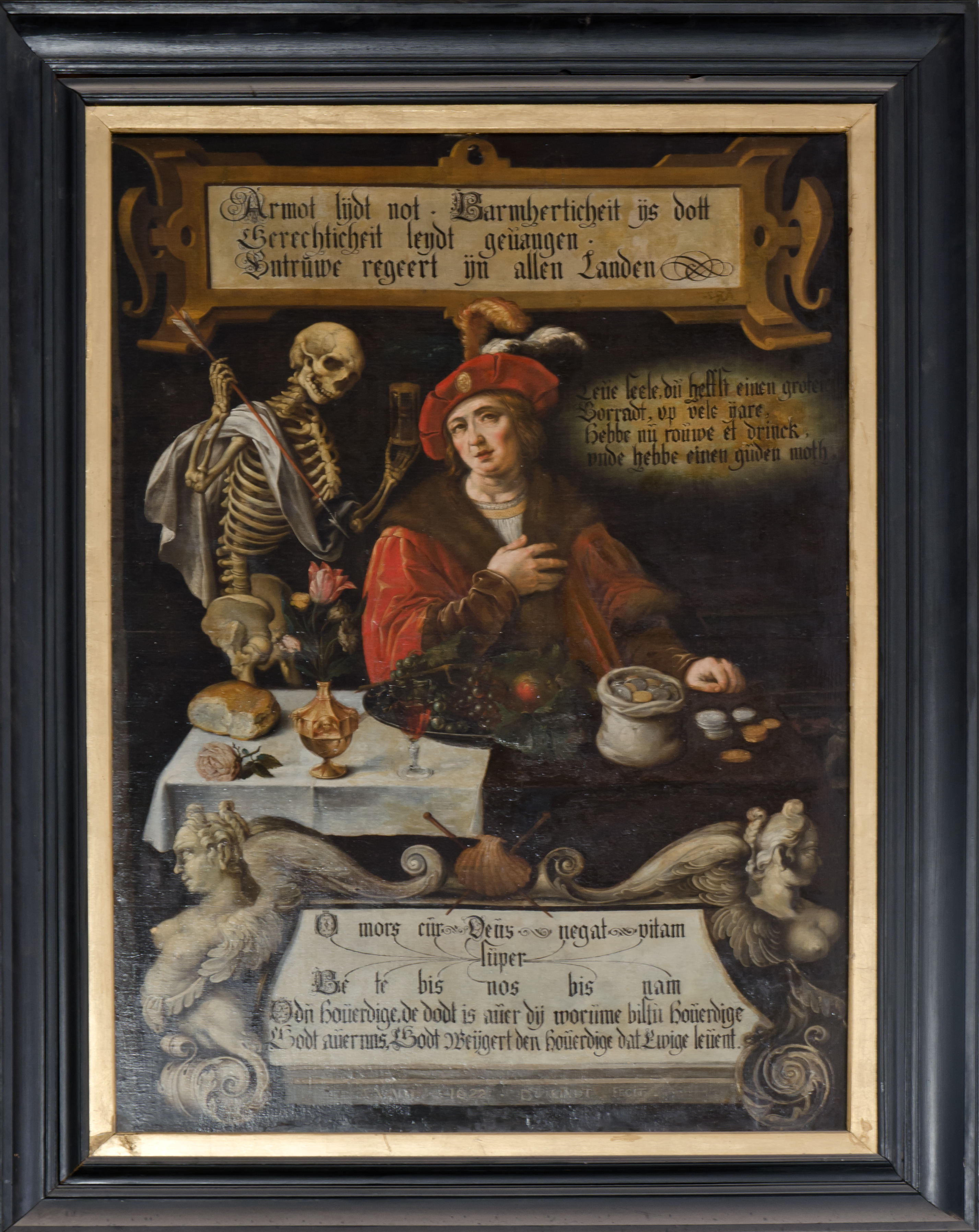
“[Jesus said,] ‘Sell your possessions and give alms. Make purses for yourselves that do not wear out, an unfailing treasure in heaven, where no thief comes near and no moth destroys. For where your treasure is, there your heart will be also.'” – Luke 12:33-34
Jesus, I am not a wealthy man… by some standards. Were I to leave my work, I’d quickly run through savings, have no home, sell the things I use to give me joy – the instruments, the cameras, the things that prompt my memory.
By other standards, I have wealth beyond imagination. I do not know where my next meal will come from, but I know that it will come. I know that if a wave arises or a lava river flows, I’ll have a place where I am safe.
My wealth be great or small, I must confess, it still is mine. In honesty, I’d sooner heed Isaiah’s words: do good, seek justice, rescue the oppressed, defend the orphan, raise my voice in favor of the widow. But.
You, Jesus, raised the bar. The tithes has turned to everything: my ukulele, photographs; my work time and my leisure, what I think and write and speak and make. For you demand all these be yours, be God’s, be holy gift.
So Jesus, I confess that though I give you much, it is not all. I may give alms; I may give time; I’ve taken on the role of the religious, but: it is not all. It is not all.
Dear Jesus, please accept my offerings, my alms of treasure and of time, of sweat and contemplation. Take the portion of my heart that unreservedly I give to you. And forgive the heart, and treasure, which I still keep for myself.
A poem/prayer based on Luke 12:32-40, the Revised Common Lectionary Gospel Reading for Year C, Proper 14 (19).
It hardly seems fair to call him a fool. Call him a practical man, call him far-seeing, call him descendant of Joseph, I say.
What did he do when faced with a surplus? He saved! Did the thing I’ve been told since a lad I’m to do with the coins that remain. When the rainy days comes, I’ve been told, they’ll be there.
In Egypt, the dreams of a monarch warned Joseph, “Prepare when it’s fruitful for days when it’s not.” And so I’ve been taught (if not followed so well), and so I have urged when it’s my turn to tell.
What’s wrong the rich man? Why was he a fool? He followed the ancient advice to the letter: Built barns that would hold all a good year produced; saved grain for the needs a bad year would demand.
Is that what he did? No, he said, “I’ll make merry with all of my goods in my barns and my hand. I might give a pink slip to all of my workers. They’ve done all I want, and I want to be done.”
Whose will the grain be? And whose all the wealth when the soul and the body divorce in the night? Not his. He has gone where the soul is the seed, and gold is the spirit which he had ignored.
How easy, how likely, to play such a fool, to mistake greed for prudence and pride for precaution. How often, I wonder, have I played the fool, for much lesser riches
And hubris as great? You know, Storyteller, and though you disclaim it, I know that you judge with a knowledge I lack. Though I’ve no grain for barns,
And no fruit for freezers, I’ll spend what I have for the people around me: a poem, a song, or even a sermon. May God bless these gifts. May God bless us all.
A poem/prayer based on Luke 12:13-21, the Revised Common Lectionary Gospel Reading for Year C, Proper 13 (18).
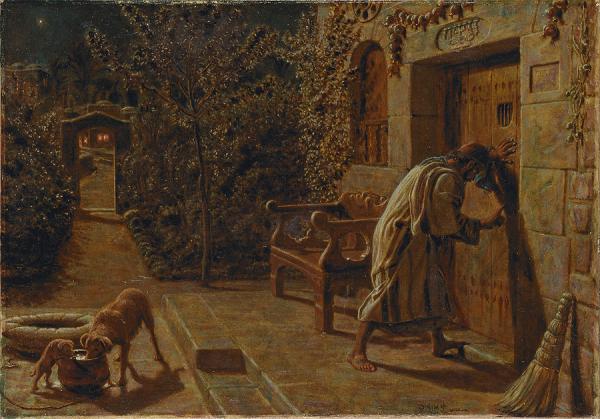
“[Jesus said,] ‘I tell you, even though he will not get up and give him anything out of friendship, at least because of his persistence he will get up and give him whatever he needs.'” – Luke 11:8
I could wish that Israel had been so considerate of its poor, instead of getting into bed with riches and with greed. I’d think that hard-edged coins would break their sleep, but sleep they did until they slept no more.
I could wish that Hosea had been so considerate of his wife and children. Yes, It was a metaphor of power, but I’d think the tears of hard-said words and names would break their sleep, but sleep they did.
I could wish the neighbor heard his friend’s distress and rose with empathetic energy to meet his need. I guess the friend was fortunate that shouts and calls would break their sleep, until they brought the bread and slept anew.
I could wish all these many things and more, when wealthy men enrich themselves at the expense of people who, deprived of healing balm, find death would break their sleep, and carry them from this world’s cares.
While in the shadows Jesus watches, weeping. While in the shadows God is raging, tears a-stream to know that in these broken covenants even the rich will wake from sleep to find their fortunes blazing.
While in the shadows God the Holy Spirit waits for someone who will listen and embrace the wisdom that resounds of old: to give your neighbor care, and wake from sleep to bright and joyful day.
A poem/prayer based on Hosea 1:2-10 and Luke 11:1-13, the Revised Common Lectionary First Reading and Gospel Reading for Year C, Proper 12 (17).
“And he sent messengers ahead of him. On their way they entered a village of the Samaritans to prepare for his arrival, but they did not receive him because his face was set toward Jerusalem. When his disciples James and John saw this, they said, ‘Lord, do you want us to command fire to come down from heaven and consume them?’ But he turned and rebuked them.” – Luke 9:52-55
Did I not ask you, not so long ago, who you say I am? James? John? Do you remember that? I guess you thought I was Elijah, after all (or that you were?), to call down fire on the captains and the fifties, or onto their Samaritan descendants in this village.
Did I not say that those who’ll follow me will bear a cross, and lose their life to save it? And were you listening to me, or to your glorious dreams? No wonder that the heavenly voice which called me “Son” demanded that you listen to me – since you weren’t. And now you want to destroy lives with heavenly fire.
Well, no, my friends, we won’t do that. We’ll make our way on by, and take our rest where people offer welcome out of grace, not out of threat, and we will tread a Via Dolorosa, you and I and all our friends, to show God’s love will not be bounded by
rejection much more thorough, drenched in blood’s finality, a breath unfinished, body broken, and forsaken by my friends. No, James and John, the world is filled with fires; no need to summon them from heaven’s vault. What’s needed is to love, and love, and love.
A poem/prayer based on Luke 9:51-62, the Revised Common Lectionary Gospel Reading for Year C, Proper 8 (13).
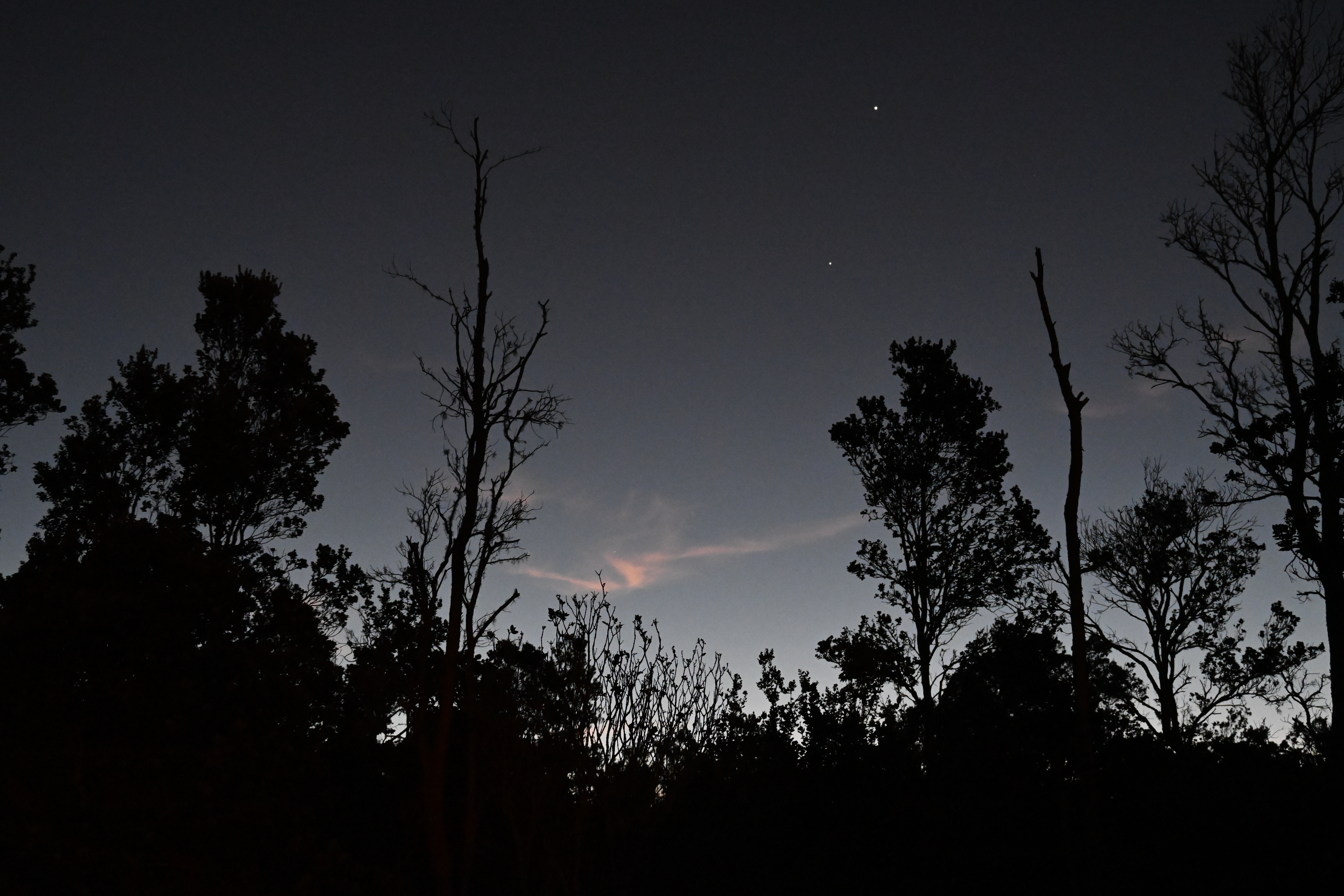
Photo of lava fountains on Kilauea by Eric Anderson (May 25, 2025).
Birds are pretty honest creatures. They sing when they’re happy, and they screech when they’re mad. They give alarm calls when they’re scared, and they make hungry noises when they’re hungry.
An ‘akiapola’au used to follow ‘elepaio through the forest to find food. The funny thing is that ‘elepaio and ‘akiapola’au don’t eat the same things. ‘Elepaio like bugs and spiders, which I don’t, to be honest. ‘Akiapola’au will eat those, it’s true, but they prefer the worms, caterpillars, and bugs that burrow into the wood of koa trees. It’s been noticed that a tree full of bugs and spiders is probably also one that’s full of burrowing insects, too. The Hawaiian canoe makers knew that, and the ‘akiapola’au knows it, too.
The ’elepaio could be trusted to tell the truth.
This one ‘akiapola’au, however, came up with a new idea one day. You see, while he was following the ‘elepaio, other birds were following him. He worried that they’d eat all the food before he did. The fact that none of them ever left the trees hungry didn’t seem to make a difference. He had to protect his food.
He thought.
Not that it was his food before he ate it, but anyway.
So he developed the habit of tapping at tree branches that didn’t have bugs in them. ‘Akiapola’au do that to find where things have burrowed into a tree, but he started doing it, and then digging where he hadn’t found any. It attracted other birds. They’d come in to see.
And he’d fly off to some other tree where he’d try to find something he could actually eat.
The result was a fair number of frustrated birds, who’d look around where he’d been tapping and find fewer spiders and insects than they expected. They went to bed somewhat hungry.
He was pretty satisfied with his trick when his auntie turned up after a day of tapping on insect-free trees. “Nephew, why are you spending so much time hunting in trees without food?” she asked.
“Don’t tell anyone, but I’m drawing the other birds away from the good trees,” he said. “I don’t want to run out of food and be hungry.”
“So you’re lying to them?” she asked. “And before you say, ‘No,’ don’t think about lying to me.”
“I don’t think I’m lying to them,” he said.
“You’re acting as if there’s food where there isn’t. You don’t have to say a word. It’s still a lie. It’s a lie that’s bringing hunger to our forest when it isn’t necessary. There’s plenty to eat. Isn’t there?”
“I guess so,” he said.
“As for you, you’re spending so much time in trees without food: how hungry are you when you go to sleep?” she asked.
He realized that, in fact, he spent so much time in trees without caterpillars that he was hungry at the end of most days. His lie meant that he wasn’t eating enough.
“No lying, nephew,” said auntie. “It’s not worth it and it never was. Go find the trees with food in them, and share the word with the other birds around us. We’ll all be better for the truth.”
by Eric Anderson
Watch the Recorded Story
I write these stories in advance, but I tell them from memory and inspiration. On this particular day, I’d happened to speak to one of the young people the night before on a video call, where I told him that I’d be telling him a story the next day.
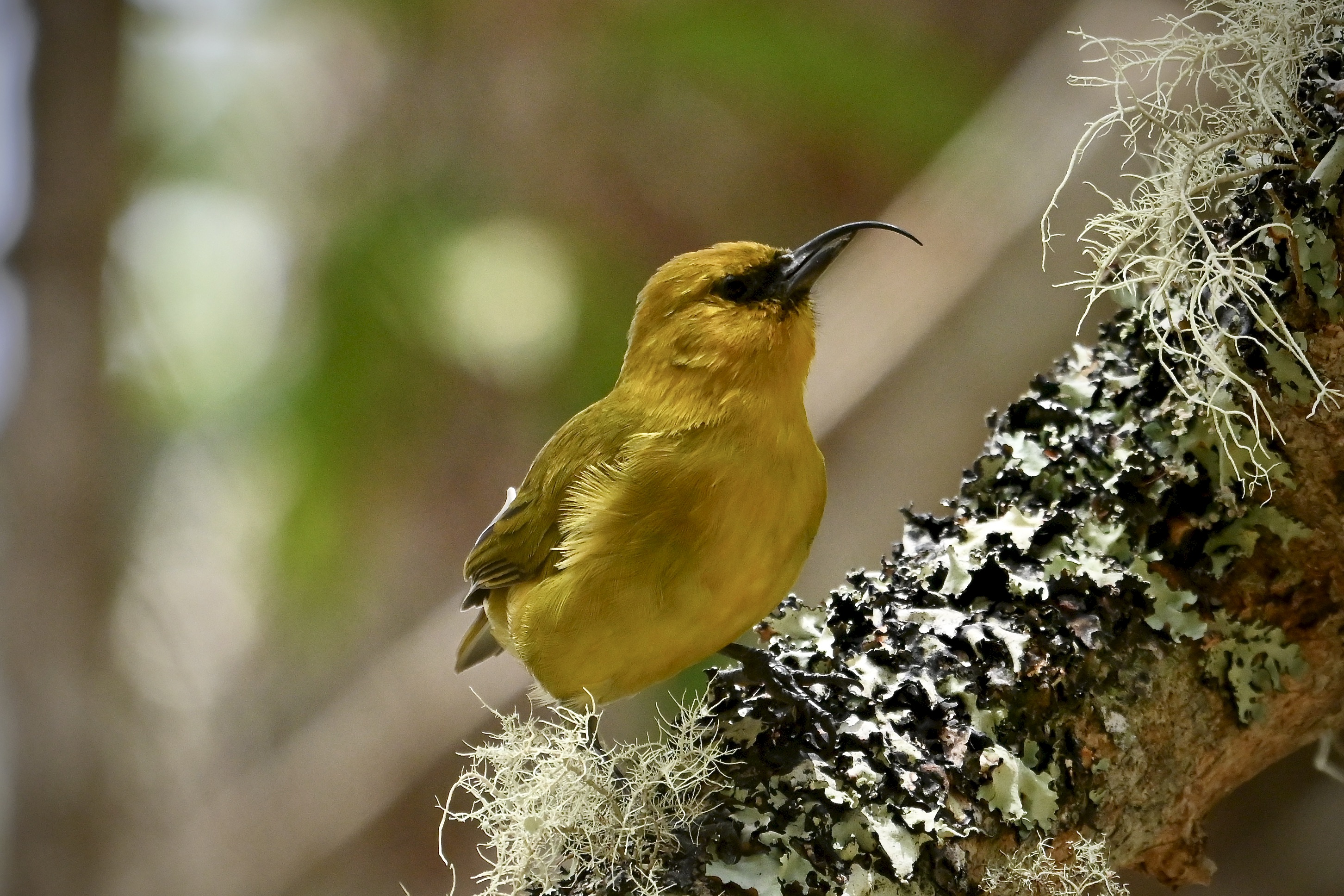
Photo of an ‘akiapola’au (adult male) by Eric Anderson.
“In the last days it will be, God declares, that I will pour out my Spirit upon all flesh, and your sons and your daughters shall prophesy, and your young men shall see visions, and your old men shall dream dreams.” – Acts 2:17, quoting Joel 2:28
Assembling for the feast of Shavuot, the Spirit roared. No gentle breeze for us; a tempest howled there among our trembling circle, through our trembling souls. The flickering light upon our foreheads did not shed illumination, no. I saw it as a portent of our immolation. Not since the angel told me not to fear have I been so afraid.
My limbs have dragged my shivering frame into the streets, which teem with goggling worshipers. They fight their way upstream along the way my son last trod beneath the burden of a cross. How many know, how many care, that Jesus died abandoned by his follower-friends, attended by these women who, like me, recall dear Miriam, who danced before the Law.
The raucous streets resound with Babel sound, with accents I know well, and languages I don’t. To my astonishment, one voice is mine, another comes from Mary here, and Mary there, and from a hundred other throats. We praise our God, because when Jesus had been laid into his tomb, the Holy One rejected our rejection, called him back to life.
They scoff, of course, that we are drunk (how drunk, they do not know, for I am filled with Spirit I have never known). I draw my breath in deep. I plant my feet upon the unforgiving stones. I start to lift my arm to summon all to hear my words, and then I hear it: Simon’s voice, my son’s beloved Rock, against all expectation quoting from the prophet Joel. Who would have thought it? I rejoice, except: I wonder, when will faithful people hear a woman’s voice again?
A poem/prayer based on Acts 2:1-21, the Revised Common Lectionary First Reading for Year C, Pentecost Sunday.
The image is The Virgin surrounded by twelve apostles or Pentecost, by Master of the Crucifix of Pesaro (ca. 1380). Photograph by Rama, Wikimedia Commons, Cc-by-sa-2.0-fr, CC BY-SA 2.0 fr, https://commons.wikimedia.org/w/index.php?curid=11148957.
Many artists included Mary among the Twelve in their depictions of Pentecost.
Full inclusion of God’s people does not stop at men and women.
He was young, which may explain why he tried something that an older bird would know didn’t work. He was also pretty anxious about things, which explains more. In the end, though, it was his tutu who saw the biggest reason, which was…
I’m getting ahead of myself. Perhaps I should start the story at the beginning.
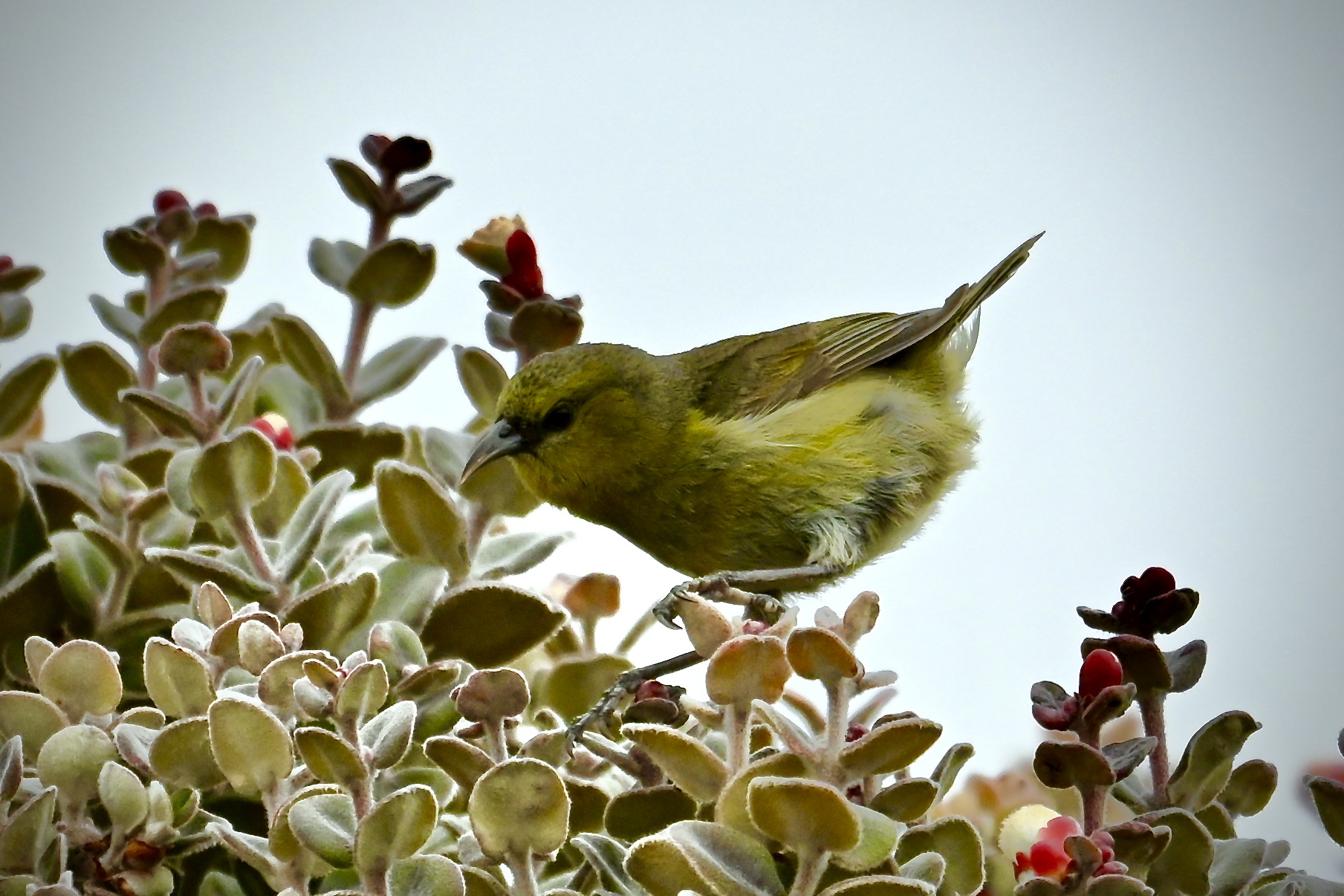
The ‘amakihi was young. And, as I mentioned, he could get anxious about things. If it was sunny, he worried about whether rain would come again. If it was raining, he worried about whether it would ever stop. If he was surrounded by other birds, he worried about whether it would ever be quiet with all these birds singing. If he was by himself, he worried that he’d be lonely forever.
Mostly, though, he worried about being hungry.
As a young and growing bird, he’d driven his parents to distraction by his constant calls for food. Some birds, and people for that matter, eat when they’re hungry. He’d call for food when he was full, because he knew he’d be hungry again soon. That can be pretty unhealthy for people and for birds, but frankly his parents couldn’t keep up with his demands, so they fed him more or less the right amount of food.
When he left the nest, he kept it up. If he was hungry, he’d head for the nearest flower, snap up the bugs, and drink the nectar. If he was still hungry, it was time for the next flower and the next bug. And if he wasn’t hungry, he’d still move on to the next flower.
What kept him from getting sick from overeating is that he had to do enough flying between trees that he couldn’t quite eat more than was good for him. Not quite.
One day, though, he was watching some bugs instead of trying to eat them. They were bees in their hive, and they were gathering nectar and storing it away. Suddenly it struck him.
“I can gather flowers and store them away like the bees,” he said. “Then I’ll never have to worry about finding flowers, and I’ll never be hungry.”
Off he flew.
He started snipping blossoms from the trees: Ohi’a, Mamane, anything he could find. He tucked them into an abandoned nest he found, then flew out in search again. If there were other birds around, he’d chase them off first so he could get the flowers. He had gotten rather big with eating, so other birds tended to fly away. The forest filled with squawking, protesting birds as he flew about with flowers in his beak.
He’d made quite a few trips and the forest was in an uproar when he found his grandmother perched next to his store of flowers.
“Aloha, Tutu,” he told her.
“Aloha, grandson,” she said to him. “What are you doing?”
“Storing flowers,” he said, “so I’ll never be hungry.”
“Really?” she said. “Who gave you that idea?”
“The bees,” he said. “They store nectar and pollen and they’re never hungry.”
“Grandson,” said Tutu, “would you look carefully at your flowers?”
For the first time since he started collecting them, he looked. No longer connected to their branches, they’d wilted and faded. Their nectar had dried and disappeared. A few bugs were crawling on them, of course, but even the bugs preferred the liquid nectar of a living flower.
“Why did you do that?” she asked. “Did you really think it would work?”
“I thought that I needed food for myself,” said her grandson, “that the other birds couldn’t take away from me.”
“The forest is for everyone,” said Tutu, “for every one of us. We’re not bees, who have ways of storing things, and they share what they store with the entire hive. We are forest birds. We don’t hoard. We don’t keep things away from others, not from ‘amakihi, not from ‘apapane, not from i’iwi. We share.”
She looked at him closely. “What do we do, grandson?”
“We share, Tutu.”
“Good. Let’s go have lunch.”
They left the sorry hoard behind for the living flowers they shared with all the creatures of the forest.
by Eric Anderson
Watch the Recorded Story
I write these stories in full ahead of time, but I tell them from memory (and inspiration).
So when Peter went up to Jerusalem, the circumcised believers criticized him, saying, “Why did you go to uncircumcised men and eat with them?” – Acts 11:2-3
You think I wanted to eat with them? I didn’t want to go at all. I was riding pretty high, you know, elated with a woman’s resurrection. OK, the only place they’d put me up was with a tanner, but a fisherman’s smelled worse.
Yes, I was riding high, and trying not to think about the things that happen when you’re riding high, the way success becomes a series of new challenges, new obligations. I was smelling those amidst the tannery. It came for Jesus; it would come for me.
I didn’t know that I could lie in dreams or visions, waking or asleep. I claimed I’d never eaten food that was unclean, and knew full well I’ve eaten shellfish when the Romans hadn’t purchased all my stock. And let’s ignore the grain I plucked on Sabbath Day.
A vision or a dream; regardless, it would summon me to something new I knew. I did not know what it would be, but who gets visions for a trivial thing? I didn’t know what that dream meant. I knew I’d go where I’d not wish to go.
The house of a centurion was not within my plan. Who knew what I would find when I reached there? Most likely was a naked sword to seek my naked gut. Why trouble with a cross when you can drain a troublemaker’s life without?
I had no plan to speak of Jesus there until they asked, but ask they did, and I pulled in my breath, and breathed it out, and spoke with sometimes trembling voice of Jesus, of his healing touch, his mercy to such fools and failures as I am.
I certainly did not expect the fire of the Spirit in a Roman house, of one who marshals military might against the people of this land. They said that he feared God, but this? The Holy Spirit, lit in him as it had been in me? Who knew?
And now, my friends, I have no plan for you. I didn’t want to go. I went. I didn’t want to speak. I spoke. I didn’t know the Spirit would appear. She did. I didn’t know that God had welcomed them, the Gentiles, just as openly as us. And now, I have no words for you, except
To tell my tale again.
A poem/prayer based on Acts 11:1-18, the Revised Common Lectionary First Reading for Year C, Fifth Sunday of Easter.
“[Jesus read from the scroll of Isaiah:] ‘The Spirit of the Lord is upon me, because he has anointed me to bring good news to the poor. He has sent me to proclaim release to the captives and recovery of sight to the blind, to set free those who are oppressed, to proclaim the year of the Lord’s favor.'”
“Today this scripture has been fulfilled in your hearing.” Your own words, Jesus, amazing them with graceful speech. Until they turned upon you.
Remind us once again of what is grace. I’m told that grace is strength, is force. I’m told that power is right, and might is good. I’m told that what we want we take.
Where is the news that sounds good to the poor? Where is the vision for the ones who will not see? Where is the freedom for the ones who are oppressed? Where are the prisoners released into the light?
You did not speak the words of grace alone. You needled them, you did, O Christ, until they burst in rage, and nearly did the work of Pilate three years earlier, by casting you to break upon a rock.
O, can we learn the lesson that you tried to teach? We claim your name but do not tread your ways. We leave the poor uncomforted, we close our eyes to the oppressed, and those we free are those who’ve flattered us.
May there be good news for the poor. May there be vision which will pierce the shade. May there be freedom for those who have been bound. Bring quickly, Jesus, the favored year of the LORD.
A poem/prayer based on Luke 4:14-21, the Revised Common Lectionary Gospel Reading for Year C, Third Sunday of the Epiphany.
The image is “The Rejection of Jesus in Nazareth” (“Prophets are not without honour, except in their hometown”); 18th-century tile panel by António de Oliveira Bernardes in the Igreja da Misericórdia, in Évora, Portugal, Public Domain, https://commons.wikimedia.org/w/index.php?curid=97133284.
Now when all the people were baptized and when Jesus also had been baptized and was praying, the heaven was opened, and the Holy Spirit descended upon him in bodily form like a dove. – Luke 3:21-22a
The water gently swirled about their legs as John and Jesus stepped into the stream, the echoes of John’s fierceness still perceivable in those who stood upon the bank, and those who dripped the water of forgiveness.
The water may be gentle, but the fire promised by the Baptist came descending. Like a dove, indeed, but doves are sharp of claw and though they promise coming home they promise nothing gentle on the way.
The river’s soft embrace receded, puddling on the riverbank. The Holy Spirit’s fire ignited in the eyes beneath the water-speckled lashes. The one who had, with hardly any word, descended peacefully, has risen purposefully.
Was there a word for John? Who knows. Perhaps a hand to brush the drying skin which shortly would be washed again with washing someone else. The fire drove him from the water to the wilderness.
O Gentle Spirit, how do humans dare to call You gentle, source of prophets’ words, apostles’ energy, and martyrs’ blood? Indeed the Baptist said it true, that though he washed with water, You baptize your followers with fire.
A poem/prayer based on Luke 3:15-17, 21-22, the Revised Common Lectionary Gospel Reading for Year C, Baptism of the Lord.




 ordainedgeek