Story: Why Do You Fly So Far?

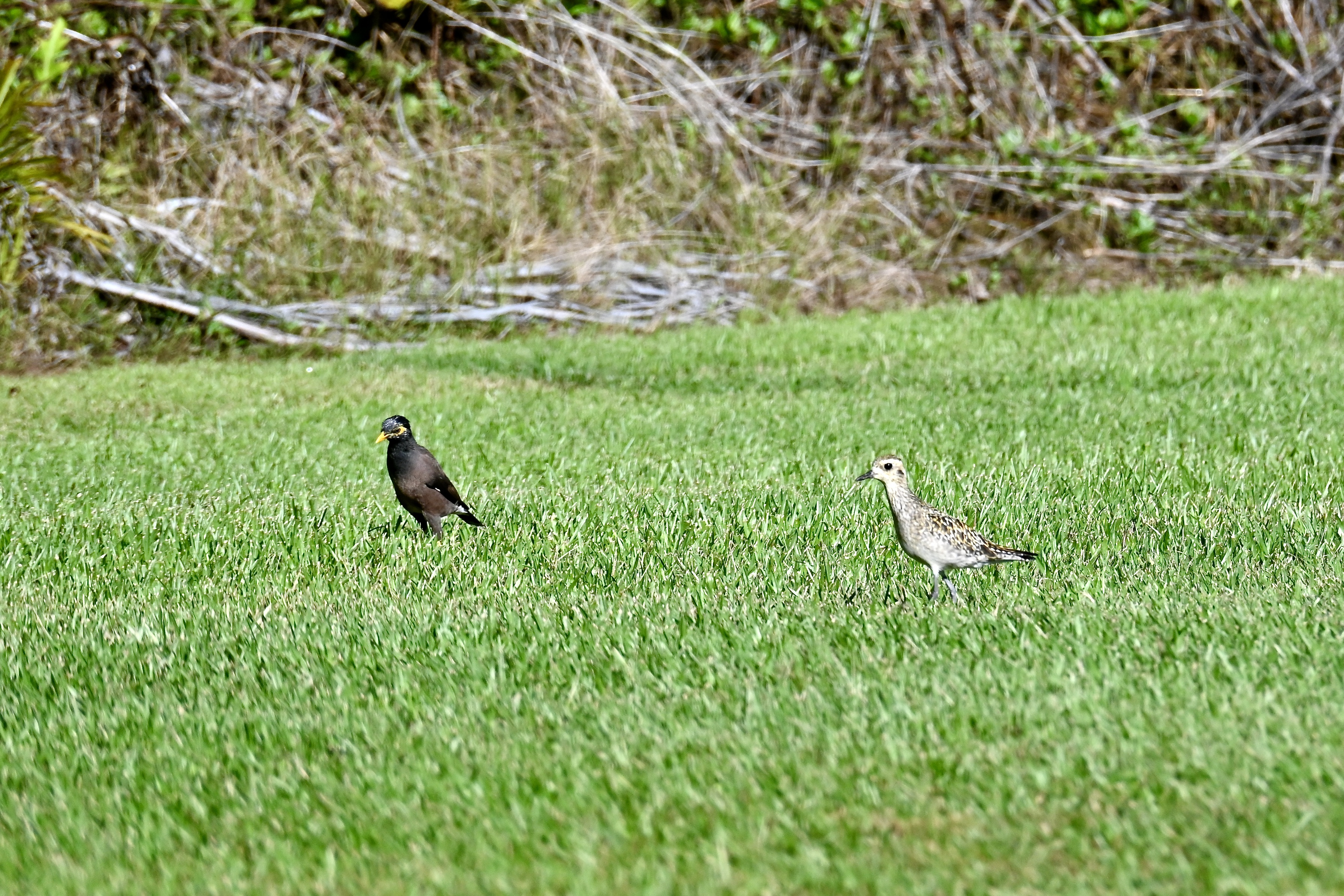
A myna (a dark colored bird with yellow feathers around the eye) and a kolea (Pacific Golden-plover, a light brown bird with darker brown spots) in a grassy field.

December 14, 2025

Luke 1:46-55
Matthew 11:2-11

The kolea is a pretty mellow bird. They’re not terribly skittish, though some will keep a sensible distance from people. We are a lot bigger than a kolea and probably look kind of scary to them.

The myna, on the other hand, is not a mellow bird. They sing a fair amount, but they also screech and argue. They’re pretty sociable with one another, and one moment everybody is happy and content, and the next moment everybody is hollering at one another.

Which makes them a lot like some people, now that I think of it.

Mynas fly, of course, but you could call them homebodies. They don’t tend to go very far. Kolea, on the other hand, fly long distances from where they nest in Alaska to where they spend the winter here in Hawai’i. If you’ve ever flown on an airplane to the North American continent, you know that’s a long flight. Well, kolea fly it with their own wings and they don’t go as fast, so it takes longer.

The mynas find it all rather puzzling and strange.

A myna was picking worms and seeds alongside a kolea one day. The two of them were quiet most of the time, because by chance most of the myna’s other friends had had a big argument and flown off to continue it somewhere else. So it was just the two of them.

“I’ve always wanted to know,” said the myna to the kolea. “Why do you fly so far?”

The kolea thought about it. “I’m not sure anyone has asked me that before,” he said.

“Well, I’m asking,” said the myna.

“I do like the change,” said the kolea, “and I know that it gets awfully cold in Alaska during the winter.”

“Then why not stay here?” asked the myna.

“There are different things there,” said the kolea, “and it just feels right to raise chicks there.”

“Then why fly all the way here?” asked the myna. “What do you come here to see?’

The kolea was quiet for so long that the myna was about to ask the question again, but then the kolea spoke:

“I come to see different trees, trees that blossom red and purple and gold. I come to see soaring mountains crowned with snow when there’s green all around the island. I come to see waterfalls that make rainbows. I come to see mountains with fire and beaches with black sand.

“I come to see birds that also live in Alaska, like ‘akekeke, and birds that don’t live in Alaska, like ‘apapane and nene and saffron finches.

“I don’t think I’d appreciated, though, that I also come to see mynas, and to be asked questions I was never asked. The next time I fly to Hawai’i, I’ll be coming to see you.”

“I’m glad,” said the myna. “Next time you fly from Alaska, I’ll be very glad to see you.”

by Eric Anderson

Watch the Recorded Story

I write these stories in advance, but I tell them from memory (and inspiration). The story you have just read is not identical to the story as I told it.

Photo of a myna (on left) and a kolea (on right) by Eric Anderson.
Story: The Sweet Bug Mystery

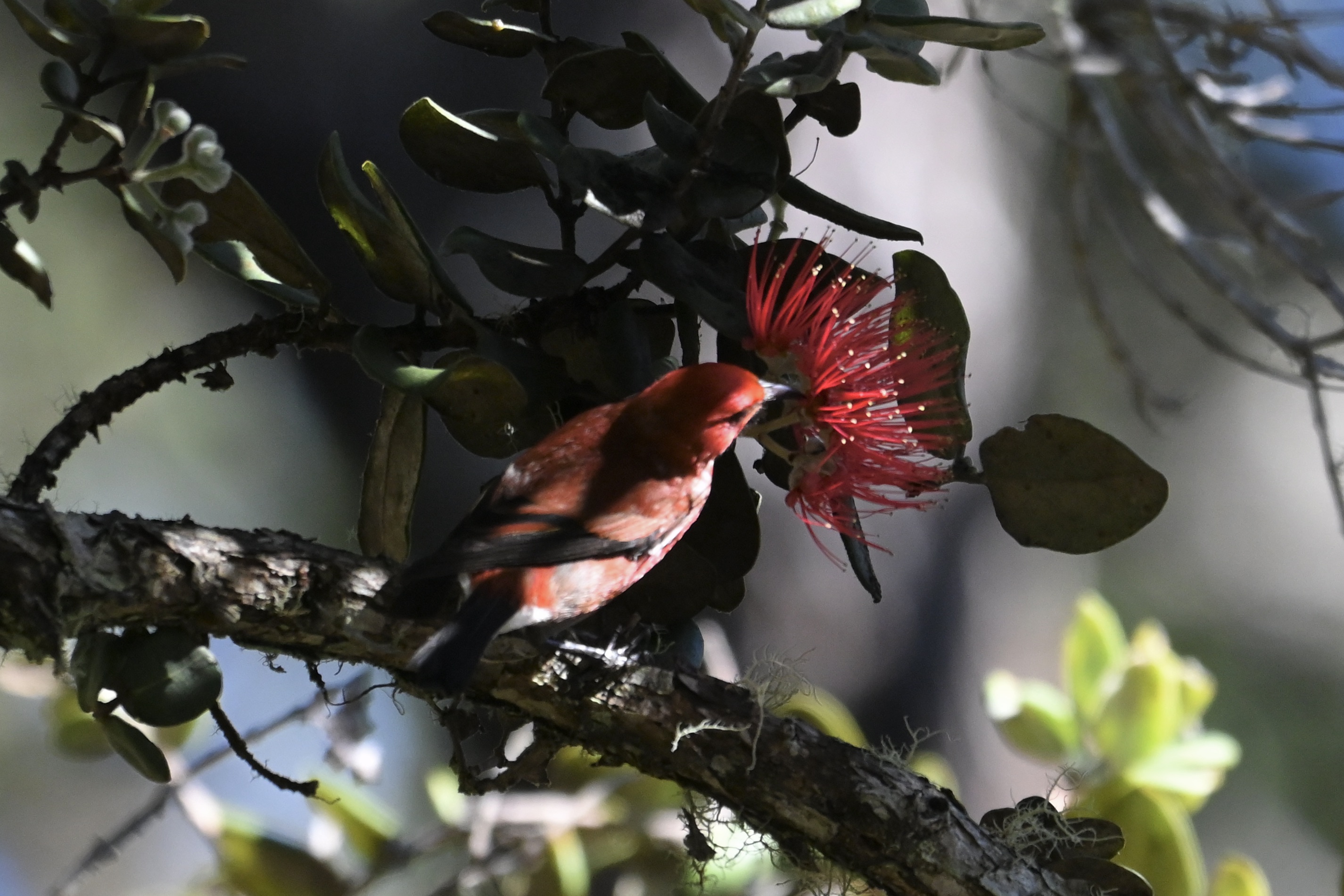
An 'apapane (a red bird with black wings) feeding at a red ohi'a flower.

January 5, 2025

Jeremiah 31:7-14
John 1:1-18

The ‘elepaio has the reputation for being the most curious bird of the forest, but once there was an ‘apapane who was as curious as nearly any ‘elepaio. He had questions about everything. Why were his feathers brown when he was younger, and why did they turn red? Why did some trees have blossoms and others didn’t? Why did the days grow shorter and longer again?

He found answers to some of his questions, and he didn’t find answers to others of his questions. He never gave up asking them, though, and he never gave up trying to find out.

One morning, while enjoying a late morning snack of bugs, it suddenly occurred to him: Why do bugs taste sweet?

I’m not sure that bugs would taste sweet to you or to me, but the bugs he was eating that day definitely tasted sweet to him. He hadn’t thought about it before, but why should a bug taste sweet? Shouldn’t they be salty, or tangy, or something like that? Why sweet?

He asked around to see if anyone else knew, but nobody did. They hadn’t thought about it, and they weren’t all that interested. “If they taste good, that’s all that matters,” said one of his friends, and didn’t help any further. So the ‘apapane decided to watch and see what sweet bugs ate.

What they ate, he discovered, was a lot of things that he also ate. Those bugs ate fruit. They ate ohi’a nectar. They even ate other bugs who were eating sweet fruit and nectar. The sweetness of what they ate was being carried along to make them at least somewhat sweet.

“That’s amazing!” he said to himself. “But now the question is: Why is fruit sweet? Why is nectar sweet?”

Again, he went to friends and family to ask, and again they didn’t know. “It tastes good; that’s all that matters,” said the same friend. So he began to watch the trees, to see what they did to produce sweet fruit and flowers.

I’m afraid that being an ‘apapane rather than a human being meant that he never did learn the answer to that. He could see that the trees spread their leaves to the sun, but he couldn’t see the way that the green of the leaves combined water from the roots with energy of the sun to make the sweetness that made the tree grow. He couldn’t see that sweet sap being concentrated in the flowers to make nectar, and later in the fruits to feed the seeds of later trees. People have microscopes and chemistry equipment and lots of years asking and answering these questions. He didn’t.

He had to admit that he wouldn’t answer the question of sweet nectar, at least until he learned something new. For him, sweet nectar would remain a sweet mystery.

It never stopped him from enjoying it, though.

by Eric Anderson

Watch the Recorded Story

I write these stories in advance, but I tell them from memory and improvisation. There will be differences between the story I’ve written and the story I told.

Photo of an ‘apapane feeding from an ohi’a blossom by Eric Anderson.

Many Tears

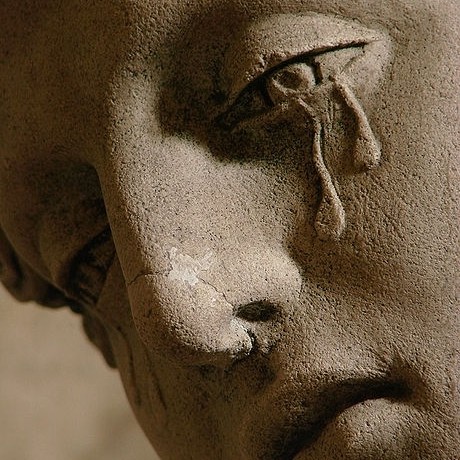
A stone statue face of a woman with two tears dripping from her left eye.

The world is filled with tears.
They spring from eyes emotion-swollen,
running down the cheeks
across the bare or stubbled chin.
The world is filled with tears.

The fountains spray their eloquence,
responding to the pains of circumstance,
of body or of mind,
of tearing of the fragile soul.
The world is filled with tears.

From other eyes the liquid leaps for joy
like ocean spray and seething foam,
a coruscating rainbow of delight.
The world is filled with tears.

Oh, Holy One, I do not pray
for you to dry our tears today,
but that we weep, relieved of fear.
Oh, let these be our tears.

The image is a detail of the figure of Mary Magdalene in the sculpture The Entombment of Christ in the Church of St. Martin, Arc-en-Barrois, France. Photo by User:Vassil – File:Sépulcre_Arc-en-Barrois_111008_12.jpg, CC BY 3.0, https://commons.wikimedia.org/w/index.php?curid=16942922.

Story: God’s Creatures Dance

July 14, 2024

2 Samuel 6:1-5, 12-19
Psalm 24

You wouldn’t think it, if most of your experience of honu is when they’re napping on the shore, but they were the ones who got it started. They started the dance.

Which one it was nobody remembers, because it was a long time ago, and sometimes the beginnings of things get forgotten, like the way children really want to forget who broke the peanut butter jar. The story simply says that a honu looked up at the stars, and saw the clouds lit by the moon above, and felt the water splashing gently on his shell, and he said, “Gotta dance.”

Now, a napping honu looks like a clumsy thing, but a honu in water can dance circles around a human swimmer. He glided, and he shook, and he made tight circles, and he whirled in place. When his head broke water an ‘ulili on the shore called out, “What are you doing?”

“I’m dancing!” replied the honu. Then, after glancing about, “Lots of us are dancing!”

Sure enough, the water teemed with the shells of honu breaking the surface, and their flippers waving as they dove back down to soar below the waves.

“Why are you dancing?” asked the ‘ulili.

“With the world as glorious as it is, what else should I do?” called the honu, and then he glided beneath the water again.

“What else indeed?” said the ‘ulili, who took her next steps with even more bounce in her long legs than usual. It didn’t take long before she and the other shorebirds were highstepping and bouncing and gliding along the rocks.

“Are you dancing?” asked a myna, perched in a low tree.

“Of course we’re dancing!” said the ‘ulili. “Wouldn’t you?”

“I suppose I would,” said the myna, and he took off to do his own dance in the air. He was soon joined by other myna, and by mejiro and saffron finches. And because what one myna knows soon other mynas will know, because they’ve got loud voices and they use them, the word spread along the beaches and up the mountain slopes. ‘Apapane danced to the music of their songs. Noio made their dives for fish with flair and grace. Even the pigs in the forest hopped back and forth to their own private rhythm.

They all danced like the only ones watching were the ones dancing with them. They all danced with a deep sense of being the one and only star of their dance, and a deep sense of dancing in the biggest dance group ever. They danced, and I’m sorry to say that the only ones who didn’t recognize it, and didn’t join the dance, were the people. I grant you that most of us were asleep at the time.

As dawn approached, the creatures from the summits of the mountains to below the waters ceased their rhythmic movements. They stretched their wings or flippers and they took at look at tender feet. Without a sound, they settled into the activities of the day.

I’m afraid they heard no applause, but there was One who applauded, and that was God. God had made them to rejoice in who and what they were, from the ‘io to the ‘apapane, from the noio to the honu. God applauded, and if they didn’t hear as they sorted themselves into a good nap, they settled into rest with glad hearts.

by Eric Anderson

Watch the Recorded Story

I write these stories ahead of time, then tell them from memory. As a result, the stories I tell aren’t precisely the ones I prepare.

Photo of an ‘ulili (a Wandering Tattler) by Eric Anderson.

Dance, David, Dance

David danced before the LORD with all his might… – 2 Samuel 6:14

Kick your heels up, David,
send the linen skirted ephod swinging.
Wheel and circle, drum your feet
in time with tambourines and cymbals.

Some will scorn you in your very house,
and some will watch in silent disapproval.
Some will wonder how you dance when death
struck down a helping hand last time.

What else to do but dance? you cry.
The presence of the LORD has blessed
the places where the mercy seat has paused.
So what to do but dance with joy as it comes home?

Whirling skirts and pounding feet.
Flying fringe and soaring hair.
Kick your heels up, David. Dance!
And bring us blessing in our heart and home.

The image is Transfer of the Ark of the Covenant by David by Paul Troger (1733), a fresco in the Altenburg Abbey Church, Altenburg, Austria. Photo by Wolfgang Sauber (2018) – File:Altenburg_Stiftskirche_-_Fresko_David_und_die_Bundeslade.jpg, CC BY-SA 4.0, https://commons.wikimedia.org/w/index.php?curid=77865740.

Story: Flying Time

'Apapane in flight

February 11, 2024

2 Kings 2:1-12
Mark 9:2-9

One of the themes that tends to pop up in my stories is something like, “When is it a good time to fly?” Sometimes the birds asking that question are chicks wondering whether they’re ready for their first flight. Sometimes it’s older but still young birds trying to figure out how far they can go. Sometimes it’s older birds trying to balance the needs of nest-building and chick-feeding. Sometimes it’s just a bird thinking, “What does the world look like over there?”

A little group of ‘apapane decided to discuss the question in some detail. They thought that they’d like to become wise birds, wise ‘apapane, wise creatures that would have some good reasons to choose to fly at some times, and not to fly at other times.

“When is a good time not to fly?” asked one of the little flock.

“When there’s an ‘io overhead,” said one.

“Or a pueo,” added another.

“Or the shadow of something big and you’re not sure what it is,” said a third.

“It’s not a good time to fly in a big wind,” put in one.

“I’m not crazy about flying when there’s lightning,” said another.

“What about if you’re lost?” asked one of the ‘apapane. “Is that a good time to fly?”

They thought about it. “If you just stay in place when you’re lost,” said one slowly, “you don’t see anything different than what you’re seeing. I think you have to fly at least a little bit so that you can see new things, which might be the old things you’re trying to find.”

“If it’s a high wind and the tree is breaking, that’s a good time to fly,” added an ‘apapane who had been thinking about this for a while.

“What is a good time to fly?” asked the first bird.

“When the tree is breaking,” said the bird who didn’t want anyone to forget that.

“When the tree you’re in is out of bugs and nectar,” said another.

“When your wings and feathers are ready, and not before,” said one of the younger ones whose first attempts at flapping his wings hadn’t gone well.

“When you want to sing with the birds in another tree,” said a particularly musical ‘apapane.

“When it’s naptime and everybody is singing in your tree,” said an ‘apapane who liked to rest after a meal.

They fell silent for a bit at this point. Suddenly the first bird, the one who’d been asking the questions, the one who really wanted to be a wise ‘apapane, laughed out loud.

“When you feel like it!” she sang, and soared up into the sky.

Flying is all about the practical things, and there are plenty of times when flying is a bad idea, when it’s dangerous. Human beings don’t fly, at least not without an airplane, but we have our own times to stretch our wings, as it were. Be careful and don’t take off when it’s dangerous, friends, but make sure to appreciate the joy when you do.

by Eric Anderson

Watch the Recorded Story

I write these stories ahead of time, but during worship I tell them from memory plus improvisation. So what you hear in the recording does not and will not match what you’ve just read.

Photo by Eric Anderson.

Sanctuaries Dance

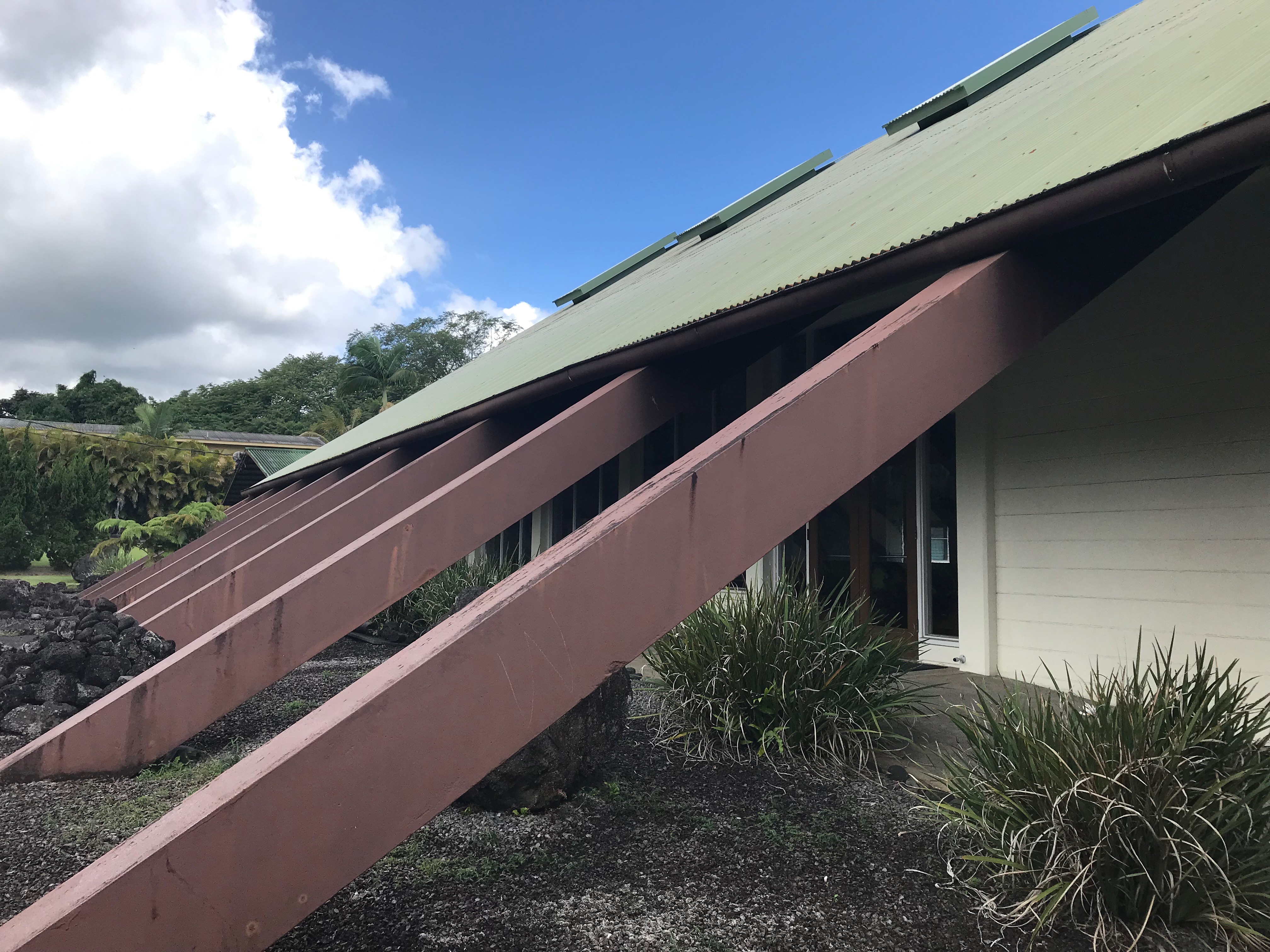
Imagine these beams dancing…

Perhaps the music welled up from the deepest
liquid heart of Earth, a thudding planetary beat.
Perhaps the music rained down from the clouds,
a pitter-patter drumming, flowing sound.

Perhaps the music swelled as oceans kept the time,
perhaps the music eddied with the whirling cyclones,
perhaps the music sailed across the universe
upon the wings of light: to make the churches dance.

A storefront plate glass window was the first
to “step onto the floor,” reflections shifting, mazing,
scribing curves on the straight sides of the decal cross,
swaying side to side and back and forth.

On village greens and at the edge of prairies,
along the streets and in the city centers,
clapboards hummed as steeples bowed,
copper clappers tapping as they circled.

Stained glass sparkled, catching light, returning it
in new directions. Saints and prophets twisted
gracefully, plaster no longer rigid, marble arms
extending, reaching, drawing near, relaxed.

Granite groaned to twist and turn, towers bowing.
Magen David whirled. Crosses leapt. Buddhas bowed.
Tabernacles, altars, tables, all their leggy footwork pounded.
Minarets described a stately pirouette.

In praise of all creation, we could watch.
In praise of holy and celestial music, we could watch.
In praise of all this Goodness, we could watch:
To see the sanctuaries dance.

This poem emerged from work on a UCC Daily Devotional, one about individual people dancing for the joy of God’s love. It placed an image in my head, however, of the Church dancing – or at least of church buildings dancing.

Photo of Church of the Holy Cross UCC in Hilo, Hawai’i, by Eric Anderson.