Story: Peace

September 21, 2025

Jeremiah 8:18-9:1
1 Timothy 2:1-7

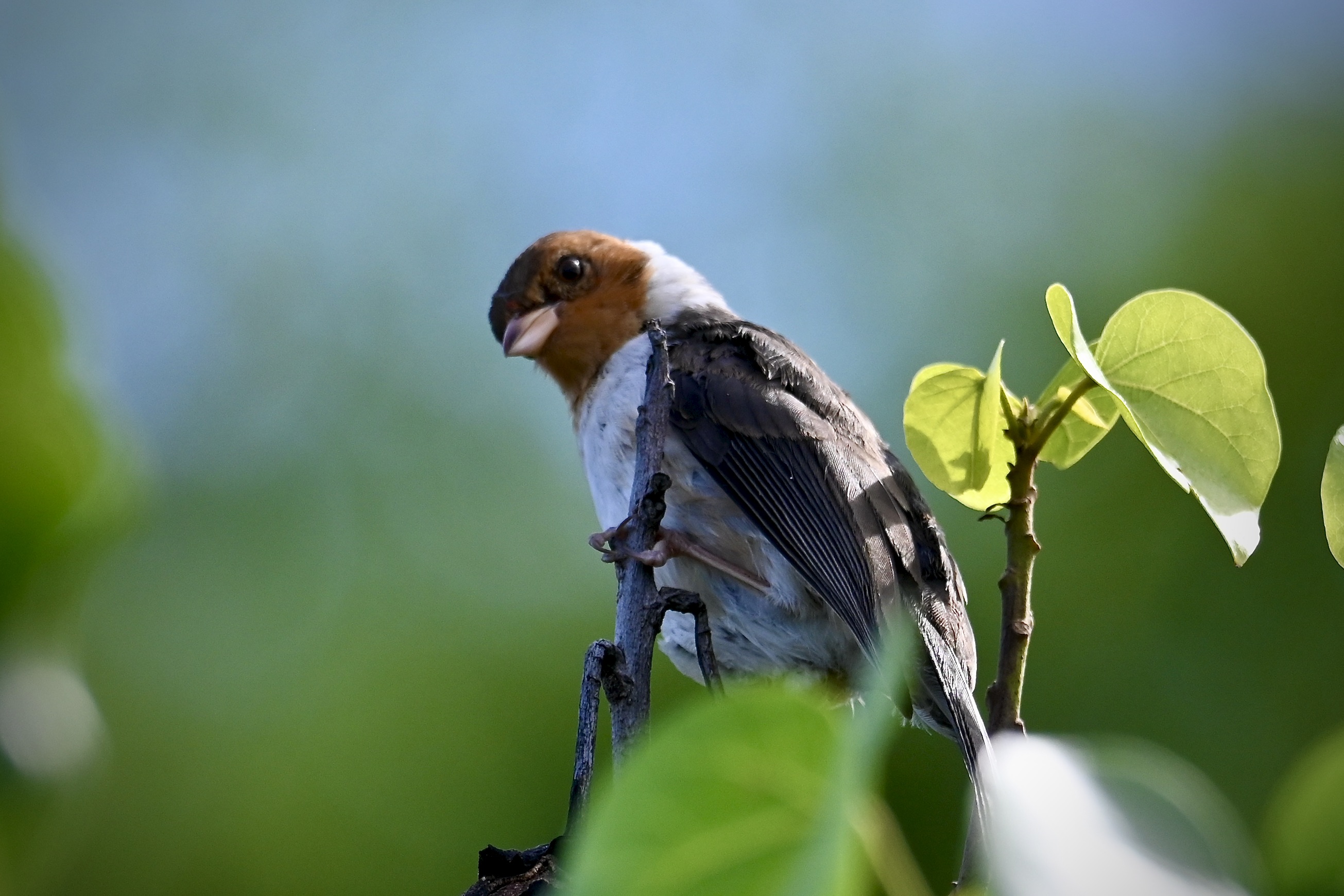
He was a yellow-billed cardinal, and he was young. He was so young, in fact, that the feathers on the top of his head weren’t red; they were brown. He was so young that his bill wasn’t yellow, it was tan.

He was old enough to be living mostly on his own, finding his own food among the seeds and berries, and his own shelter for the night. He was old enough to enjoy a sunrise or a sunset, and he was old enough to enjoy sitting quietly in the sun.

What he wasn’t old enough for was to understand what “peace” was.

That may seem odd, given that sitting quietly and enjoying the sunshine sounds pretty peaceful, but it didn’t always feel that way. For one thing, if he sat in the sunshine for too long, he’d start to feel hungry. Feeling hungry, he thought, wasn’t very peaceful. I guess he had a point there. Being uncomfortable isn’t very peaceful.

Worse than that, though, when he got hungry, he had to find food. He knew how to do that, of course. That wasn’t the problem. The problem was that other birds would show up, and he didn’t like that. Other yellow-billed cardinals were usually OK – he knew a couple of them that tended to tease him – but he really didn’t like it when different kinds of birds turned up. House finches made him nervous. House sparrows were kind of scary. Saffron finches made him feel uneasy about his rather dull coloring.

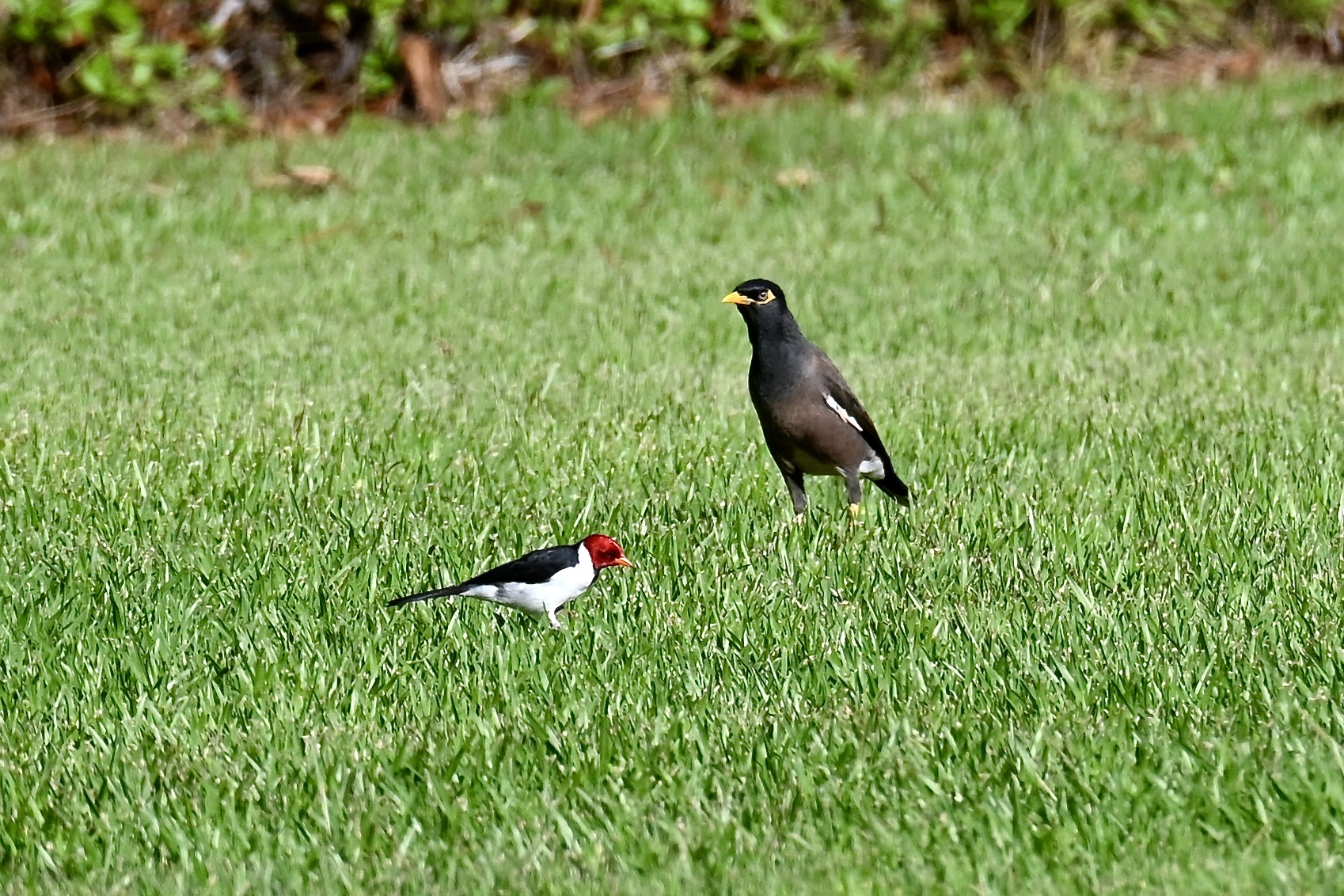
Worst of all, as you might guess, were the mynas. For one thing, they had brighter yellow bills than he did. For another, they were a good deal bigger. And, of course, they were often really loud, really argumentative, and really frightening.

As he got older and his head feathers turned red and his bill turned more yellow, he still didn’t like it when other birds turned up while he was feeding. He didn’t really notice that the finches and sparrows and kolea really paid him no mind. They just got on with looking for bugs and seeds and worms to eat. So when the myna turned up near him while he was eating, he jumped.

“What’s wrong, youngster?” asked the myna. “Is there something wrong?”

“Oh, no, myna sir,” said the yellow-billed cardinal. “Nothing wrong at all.”

“You jumped,” said the myna. “Did something startle you?”

“Well,” said the cardinal, “you did. You caught me by surprise when you landed.”

“Oh, that’s fine,” said the myna, who sounded somewhat relieved. “Sorry about that. You had me worried for a minute there.”

“You worried?” said the yellow-billed cardinal. “Why?”

“Some birds get upset about mynas,” said the myna. “They think we’re loud and obnoxious. They don’t like it when we’re around.”

The yellow-billed cardinal had thought such things, so he thought that now he’d better stay quiet.

“I’m glad you’re not like that,” said the myna. “I could do with a bit of peace today.”

That’s when the yellow-billed cardinal learned what peace could be – a time when creatures who were rather different could live side-by-side, meet their needs, and not fear one another. A yellow-billed cardinal could be safe from the bullying he feared from a bigger bird. A myna could be safe from the rejection and disdain of a smaller bird.

“I could use a bit of peace myself,” said the yellow-billed cardinal. “Let’s enjoy it while we can.”

by Eric Anderson
Watch the Recorded Story

I write these stories in advance, but I tell them from memory, which means things change.

Photos by Eric Anderson.
Story: The Molting ‘Apapane

May 25, 2025

Acts 16:9-15
John 14:23-29

He wasn’t the oldest among his siblings, cousins, and friends from nearby nests, but he was one of the first to molt from his young feathering to his adult colors. He’d had gray feathers on the chest and brown on his head and back, with black on his wings and tail. They all did. It made their games of hide-and-seek pretty difficult, because those colors melded into the shadows on the tree branches pretty well.

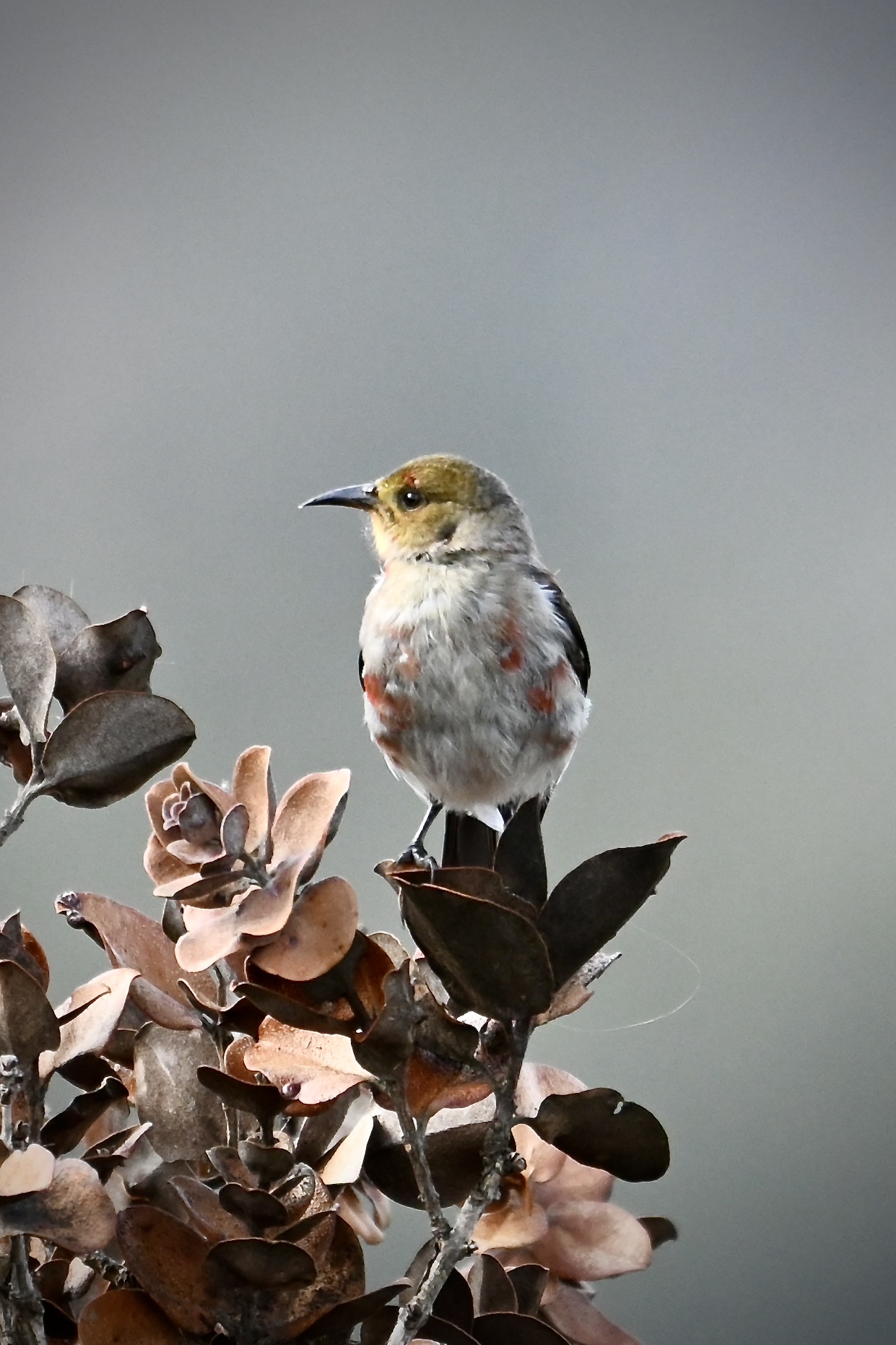
As I say, though, he was the first among them to start losing some of those brown and gray feathers, and start to gain the red feathers from head to tail. Frankly, it wasn’t going well. Loose feathers itched, and so did the new feathers as they grew in. They also didn’t fall out evenly. He found himself with a grayish belly blotched with the new red feathers.

“You look ridiculous,” said one of the young ‘apapane who played hide-and-seek with him, and, well, he felt ridiculous.

“Can’t you hide that?” asked another of the ‘apapane. He was a cousin, but he could be mean, even to a cousin. Our young ‘apapane couldn’t think of how.

“Go clean that up,” ordered one of the bossier young ‘apapane. She was one of those who thought she knew best for everybody else. But he still didn’t know how to take care of it, so he kept his perch and tried not to cry.

“Knock it off,” said the smallest of the young ‘apapane. All her feathers were still brown and gray, and she looked like she’d just been groomed by the finest feather-settlers of the forest. Everybody assumed that she was talking to the young bird with the splotchy red.

“Yeah, knock it off,” said the one who’d started this by calling him ridiculous in the first place.

“No, you knock it off,” said the smallest ‘apapane. “And you. And you. And all of you.”

She shook her wings and continued, “First of all, what can he do about it? You all know that our feathers will change from what we’re wearing to what our parents wear. Did you think that happened overnight? Didn’t you realize that it’s going to take time and that there are rough spots along the way?”

As it happened, none of them had thought about it.

“What are you going to do,” she demanded, “when this happens to you in a week or two? Are you going to make everybody going through this fly away, or are you going to help them when it itches and tell them it will be all right? What would you want for yourself?”

She asked that last question straight at the bird who’d ordered the molting ‘apapane to go clean that up. She didn’t say anything until it became clear that she had to answer.

“I’d want help,” she said.

“How about the rest of you?” demanded the smallest ‘apapane. They all admitted they’d want help.

“And that’s what you’ll get,” she said. “We’ll start with our friend here.”

“So how are you?” she asked. “Does it itch today?”

That’s how that generation of ‘apapane made it through their molt.

by Eric Anderson

Watch the Recorded Story

I write these stories in advance, but I tell them from memory and improvisation. What you have just read will not match the way I told it.

Photo of a juvenile ‘apapane in molt (at least that’s what I think it is) by Eric Anderson.

Story: Dirty Finches

Two saffron finches in the grass.

September 1, 2024

James 1:17-27
Mark 7:1-8, 14-15, 21-23

Saffron finches don’t fly about in larger flocks like mynas, but they certainly do gather in small groups to feed and chirp and, one assumes, share the news of the saffron finch world. One little group was having a problem with not one, but two, of their members.

The first one who bothered them was, well, unwashed. Routinely. A finch is going to get dust and bits of grass and, I suppose, the occasional bug wing on their beak and face, and he did that. They’ll also get dirty feet and, if they’re hopping about on muddy ground, get dirty feathers. He did that, too.

Most saffron finches find ways to wash it off. They’ll clean with beak and toes and let the rain wash them off when they can. On a gray day a saffron finch is a pretty bright sight. But not this guy. Somehow a rain shower left him muddier. If he pushed bug wings off his head he’d get dirt in the feathers.

He was a sight, let me tell you.

The other troublesome bird was clean and bright. He not only got himself clean, somehow he avoided most of the dust and dirt that the other birds had to deal with. And… he let you know it.

“Are you going to clean those feet?” he asked. “There’s a bug wing on your beak,” he said. “Can you believe it? You’ve got a speck of mud on your feathers,” he commented.

He went on and on about the finch with the dirty feathers. “Look at that, he’s a disgrace,” he’d say, and “I’m so glad I’m not like him.”

They say “Sticks and stones may break my bones, but names will never hurt me,” but you know? Words hurt. And nearly every bird in the little flock of saffron finches felt the sting, with our dirty finch feeling it the worst.

What to do?

They got together, the other finches. They talked it over while the dirty finch and the absolutely clean finch were elsewhere. They come up with some possibilities. They made some decisions. They got ready to offer some options.

They called the whole flock together, including our two problem finches, and said, “We’ve got to see some changes here. First,” they said to the dirty finch, “we’re going to give you some help, because clearly you need it. We’ll help you with the preening and the cleaning and make sure you stay both healthy and show off your bright feathers.

The dirty finch, who thought he was going to be kicked out of the flock, chirped a grateful “Mahalo!”

The absolutely clean finch huffed, “I can’t believe you’re going to put up with him and his filth. You’re as bad as he is.”

“What we’re not going to put up with,” said the spokesfinch, “is your bullying any longer. You’ve been hardest on this finch here, but you’ve been at all of us at one time or another. Yes, your feathers are always immaculate, and no, our aren’t always at their best. But your tongue is never at its best, and that needs to change. Now.”

The absolutely clean finch was speechless for a moment (which was a good thing, if you think about it), and then he burst out with a harangue that few have ever heard. I’m afraid he didn’t learn his lesson, and I’m afraid he couldn’t stay with that flock.

When it came down to it, the things that make a finch dirty from the outside are things they could help with. But the things that make a finch dirty from the inside, all the harshness and bullying, those are the things that have to go.

by Eric Anderson

Watch the Recorded Story

I write these stories ahead of time, but I tell them from memory – memory and inspiration. What I’ve written does not match how I tell it.

Photo by Eric Anderson.

Story: Here. Not There.

August 21, 2022

Psalm 71:1-6
Luke 13:10-17

It’s been a while since I told a story about this kind of fish. It’s called a hinalea, a cleaner wrasse – in fact, a Hawaiian cleaner wrasse – and they’re small fish that live along the reefs in somewhat deeper water.

As small fish, you’d expect they’d be hunted by larger fish for breakfast, lunch, and dinner. And they are, in fact, hunted – but not as food. Despite the fact that we’re so much bigger than a mosquito, they still come and land on us and try to eat a little bit of us, right? Similar things happen to fish, and unlike mosquitoes, a lot of these pesky creatures don’t let go. After a while, a fish can have quite a lot of unwelcome passengers, all of them trying to take a nibble on them. It’s not fun.

Cleaner wrasse eat those tiny pesky irritating creatures, gently nibbling them away from the skin and scales of the larger fish. They set up spots along the reef which people call “cleaning stations,” and where the larger fish will gather for a cleaner wrasse or three to remove those little pests. It’s a nice arrangement. The large fish go away greatly relieved, and the hinalea get, well, breakfast, lunch, and dinner.

One particular school of hinalea had one of the busiest cleaning stations on the reef. The school leaders – and I know you want me to call them teachers, but a wrasse school isn’t a school, it’s a business, so the best term for school leaders is bosses – the school leaders had announced that they needed all the hinalea there at the cleaning station. No cleaning fish anywhere else.

They couldn’t clean all the time, of course. Nobody can eat all the time, despite the things you’ll sometimes hear about human teenagers. The cleaner wrasse would take a break for a while, but the only place they were allowed to clean was at the station.

One hinalea was on his break, lazily swimming along the reef and not much worried about anything, when a larger fish came along. It was an ‘uhu, a parrotfish, and it was in terrible shape. It had picked up so many pesky creatures that it was really painful. She was wandering aimlessly along the reef, unable to figure out which way she was going and where she could find a cleaning station. She spotted the lone hinalea with its bright blue and yellow and purple scales, and settled next to him.

She didn’t need to say anything. She needed help. The hinalea went to work. All alone outside the cleaning station and as covered as she was, this would take some time.

Another hinalea, one of the bosses on break, wandered over and stopped, shocked to see what he was doing. “This isn’t the cleaning station!” he said. “Stop that now!”

Our hinalea said nothing – his mouth was full. In fury, the other hinalea swam at him and chased him away from the ‘uhu, chased him all the way back to the cleaning station.

“This fish cleaned away from the cleaning station,” announced the boss. “What shall we do with him?”

The other bosses gathered menacingly. This didn’t look good at all. But just then the ‘uhu appeared and swam to the little wrasse in the center of the angry fish. “Thank you so much,” she said.

She turned to the bosses and said, “Do you know what this little one did? I had so many pests on me that I couldn’t find the cleaning station. He picked off enough of them that I could find you. I can’t tell you what would have happened if he hadn’t. I’m pretty sure you would have lost a customer.”

She looked at the hinalea again and said, “As good a job as you did, you got interrupted. Do you suppose you could finish?” And so he did.

Sometimes bosses in the world are foolish, and sometimes they are wise. This group of hinalea bosses chose wisdom that day. It remained important that everyone concentrate on the cleaning station – a lot of fish waited there – but if a hinalea on break could help get a fish to the station? That was good, and right, and important, too.

by Eric Anderson

Watch the Recorded Story

The story above was told live from memory of this text.

Photo of two hinalea by Dr. Dwayne Meadows, NOAA/NMFS/OPR – http://www.photolib.noaa.gov/htmls/reef0662.htm, Public Domain, https://commons.wikimedia.org/w/index.php?curid=2111807.