Story: One Might Know

May 10, 2026

Acts 17:22-31
John 14:15-21

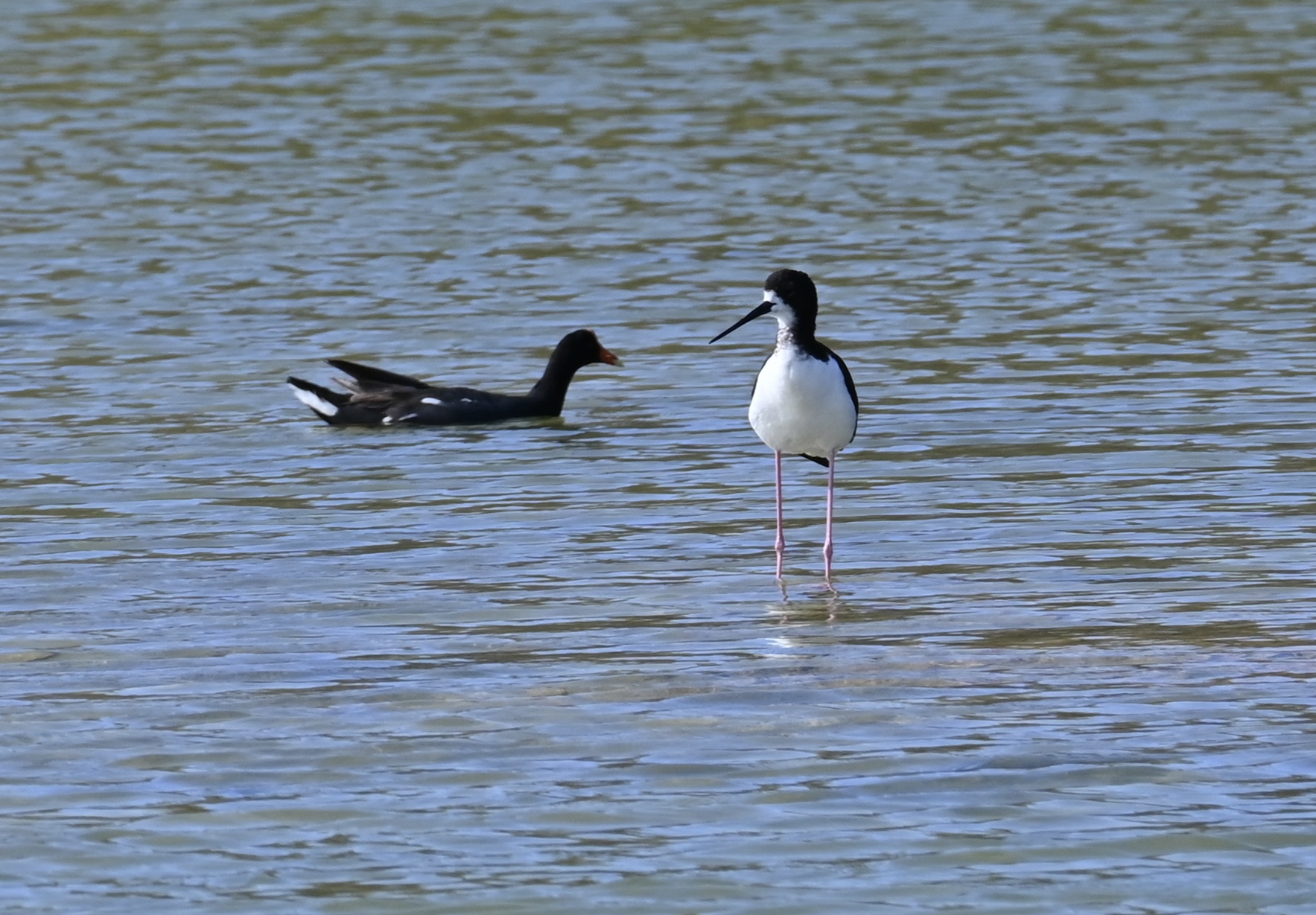
This story didn’t take place on our island, because although one of the birds in it lives on Hawai’i, the other doesn’t. I took this picture on Kauai, though both birds also live on O’ahu.

The one on the left, swimming in the water, with its red beak and red on its forehead, is an ala’e ‘ula, or Hawaiian gallinule. The one on the right, standing on long thin pink legs with white and black feathers and a very long straight black beak, is an ae’o, or Hawaiian black-necked stilt.

Both of them like to search for food in roughly the same kinds of places: relatively still and shallow water, like old fish ponds or coastal marshes. They don’t eat the same food, however. The ala’e ‘ula likes plant roots and seeds and shoots, and enjoys a snail or two. The ae’o mostly looks for fish, but will snap up water insects when it finds one.

Actually, the ala’e ‘ula will eat those insects, too, but neither of them is so fond of a diet of bugs to get very upset about it.

On this day the ae’o was getting somewhat upset, but not about bugs. It was fish. He couldn’t find many. Oh, one or two swam his direction, but where were the rest of them? He was getting hungry, and he was also getting irritated with the world. Being hungry does that to some people, and to some birds as well.

“Where are the fish?” he squawked in frustration.

“You can’t find fish?” asked an ala’e ‘ula a short way away.

“No, I can’t, and is that any of your business?” he said rudely.

“No, I suppose not,” said the ala’e ‘ula, who’d been feeding quite happily on roots and shoots and therefore wasn’t hangry with the world. “Would you like me to tell you if I find some fish?”

“You do what you want to do,” said the ae’o irritably, and as the ala’e ‘ula swam off to another section of the fishpond, grumbled to himself, “It’s not as if you’ll be of any help.”

It wasn’t very long, though, before the ala’e ‘ula swam back toward the hungry, grumpy ae’o. “Say, friend,” he said. “Take a look over there. There’s a good sized school of fish milling around eating flies.”

“How would you know?” demanded the ae’o, who couldn’t make out the flies on the water from where he stood.

The ala’e ‘ula shrugged. “One might know if one looks under water,” he said. “I was pulling up a root and there they were, all around. When I got my head out of the water I saw the flies swimming on the surface.

“I suppose you could make a meal of the flies if you have to,” he said thoughtfully, “but I imagine you like the fish better.”

“One might know,” muttered the ae’o as he stepped over to where the ala’e ‘ula had been, “but one probably doesn’t. More fool I.”

Then he saw the milling flies, and he saw the ripples where the fish had risen to the surface. He saw the water swirl as they swam beneath. In a moment he was there, and dipping his beak, and catching his fish, and feeling better than he had all day.

“I guess one might know at that,” he said when the ala’e ‘ula found him again shortly after.

“One might know,” said the ala’e ‘ula.

“Even better,” said the ae’o, “one might share what one knows. And the world gets a little bit better than it was.”

by Eric Anderson

Watch the Recorded Story

I write these stories in full ahead of time, but I tell them in worship from memory and improvisation. The story as written and the story as told are not identical.

Photo of an ala’e ‘ula (Hawaiian gallinule) and an ae’o (Hawaiian black-necked stilt) by Eric Anderson.
Story: The Wisdom of Flight

January 4, 2026

Jeremiah 31:7-14
John 1:1-18

“What is wisdom?” wondered the ‘amakihi as he flew through the sky.

“What is wisdom?” wondered the ‘amakihi as he sipped on ohi’a nectar.

“What is wisdom?” wondered the ‘amakihi as he settled down to sleep at night.

“What is wisdom?” wondered the ‘amakihi as he woke in the morning.

“What is wisdom?” is, in fact, an extremely good question whether you’re an ‘amakihi or a human being. Wisdom, after all, tends to prevent a lot of foolishness. Foolishness, on the other hand, tends to happen in the absence of wisdom.

“What is wisdom?” wandered the ‘amakihi over the course of the day.

One of the features of wisdom is that when someone who is wise doesn’t know or doesn’t understand something, they do things to learn more about it. They look around at things. They measure and they think about what they’ve measured. If they’re human, they might read something, or a lot of somethings. They ask others to see what they know.

Whether you’re a human or an ‘amakihi, a good one to ask would be tutu.

“Tutu,” asked the ‘amakihi, “what is wisdom?”

Tutu was pleased. It was a wise question – if you don’t know something, wisdom says, “Ask.” He’d made a wise choice about who to ask – grandparents often know things. And he was asking about something important, wisdom itself.

She replied with a question of her own: “What is knowledge, grandson?”

“Knowledge?” he asked. “I hadn’t thought much about that… it seemed kind of obvious. If I know something that’s true, that’s been demonstrated to me, that’s knowledge. If I think I know something that isn’t true, or if I simply don’t know something, that’s not knowledge. Is that right?”

“That’s right,” said Tutu. “Now let me ask something else.”

“Are you going to answer my question?” asked her grandson, who was starting to worry that if he answered all her questions she wouldn’t get around to answering his.

“I am,” she said. “Now here’s my question: Can you fly with your wings closed?”

He opened his beak to reply, then stopped. It doesn’t make much sense, but he realized that sometimes while flying, he would close his wings. Not for long. Not all the time, obviously. But for a few moments in many flights, he would be flying with his wings closed.

“Yes,” he said carefully. “For a moment or two.”

“How do you know whether to close your wings in flight?”

“It’s complicated,” he said. “How high up am I? How much do I need to rest my wings for a moment? Will I need to make a quick turn or slow down to land? There isn’t a simple answer.”

“That’s right, there isn’t,” she told him. “Knowing that you can fold your wings in flight is knowledge. You know it’s something you can do. Choosing the right moment to do it – or the right moment not to do it – that’s wisdom.

“Wisdom is when you consider what you don’t know for certain, what might happen, or what might not happen if you do something, and then make a good choice. Wisdom looks at what you know, and asks whether you should.

“That, grandson, is wisdom.”

by Eric Anderson

Watch the Recorded Story

I write these stories in advance, but I tell them from memory and inspiration on Sunday mornings. What you have just read does not precisely match how I told it.

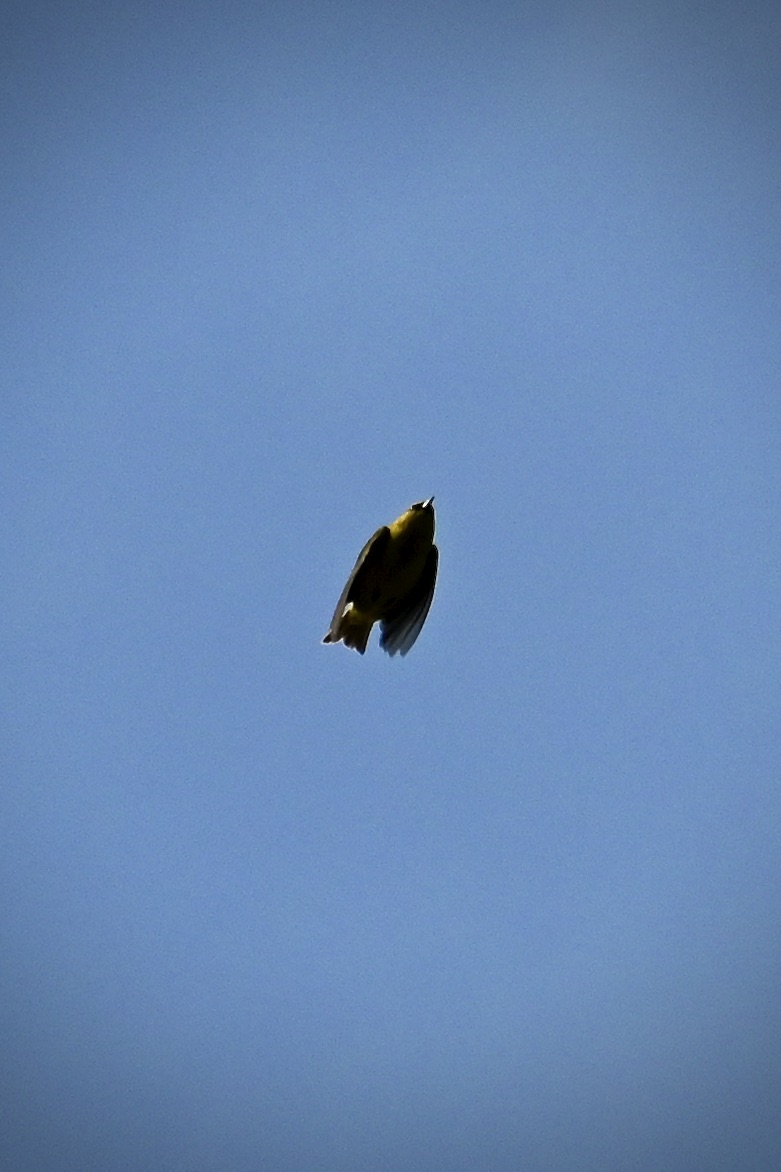
Photo of an ‘amakihi in flight by Eric Anderson.

Story: Important Things

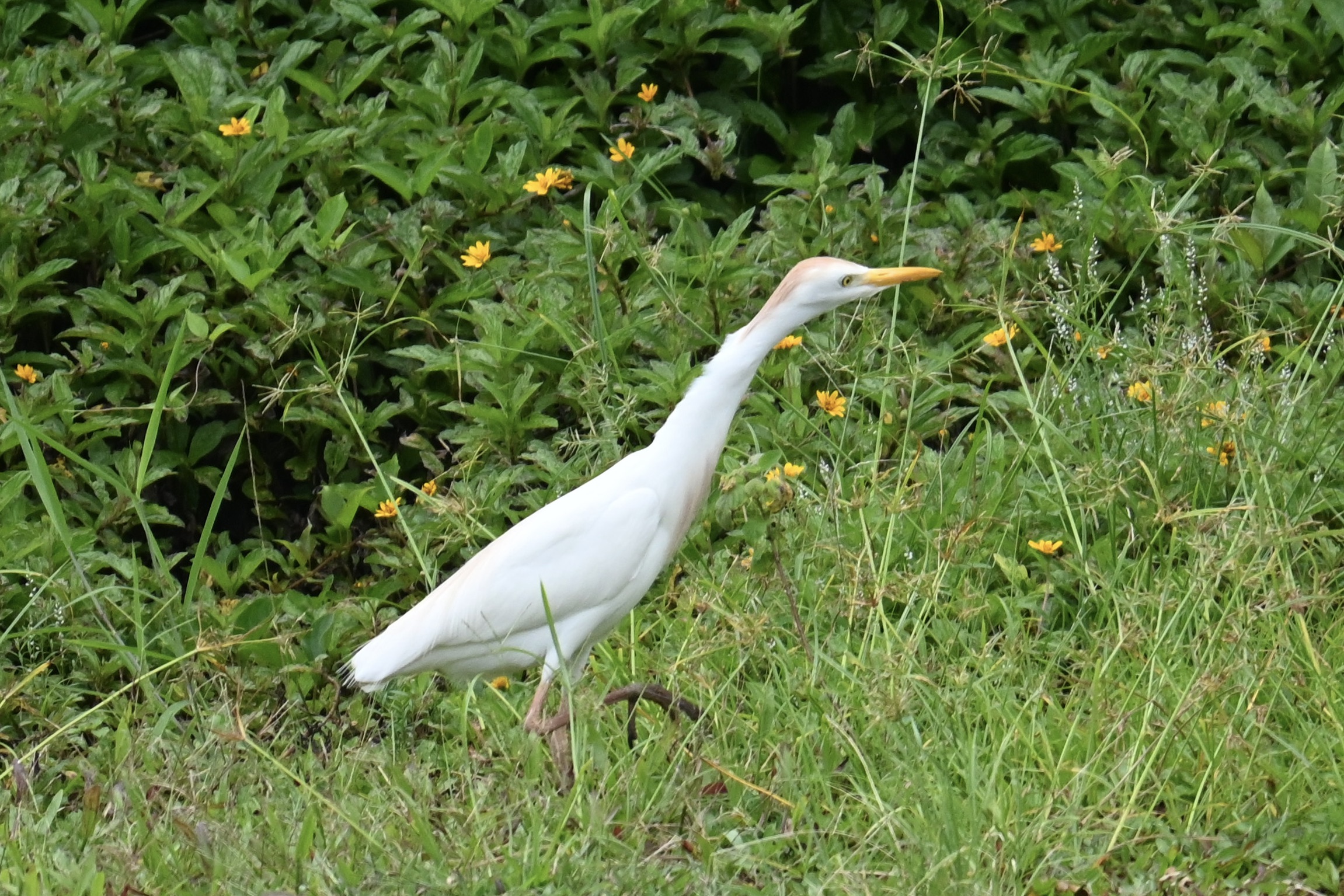
A cattle egret in tall grass.

December 8, 2024


Philippians 1:3-11

Luke 3:1-6

The cattle egret is a relatively quiet bird. Most of the time it goes about its business of hunting insects and such without talking about it. When a cattle egret has something to say, it will say it. But if it doesn’t have something to say, it doesn’t say anything.

Unlike a lot of people you’ve met, I’m sure.

There was another bird who really wanted a cattle egret to say something. I don’t know why a saffron finch decided that he wanted wisdom from a cattle egret, but he did. Maybe it was their relative sizes (rather small to quite impressively tall). Not that size reliably indicates wisdom. Maybe it was the bright white feathers, but color doesn’t tell you much about wisdom, either. Maybe it was the silence.

Not saying anything until you have something to say could be a good sign of wisdom.

At any rate, it’s wiser than saying something when you don’t have anything to say.

The saffron finch landed on the ground near a cattle egret and the two of them fed side-by-side without speaking for a while. The cattle egret ate bugs. The saffron finch ate one or two spiders and a good amount of seeds. Neither of them chose to speak with their mouths full.

When he was feeling pretty satisfied, the saffron finch asked, “What’s the most important thing?”

The cattle egret looked around to see if there were any other birds the finch might have been talking to. She didn’t see any, but she also didn’t think that this was a question a complete stranger was likely to ask her, so she didn’t say anything.

“No, really,” said the saffron finch. “What the most important thing?”

The cattle egret looked carefully at the saffron finch. He was clearly asking her, though she didn’t know why. She took a couple more mouthfuls of insects to give her time to consider the question. Then she cleared her throat and said:

“Love.”

She looked around and didn’t see any more bugs, so she nodded to the saffron finch and took off to find another spot with more bugs. When she got there, she was surprised to find the saffron finch landing beside her.

“Could you say that again?” he asked.

“Love,” she said, and went on eating.

“Really?” he asked.

“Love,” she repeated for the third time.

“I’m not sure I know how to love,” he said sadly.

The cattle egret paused her hunting for a moment and looked carefully at the saffron finch.

“Ask,” she said.

“Really?” he said.

“Ask,” she said.

I’m still not sure I’d go first to a cattle egret for wisdom – which is mostly my problem for not understanding what a cattle egret might say – but I have to agree with this cattle egret. What’s the most important thing? Love.

And if you’re not sure how to love: Ask.

by Eric Anderson

Watch the Recorded Story

I write these stories in advance, but I tell them from a combination of memory and improvisation, so it won’t sound exactly like you’ve just read.

Photo by Eric Anderson.