“Jesus said, ‘Take away the stone.’ Martha, the sister of the dead man, said to him, ‘Lord, already there is a stench because he has been dead four days.'” – John 11:39
The first stones were the threats, the stones they reached for when you said, “The Father and I are one.” They called it blasphemy, and well, it would be if it weren’t true.
Given the risk of stones, which thrown, break bones, returning to Judea to heal your friend whose illness was not to the death would make no sense, at least if true.
But Lazarus was dead and in the grave when you decided to return. Dear Thomas pledged to join you in your death if stones were cast. I’m sure he thought he told the truth.
They came to you to weep. They came to tell you just how much they trusted you. “If you had been here, Lazarus would not have died.” Your tears proclaimed your love for Lazarus in truth.
“Remove the stone,” you called, despite the stink. “Remove the stone,” you called, though they recoiled. “Remove the stone,” you called, and Lazarus emerged. “Unbind him now,” you called: he lived in truth.
The stones they feared remained upon the ground. No stones would break your bones, though one would seal your tomb like Lazarus’. You there, as here, proclaimed “I am the resurrection and the life” in truth.
A poem/prayer based on John 11:1-45, the Revised Common Lectionary Gospel Reading for Year A, Fifth Sunday in Lent.
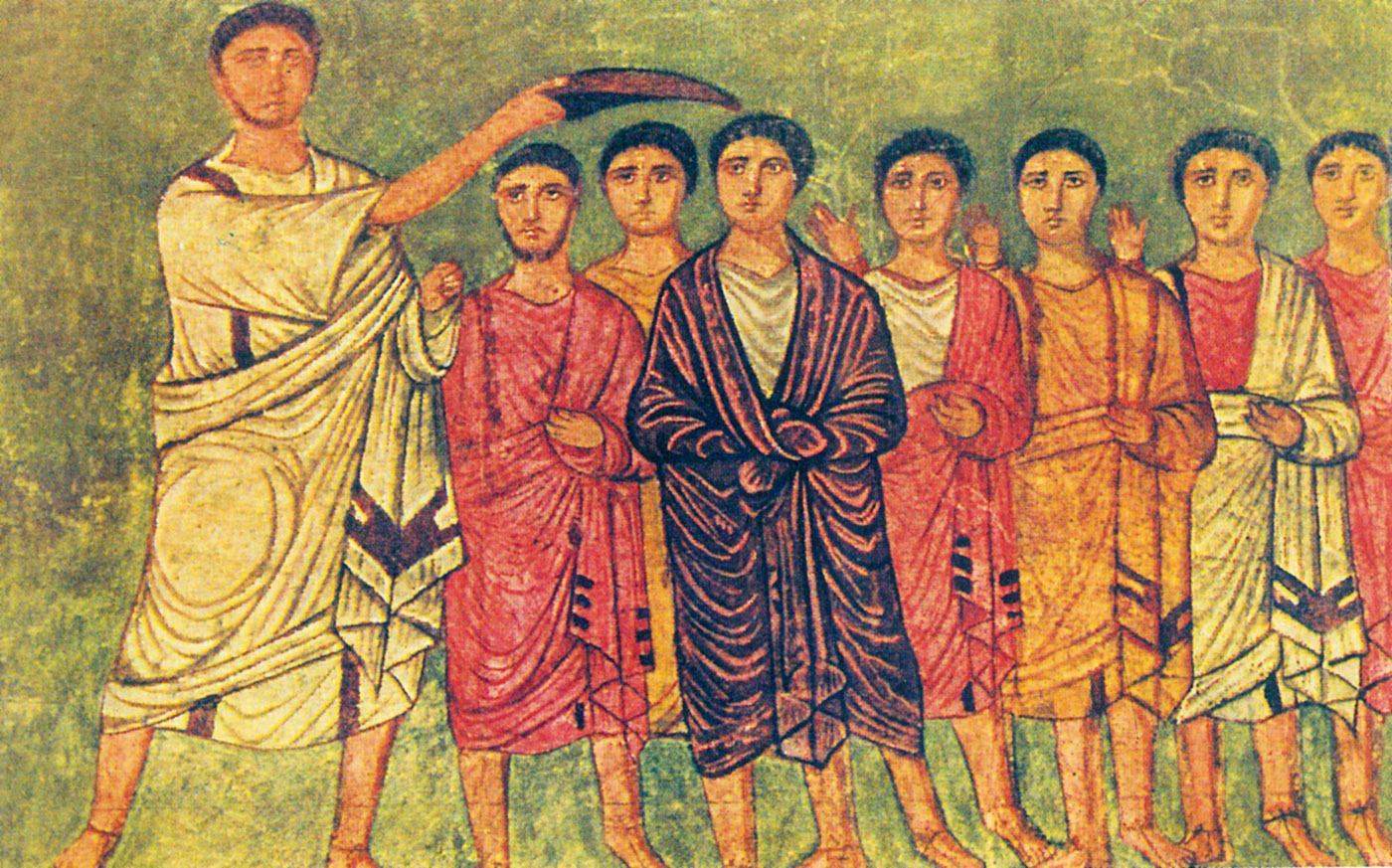
“Jesse made seven of his sons pass before Samuel, and Samuel said to Jesse, ‘The LORD has not chosen any of these.'” – 1 Samuel 16:10
Eliab, no. Abinadab: rejected, too. Perhaps Shammah? Well, no. Not he. Four more paraded past their father and the prophet and of those seven sons you chose, O God,
Not one.
I wonder if they knew. I wonder if they guessed, since all seemed to have heard that king and prophet were at odds. Were they at all concerned that You, O God, sought to incite rebellion?
Maybe one?
You told the prophet you peer in the heart, where humans cannot comprehend (my own heart is a mystery). Full seven times you looked, and saw, and told the prophet, “No.
“Not this one.”
What did you see in David, God, for he committed sins that Saul had never dreamed. A hasty spear that missed is terrible. Conspiracy to cover up a rape is so much worse, as David did.
This one.
They fade away from this account: Eliab and Abinadab, Shammah as well. Four brothers’ names have fallen from the tale. I wonder, though, how many breathed a soul-relieving sigh that they were not anointed by the sage, that they were not
The one.
A poem/prayer based on 1 Samuel 16:1-13, the Revised Common Lectionary Gospel Reading for Year A, Fourth Sunday in Lent.
“For this reason the promise depends on faith, in order that it may rest on grace, so that it may be guaranteed to all his descendants, not only to the adherents of the law but also to those who share the faith of Abraham (who is the father of all of us, as it is written, ‘I have made you the father of many nations’), in the presence of the God in whom he believed, who gives life to the dead and calls into existence the things that do not exist.” – Romans 4:16-17
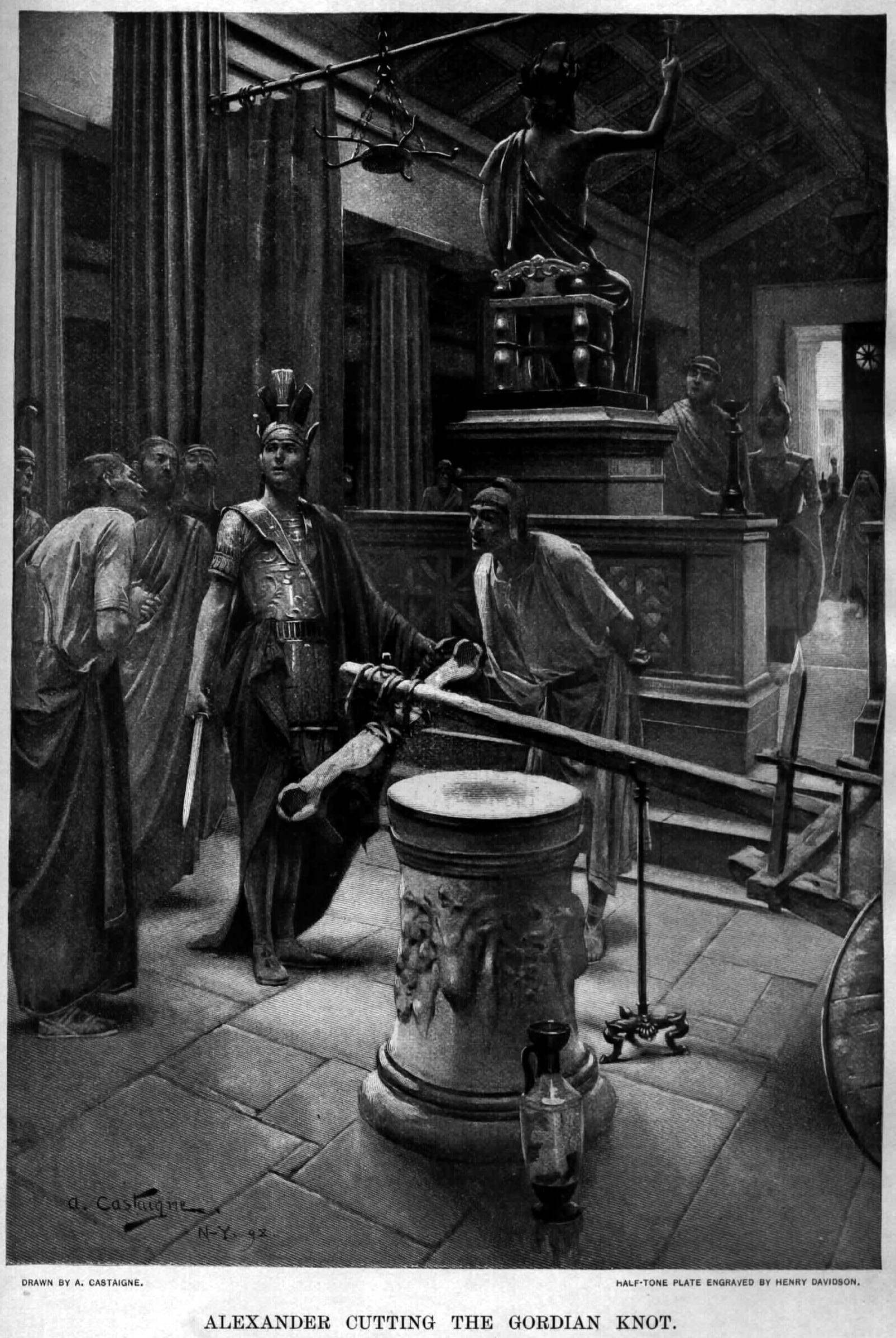
An ox-cart won for Gordias the crown of Phrygia, so they say, and Midas tied the cart’s yoke with a knot so intricate removing it would win a continent.
Great Alexander, so they say, could not untie the knot. Perhaps he pulled the pin. Perhaps he sliced it open with his sword. His death released the Asian lands he’d won.
Three centuries and some, along came Paul with no ambition toward war and rule, but faced with as intractable a knot as Midas ever tied to hold a cart.
The knot held some, he thought, in servitude, in hopeless effort to be righteous when “not one is righteous, no, not one… they all have turned aside from kindness, every one.”
The knot barred others from the knowledge of their failure to do good (though honestly they should have known through what Creation tells of God’s eternal justice, wrath, and power).
How to release this knot? How meld these two communities into a house of faith? How reconcile circumcised with those uncircumcised, with mutual distrust?
How else? He tied a knot of elegant and pirouetting thought, a logical connection that would bind the Church in one, close fastened, one and all, to Jesus Christ.
What loving, faithful pains he took to show we travel in one boat, we worship just one God, we are one Church, wherever we began our faith’s life’s journey, Jew or Greek.
I wonder, though, if tying up new knots is all that useful when the animal needs water, and the lead is all too short, when dinner waits beyond the leash’s length.
I wonder if the Messianic fingers had already loosed the knot dividing us, and if, with all this elegance of thought, poor Paul re-tied it hopelessly again.
Some months ago upon a mountain trail I came upon a fence and gate, which served to give endangered plants a chance to grow, not be consumed by wandering ungulants.
The gate was closed by string, and at first glance I thought it held by a close-fastened knot, and reached toward it, fingernails prepared to pull and loosen its constricted coils.
But then I looked again. The knot did not secure the gate. It closed a loop, which I quite easily unwrapped and wrapped again, continuing along the mountain trail.
Dear Paul: Is that what you have tried to do? Is this a loop we can unwrap to make our way along the Way? Is grace beyond accessible to us despite the knot?
A poem/prayer based on Romans 4:1-5, 13-17, the Revised Common Lectionary Second Reading for Year A, Second Sunday in Lent.
“Then the devil left [Jesus], and suddenly angels came and waited on him.” – Matthew 4:11
He challenged you, Jesus. Summon the angels! They won’t let you fall. You won’t have a bruise on your heel, Nor a strike from a snake.
You said no. No to bread. No to flight. No to glory (that fails to transcend all the kingdoms of earth).
Then he left. And who came? Yes, the angels. The angels. They were hovering ’round, And they brought you relief.
Well, Jesus, I’m tempted. So tempted, you know, so hungry and weary, confused and distressed.
Where are the angels? Will they tend my bruises? Will they feed my hungers? Where are the angels, Jesus the Christ?
“There are angels hov’ring ’round.”
A poem/prayer based on Matthew 4:1-11, the Revised Common Lectionary Gospel Reading for Year A, First Sunday in Lent.
The image is Weite Gebirgslandschaft mit der Versuchung Christi (Vast Mountain Landscape with the Temptation of Christ) by Jan Brueghel the Elder – dorotheum.com heruntergeladen am 30. September 2012, Public Domain, https://commons.wikimedia.org/w/index.php?curid=21801997.
“Six days later, Jesus took with him Peter and James and his brother John and led them up a high mountain, by themselves. And he was transfigured before them, and his face shone like the sun, and his clothes became bright as light.” – Matthew 17:1-2
Bright with light, walking with the prophets, hailed by holy voice that stunned the clouds and silenced even Simon Peter: Jesus the Beloved Son of God.
Transfigured on the mountaintop.
At mountain’s foot, however, trouble lay, because a demon would not be rebuked by any of the nine disciples there. “Where can I find the mustard seed of faith?” they asked.
I grant you they had missed the mountaintop.
But Peter, James, and John, who’d seen the sight, had heard the voice, been silenced clean: how had they been transfigured? Were they changed? Did they bring nourishment to their own mustard seeds?
For they had known the mountaintop.
Yet Peter asked if there were limits on forgiveness. He wondered what he’d gain from following his Lord. While James and John coopted their own mother to secure a place of power.
Though they had been upon the mountaintop.
When Jesus brought the three apart again, this time into a corner of Gethsemane, their bodies ruled their spirits, and they slept, while Jesus wept the bitter tears of grief and fear.
Had they forgotten about the mountaintop?
Approaching soldiers woke them. Weariness no longer slowed them. As blood streamed from a stricken servant’s ear, the three who’d seen and heard the most took to their heels and fled.
Had they been changed upon the mountaintop?
One found his courage and his way back to the courtyard of the trial, but did not bring his name. Three times they asked, three times he cried, “I do not know the man!”
He’d known him on the mountaintop.
So Jesus, here I stand, at best an image in a mirror darkly of those first disciples. I am not the person I would like to be, say nothing of the follower whom you expect.
And I was never on that mountaintop.
Yet truly, you have summoned me by less dramatic means than brilliant clouds and stunning voices on the wind, to be your follower, your servant, and your friend.
But have I been transfigured by the mountaintop?
A poem/prayer based on Matthew 17:1-9, the Revised Common Lectionary Gospel Reading for Year A, Transfiguration Sunday.
You are the light of the world. A city built on a hill cannot be hid.
“[Jesus said,] ‘People do not light a lamp put it under the bushel basket; rather they put it on the lampstand, and it gives light to all in the house. In the same way, let your light shine before others, so that they may see your good works and give glory to your Father in heaven.'” Matthew 5:15-16
You sure do build on Scripture, Jesus. God told Abraham that he and Sarah would become a blessing to the nations of the world, to all the families of Earth.
A pity that he promptly lied and said his wife was not his wife, and gave her up to Pharaoh for a concubine, which cursed the land, afflicted every family.
Isaiah comforted survivors of a great destruction after years had passed, declaring that the people, soon renewed, would shine a beacon to the aching world.
A pity that so many kept the ways that frustrated the prophets years before, preferring their own wealth and potency and damming justice’ waters lest they flow.
Well, Jesus, to fulfill the broken Law and bring to life the prophets’ promised call will call for more than human frailty, unseasoned salt, or lamp without a flame.
Can we fulfill what you came to fulfill? Can we preserve and season all the Earth? Can we be candles brilliant in the dark? Can we be great in Heaven’s realm of life?
A poem/prayer based on Matthew 5:13-20, the Revised Common Lectionary Gospel Reading for Year A, Fifth Sunday after the Epiphany.
The image is “The Candle,” an etching by Jan Luyken illustrating Matthew 5:15 in the Bowyer Bible, Bolton, England (1795). Bowyer Bible photos contributed to Wikimedia Commons by Phillip Medhurst – Photo by Harry Kossuth, FAL, https://commons.wikimedia.org/w/index.php?curid=7550068.
“And he began to speak and taught them, saying: ‘Blessed are the poor in spirit, for theirs is the kingdom of heaven.'” – Matthew 5:2-3
By God, you’ve got it so wrong, Jesus. Do you really not know? That’s not how it works.
The poor in spirit won’t receive the kingdom of heaven. The poor in spirit are poor by their own negligence. They could be rich, you know, if they made the right choice, invested in the things that bring them gain, ignored the claims of other obligations, engaged in fraud, then they’d be rich…
In spirit. Right. Of course. In spirit.
The ones who mourn, will they be comforted? There’s a whole industry to comfort them. They’ll pay for it, of course, because who wants to write insurance for a mental health distress? If they were rich, they’d comfort themselves…
In spirit. Right. Of course. In spirit.
The meek? Don’t make me laugh. The earth belongs to those who take and seize and hold it firm. The meek are those who follow orders barked by armed and masked anonymous authorities. The meek are not entitled to the earth…
In spirit. Right. Of course. In spirit.
Now how can you assert that anyone is hungering for righteousness? We have the law (that serves me well) and isn’t that enough? And if we bend it some to punish those we’ve in advance condemned, we will not satisfy this thirst of sentimental saps…
In spirit. Right. Of course. In spirit.
I see the people who cry, “Mercy!” stand between the human vultures and their prey, and hear them ask the victims if they are OK, and tell the wolves, “That’s fine, dude. I’m not mad at you,” and they receive the mercy I expect…
In spirit. Right. Of course. In spirit.
As for the pure in heart, they can be pure as pure they wish to be. But if they live where I don’t want them to, and if they live on land I want, well. They’ll just have to move. If they resist, they will see God for sure…
In spirit. Right. Of course. In spirit.
Now if I claim to be a peacemaker and threaten nations with invasion after blowing boats to kingdom come and killing their survivors, you’ll give to me the prize of Child of God? That’s right…
In spirit. Right. Of course. In spirit.
Once more I tell you, Jesus, not one soul is persecuted for their righteousness. They suffer for their crimes, the crimes that I decide, the story that I tell, and I alone. Not heaven theirs, but hell, and hell on earth…
In spirit. Right. Of course. In spirit.
And tell me, Jesus, who you think has been oppressed or injured for their loyalty to you? We pepper spray the ministers who resist us, not for their faith in you. Do you maintain that they are marching in the streets on your behalf?
In spirit. Right. Of course. In spirit.
By God, you’ve got it so wrong, Jesus. Do you really not know? That’s not how it works.
And Jesus wept.
A poem/prayer based on Matthew 5:1-12, the Revised Common Lectionary Gospel Reading for Year A, Fourth Sunday after the Epiphany.
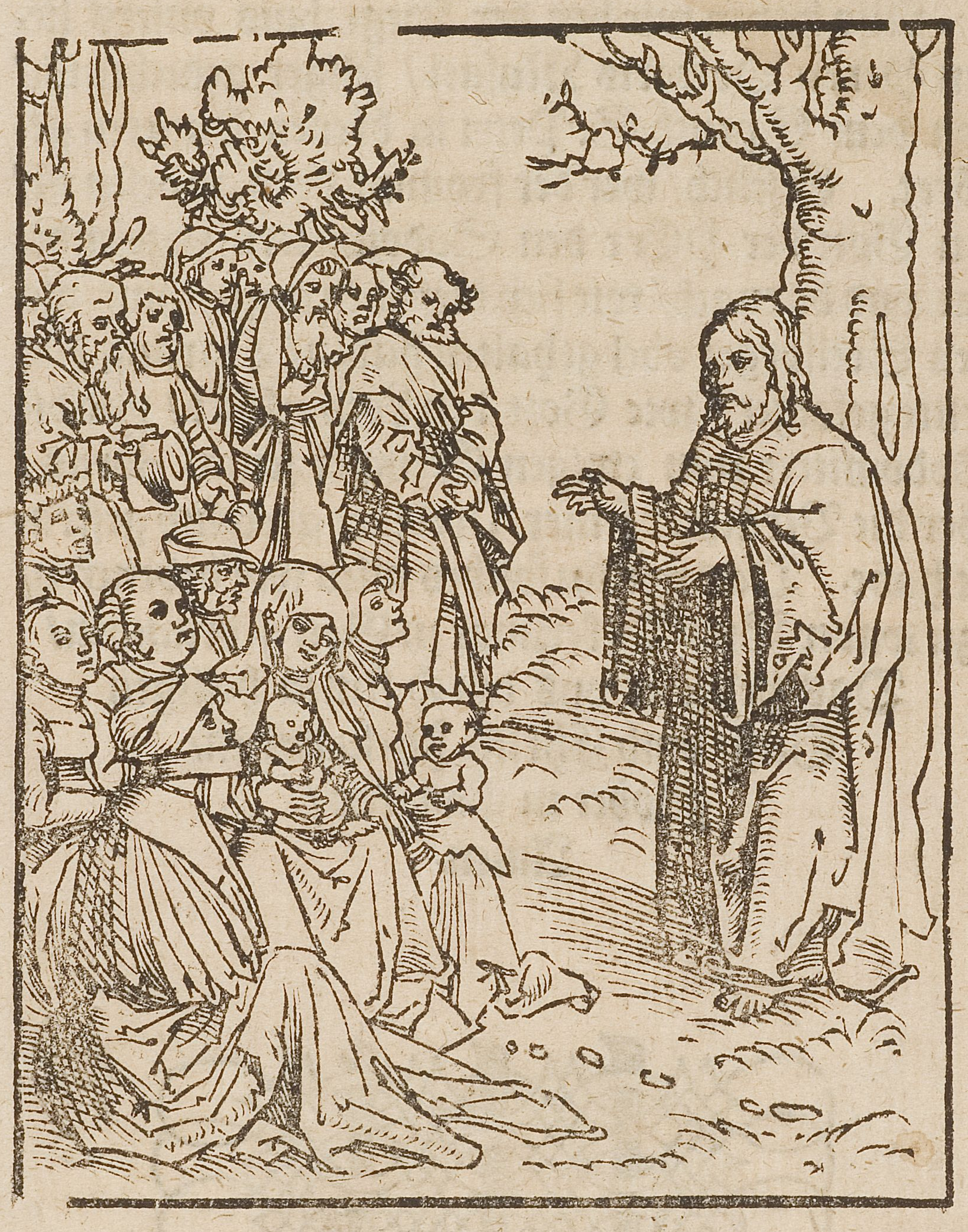
The image is “The Sermon on the Mount,” woodcut by Lucas Cranach the Elder, from his Passion Christ und Antichrist, Herzog Anton Ulrich-Museum, Braunschweig (1582) – Digitised image, Rheinisches Bildarchiv, Köln, Public Domain, https://commons.wikimedia.org/w/index.php?curid=50665418.
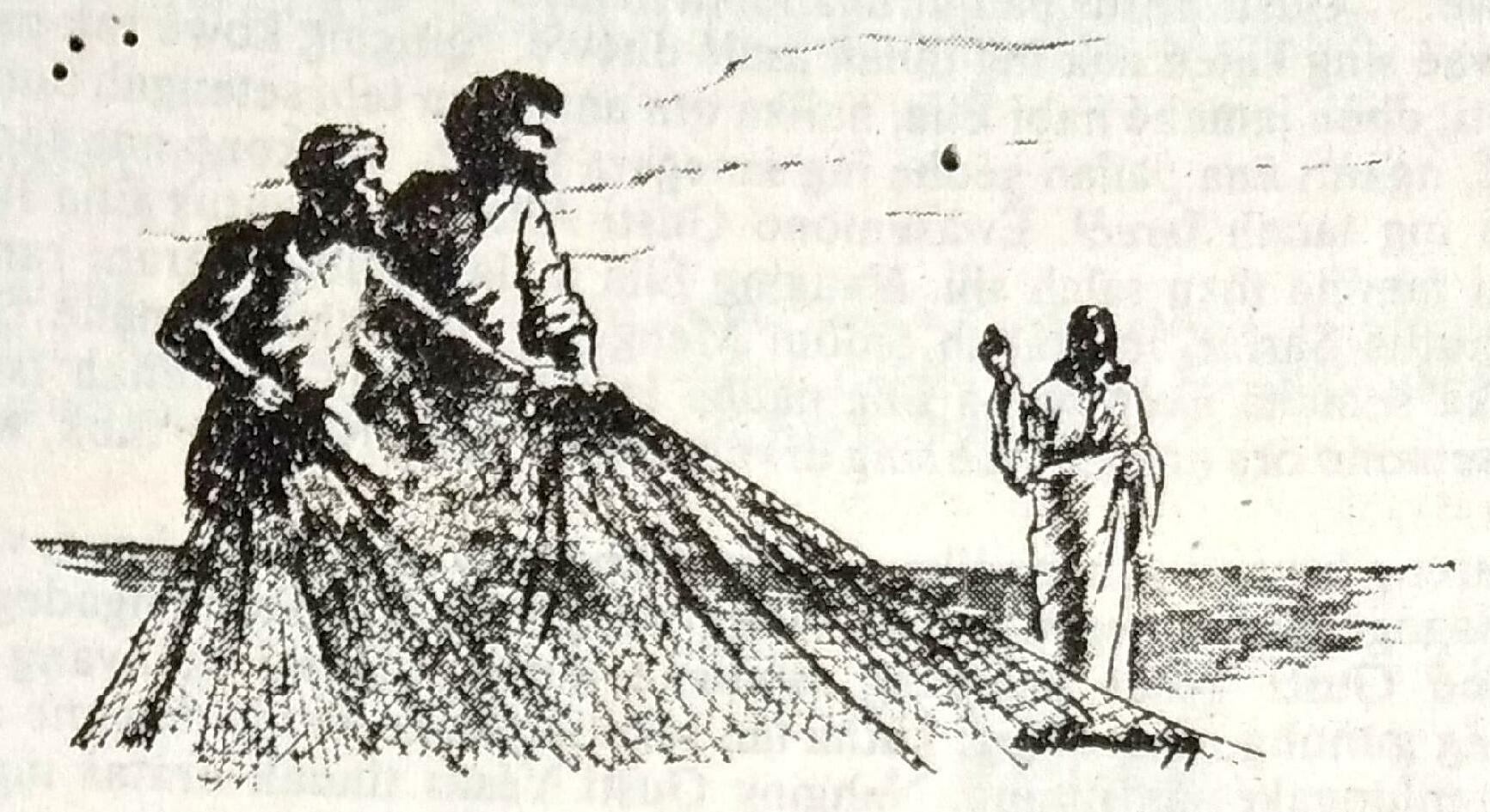
“As he walked by the Sea of Galilee, he saw two brothers, Simon, who is called Peter, and Andrew his brother, casting a net into the sea for they were fishers. And he said to them, ‘Follow me, and I will make you fishers of people.'” – Matthew 4:18-19
Matthew left it out, of course. What did you tell them, Jesus?
“Hey, guys, I’m sort of on the run since they took John, although they probably don’t know my name, so that’s all right, you think? Come follow me.
“Now mind you, folks will hear my name, and quickly, too, if I am any judge. They’ll come even from Syria to seek some healing for their bodies and their souls. Come follow me.
“I’m sure no one will think to look for me atop a mountain peak – unless they follow those who follow me, and frankly guys, I hope to leave a wide and beaten track. Come follow me.
“Now come along. We’ve work to do that doesn’t need a net. No, we’re as likely to be caught in Roman or Herodian nets as John. They’ll lift us high – but not as high as God will raise us all. Come follow me.”
A poem/prayer based on Matthew 4:12-23, the Revised Common Lectionary Gospel Reading for Year A, Third Sunday after the Epiphany.
“When Jesus turned and saw them following, he said to them, ‘What are you looking for?'” – John 1:38
Well, Teacher, I’ve been following you for forty-five years and more, and yet: I don’t think I can tell you what I’m looking for.
It’s such an awkward question.
Like Andrew and his long-forgotten friend (what happened to him, anyway?), if you asked me I’d say something inane.
“Where are you staying, Teacher?”
You know, I know, they knew that wasn’t why they took those steps from John the Baptist’s side to yours.
But how were they to answer what they didn’t know?
And I, with decades as a follower, with decades as a teacher of your flock, with years of writing poem prayers to you,
I still don’t know.
What am I looking for in you? A place of honor, a big frog in what seems like a shrinking pond?
That would be silly, wouldn’t it?
Might I be looking for some meaning in a world that seems to shed its sense and sense of morals, too?
Can you make sense of what’s nonsensical?
Could I be looking for a safe embrace, for arms extended wide, to hold me fiercely, gently, for all time?
I could. I could indeed.
But most of all, dear Teacher, I suspect I’m looking for the One who’ll listen to my babbled nonsense answer, and
Reply with, “Come and see.”
A poem/prayer based on John 1:29-42, the Revised Common Lectionary Gospel Reading for Year A, Second Sunday after the Epiphany.
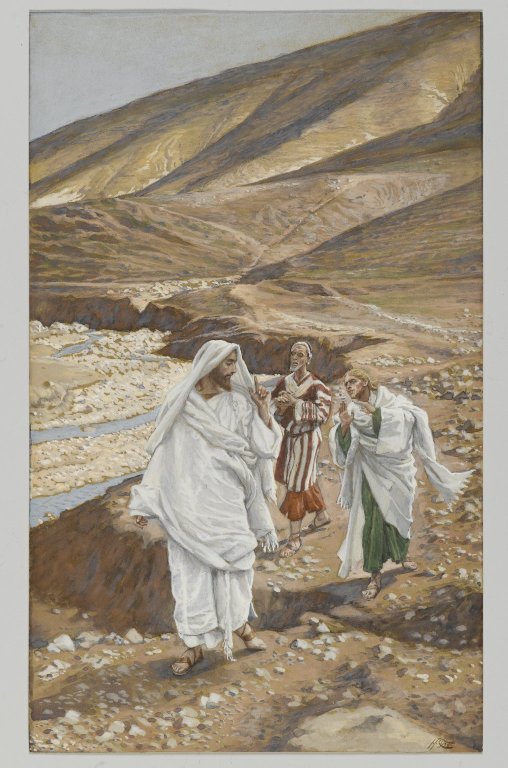
The image is Vocation de Saint Jean et de Saint André (The Calling of Saint John and Saint Andrew) by James Tissot (between 1886 and 1894) – Online Collection of Brooklyn Museum; Photo: Brooklyn Museum, 2008, 00.159.55_PS2.jpg, Public Domain, https://commons.wikimedia.org/w/index.php?curid=10195829.




 ordainedgeek