Discerning a Lenten Discipline

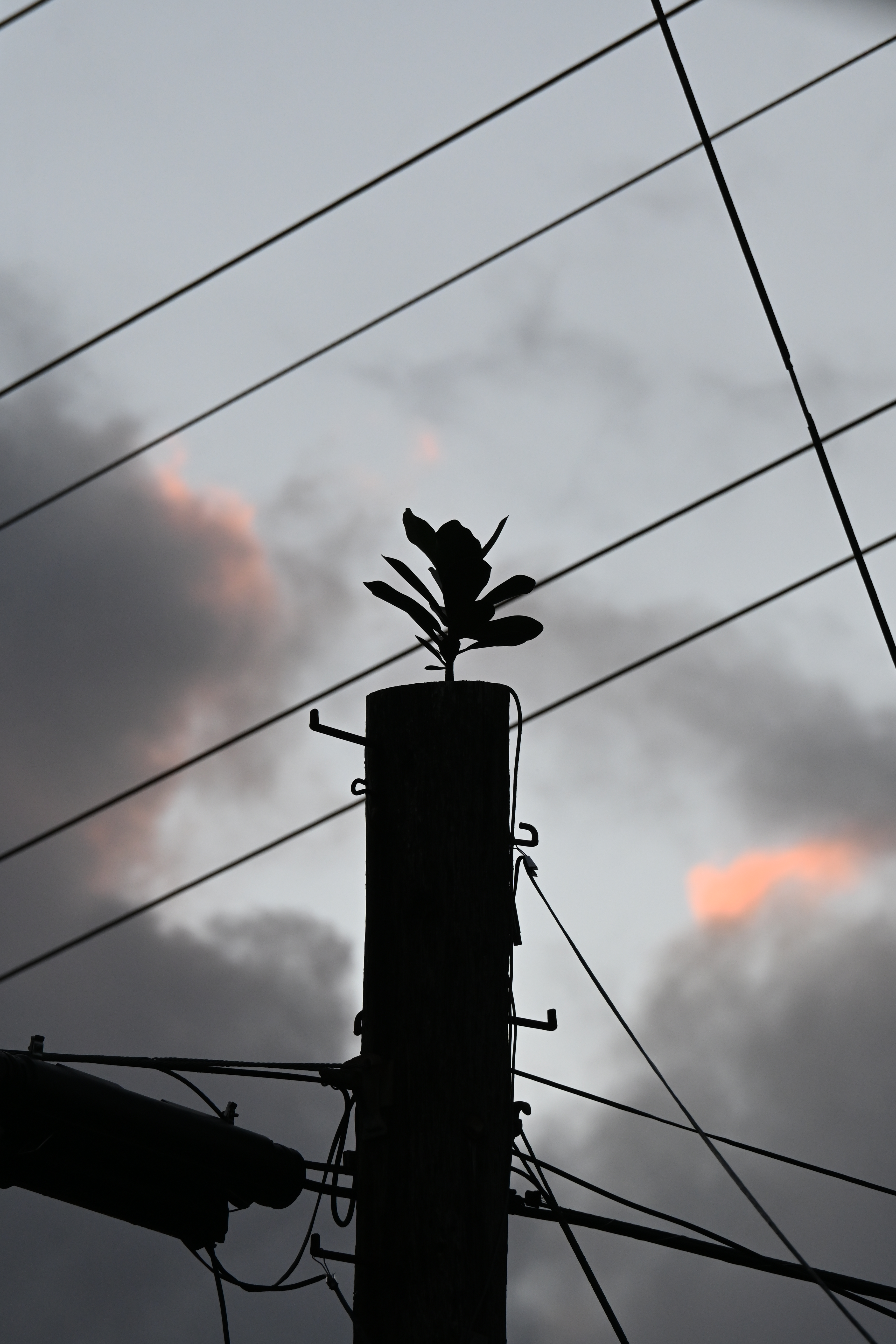
A small plant grows from the top of a light pole with electrical and communications wires around it and just a hint of sunrise color in the clouds.

I take both sides of the annual Lenten argument about whether it is better to give things up or take things on. The point of Lenten discipline, I believe, is to invite God’s love, guidance, and compassion into your soul. That doesn’t happen the same way for every person, and for that matter, it doesn’t happen the same way for any one person at different times in their life. I’ve ruefully observed that when I’ve tried to repeat successful Lenten disciplines in later years, I haven’t been able to keep them. Familiarity may not breed contempt, but for me, novelty holds my attention better.

I still wish I could repeat the year I gave up anxiety for Lent. I’d like to give up anxiety for good.

Each year I choose two things. One is something to give up for the Lenten season. That has included different foods and beverages, activities, and yes, one year I gave up anxiety. The second is something to take on for the Lenten season. I’ve taken photos, written poetry, composed songs, exercised. With the two disciplines to either side, I’ve looked within each and between them both for the presence of God. Sometimes I just find myself – which isn’t a bad achievement, mind you. Sometimes I get a glimpse of eternity.

Another element of the practice is what I say about them. The “take on” projects tend to be visible (or audible, the year I wrote songs). I often acknowledge them and reflect on them during the season. In contrast, I say as little as I can manage about the “give up” disciplines. I’m trying to avoid public piety for public piety’s sake. It’s so easy to “look good” by spotlighting Lenten practice. Some people can do that and do that well. I prefer to keep a windy distance between my private devotion and public reputation.

That brings me (finally; what a long introduction this has been) to this year’s discipline. I’ve thought about things I could give up this year. I’ve thought about things I could take on. As I lingered over some delicious mashed potatoes with mushroom sauce, I considered giving up potatoes. That would have been quite a challenge for me, and definitely a challenging discipline. I may take it on in some other year.

Another challenge has presented itself recently, and I found myself lingering over that even more than over the mashed potatoes. Judgmentalism. It’s not a new struggle, and it’s not a new temptation for me. The first time I ever heard what I identified as the voice of God, it challenged a judgment I’d made. God told me I was wrong.

Given my inclinations, I’m not sure I can give up judgmentalism without great effort, even for forty-six days. I’m quite confident that the effort is worth it (is that judgmental?). I also think I need to struggle with it “out loud,” as it were, because I rapidly realized that it’s a complicated project.

Human beings can’t live without making judgments – quite literally. We have to make choices between options of food, drink, thoughts, approaches to tasks, even relationships. If I gave up making decisions for Lent, people would rightly accuse me of irresponsibility.

So what do I need to do to make an appropriate judgment that isn’t judgmental?

That is my Lenten project. I will write a series of essays on discernment, judgment, and judgmentalism with the goal of reducing the last and strengthening the first. I have no outline for the project other than to somewhat aimlessly predict that there will be six essays, one written during each week in the season. It’s possible there may be more, as one way of considering these questions is to work through actual issues I’m considering rather than consider the issues in the abstract.

So that’s my Lenten discipline, spread out before you. I pray God’s blessings upon you in your own practices through this time and all time.

Oh, one other thing. I decided that each essay would be accompanied by a new original photo. As I learned during last year’s sabbatical, photography has been good for my soul, so I need it in this project.

Photo by Eric Anderson
Dolphin Tempted

dolphins-by-robert-youngThis story may sound like one you’ve heard before. Perhaps it will be a little familiar, even though it’s not set on land like the original. This one takes place in the ocean.
Once there was a shark who decided to try to tempt a dolphin away from its pod.

(Do you know what a pod is? You do? Yes, that’s exactly right: a pod is a group or family of dolphins. Well done!)

So the shark found a pod, with one young dolphin swimming along near the side and toward the back. The water was rather murky, so the shark was able to get pretty close without being clearly visible as a shark.

I don’t really want to tell you what the shark had in mind. What? No, I’m afraid it wasn’t friendship. You’re thinking of the movie, Finding Nemo. No, this shark was not following the twelve steps toward seeing fish as friends, not food. Or, in this case, dolphins.

So, okay, the shark had his mind on lunch.

Well, from out there in the murk, he said to the young dolphin, “Hey, come over to the other side of this reef. I found this amazing place to catch fish. You’ll eat until you can’t eat any more.”

The young dolphin was pretty hungry himself, so this sounded pretty good, but his pod leader hadn’t said anything about going to the other side of the reef. “No,” he said eventually, “I think I’d better not. You might tell the pod leader about it, though.”

That was the last thing the shark wanted to do, so he tried something different.

“The pod leader would want you to learn leadership yourself,” he said. “Not to worry, of course. Other dolphins will come along to keep you safe if there should be any danger nearby.”

Though not enough, he thought, to make a difference when the dinner bell chimes.

That sounded even better to the young dolphin, who certainly aspired to become a pod leader. Maybe this would be a good time to experiment, and to take a risk.

“Well, no, I don’t think so,” he finally said. “I wouldn’t want to make the other members of the pod choose between me and our pod leader. No. Definitely not.”

Oh, come on, thought the shark. So close and yet so far…

“If you come now,” the shark murmured, “I’ll make you into a pod leader. You’ll be the pod leader. Just follow me.”

Oh, that sounded awfully good to the young dolphin. To be a pod leader, and not wait! Wow.

Wouldn’t you like to be a pod leader?

Yes? No?

Well, about half and half.

Our dolphin, though, he did want to be a pod leader someday. But he decided that he’d trust in his own pod leader’s wisdom about when that time would come, and not the sweet words of this rather murky figure.

“No,” he said firmly. “I’ll follow my pod leader until it’s time to lead myself.”

It was at about that time that the pod leader up at the front realized that there was a figure in the shadows behind them that didn’t belong. He darted back through the swimmers, joined by other dolphins as he went, and together they chased the shark far away from the pod, clear to the other side of the reef, where the fishing truthfully wasn’t any better than where they were.

So, did that story sound at all familiar?

A little?

The title of that other story?

Why, it’s “The Temptation of Jesus.”

Photo by Robert Young. Used by permission under Creative Commons license.

When the Tempter Quotes Scripture

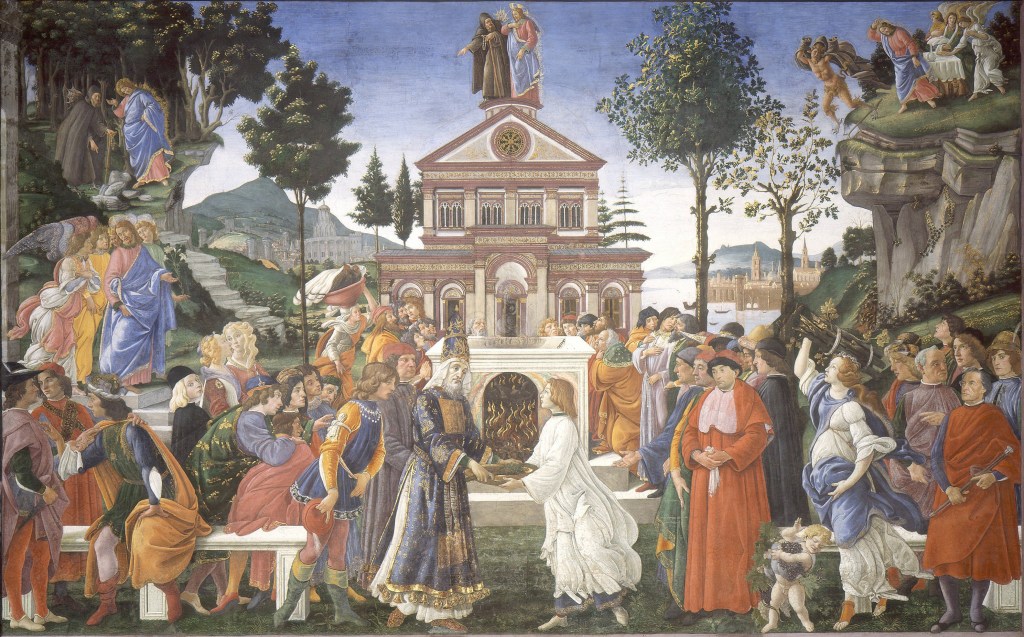
tentaciones_de_cristo_botticelliThis poem was written as part of a sermon (of the same title) delivered at Church of the Holy Cross UCC in Hilo, Hawai’i, on March 5, 2017.
Did a quaking pulse accompany
You to the Temple’s zenith, Jesus?
With the Tempter?
Did your sandals slip or grip the cedar of the ridge?
Did your mortal soul take hold, just for a moment,
To protest:
“Tempter, you have lifted me too high”?

Ah, now you hear the words of sweet assurance:
“On their hands the messengers of God
Will bear you up,
No bruise will mar your angel-guarded feet
As gently they regain the comfort
Of the ground.”

Across the ages, words of Psalmist’s faith.
And did they challenge You to step, to leap,
To dive toward ground?
For just a moment, did you fail to see
The test it posed to God, and see instead a test
Of your own faith?

We know your story’s ending, Jesus,
How you deflected Tempter’s texts
And Tempter’s taunts
How you refused to put God to the test,
How you refused the bread and realms which were
In truth, your own.

We know this story’s end was the beginning,
Taking your unbruised feet to Galilee,
Samaria,
Jerusalem and Bethany and to the courts of Pilate
Where those feet were bruised and pierced by nails
For love
Of
Us.

Dust Prayer

kileaua-iki-sand-20161010“Remember you are dust, and to dust you will return.”

I’m not complaining, God, but I don’t feel like dust.
Sensations far more liquid dominate my body.
Perspiration trickles in the hollows of my spine.
I cannot count the instances of swallowing saliva.
I cannot count the welling tears of sadness,
Or joy, or simply yawning (wetly) at the close of day.
No, I don’t feel like dust. Like mud, perhaps, or clay
Unfired,
Unglazed,
Unfinished,
Unrefined.

“Remember you are dust, and to dust you will return.”

Liquid, then, or solid;
Dust and ashes, then, or dripping clay,
On this day of dust and ashes I recall
That none of this accreted star-stuff of my frame
Assembled to my own design or plan.
Yes, even though I eat and drink, sustaining skin and bone,
I do not, need not, supervise the flowing pathways
Which disperse the building blocks of me
To make
Me
Me.

Yes, I am dust, Your dust, O God:
Fearfully,
And wonderfully,
(And humbly)
Made.

Amen.