That Was Fast

Clouds in the sky with sunlight illuminating from behind and to the side.

Having selected my Lenten discipline of giving up judgmentalism (and writing about it), I was promptly challenged to keep that discipline. I hadn’t even finished the first essay about the project when I encountered this story on Religion News Service by a reporter I follow on the BlueSky social network, Jack Jenkins: “400 Christian leaders urge resistance to Trump administration on Ash Wednesday.”

One of the reasons I chose to examine judgment and judgmentalism this Lent is that I’ve been challenged for judgmentalism. I’ve been taken to task for criticizing some behaviors while excusing others. I’ve been told that some of the things I protest in some have been done by others – did I protest them?

The critique has sometimes been fair. I can’t say I was aware of all the examples that I didn’t protest (which makes it harder to protest them), but it’s also true that those wouldn’t have circulated in places where I pay attention. Limit your attention; limit your awareness. That’s something to consider as I continue this Lenten reflection on judgmentalism.

There on the very first day I had to discern and judge, because the statement invited religious leaders to sign on. Whether I signed or not, I would be making a judgment.

I hadn’t expected it to happen so fast. I hadn’t expected to face a significant decision before I’d laid up some intellectual foundations. Ah, well. As Robert Burns wrote to a mouse:

But Mousie, thou art no thy-lane,
In proving foresight may be vain:
The best laid schemes o’ Mice an’ Men
          Gang aft agley,
An’ lea’e us nought but grief an’ pain,
          For promis’d joy!

Robert Burns, from “To a Mouse”

So what to use to discern?

When I first considered this question over pork chops and mashed potato, the first thing I thought of as a feature of discernment was time. Before choosing, give it time. Before deciding, give it time. Before acting, give it time. I expect to spend more time on this element (see what I did there?) through the next six weeks, but even as I thought it over I realized that we make a number of decisions in the moment and rightly so. When I finished my meal I drove home. I made decision after decision in those few minutes without reflecting on it for more than an instant. If I hadn’t, I’d have run the front of my car into a car in front of me.

Likewise, I have to admit that I have spent long periods of time considering my actions and ended up deeply regretting what I’d chosen. Time is no panacea.

Nevertheless, I decided I would consider the decision over a day.

(I decided I would decide. See what I did there?)

I read the statement “A Call to Christians in a Crisis of Faith and Democracy” several times. It’s not a subtle piece. “We are facing a cruel and oppressive government,” it claims. “This political crisis is driven by people who have fallen for the temptation of absolute power,” it asserts. “Governance is being hollowed out and replaced with corruption, loyalty tests, intimidation, and the normalization of lawlessness,” it states. Strong words. Strong judgments. The authors of the statement have looked at the acts of the administration and made conclusions about the character of those acts: cruel, oppressive, corrupt, and lawless. Further, they have asserted that the temptation of absolute power is a driving factor for those who direct those acts.

I face the question: Do I concur with those judgments? Do I agree with their characterization of these acts? Do I accept the diagnosis of the motives?

Further, I read the list of signatories. Although I’ve been in ministry a long time, I didn’t recognize all the names. I saw many that were familiar, including quite a few whose words and work I’ve greatly admired. I also saw a number of people from organizations I’ve never heard of. I saw that representatives of the “mainline” Protestant churches clearly predominated, with a lot of leaders from ecumenical settings. A number of the people who signed come from my own denomination, the United Church of Christ, including our General Minister and President. Some of the signers are colleagues I deeply respect. Some are dear friends.

I face the question: Are these people whose discernment I trust? While I still have to do my own work, can I trust the work they have done?

The statement is not simply a diagnosis of our condition. It is also a call to action. Those who signed made eight commitments. The authors expanded more on them than I have here:

  • Protect and stand with vulnerable people,
  • Love our neighbors,
  • Speak truth to power,
  • Seek peace,
  • Do justice,
  • Strengthen democracy,
  • Practice hope, and
  • Ground our discipleship in prayer and inward journey.

I face the question: Are these commitments I can make? Are they consistent with my understanding of Christianity? Are they things I have the power to do? Are they things I have the will to do?

I slept on it. I read the statement again (and again). I reviewed the names. I found more names I knew. I considered the commitments.

Here’s the thing: I knew I was inclined to add my name to the list when I read Jack Jenkins’ headline. That was my first judgment, my off-the-cuff discernment. But was it judgmental? Particularly given the strong language about the political and spiritual condition of the nation?

Also, was I (am I) merely reinforcing my own pre-established conclusions? On the Sunday after the election, I said, “The United States has re-elected as President a devourer of widows’ houses. Plain and simple. Already his followers have sent messages to African American children telling them to report for sale as slaves. Already his followers have sent messages to women: ‘Your body. My choice.’”

Of the three areas of discernment I’ve named here, I had no problems with the commitments. I’ve held those as virtues consistent with Christianity for many years (which raises the problem of reinforcing my conclusions again). There were more than enough people whose judgment I trust in the list to make their willingness to sign compelling. The sticking point was: Do I agree enough with the diagnosis section to sign on to it? Do I need to learn more that either confirms or refutes that characterization of the administration’s acts?

This morning I sat with it again, considered it again. And I came to the same conclusion with which I’d started: I believe I know enough. I agree with the characterization. I need to make the commitment.

I signed.

Discerning a Lenten Discipline

A small plant grows from the top of a light pole with electrical and communications wires around it and just a hint of sunrise color in the clouds.

I take both sides of the annual Lenten argument about whether it is better to give things up or take things on. The point of Lenten discipline, I believe, is to invite God’s love, guidance, and compassion into your soul. That doesn’t happen the same way for every person, and for that matter, it doesn’t happen the same way for any one person at different times in their life. I’ve ruefully observed that when I’ve tried to repeat successful Lenten disciplines in later years, I haven’t been able to keep them. Familiarity may not breed contempt, but for me, novelty holds my attention better.

I still wish I could repeat the year I gave up anxiety for Lent. I’d like to give up anxiety for good.

Each year I choose two things. One is something to give up for the Lenten season. That has included different foods and beverages, activities, and yes, one year I gave up anxiety. The second is something to take on for the Lenten season. I’ve taken photos, written poetry, composed songs, exercised. With the two disciplines to either side, I’ve looked within each and between them both for the presence of God. Sometimes I just find myself – which isn’t a bad achievement, mind you. Sometimes I get a glimpse of eternity.

Another element of the practice is what I say about them. The “take on” projects tend to be visible (or audible, the year I wrote songs). I often acknowledge them and reflect on them during the season. In contrast, I say as little as I can manage about the “give up” disciplines. I’m trying to avoid public piety for public piety’s sake. It’s so easy to “look good” by spotlighting Lenten practice. Some people can do that and do that well. I prefer to keep a windy distance between my private devotion and public reputation.

That brings me (finally; what a long introduction this has been) to this year’s discipline. I’ve thought about things I could give up this year. I’ve thought about things I could take on. As I lingered over some delicious mashed potatoes with mushroom sauce, I considered giving up potatoes. That would have been quite a challenge for me, and definitely a challenging discipline. I may take it on in some other year.

Another challenge has presented itself recently, and I found myself lingering over that even more than over the mashed potatoes. Judgmentalism. It’s not a new struggle, and it’s not a new temptation for me. The first time I ever heard what I identified as the voice of God, it challenged a judgment I’d made. God told me I was wrong.

Given my inclinations, I’m not sure I can give up judgmentalism without great effort, even for forty-six days. I’m quite confident that the effort is worth it (is that judgmental?). I also think I need to struggle with it “out loud,” as it were, because I rapidly realized that it’s a complicated project.

Human beings can’t live without making judgments – quite literally. We have to make choices between options of food, drink, thoughts, approaches to tasks, even relationships. If I gave up making decisions for Lent, people would rightly accuse me of irresponsibility.

So what do I need to do to make an appropriate judgment that isn’t judgmental?

That is my Lenten project. I will write a series of essays on discernment, judgment, and judgmentalism with the goal of reducing the last and strengthening the first. I have no outline for the project other than to somewhat aimlessly predict that there will be six essays, one written during each week in the season. It’s possible there may be more, as one way of considering these questions is to work through actual issues I’m considering rather than consider the issues in the abstract.

So that’s my Lenten discipline, spread out before you. I pray God’s blessings upon you in your own practices through this time and all time.

Oh, one other thing. I decided that each essay would be accompanied by a new original photo. As I learned during last year’s sabbatical, photography has been good for my soul, so I need it in this project.

Photo by Eric Anderson

Angels Hovering ‘Round

In the center of a large dramatic landscape of mountains and clouds, two smaller figures speak to one another. One, in pink, is Jesus. The other, in brown, is Satan.


“Then the devil left [Jesus], and suddenly angels came and waited on him.” – Matthew 4:11

He challenged you, Jesus.
Summon the angels! They won’t let you fall.
You won’t have a bruise on your heel,
Nor a strike from a snake.

You said no. No to bread.
No to flight. No to glory
(that fails to transcend
all the kingdoms of earth).

Then he left. And who came?
Yes, the angels. The angels.
They were hovering ’round,
And they brought you relief.

Well, Jesus, I’m tempted.
So tempted, you know,
so hungry and weary,
confused and distressed.

Where are the angels?
Will they tend my bruises?
Will they feed my hungers?
Where are the angels, Jesus the Christ?

“There are angels hov’ring ’round.”

A poem/prayer based on Matthew 4:1-11, the Revised Common Lectionary Gospel Reading for Year A, First Sunday in Lent.

The image is Weite Gebirgslandschaft mit der Versuchung Christi (Vast Mountain Landscape with the Temptation of Christ) by Jan Brueghel the Elder – dorotheum.com heruntergeladen am 30. September 2012, Public Domain, https://commons.wikimedia.org/w/index.php?curid=21801997.

Wilderness

COL; (c) City of London Corporation; Supplied by The Public Catalogue Foundation

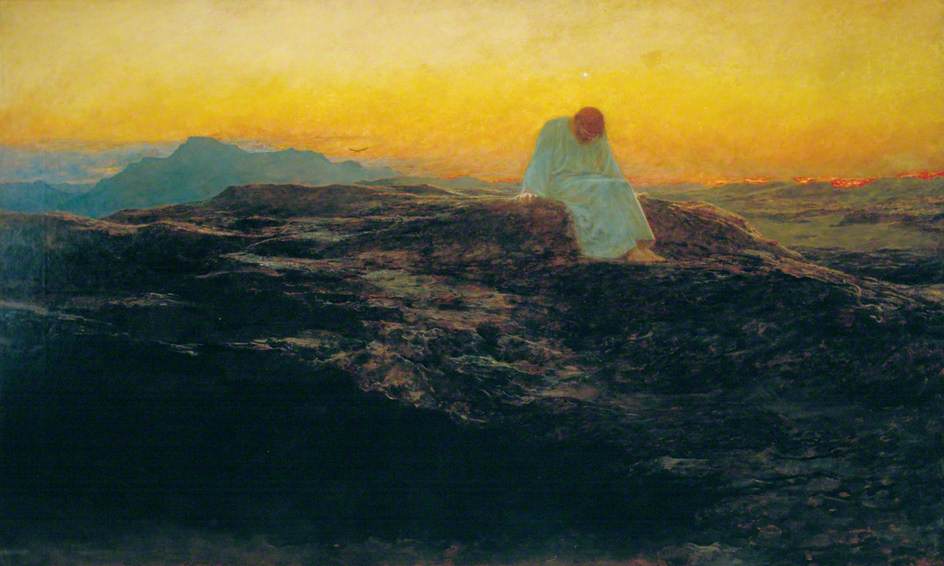
“He was in the wilderness forty days, tempted by Satan; and he was with the wild beasts; and the angels waited on him.” – Mark 1:13

Why did I come to Jordan?

My life in Galilee was nothing much.
I did my work. I paid attention to my mom.
I read the texts and prayed upon their words.
If nobody was eager to accuse me of great sin,
I can’t say anybody was inclined to say,
“Here’s one who’s lived a life untarnished.”

My mother, to choose one, would never say those words.

Still, my conscience rested easy. My sins
were bearable enough to wait until the day
of offering within the Temple, and even then
I’d struggle some to name my sins. So why
did I accept the labor of the miles
and seek a baptism, repenting for my sins?

The Spirit drove me dripping to the wilderness.

I’d had a life which had its just rewards,
its comforts, and its faithfulness, but now
my heart will never rest at “home.”
The softest bed will scratch my soul until
I set once more upon the road to speak
to new assemblies, gathered for the Word.

My life will be a wilderness.

Oh, can I not just take the road to home?
Can I not set aside the heavenly words
as meant for someone else, and not for me?
Must I embark upon a journey, knowing that
it leads to only one imaginable
destination: a shameful death upon a cross?

There’s little mercy in the laws of Rome.

I’d cry out, “Get behind me, Satan,” but temptation
is behind me, and before me, and at either side.
It’s graven deep within my bones which long
for hearth and home. What do I care for bread,
for power, or for Messianic name?
All I want, my God, is to go home.

But now my home is wilderness in truth.

Oh, you can come now, angels. Wipe
my sweat-soaked brow, and dry my streaming eyes.
Supply the bread I’ve done without
and gently satisfy my body’s thirst. Just like
the prophet long ago, I take your nourishment.
I take the highway of the wilderness,

From this day forth, and always.

A poem/prayer based on Mark 1:9-15, the Revised Common Lectionary Gospel Reading for Year B, First Sunday in Lent.

The image is The Temptation in the Wilderness by Briton Rivière (1898) – Art UK, Public Domain, https://commons.wikimedia.org/w/index.php?curid=39630461.

A Lenten Success

I try to avoid patting myself on the back in public – but if I don’t, what is social media for?

For some years I have chosen to follow two parallel disciplines each Lent. One is a fairly straightforward decision to refrain from something during the forty-six days of the season (I include the Sundays for this). I’ve given up fast food, beer, soda, computer games, and similar kinds of things (though never coffee – never coffee). I have almost never been able to successfully repeat one of these, so I generally have to choose something new and different each year.

The second discipline, on the other hand, is to take something on. I’ve followed exercise programs and prayer cycles. Frequently I’ve done creative projects with photography or poetry. In fact, my weekly Lection Prayers are an outgrowth of one Lenten season. I simply kept going with them.

This year I set a goal I was not certain I could achieve. I decided to write a song each week of Lent.

Although my repertoire of compositions has expanded greatly over the years, the truth is that I don’t write songs all that often. I was astonished when I counted the songs I’d written in 2021 and came up with a dozen. For me, songwriting requires a good deal more time, concentration, and focus than most other writing projects. I have and do write to deadlines, but I generally prefer to follow some kind of inspiration when it comes to music. I usually am happier with the results.

To set a goal for songwriting which is half my output in the previous year – in six weeks – well. I wasn’t sure I could do it.

I did give myself some space. I did not insist that each song be composed within an assigned week. All I required was that there be six songs by the end of the season. Nor did I impose any subjects or themes on them. The songs would be what they were, and they could fit into the sacred or the secular as it came along. I also knew I’d write one anyway: I’ve made a habit for a few years now of writing something for Easter. Still. Six songs in six weeks?

Friends, I did it. And… all six have now been performed and are available on YouTube.

Wisdom, Feed Us

Premiere performance during the Community Concert of March 11, 2022.

Dream of Peace

Premiere performance during the Community Concert of March 25, 2022.

Come On, Guitar

Premiere performance as A Song from Church of the Holy Cross, March 23, 2022.

Creature of this World

Premiere performance as A Song from Church of the Holy Cross: April 6, 2022.

As We Bring Him Down

Premiere performance during Scripture and Poetry for Good Friday, April 15, 2022.

Walk, Mary, Walk

Premiere performance during What I’m Thinking #259, April 18, 2022.

A Lenten Practice that Won’t Be Easy – for Me

I don’t remember when I adopted the annual practice of a Lenten discipline. I’m pretty sure that it was after I’d begun serving as pastor of my first churches, though it might have been before seminary graduation. I tried on a number of ways to draw closer to God in those days.

For some years I mostly practiced a discipline of “giving something up for Lent.” Some have heard me tell the story of giving up anxiety for the season, and how delighted I was that I’d succeeded. Some have heard me tell the follow-up story. The next year I pledged to give up anxiety for Lent again… and failed.

I have never successfully repeated a Lenten discipline.

More recently, I have added an activity, practice, or creative effort to the season. I “take something on” as well as “giving something up.” I don’t announce my choices for the season. I recall Jesus’ stern warnings about praying so that other people could hear rather than that God could hear. Lenten practice should be about my relationship with God and with myself. It’s not to make me look pious to others.

This year, however, I have to make an exception. I think I will need help. I’ve decided to give up self-deprecation for Lent.

It’s a challenge.

I love humor. I love a sense of fun, games, and jokes. I do not, however, like to tell jokes at someone else’s expense. I don’t like to make fun of anyone’s appearance, background, personality, or challenges. I don’t like to make fun of anyone’s vulnerabilities or strengths. Sometimes these jests don’t hurt, but far too often they do. “It’s just a joke” doesn’t cut it. I’d rather not do it.

(By the way, this doesn’t mean I’m successful at this. I do poke fun at others from time to time – and I tell myself not to do it again.)

I’d rather poke fun at myself. That’s what I try to do. Truthfully, I’m the only person I have the right to poke fun of, and I do it pretty often.

Within a few hours of deciding I’d stop doing that for Lent, I caught myself doing it several times.

Self-deprecation might be a more comfortable frame for humor, but for me it is also a sign of insecurity and anxiety. Some of those jokes function to disguise those things, and some of those jokes function to invite comfort for them. Both the mask and the invitation to comfort are… problematic. Both allow me to avoid internal struggle by turning it outward. Both allow me to avoid the work to resolve or refresh what’s unsettled in my soul.

That’s a good reason to give it up, at least for a season.

But it’s going to be difficult, and I don’t think that’s self-deprecation. I invite your help as this season goes along, friends. If you detect me “putting myself down,” I invite you to call me on it – not comfort me, call me on it. “Eric, didn’t you give that up for Lent?” will do.

It is, and will be, a challenge.

Holy Week 2019: Good Friday

He was oppressed, and he was afflicted,
yet he did not open his mouth;
like a lamb that is led to the slaughter,
and like a sheep that before its shearers is silent,
so he did not open his mouth.
By a perversion of justice he was taken away.
– Isaiah 53:7-8a

Then Jesus said, “Father, forgive them; for they do not know what they are doing.”
– Luke 23:34

Silence, Jesus? Excuses, Jesus?
In truth, I want a louder Savior.
I want a firebrand, I want a chief.
I want a voice that echoes from the hills.

I do not want excuses.
I do not want a suffering servant
satisfied with our perverted justice,
consenting with your silence.

For heaven’s sake, shake the heavens!
For earth’s sake, rattle the earth!
For the oppressed’s sake, break the bonds!
For humanity’s sake, do something!

Don’t – don’t – make excuses.
Not for them. Not for us.
Not even – dare I say it?
Don’t make excuses for me.

I do not need excusing, Jesus.
No, I need forgiving.
Excuses will not change the world:
Repentance and forgiveness might.

Suffering Savior, keep your silence:
but do not keep your peace.
We who witness your great love
weep for your peace.

Photo by Eric Anderson

But Now…

I’ve never worried before, O God,
about the younger son’s repentance.
I’ve always gratefully assumed
he walked the roads of sackcloth
and of ashes. What a shock
his father’s welcome must have been!

But now… I wonder.

Was he another twister of the truth?
Was he another one who turns the world
around his little finger? Did Narcissus blush
with shame at his temerity, his lies?
And did the pounding of his heart betray
his gratitude or hidden glee?

And now… I wonder.

In that Great Somewhere, do you wait for me?
Do you wonder when I’ll lay aside deceit –
delusion sweet for me, unwitting lie to you –
and truly bring my starving soul back home?
Does the pounding of my heart betray
my gratitude or deeply hidden lies?

Yes now… I wonder.

A poem/prayer based on Luke 15:1-3, 11b- 32, the Revised Common Lectionary Gospel reading for Year C, Fourth Sunday in Lent.

Photo by Eric Anderson.

Go Tell that Fox

Salomé with the Head of John the Baptist by Caravaggio
Oil on canvas, 114 x 137 cm, 1606 – 1607

“Go tell that fox for me…”

Are you kidding, Jesus? I’m not telling Herod
anything. I know the risks. And if you don’t,
might you recall the head of John
the Baptist on a platter?

“…’Listen, I am casting out demons
and performing cures today
and tomorrow…”

That’s great for you, Messiah, but,
I’m no messiah (if you hadn’t noticed).
I stand by beds of illness impotent,
and listen to my breaking heart.

“‘…and on the third day finish my work.”

Ha! That’s a good one, Jesus. Yes, I know
the joke, that preachers only work one day
a week. Not even I believe I’ll finish –
or you’ll finish – in just three.

“‘…Yet today, tomorrow, and the next day
I must be on my way.'”

Oh, must you leave so soon? No longer to
encourage me to take on earthly powers,
summon them to righteousness,
decry their foul abuses?

Yes, there you go, into your self-proclaimed
three days of labor, leaving me…
leaving me… commissioned
to confront the Herod of today.

A poem/prayer based on Luke 13:31-35, the Revised Common Lectionary Gospel reading for Year C, Second Sunday in Lent.

The image is “Salome with the Head of John the Baptist” by Caravaggio, Public Domain, https://commons.wikimedia.org/w/index.php?curid=509510.

Messiah’s Temptations

Cliff edge on Hawai’i Island

I’m hungry, but…
I know that I’ll find bread
a step or two away.

I’m arrogant, but…
I can’t be sure
I’ll rule the world
any better than Satan.

(Isn’t that a kick in the head?)

I’m courageous, but…
I’m hardly likely to
accept this gracious offer
for a heavenly bungie jump .

(At least not without a harness
and a springy cord.)

They may have tempted you, Messiah,
but they don’t do much for me.

So I guess I’ll live in gratitude
you could resist the miracle,
the earthly power, the heady taste
of Godliness – and give yourself to me.

A poem/prayer based on Luke 4:1-13, the Revised Common Lectionary Gospel reading for Year C, First Sunday in Lent.

Photo by Eric Anderson.