February 1, 2026
Micah 6:1-8
Matthew 5:1-12
Lots of the Hawaiian forest birds are bright with color. Think about the ‘amakihi and the ‘ahiapola’au with their bright yellow feathers, or the ‘apapane in red and black, or the i’iwi that adds a bright orange bill and orange legs to all those red feathers. That’s a lot of colorful birds flying about the mountain forests.
It has to be said that they also fly around quite a bit. Since they mostly sip nectar and eat nectar-eating bugs, they go from flower to flower pretty quickly, not pausing for very long. When there’s not a lot of nectar in any given flower, you’ve got to visit a lot of flowers for a meal.
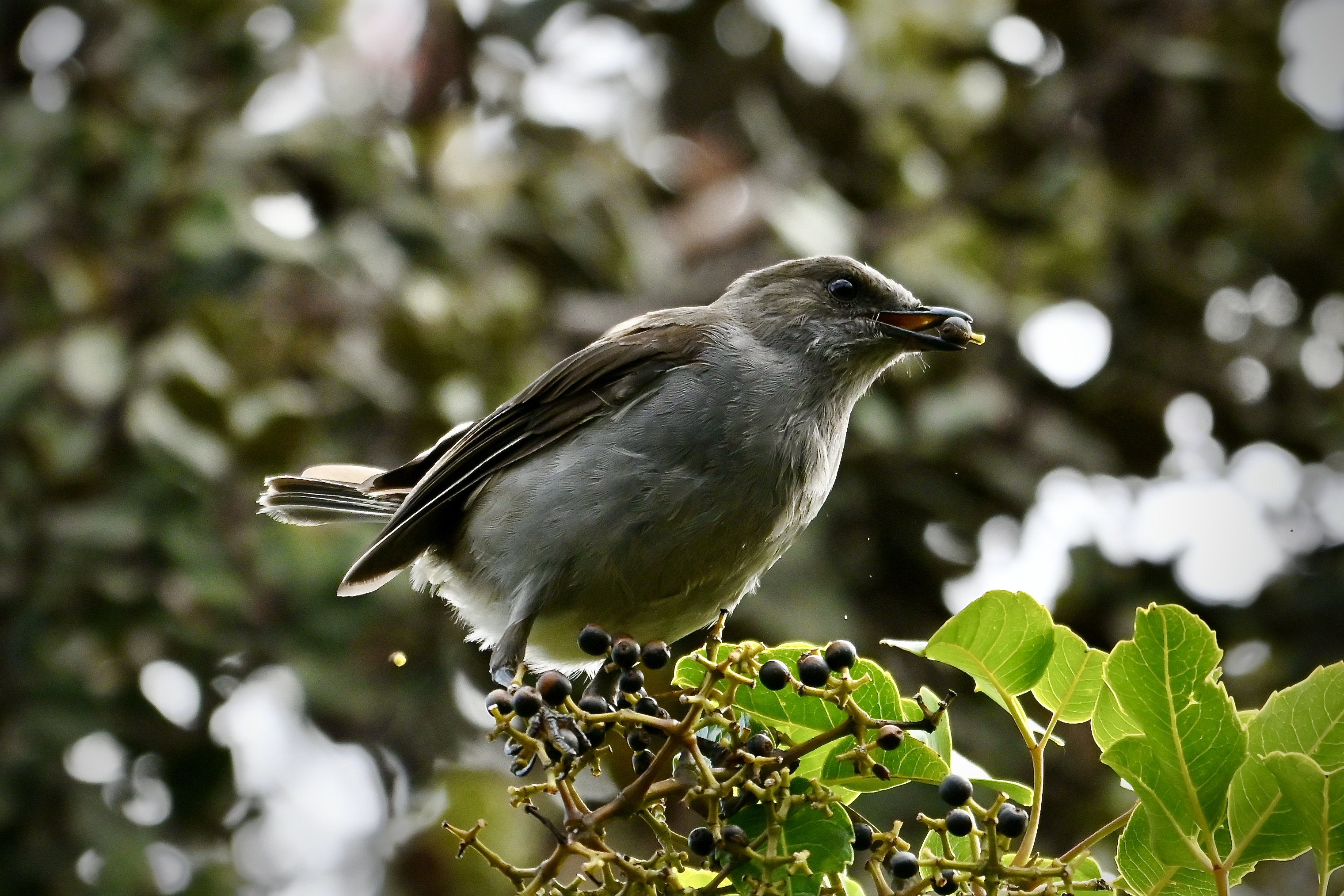
The oma’o is different. The oma’o’s gray and brown feathers match the trunks and branches of the trees. It eats lots of fruits, such as the ‘olapa berries in this photo, so it doesn’t fly around as much. Oma’o are enthusiastic and talented singers, rather like the ‘apapane. It even has a call that, to me, sounds like they’re singing, “Oma’o!”
One oma’o, though got to feeling bad about being so gray and so settled. “You should get out more!” sang the ‘apapane as they flew past. “You should be yellow!” shouted the ‘amakihi as they hopped along nearby branches. “You should be red and black!” said an i’iwi as it chased some ‘apapane away.
“Maybe I should,” said this oma’o.
He tried, in fact, to change this. He started with what was easy. He flew about more, flitting from tree to tree. He didn’t really have much idea about how to eat nectar, but he focused on the nectar-eating bugs for a while. That kept him busy, but it also kept him hungry, so he’d return to the ‘olapa trees from time to time and perch and pluck berry after berry until he realized he’d been stationary for “too long” (whatever “too long” meant) and leaped into the air again.
Getting colorful was harder. As far as he could tell, his feathers were the color they were and weren’t going to change. He supposed he could dye them, but his experiments with ‘akala, the Hawaiian raspberry, washed off in the next rain, and hadn’t made him very colorful anyway. He took to following ‘apapane around (i’iwi were too grumpy for this) and picking up feathers that they dropped. Then he’d carefully place them among his own feathers. Feathers have little hooks in them, so this worked better than you’d think, but not much better. They fell out nearly every time he took off, and remember, he had to fly a lot to be like the honeycreepers.
“Grandson, what are you doing?” his grandfather asked one day, having observed the frequent flying and the phony feathers for a couple days.
“I’m trying to be bright,” the younger one said. “I’m trying to show some energy and some color in the forest.”
“Whatever for?” asked his grandfather.
“Because all these other birds look so good, and seem to eat so well, and sing so well, too. I want to be like them.”
“You mean, you want to be happy and well fed? You want to sing with a full heart and a full stomach?”
“Right. Just like that.”
“Now grandson,” said the grandfather, “have you been doing that?”
Of course he hadn’t. He’d been flying about eating things that didn’t satisfy him. He’d been singing sad songs about the colorful feathers that kept dropping away.
“Go perch on some ‘olapa and get filled up,” said grandfather, “and then settle down for a bit and sing the song that’s in your heart. See if doesn’t match the ‘apapane’s song or even do better.”
He’d been foolish, but the younger oma’o recognized wisdom when he heard it. He at some ‘olapa and he perched on its branches for a while. Then he opened his beak and shared his wondrous song.
Like the poor in spirit, like the meek, he was blessed, and shared blessing.
by Eric Anderson
Watch the Recorded Story
I write these stories in full ahead of time, but I tell them from memory (plus improvisation). The story you just read does not precisely match the way I told it.
Photo of an oma’o eating ‘olapa by Eric Anderson.
 ordainedgeek