“He opposes and exalts himself above every so-called god or object of worship, so that he takes his seat in the temple of God, declaring himself to be God. Do you not remember that I told you these things when I was still with you?” – 2 Thessalonians 2:4-5
I remember lots of things. I remember grandiosity and pride. I recall my own, of course, and sometimes mourn its passing, though more often I regret its resurrection.
I remember lots of things, including those who, yes, exalt themselves. They openly accept the praise that’s due to God, declaring that they stand for God.
What law except their own will they obey? What limits place upon their power and their pride? What wisdom will they own except the rules of ownership and privilege?
In times like these, I fear I may be like your troubled friends in Thessalonica, dear Paul. With evil rampant, justice tossed aside, I say: “Come Jesus, now, and bring us your relief.”
Though twenty centuries have passed since Thessalonians cried out for the same thing, dear Paul advises us the same: Stand firm. Hold fast. Be filled with Spirit’s love. And may God strengthen you in doing good.
A poem/prayer based on 2 Thessalonians 2:1-5, 13-17, the Revised Common Lectionary Second Reading for Year C, Proper 27 (32).
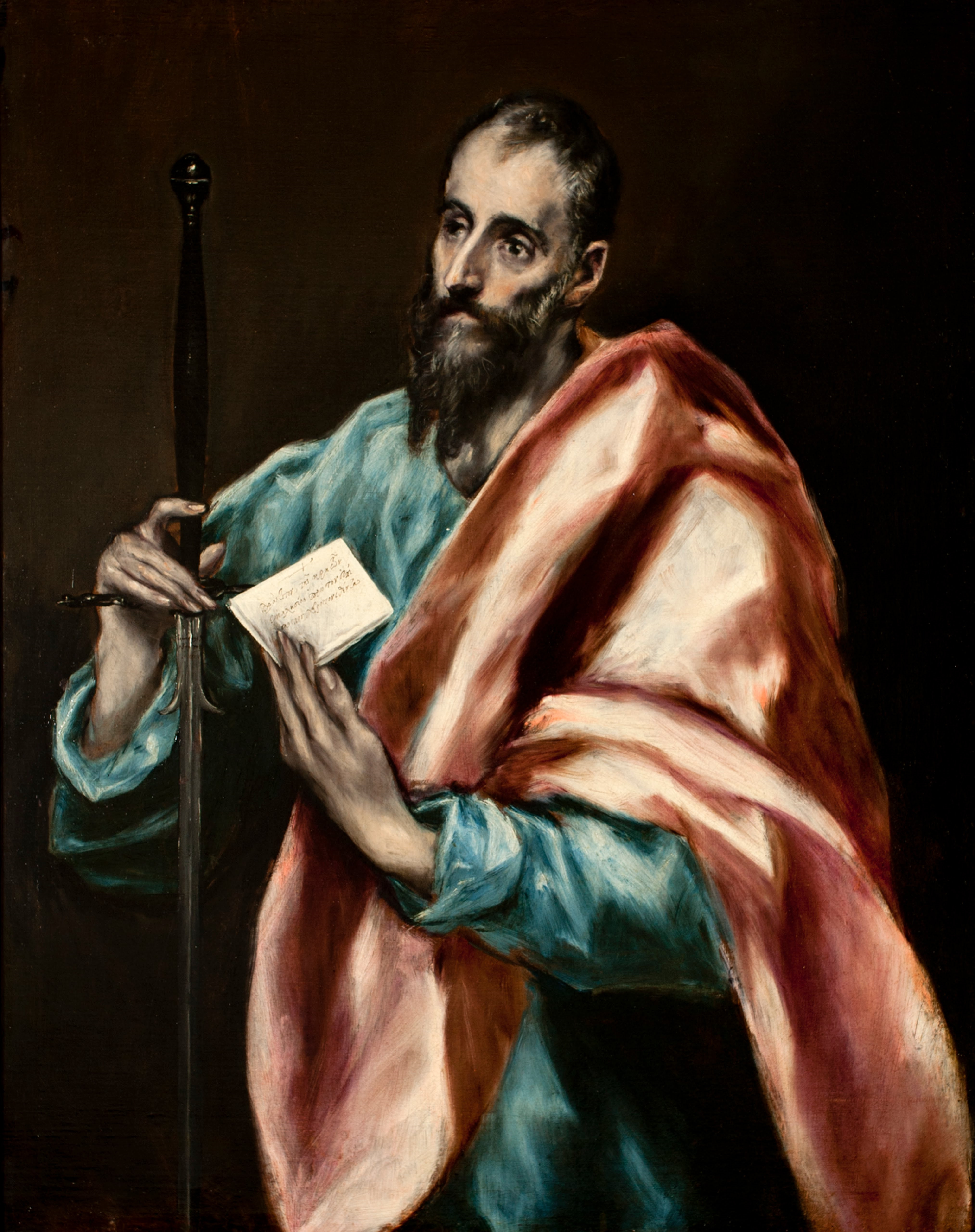
The image is The Apostle Saint Paul by El Greco (between 1610 and 1614; painting displayed at the El Greco Museum, Toledo, Spain – 1QEs4novinaf3A at Google Cultural Institute, zoom level maximum, Public Domain, https://commons.wikimedia.org/w/index.php?curid=29844105.
“[Jesus asked the expert in the law] ‘Which of these three, do you think, was a neighbor to the man who fell into the hands of the robbers?’ He said, ‘The one who showed him mercy.’ Jesus said to him, ‘Go and do likewise.'” – Luke 10:36-37
We all know the story, O Jesus – a credit to you that we understand its scandalous message even today. “Who is my neighbor?” “The one who shows mercy.” Even the one whom we view eyes askance.
We all know the story. We’ve not softened its meaning. If we would be neighbors, the model Samaritan shows us the way. I just have one question: When did we choose that we would not be neighbors?
Mercy lies bleeding on the stones of the highway.
A poem/prayer based on Luke 10:25-37, the Revised Common Lectionary Gospel Reading for Year C, Proper 10 (15).
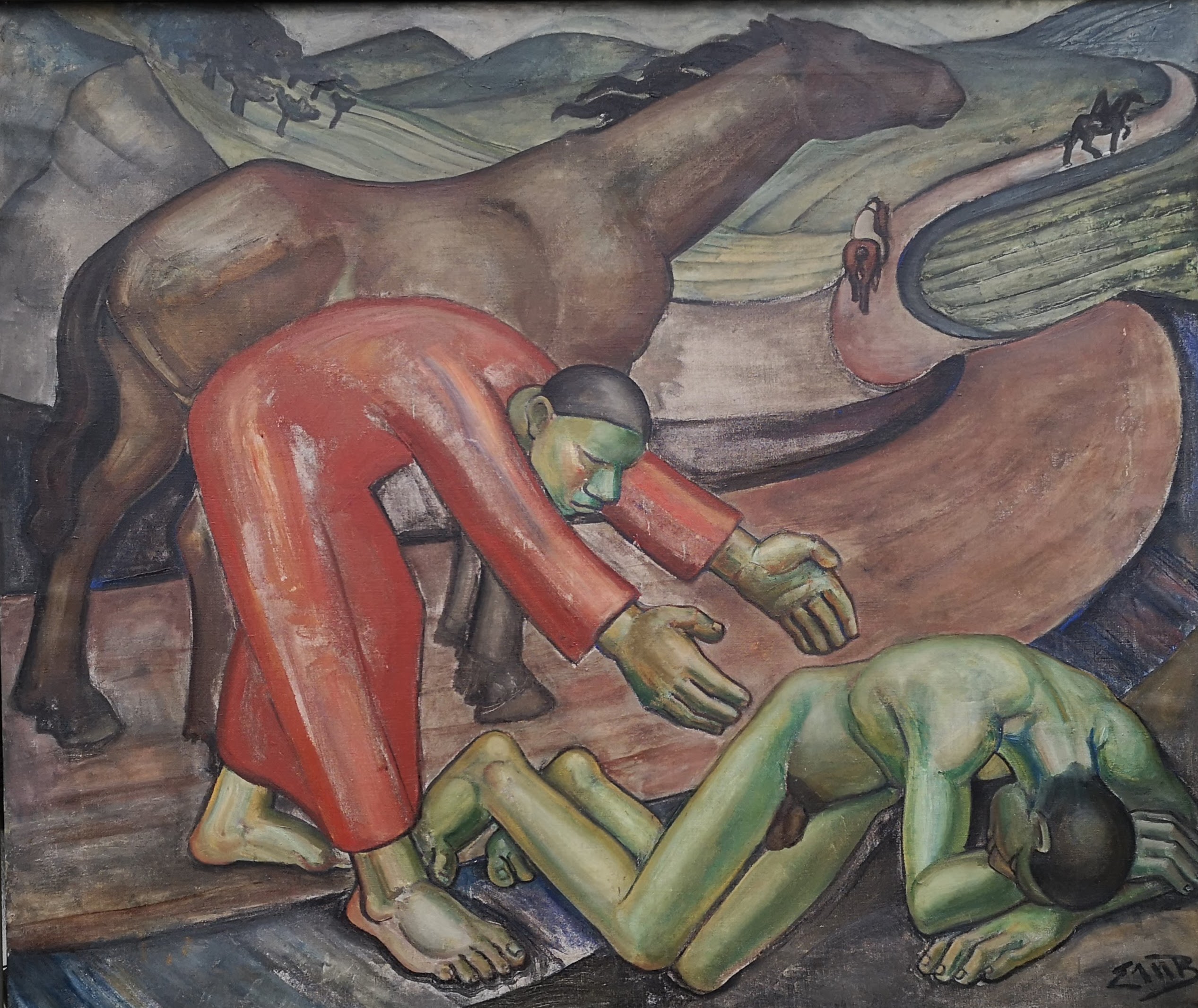
The image is Den barmhjertige samaritaner (The Good Samaritan) by Elisa Maria Boglino (1928) – Eget foto af maleri udført af (own photo of painting of) Elisa Maria Boglino, CC BY-SA 4.0, https://commons.wikimedia.org/w/index.php?curid=73771804.
“…Let us approach with a true heart in full assurance of faith, with our hearts sprinkled clean from an evil conscience and our bodies washed with pure water.” – Hebrews 10:22
There are mornings when I revel in the water which cascades along my form and carries off the aggravating dust and clinging grime.
In likewise do I cast my grateful soul into refreshment of a loving God, who takes away the grunge, the guilt, the shame.
And then I step upon the shower mat, to towel off the residue of cleanliness, prepare to wrap my form in clothing for the day.
In likewise does my soul release forgiveness’ bliss, replenished to the work which lies ahead, and clothed (we hope) in righteousness’ array:
Provoking those around to love, to acts of doing good, to mercy shared, to meet and raise the courage of those souls who’d do the same.
A poem/prayer based on Mark 12:38-44, the Revised Common Lectionary Gospel Reading for Year B, Proper 27 (32).
Well, that’s not an original way to begin a story, but it was pretty dark, and rain was falling, and the winds were howling up there on the mountain. If you were a pig, it was a good night to find a rocky overhang. If you were an ohi’a tree, it was a good night to rock back and forth with limbs and trunk, and a better night to hold on tight with your roots.
If you were one of the honeycreepers of the forest, it was a good night to shelter beneath lots of thick leaves and hope the branch you’d perched on was sturdy.
A grumpy ‘amakihi had found just such a space in a koa tree. He wasn’t exactly dry, but he wasn’t being pelted by rain, either. The branch he grasped with his feet was only tossing a little bit. He wasn’t comfortable – that’s why he was grumpy – but he was as comfortable as he was going to get until the sun came out so he could dry his feathers.
He wasn’t pleased when the branch gave another bounce that was out of rhythm with the winds and there was a new shadow among the leaves. A young ‘apapane – so young that she didn’t have her red feathers yet – had landed on the branch and stood shivering. She tried to shake the water from her wings, but mostly just banged herself against the leaves and twigs.
“Stop that,” said the grumpy ‘amakihi. “What are you doing here? You shouldn’t be flying in this storm.”
“I didn’t mean to,” said the young ‘apapane. “The wind swept me off the branch.”
“Well, you’d better go back there,” said the ‘amakihi. “Go on.”
The young ‘apapane looked out through a gap in the leaves to where they could both see the trees tossing in the gale.
“Well, maybe not right now,” said the ‘amakihi, who was still grumpy but a fairly considerate bird. “What can I get for you? Do you want a bug? There’s some here.”
“No, sir,” said the ‘apapane.
“How about a drink of water? Well, maybe not,” he said, when the young ‘apapane shivered. “You’ve probably had enough water.”
“Yes, sir,” said the ‘apapane.
“Well, what do you want? You don’t want me to help you find your own tree, do you?”
The ‘apapane shook her head.
“What do you want me to do for you?” insisted the ‘amakihi.
“Could I just stay here for a while, and not be alone?” asked the ‘apapane.
“You don’t want to be alone?” asked the ‘amakihi.
“No, sir,” said the ‘apapane.
The ‘amakihi thought about it, and realized even as he said it, “You know, I don’t want to be alone in this storm, either. Come find a dryish spot here on this branch. We’ll ride it out together.”
And that is how a grumpy ‘amakihi and a frightened ‘apapane were merciful to each other in the midst of the storm.
by Eric Anderson
Watch the Recorded Story
I write these stories in advance, then tell them from memory during worship. That means that changes happen.
“Now the woman was a gentile, of Syrophoenician origin. She begged him to cast the demon out of her daughter. He said to her, ‘Let the children be fed first, for it is not fair to take the children’s food and throw it to the dogs.'” – Mark 7:26-27
I had no illusions, Jesus.
I almost didn’t spot you, though I looked. A neighbor mentioned casually that “a healer Jew from Galilee” was near as if it made no difference to me.
You know it did, Jesus.
I left my wailing daughter with a friend and searched the streets to find a face I did not know. Despite our sorrows, I know every face upon our streets.
I knew you from not knowing you, then, Jesus.
You’d made no effort to declare yourself so I could not believe you’d come to help the sick and demon-burdened in our village here, but help you would, if I could have my way.
I had to have my way, Jesus.
I found your stranger’s face. I bowed upon your feet. I begged you for your healing touch to soothe my child’s rage, assuage her fear, give to her peace.
I knew that you’d say, “No.”
You said it with a cruelty that nearly stopped my breath, though I had no illusions, none. I stammered out my need’s reply: “The dogs can eat the children’s crumbs.”
I was not after crumbs.
No, Jesus, I would have it all. Not all or nothing, I would have it all, because what use is partial banishment of demons burdening the human soul?
No crumbs, Jesus. All. And I mean all.
You gave it all to me, you know. You gave me all your cruelty (I hope you used it up). But then you gave me all the healing power of your anguished face.
My daughter got it all.
She’s never seen you, Jesus, as you know. You took your shattered heart, remade it new, to heal and heal again, and left behind a girl once more herself,
And your illusions cast aside.
A poem/prayer based on Mark 7:24-37, the Revised Common Lectionary Gospel Reading for Year B, Proper 18 (23).
It’s been a while since I told a story about this kind of fish. It’s called a hinalea, a cleaner wrasse – in fact, a Hawaiian cleaner wrasse – and they’re small fish that live along the reefs in somewhat deeper water.
As small fish, you’d expect they’d be hunted by larger fish for breakfast, lunch, and dinner. And they are, in fact, hunted – but not as food. Despite the fact that we’re so much bigger than a mosquito, they still come and land on us and try to eat a little bit of us, right? Similar things happen to fish, and unlike mosquitoes, a lot of these pesky creatures don’t let go. After a while, a fish can have quite a lot of unwelcome passengers, all of them trying to take a nibble on them. It’s not fun.
Cleaner wrasse eat those tiny pesky irritating creatures, gently nibbling them away from the skin and scales of the larger fish. They set up spots along the reef which people call “cleaning stations,” and where the larger fish will gather for a cleaner wrasse or three to remove those little pests. It’s a nice arrangement. The large fish go away greatly relieved, and the hinalea get, well, breakfast, lunch, and dinner.
One particular school of hinalea had one of the busiest cleaning stations on the reef. The school leaders – and I know you want me to call them teachers, but a wrasse school isn’t a school, it’s a business, so the best term for school leaders is bosses – the school leaders had announced that they needed all the hinalea there at the cleaning station. No cleaning fish anywhere else.
They couldn’t clean all the time, of course. Nobody can eat all the time, despite the things you’ll sometimes hear about human teenagers. The cleaner wrasse would take a break for a while, but the only place they were allowed to clean was at the station.
One hinalea was on his break, lazily swimming along the reef and not much worried about anything, when a larger fish came along. It was an ‘uhu, a parrotfish, and it was in terrible shape. It had picked up so many pesky creatures that it was really painful. She was wandering aimlessly along the reef, unable to figure out which way she was going and where she could find a cleaning station. She spotted the lone hinalea with its bright blue and yellow and purple scales, and settled next to him.
She didn’t need to say anything. She needed help. The hinalea went to work. All alone outside the cleaning station and as covered as she was, this would take some time.
Another hinalea, one of the bosses on break, wandered over and stopped, shocked to see what he was doing. “This isn’t the cleaning station!” he said. “Stop that now!”
Our hinalea said nothing – his mouth was full. In fury, the other hinalea swam at him and chased him away from the ‘uhu, chased him all the way back to the cleaning station.
“This fish cleaned away from the cleaning station,” announced the boss. “What shall we do with him?”
The other bosses gathered menacingly. This didn’t look good at all. But just then the ‘uhu appeared and swam to the little wrasse in the center of the angry fish. “Thank you so much,” she said.
She turned to the bosses and said, “Do you know what this little one did? I had so many pests on me that I couldn’t find the cleaning station. He picked off enough of them that I could find you. I can’t tell you what would have happened if he hadn’t. I’m pretty sure you would have lost a customer.”
She looked at the hinalea again and said, “As good a job as you did, you got interrupted. Do you suppose you could finish?” And so he did.
Sometimes bosses in the world are foolish, and sometimes they are wise. This group of hinalea bosses chose wisdom that day. It remained important that everyone concentrate on the cleaning station – a lot of fish waited there – but if a hinalea on break could help get a fish to the station? That was good, and right, and important, too.
by Eric Anderson
Watch the Recorded Story
The story above was told live from memory of this text.


 ordainedgeek