Story: Surprise

April 5, 2026

Acts 10:34-43
John 20:1-18

Sometimes a bird on the mountainsides just takes a liking for a particular ohi’a tree. I don’t know whether the nectar tastes better, or if you get a particularly crunchy kind of bug, or if there’s something else that gets a bird excited.

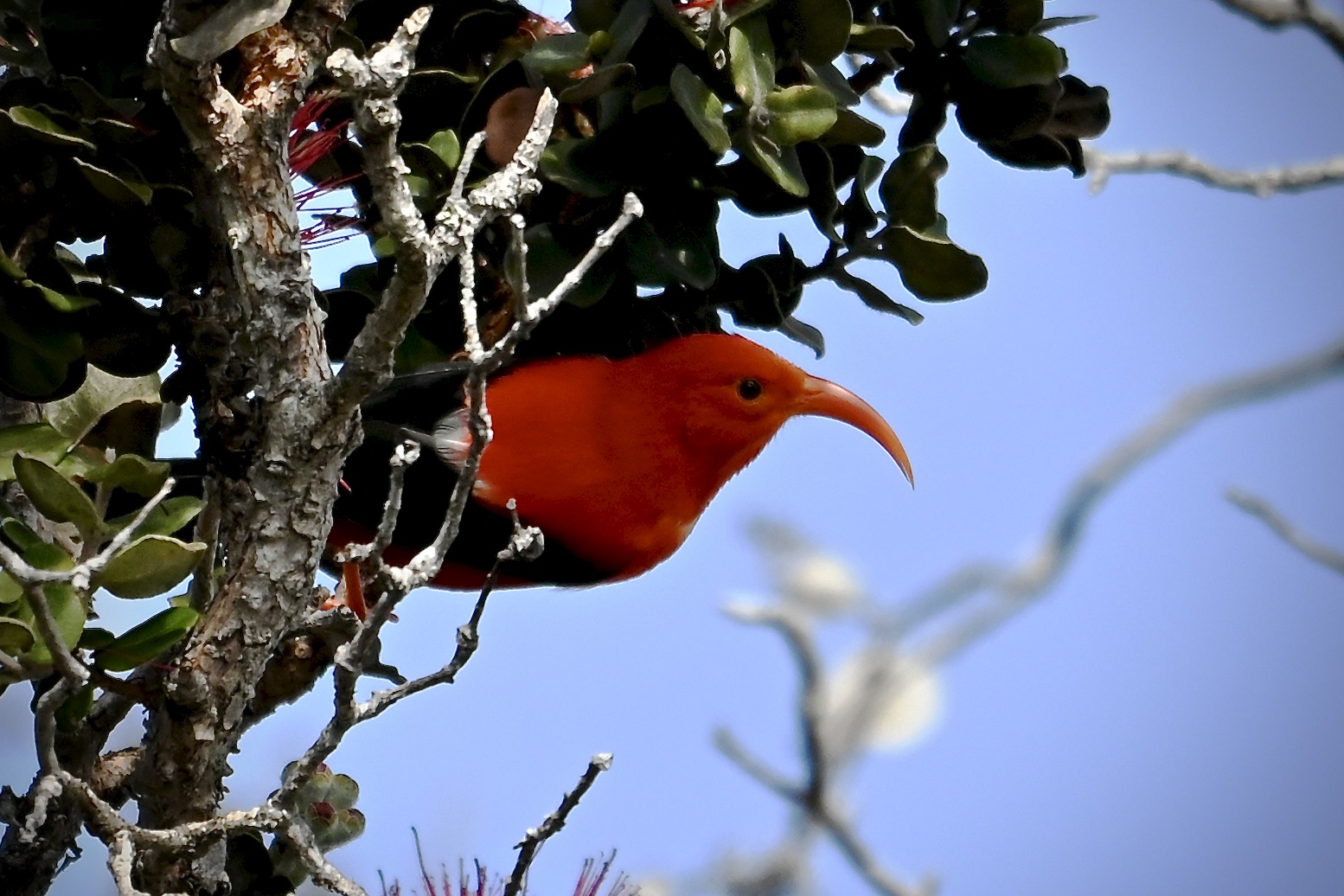
This is about an i’iwi who had a favorite ohi’a tree.

He like other trees as well. When the mamane were in blossom, he’d happily sip from those flowers as well, but as far as he was concerned there was nothing better than his favorite ohi’a tree. The flowers were the right color red, he thought, and they’d get that lovely gold tip as they blossomed. Sometimes there weren’t any flowers on it, of course, but that just meant he’d develop an appetite as he waited for them to bloom again.

It was his favorite tree.

I think you know, however, that sometimes trees in the ohi’a forest die. Sometimes the wind blows them down. Sometimes an earthquake from the volcano shakes the soil loose beneath them. Sometimes an eruption knocks them down. And sometimes, I’m very sad to say, they get very sick very quickly. Their leaves fall and, all too often, no leaves grow ever again.

The i’iwi’s favorite tree got sick.

He didn’t notice at first. He noticed it didn’t have any blossoms, of course, but that wasn’t unusual. A tree can’t bloom all the time. But then he noticed that some of the leaves were browning and dropping away. It looked like the tree was trying to grow new leaves, but there didn’t seem to be a lot of them. The i’iwi realized that the tree was in bad shape.

He shouted out his frustration to the world.

He carried on with living. But he decided it would make him too sad to see his favorite tree get sick and maybe – probably – die, so he spent his time in other parts of the forest. There were good trees there. None of them were his favorite tree. None of them could ever be his favorite tree.

One day, however, the forest’s blossoms were scarce in the groves he’d been browsing. The pattern of flowers led him, tree by tree, toward his favorite tree. He didn’t really want to go there, but if that’s where the nectar was, that’s where the nectar was. Eventually he found himself flying right toward his favorite tree.

It was covered with bright red ohi’a lehua.

Imagine his surprise. He was sure the tree was dead, but it had survived, and it had even thrived. He flew around it, singing for joy. He settled onto a branch and lowered his long curved beak into a flower. The nectar tasted like heaven, even better than before, he thought.

This story is about Easter, but it’s not about mistaking who’s alive for someone who is dead. No. this story is about Easter because it’s about surprise. That i’iwi knew, knew to his soul, that his favorite tree was no more. Jesus’ friends and disciples, Simon Peter and Mary Magdalene, they knew that Jesus had died – as he had.

Both a Hawaiian bird and Mediterranean human beings learned that the world has more surprises in it than they’d imagined. An ohi’a that got better. A Savior who rose again to new life.

Happy Easter!

by Eric Anderson

Regrettably, there was a technical problem this morning, and the story was not recorded.

In Those Days

In those days Mary set out and went with haste to a Judean town in the hill country, where she entered the house of Zechariah and greeted Elizabeth. – Luke 1:39-40

In those days, Luke? Say rather:
“After her imagined life had been upset
by visitation of an angel,
Mary saw the pretenses of life too well,
her friends and loved ones, neighbors, too,
persisting in a sad semblance of ‘normal’
when the love of God was breaking in.

“She fled because her efforts to
acquaint the villagers of Nazareth
with blessing, with deliverance,
were greeted with polite discount,
with blank incomprehension,
silent disbelief, and smirks that smack
of shame and slander.

“She fled because she had no outlet for
the wonder bottled up inside,
no person who would recognize the glory.
Who but one already bearer of
a miracle would comprehend
a miracle before her?

“So in those days she fled. When Mary stood
upon the threshold of Elizabeth, received
a wave of welcome, knew they shared in wonder,
all the pain of others’ disbelief gave way,
and in a flood of tears she praised
magnificent reversal, pride dispersed,
power humbled, humble lifted,
hungry satisfied and wealthy leaving empty.

“For in the shared experience of grace,
they built on love’s foundation,
Mary and Elizabeth, to raise up faith
and hope and joy that others would not see.”

Write that, Luke. It’s what you meant by,
“In those days.”

A poem/prayer based on Luke 1:39-55, the Revised Common Lectionary Gospel Reading for Year C, Fourth Sunday of Advent.

The image is Visit of Mary to Elizabeth by Fr. George Saget, a portion of a larger mural behind the altar of Keur Moussa Abbey in Senegal. Downloaded from Art in the Christian Tradition, a project of the Vanderbilt Divinity Library, Nashville, TN. https://diglib.library.vanderbilt.edu/act-imagelink.pl?RC=56517 [retrieved December 15, 2021]. Digital source photo by Jonas Roux – Flickr [1], CC BY 2.0, https://commons.wikimedia.org/w/index.php?curid=4870110.

I Pray for a Miracle

O, God,

I pray for a miracle.

I pray for weary bodies to find strength
and in resilience live beyond a virus.

I pray for souls who lack compassion
to find empathy for suffering.

I pray for those augmenting their own power
to embrace compassion and its sharing.

I pray for those obsessed with their self-image
to be filled with overflowing love.

I pray for those in pain of injury
to be comforted in justice.

I pray for those dismissive of their neighbors
to be startled at the gifts their neighbors share.

I pray, O God, for miracles
to erupt within the human soul.

This Man Demands

Bernardo_Strozzi_-_Prophet_Elijah_and_the_Widow_of_Sarepta_-_WGA21919One meal remains, just one
To comfort us, my son and I.
I search the barren ground,
Aching for rain,
To find the fuel to bake
That last pathetic cake
For our memorial feast.

And, of course, he comes to me
Asserting hospitality’s demands.
Some water (in a drought, no less!):
All right, the well provides
(How long, I ask, how long?).
But then, another call
For bread, that he may eat.

I have no bread, demanding man.
I am a corpse too stupid to stop walking.
I have the makings of one meal
To bring brief comfort
To my son and I
Before the pangs of hunger
Take our lives.

What matter if I feed this man?
Our fate is written; we are bound for death.
So, I suspect, is he,
Fool foreigner demanding bread.
One meal alone I’ll share.
Perhaps he’ll linger long enough
To watch me die.

Hospitality demands.
Our straight poverty demands.
Time of drought demands.
Arrogance demands.
Death’s imminence demands.
This man demands.
This man’s God…
Gives.

Based on 1 Kings 17:8-16