Story: Peace

September 21, 2025

Jeremiah 8:18-9:1
1 Timothy 2:1-7

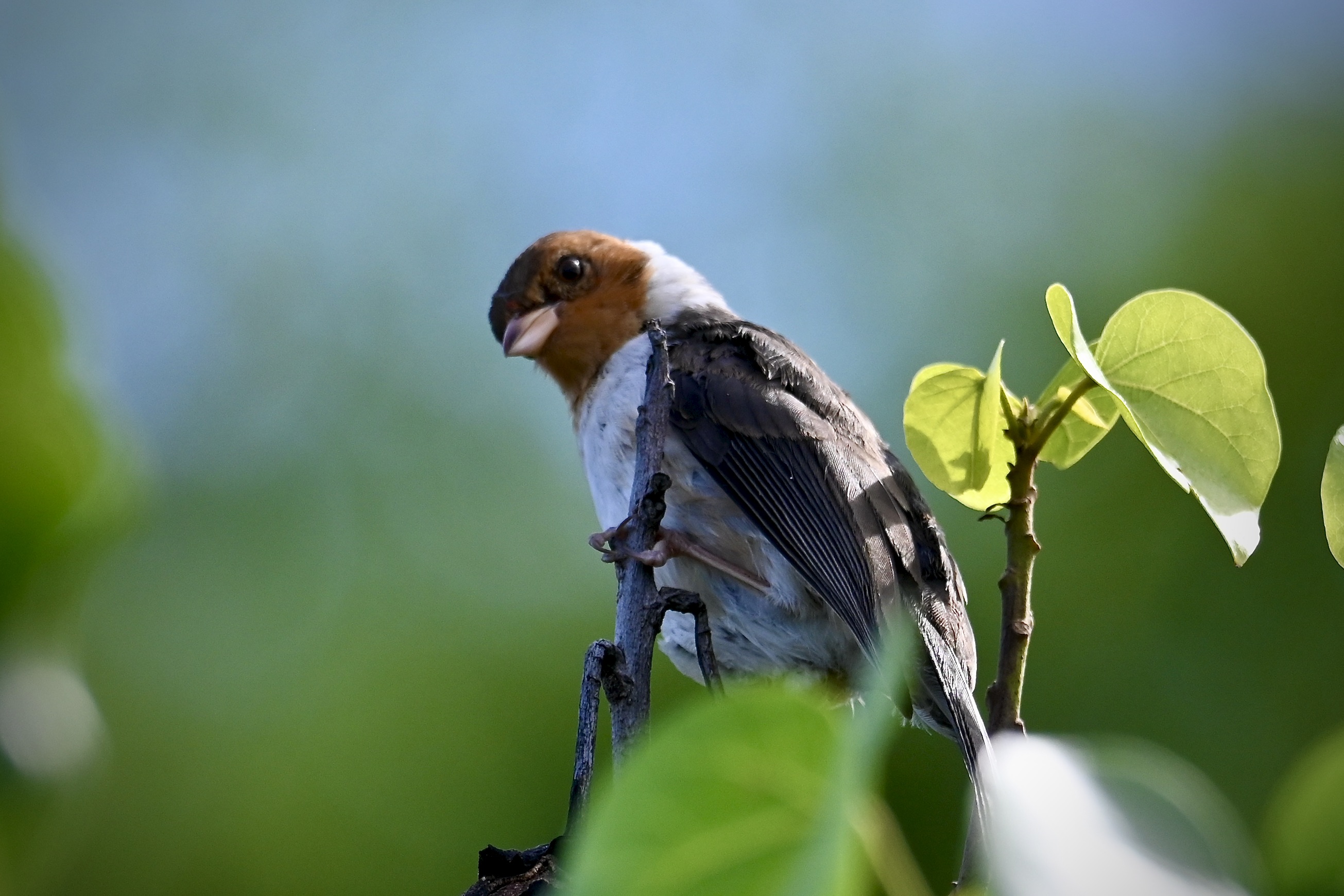
He was a yellow-billed cardinal, and he was young. He was so young, in fact, that the feathers on the top of his head weren’t red; they were brown. He was so young that his bill wasn’t yellow, it was tan.

He was old enough to be living mostly on his own, finding his own food among the seeds and berries, and his own shelter for the night. He was old enough to enjoy a sunrise or a sunset, and he was old enough to enjoy sitting quietly in the sun.

What he wasn’t old enough for was to understand what “peace” was.

That may seem odd, given that sitting quietly and enjoying the sunshine sounds pretty peaceful, but it didn’t always feel that way. For one thing, if he sat in the sunshine for too long, he’d start to feel hungry. Feeling hungry, he thought, wasn’t very peaceful. I guess he had a point there. Being uncomfortable isn’t very peaceful.

Worse than that, though, when he got hungry, he had to find food. He knew how to do that, of course. That wasn’t the problem. The problem was that other birds would show up, and he didn’t like that. Other yellow-billed cardinals were usually OK – he knew a couple of them that tended to tease him – but he really didn’t like it when different kinds of birds turned up. House finches made him nervous. House sparrows were kind of scary. Saffron finches made him feel uneasy about his rather dull coloring.

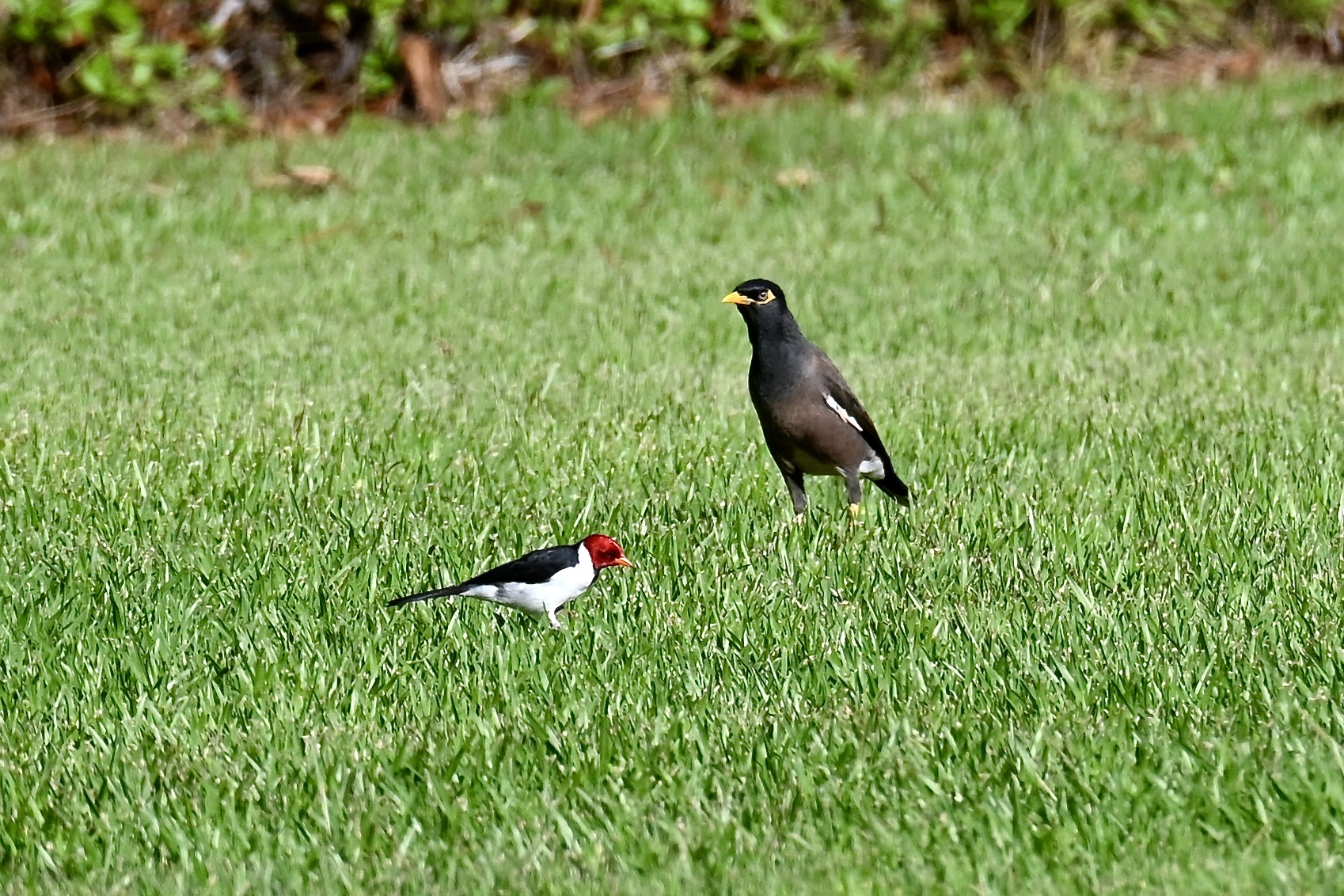
Worst of all, as you might guess, were the mynas. For one thing, they had brighter yellow bills than he did. For another, they were a good deal bigger. And, of course, they were often really loud, really argumentative, and really frightening.

As he got older and his head feathers turned red and his bill turned more yellow, he still didn’t like it when other birds turned up while he was feeding. He didn’t really notice that the finches and sparrows and kolea really paid him no mind. They just got on with looking for bugs and seeds and worms to eat. So when the myna turned up near him while he was eating, he jumped.

“What’s wrong, youngster?” asked the myna. “Is there something wrong?”

“Oh, no, myna sir,” said the yellow-billed cardinal. “Nothing wrong at all.”

“You jumped,” said the myna. “Did something startle you?”

“Well,” said the cardinal, “you did. You caught me by surprise when you landed.”

“Oh, that’s fine,” said the myna, who sounded somewhat relieved. “Sorry about that. You had me worried for a minute there.”

“You worried?” said the yellow-billed cardinal. “Why?”

“Some birds get upset about mynas,” said the myna. “They think we’re loud and obnoxious. They don’t like it when we’re around.”

The yellow-billed cardinal had thought such things, so he thought that now he’d better stay quiet.

“I’m glad you’re not like that,” said the myna. “I could do with a bit of peace today.”

That’s when the yellow-billed cardinal learned what peace could be – a time when creatures who were rather different could live side-by-side, meet their needs, and not fear one another. A yellow-billed cardinal could be safe from the bullying he feared from a bigger bird. A myna could be safe from the rejection and disdain of a smaller bird.

“I could use a bit of peace myself,” said the yellow-billed cardinal. “Let’s enjoy it while we can.”

by Eric Anderson
Watch the Recorded Story

I write these stories in advance, but I tell them from memory, which means things change.

Photos by Eric Anderson.

What Peter Didn’t Say

So when Peter went up to Jerusalem, the circumcised believers criticized him, saying, “Why did you go to uncircumcised men and eat with them?” – Acts 11:2-3

You think I wanted to eat with them?
I didn’t want to go at all.
I was riding pretty high, you know,
elated with a woman’s resurrection.
OK, the only place they’d put me up
was with a tanner, but a fisherman’s smelled worse.

Yes, I was riding high, and trying not
to think about the things that happen when
you’re riding high, the way success becomes
a series of new challenges, new obligations. I
was smelling those amidst the tannery.
It came for Jesus; it would come for me.

I didn’t know that I could lie in dreams
or visions, waking or asleep. I claimed
I’d never eaten food that was unclean,
and knew full well I’ve eaten shellfish when
the Romans hadn’t purchased all my stock.
And let’s ignore the grain I plucked on Sabbath Day.

A vision or a dream; regardless, it
would summon me to something new
I knew. I did not know what it would be,
but who gets visions for a trivial thing?
I didn’t know what that dream meant.
I knew I’d go where I’d not wish to go.

The house of a centurion was not
within my plan. Who knew what I would find
when I reached there? Most likely was
a naked sword to seek my naked gut.
Why trouble with a cross when you
can drain a troublemaker’s life without?

I had no plan to speak of Jesus there until
they asked, but ask they did, and I
pulled in my breath, and breathed it out,
and spoke with sometimes trembling voice
of Jesus, of his healing touch, his mercy to
such fools and failures as I am.

I certainly did not expect the fire of
the Spirit in a Roman house, of one
who marshals military might against
the people of this land. They said that he
feared God, but this? The Holy Spirit, lit
in him as it had been in me? Who knew?

And now, my friends, I have no plan for you.
I didn’t want to go. I went. I didn’t want to speak.
I spoke. I didn’t know the Spirit would appear.
She did. I didn’t know that God had welcomed them,
the Gentiles, just as openly as us. And now,
I have no words for you, except

To tell my tale again.

A poem/prayer based on Acts 11:1-18, the Revised Common Lectionary First Reading for Year C, Fifth Sunday of Easter.

The image is St. Peter and Cornelius the Centurion by Bernardo Cavallino (1640s) – Web Gallery of Art:   Image  Info about artwork, Public Domain, https://commons.wikimedia.org/w/index.php?curid=15452357.

Story: Rocky the Honu

August 25, 2024

Psalm 34:15-22
Ephesians 6:10-20

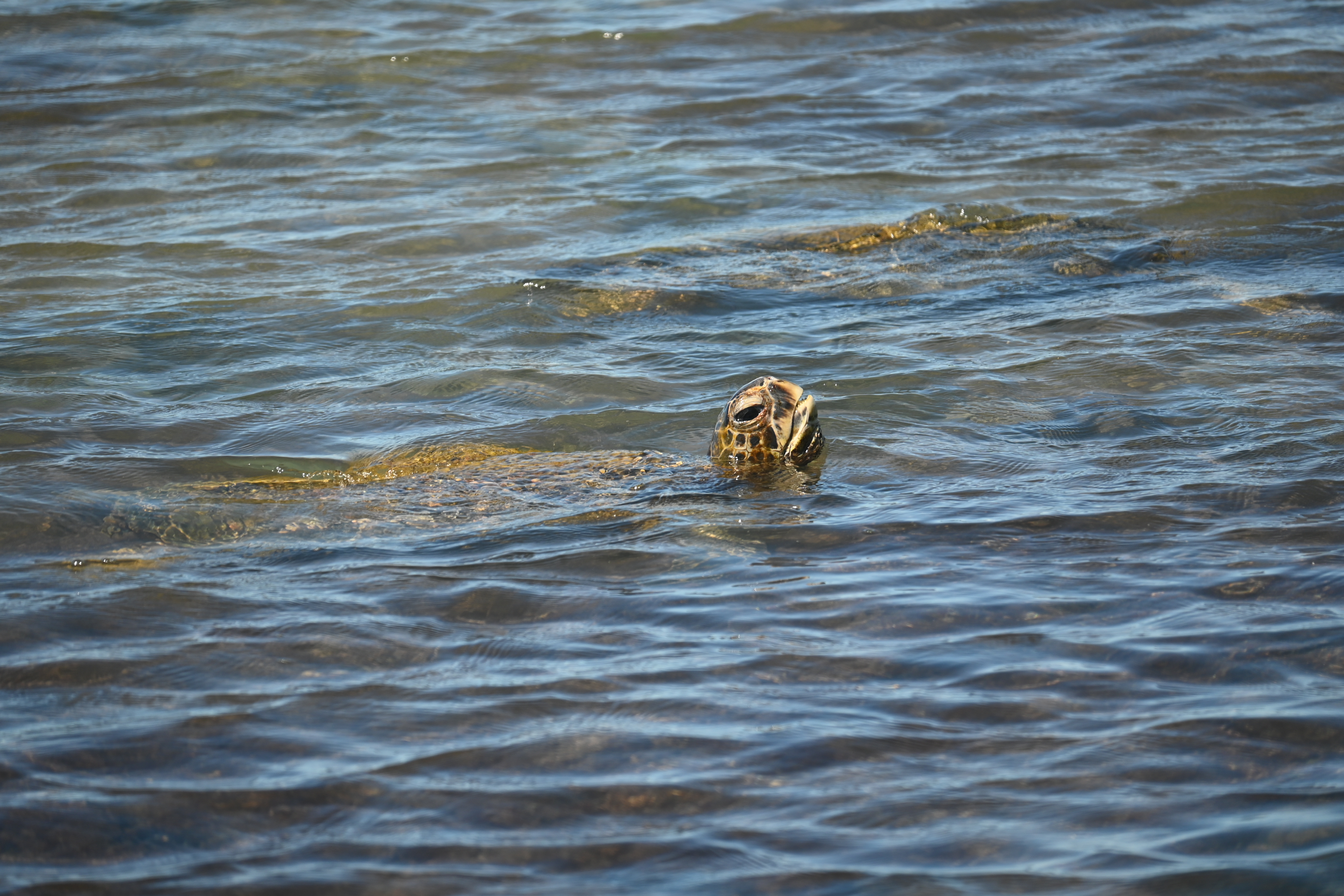
A newly hatched honu isn’t very big. Two or three inches long. They spend their time feeding on the seagrasses in which they hide in the shallows of our island.

A kupuna honu is a lot bigger, up to four feet long and weighing over 300 pounds.

Our honu today was bigger than a hatchling and smaller than a kupuna. He was maybe a foot long, had well developed flippers and tail, and enjoyed both swimming in the ocean waters and in the shallows near the beach. And, like all honu, he liked sunning himself on the rocks or the sands.

But… he was worried about manō. Sharks. A good size tiger shark could be a real problem. He kept a wary eye out for manō as he swam along the reef, and he listened intently for the sound of water passing over their sleek fins. He had a good strong shell, he knew, but… well. Who could tell if that would be enough?

One day, though, he got an idea. He’d just seen a wave move some rocks up and down the beach. What if he could find some way to attach rocks to his shell? Corals and opihi and, for that matter, the sea grasses he liked to eat managed to stick to things. What might give him an extra shell?

I still don’t know what he found to do it, but he did find something sticky, and he covered his shell with it. Then he went to a beach loaded with loose stone, moving back and forth with the waves. As they went clattering down the beach, they stuck to his shell, and suddenly he was the best armored honu in history.

He rested on the beach for a while, delighted with his success. He napped in the sun. The rocks actually made him just a little warmer as the sun warmed them, which was really nice. When he woke up, he was hungry. So he started crawling down the beach into the surf.

He was surprised to find it really difficult to move along. The stones on his shell weighed him down, and his flippers strained to push him along. “It will be better when I get into the water,” he thought.

He was wrong.

As difficult as moving along the beach had been, swimming was worse. The stones dragged him right down to the sea floor, and he struggled to swim back up to breathe – honu aren’t fish, you know. They breathe air. Every time he caught a breath he’d be back under a moment later. Honu can hold their breath a lot longer than I can, but this was not good. Not good at all.

He struggled back to the beach until his tail was in the water and his head out of it, with waves lapping at his shell as he gasped.

“Too heavy?” asked a passing ‘ulili.

“Too right,” said the honu, who started scraping the stones off. The ‘ulili used his long beak to help pray them away.

“Thanks for your help,” said the honu, and the ‘ulili replied, “I’m happy to help, Rocky.”

Rocky the honu laughed, and he wore the name the rest of his long life, but he never wore any rocks again.

Armor has its price, you know. Sometimes its protection is too heavy for living. Sometimes we do best by relying on what we can carry.

by Eric Anderson

Watch the Recorded Story

I write these stories in advance, but I tell them on Sunday morning from (occasionally poor) memory and (occasionally creative) inspiration. What you’ve just read will not match what I said.

Photo of a honu by Eric Anderson.