“Many peoples shall come and say, ‘Come, let us go up to the mountain of the LORD, to the house of the God of Jacob, that he may teach us his ways and that we may walk in his paths.'” – Isaiah 2:3
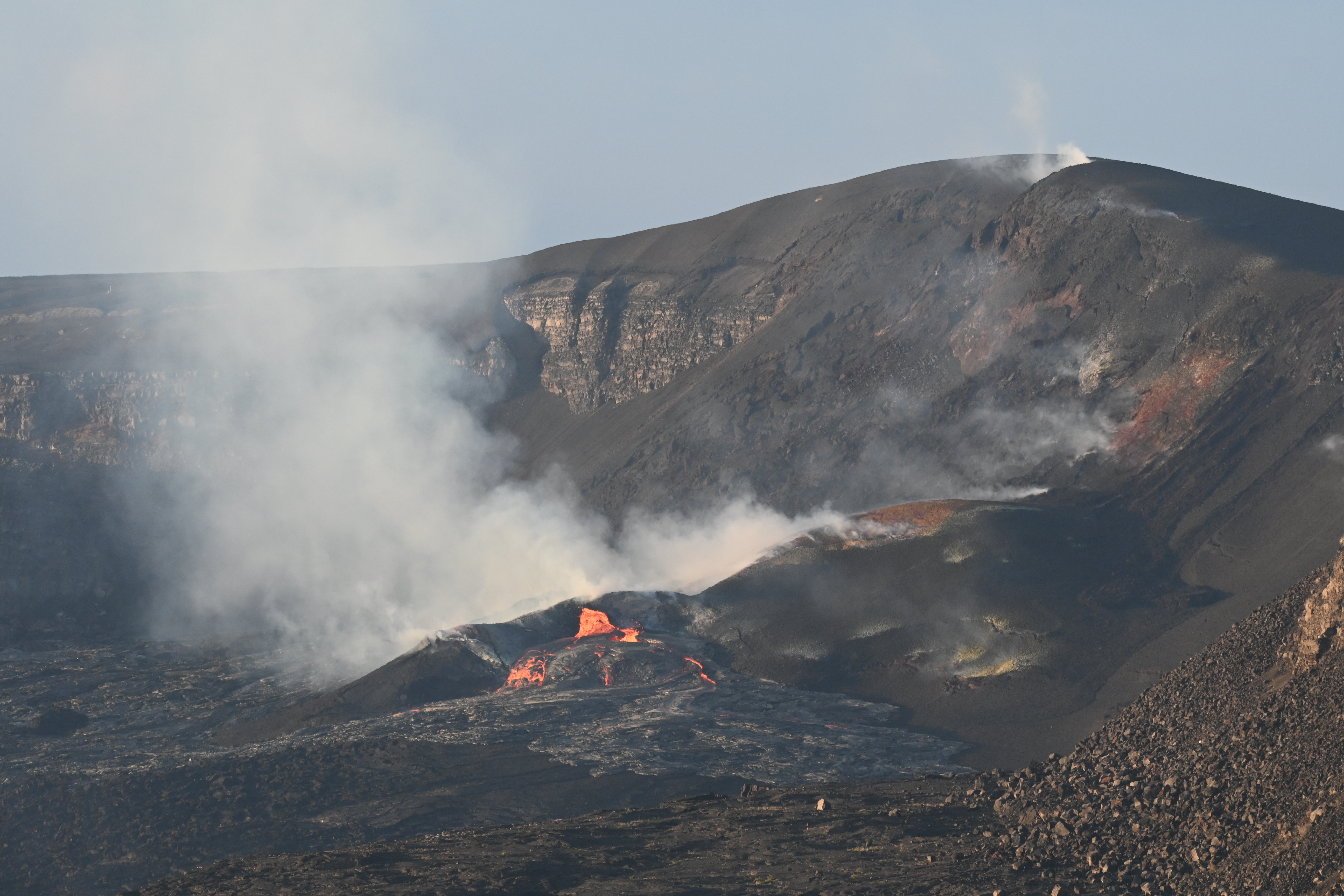
A mountaintop is the House of God, a place of mystery.
A mountaintop lacks human homes, for it is foreign ground.
A mountaintop is a solid thing, we think, until it flows.
A mountaintop can teach us anything we wish to learn.
A mountaintop can teach us truth unless we’d rather hold our lies.
The liquid stone flows down the mountainside passing people flowing up.
The mountain’s fluid flanks sweep our pretense away.
And then the lava hardens into rock like human hearts
Who fail to learn the truth that swords and spears mean nothing
And the truth that plows and pruning hooks mean everything.
A mountaintop can teach us truth unless we’d rather hold our lies.
A poem/prayer based on Isaiah 2:1-5, the Revised Common Lectionary First Reading for Year A, First Sunday of Advent.
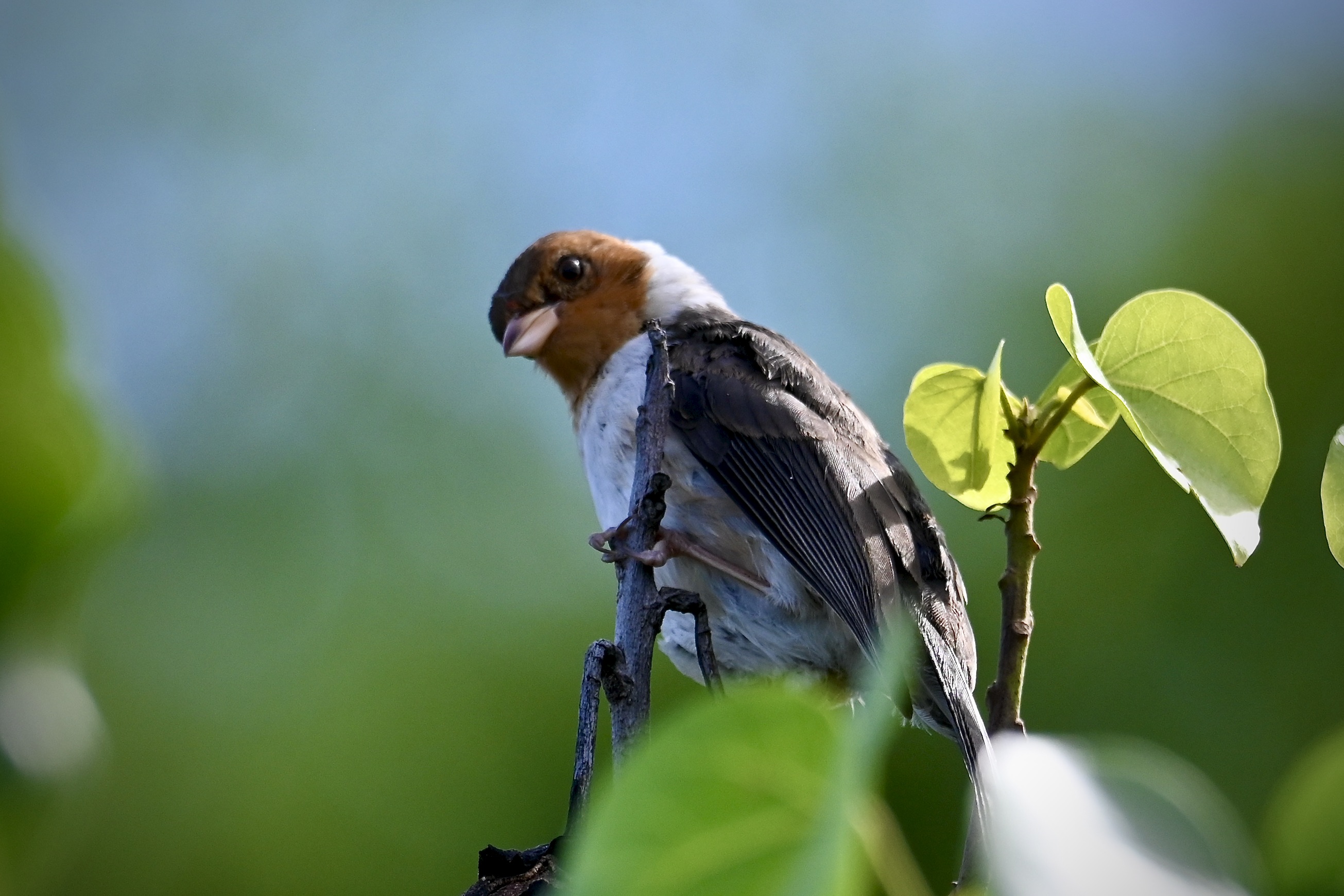
He was a yellow-billed cardinal, and he was young. He was so young, in fact, that the feathers on the top of his head weren’t red; they were brown. He was so young that his bill wasn’t yellow, it was tan.
He was old enough to be living mostly on his own, finding his own food among the seeds and berries, and his own shelter for the night. He was old enough to enjoy a sunrise or a sunset, and he was old enough to enjoy sitting quietly in the sun.
What he wasn’t old enough for was to understand what “peace” was.
That may seem odd, given that sitting quietly and enjoying the sunshine sounds pretty peaceful, but it didn’t always feel that way. For one thing, if he sat in the sunshine for too long, he’d start to feel hungry. Feeling hungry, he thought, wasn’t very peaceful. I guess he had a point there. Being uncomfortable isn’t very peaceful.
Worse than that, though, when he got hungry, he had to find food. He knew how to do that, of course. That wasn’t the problem. The problem was that other birds would show up, and he didn’t like that. Other yellow-billed cardinals were usually OK – he knew a couple of them that tended to tease him – but he really didn’t like it when different kinds of birds turned up. House finches made him nervous. House sparrows were kind of scary. Saffron finches made him feel uneasy about his rather dull coloring.
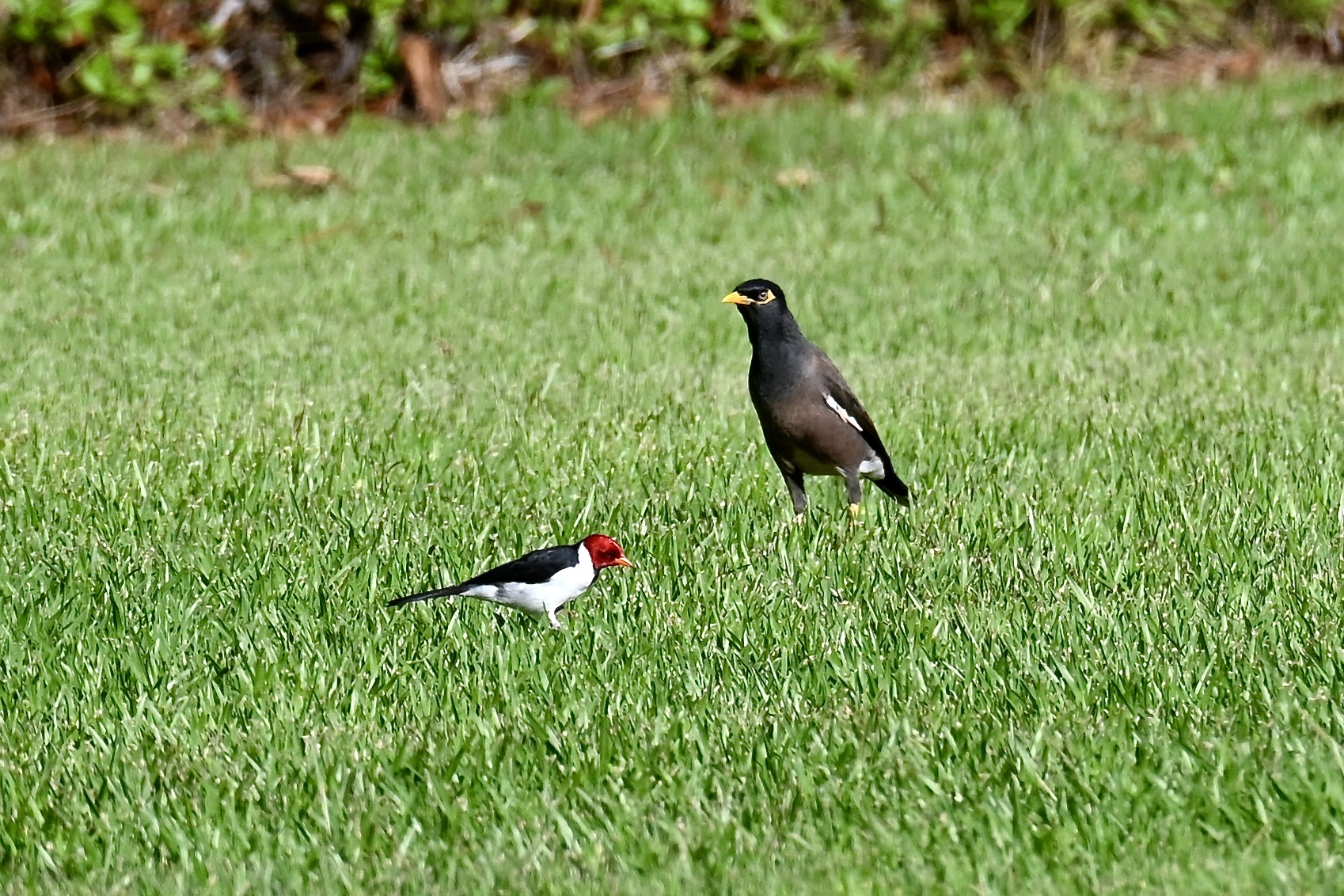
Worst of all, as you might guess, were the mynas. For one thing, they had brighter yellow bills than he did. For another, they were a good deal bigger. And, of course, they were often really loud, really argumentative, and really frightening.
As he got older and his head feathers turned red and his bill turned more yellow, he still didn’t like it when other birds turned up while he was feeding. He didn’t really notice that the finches and sparrows and kolea really paid him no mind. They just got on with looking for bugs and seeds and worms to eat. So when the myna turned up near him while he was eating, he jumped.
“What’s wrong, youngster?” asked the myna. “Is there something wrong?”
“Oh, no, myna sir,” said the yellow-billed cardinal. “Nothing wrong at all.”
“You jumped,” said the myna. “Did something startle you?”
“Well,” said the cardinal, “you did. You caught me by surprise when you landed.”
“Oh, that’s fine,” said the myna, who sounded somewhat relieved. “Sorry about that. You had me worried for a minute there.”
“You worried?” said the yellow-billed cardinal. “Why?”
“Some birds get upset about mynas,” said the myna. “They think we’re loud and obnoxious. They don’t like it when we’re around.”
The yellow-billed cardinal had thought such things, so he thought that now he’d better stay quiet.
“I’m glad you’re not like that,” said the myna. “I could do with a bit of peace today.”
That’s when the yellow-billed cardinal learned what peace could be – a time when creatures who were rather different could live side-by-side, meet their needs, and not fear one another. A yellow-billed cardinal could be safe from the bullying he feared from a bigger bird. A myna could be safe from the rejection and disdain of a smaller bird.
“I could use a bit of peace myself,” said the yellow-billed cardinal. “Let’s enjoy it while we can.”
by Eric Anderson
Watch the Recorded Story
I write these stories in advance, but I tell them from memory, which means things change.
“By faith Rahab the prostitute did not perish with those who were disobedient, because she had received the spies in peace. And what more should I say? For time would fail me to tell of Gideon, Barak, Samson, Jephthah, of David and Samuel and the prophets…” – Hebrews 11:31-32
Rahab and Samson, heroic opposites. She was the foreigner betraying her nation, saved by her pledge to the ruthless invader. Her neighbors all died, but she and her family did not.
Samson the Strong, a leader and judge, praised for his strength but not for his folly. Like Rahab, he trusted an enemy, losing his strength. But when it returned, he died with his foes.
Grim heroes. Grim stories of warfare, betrayal, coercion, and death. No wonder that neither received “the promise” in full. How could they, when the promise of Jesus is life?
A poem/prayer based on Hebrews 11:29:12:2, the Revised Common Lectionary Second Reading for Year C, Proper 15 (20).
The image is of two mosaics in Santa Maria Maggiore, Rome (ca. 430). Above: Joshua meets the commander of the Lord’s army. Below: Israel’s scouts flee from Jericho, aided by Rahab. Photo by Fabrizio Garrisi – Own work, CC0, https://commons.wikimedia.org/w/index.php?curid=157025271.
[Jesus said,] “Peace I leave with you; my peace I give to you. I do not give to you as the world gives. Do not let your hearts be troubled, and do not let them be afraid.” – John 14:27
The world gave to you the way it gives, Lord: Resentment, suspicion, condemnation, violence. At the table you offered your peace to your friends. In the garden, at the cross, peace fell away.
I pray, give to me as you give, not the world. The world still loves to condemn and coerce. In your peace I just might be able to stand, my spirit unbowed by all evil’s power.
A poem/prayer based on John 14:23-29, the Revised Common Lectionary Gospel Reading for Year C, Sixth Sunday of Easter.
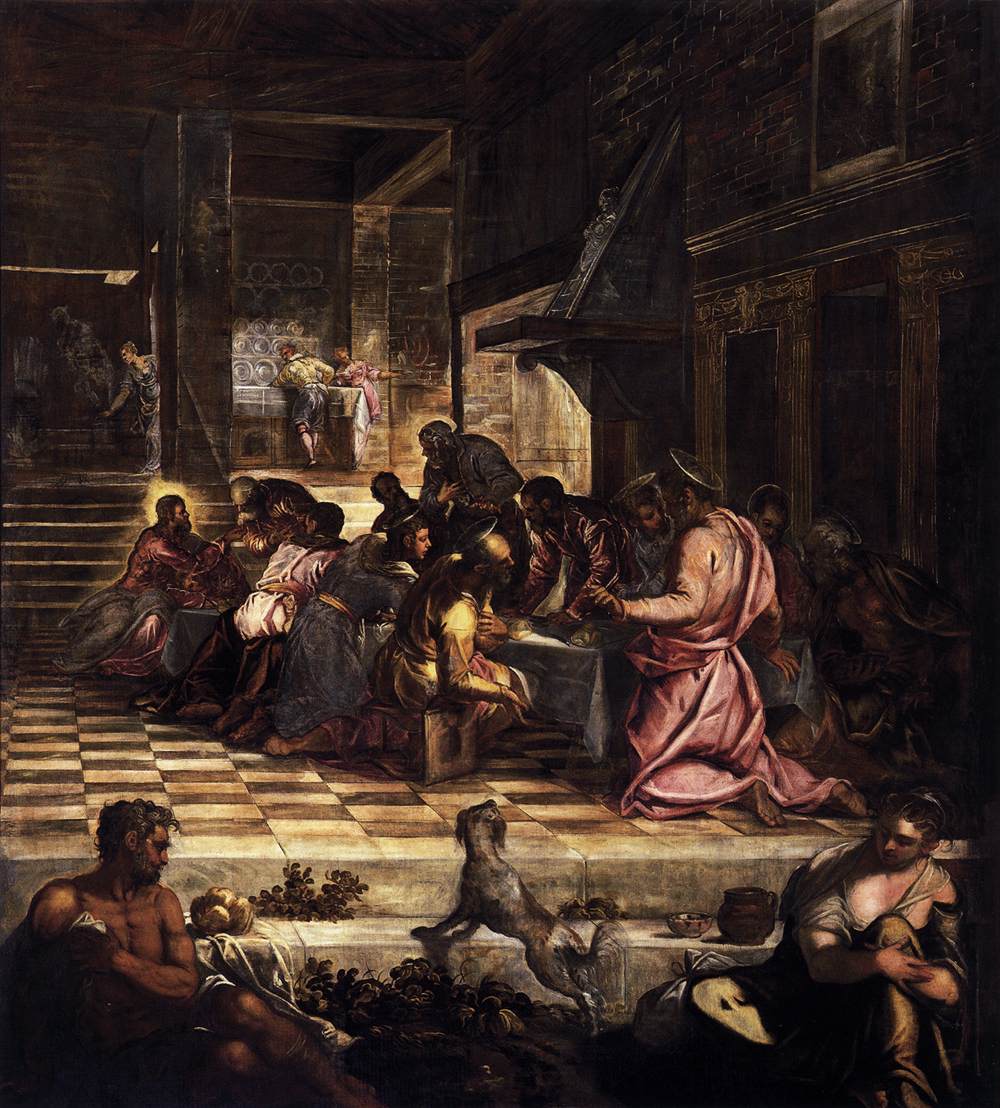
Tintoretto painted more than one Last Supper. The chaotic atmosphere of this image drew me in, even as I was writing about peace, because peace in the chaos is our great challenge.
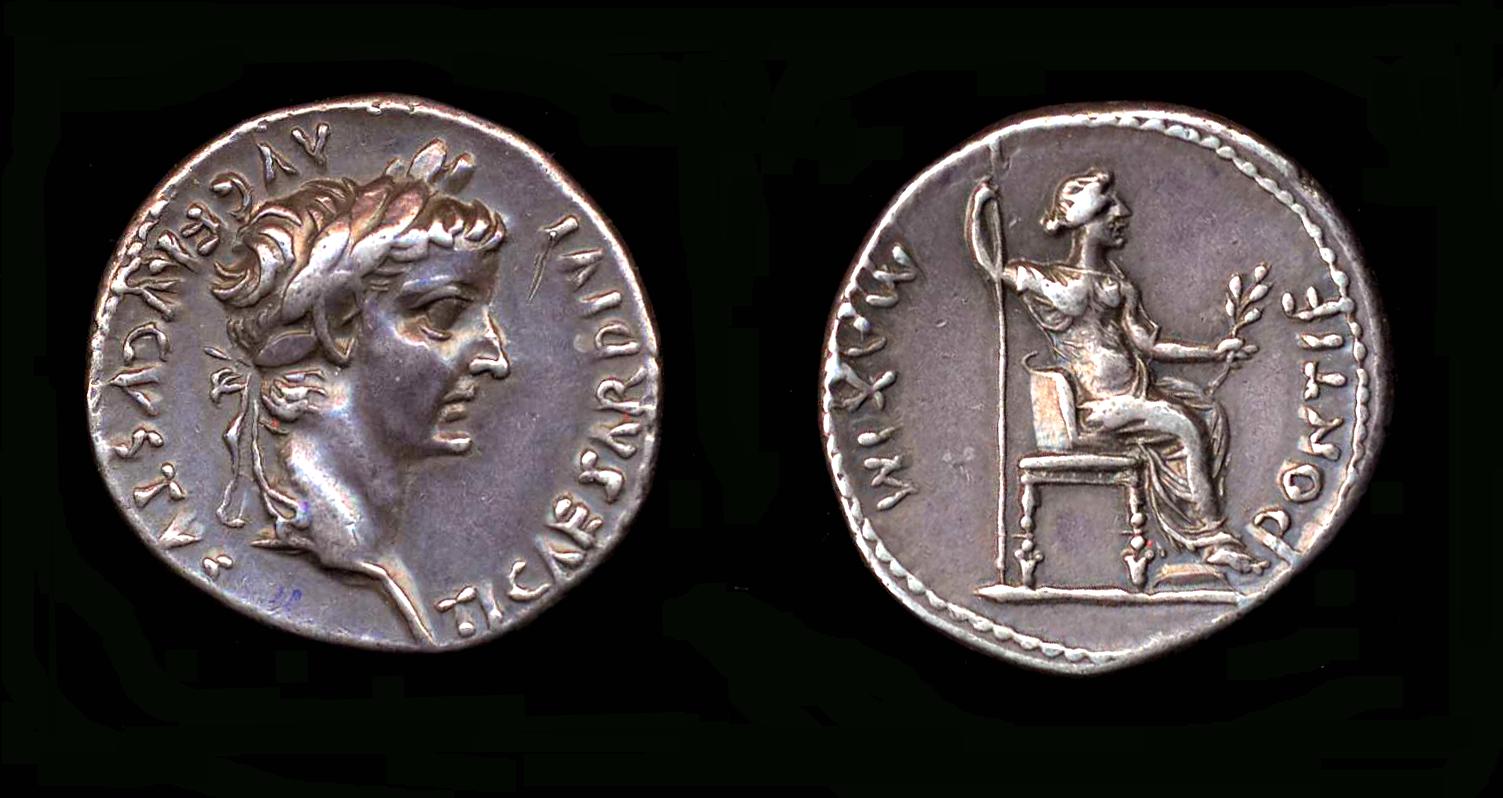
Then [Jesus] said to them, “Give therefore to the emperor the things that are the emperor’s, and to God the things that are God’s.” – Matthew 22:21
Nobody asked, “What things are God’s?” for fear, perhaps, you’d speak the answer then: “All things belong to God; all things, including you.”
Two millennia we’ve focused our attention on the first, imperial, clause, debating what the monarch, governor, or mayor should receive,
As if what they received did not belong to God, both when the coins were in our hands and when they’d dropped into official palms. They still belong to God.
As crimson cascades in its gruesome torrents from the slain of Israel and Gaza, of Ukraine, Myanmar, Maghreb, of Russia and Sudan,
Of Mexico and Ethiopia, and dozens, scores, of nations bled by fewer deaths but still, too many when the the only number should be, “none,”
What do you tell us now, in our imperial power? Do you hold out the twenty dollar bill and say, “Please, not like this. Oh, not like this”?
Or do you drop your head into your hands and in a river of frustrated tears weep for the desecrated images of God?
A poem/prayer based on Matthew 22:15-22, the Revised Common Lectionary Gospel Reading for Year A, Proper 24 (29).
Photo of a first century denarius of the Emperor Tiberius by Portable Antiquities Scheme from London, England – Tiberius, R6195, BMC 49. Uploaded by Victuallers, CC BY 2.0, https://commons.wikimedia.org/w/index.php?curid=10817585.
There were three fledglings in the ‘apapane nest, a sister and two brothers. All three had hatched on the same day, which is pretty common for ‘apapane. All three had steadily grown from the food their parents brought to them each day. They’d just begun to learn to fly.
For whatever reason, and who knows the reasons for these things, the sister grew more quickly than her two brothers. Her wing muscles got stronger faster, and she stood taller than they in the nest and on the branches near the nest. And… she started to take charge.
When father or mother came by at mealtimes, she got to the front first. Her brothers got the same amount of food that she did, so the parents didn’t remark on it, but she increasingly got fed first. When it came time for their first test flights, she summoned more of her parents’ attention than her brothers did. She’d fly a little farther among the branches of the nesting tree so they had to keep track of her. But she’d also sing out, “Look at me!” when father or mother started giving instructions to one of her brothers.
When they settled down at night, her brothers had to be satisfied with what room she left them in the nest. She began to push them aside when she wasn’t comfortable, and she began to order them to do things for her. She was bigger. She was stronger. They did what she ordered them to do.
They weren’t happy about it.
“Don’t complain,” she told them. “I’m the oldest and the biggest. You have to do what I tell you.”
She wasn’t actually the first to hatch, but they didn’t dare to tell her so.
Father and Mother didn’t actually notice all this. When one of them was nearby, they were the oldest and the biggest, and she didn’t try to dominate them. But the moment the three chicks were alone, she was in charge, and when she was in charge, she got what she wanted.
If one of her brothers had flown to a particularly nice cluster of ohi’a blossoms, she’d come along and order him away. If one of her brothers was relaxing in a sunny spot, she’d push him off the branch. If it was raining and one of them found a spot where the leaves kept the drops away, guess who would be dry at the end of the shower?
You guessed it. She would.
It was grandmother who spotted all this, observing from a neighboring tree. She flew over when big sister had taken over a cluster of ohi’a flowers.
“Not like that,” she told her granddaughter.
“Not like what?” said granddaughter.
“Stop bullying your brothers.”
“I’m not bullying them,” she said.
“You certainly are,” said grandmother. “You just took over this flower cluster.”
“I’m entitled,” said the big sister. “I’m the biggest and the oldest. How should I treat my little brothers?”
“Not like that. You all hatched on the same day,” said grandmother, “and soon enough your brothers will catch up to your size and one or both of them might get bigger than you are. Will you be content to be kicked off your flowers then?”
Her granddaughter had to admit that she wouldn’t.
“Treat your brothers the way you want to be treated. Treat them better, in fact. That’s how we build a strong family. It’s how we make peace among ‘apapane.”
She did change her ways, though it took a little while. Fortunately she did it before one of her brothers did, in fact, grow to be bigger than she was – but he had learned that lesson, too, and treated his sister as he wanted to be treated, and even better.
by Eric Anderson
Watch the Recorded Story
First I write the story (you’ve just read what I wrote). Then I tell it without the written copy in front of me. And… things change.
I offered this prayer as the Invocation for the March 9, 2022, meeting of the Hawai’i County Council. I can’t claim this is the prayer exactly as I prayed it – I didn’t write it in advance – but this is certainly close.
E pule kakou. Let us pray.
O Holy One, we pray for peace today. We pray for peace in our minds and our spirits, because it is in that peace that wisdom and compassion emerge. We pray for peace in our homes, so that our community may find its foundation in love. And we pray for peace in the world, especially in those places where the peace is broken: Ukraine, Afghanistan, Myanmar, Tigray, Yemen, and other places where the violence is less but the grief is just as deep. We pray for peace, O God, in our world, in our community, in our homes, and in our hearts.
“Put on the whole armor of God, so that you may be able to stand against the wiles of the devil.” – Ephesians 6:11
“Saul clothed David with his armor; he put a bronze helmet on his head and clothed him with a coat of mail. David strapped Saul’s sword over the armor, and he tried in vain to walk, for he was not used to them. Then David said to Saul, ‘I cannot walk with these; for I am not used to them.’ So David removed them.” – 1 Samuel 17:38-39
Truth? You want me to wear truth? That’s a heavy burden to carry on the belt. My hips are groaning just to think of carrying the truth. I cannot walk with these.
Righteousness? You want me to wear righteousness, to face the world with generosity presented as my face? I can’t imagine feeling any more vulnerable than that. I cannot walk with these.
Faith? You want me to bear faith? I tell that, as bucklers go, faith wears a little thin. The barbed and flaming arrows pierce it through even as I strain to lift it. No; I cannot walk with these.
Salvation? You want me to wear salvation? This one sounds good, I grant you, but it bows the head. I’d rather revel in my sovereignty than yours, which makes me bow. I cannot walk with these.
The hardest of all to wear are the shoes that make me ready to proclaim the gospel of peace. Where might they take me? Into what risks? And what protection do they offer? None.
No and no and no. I cannot walk with these.
And yet… I try.
A poem/prayer based on Ephesians 6:10-20, the Revised Common Lectionary Second Reading for Year B, Proper 16 (21).
She just wants a home without gunfire. She just wants a home without force. She just wants a home without war at the door. She just wants a home without war beneath the roof…
Grant to her justice, O God. Grant to her justice with the speed of the unjust judge. Grant to her justice, O God, for she waits.
A poem/prayer based on Luke 18:1-8, the Revised Common Lectionary Second reading for Year C, Proper 24.
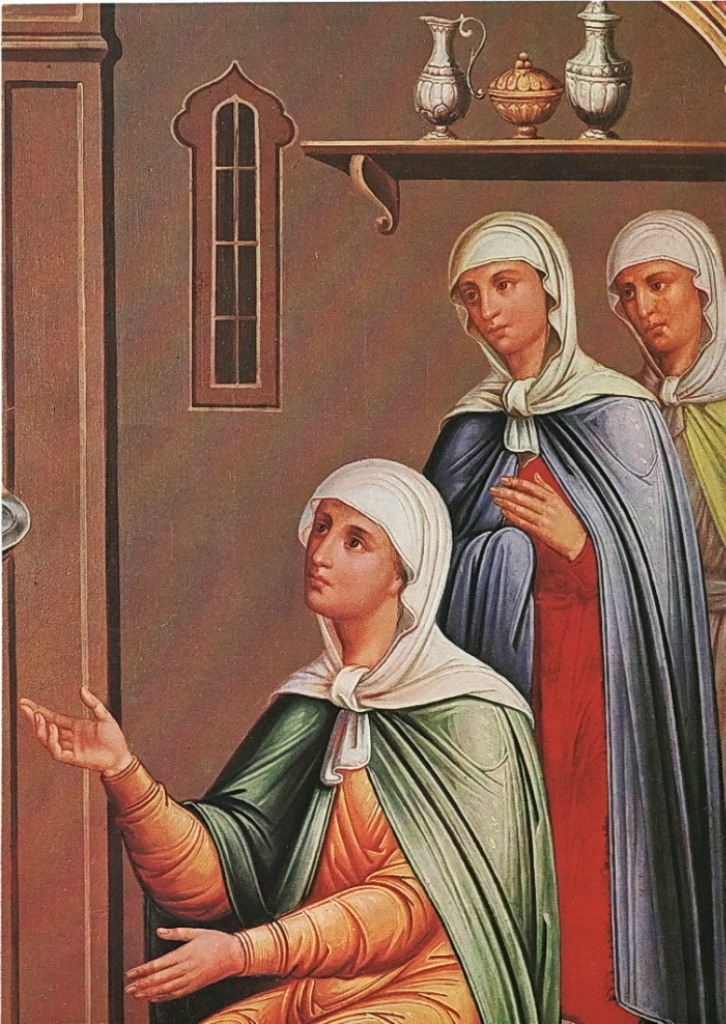
The image is a section of a 19th century composition “The Parable of the Unjust Judge” found in the Palace of Facets, Moscow. Public Domain.




 ordainedgeek