Both Men and Women


“In the last days it will be, God declares, that I will pour out my Spirit upon all flesh, and your sons and your daughters shall prophesy, and your young men shall see visions, and your old men shall dream dreams.” – Acts 2:17, quoting Joel 2:28

Assembling for the feast of Shavuot, the Spirit roared.
No gentle breeze for us; a tempest howled there
among our trembling circle, through our trembling souls.
The flickering light upon our foreheads did
not shed illumination, no. I saw it as
a portent of our immolation.
Not since the angel told me not to fear
have I been so afraid.

My limbs have dragged my shivering frame
into the streets, which teem with goggling worshipers.
They fight their way upstream along the way
my son last trod beneath the burden of a cross.
How many know, how many care, that Jesus died
abandoned by his follower-friends, attended by
these women who, like me, recall dear Miriam,
who danced before the Law.

The raucous streets resound with Babel sound,
with accents I know well, and languages
I don’t. To my astonishment, one voice is mine,
another comes from Mary here, and Mary there,
and from a hundred other throats. We praise
our God, because when Jesus had been laid into
his tomb, the Holy One rejected our rejection, called
him back to life.

They scoff, of course, that we are drunk (how drunk,
they do not know, for I am filled with Spirit I have never known).
I draw my breath in deep. I plant my feet upon the unforgiving stones.
I start to lift my arm to summon all to hear my words,
and then I hear it: Simon’s voice, my son’s beloved Rock,
against all expectation quoting from the prophet Joel.
Who would have thought it? I rejoice, except: I wonder, when
will faithful people hear a woman’s voice again?

A poem/prayer based on Acts 2:1-21, the Revised Common Lectionary First Reading for Year C, Pentecost Sunday.

The image is The Virgin surrounded by twelve apostles or Pentecost, by Master of the Crucifix of Pesaro (ca. 1380). Photograph by Rama, Wikimedia Commons, Cc-by-sa-2.0-fr, CC BY-SA 2.0 fr, https://commons.wikimedia.org/w/index.php?curid=11148957.

Many artists included Mary among the Twelve in their depictions of Pentecost.

Full inclusion of God’s people does not stop at men and women.

Redemption of the Rock

“But Peter, standing with the eleven, raised his voice and addressed them…” – Acts 2:14 

Has there been enough time to redeem me?

“You’re the Rock,” smiled Jesus. Oh, yes. I’m the rock.
Always first to reply, always first to be chided. They smirked,
those eleven, every time I was caught
being first to say things they were thinking in silence.

Can a month or two’s passage possibly remake me?

“You’re the Rock,” they have said since the day that he rose.
“You’re the first to have seen him” – I open my mouth
to remind them of Magdalene, then shut it again.
“You’re the Rock.” Well, at least we’re a dozen again.

I wonder what time could refashion a rock?

I told them my shame which the Teacher predicted.
How could I hide it? They’d heard, and they’d seen
the look on my face on that terrible morning
when the heart of the Rock was as brittle as flint.

Passover to Pentecost can’t be enough time.

They never have heard what the Teacher said to me
that glorious day when his death turned to life.
My flint heart had shattered, and molten, ran over.
What words could declare the forgiveness he gave?

But can I be reborn in these brief fifty days?

The wind rushes madly. Lights leap on our brows.
Only the Marys sit silent, serenely. We’re out in the street.
My God, we look drunk. I’m speaking a language I don’t think I’ve heard.
How can I explain what has happened to me?

Fifty days weren’t enough, but a moment transformed me.

Now they look to the thick one, the Rock, to say something.
I have no skill with words. I was trained to the net.
But Jesus stayed with me, and I recall some things.
I’ll start with this verse that he taught me from Joel.

I guess fifty days is enough to redeem.

A poem/prayer based on Acts 2:1-21, the Revised Common Lectionary First Reading for Year B, Pentecost Sunday.

The image is The Penitent Saint Peter by El Greco (between 1590 and 1595) – https://collection.sdmart.org/objects-1/info/1090, Public Domain, https://commons.wikimedia.org/w/index.php?curid=119297661. The eyes contain some of the apostle’s self-doubt which I’ve tried to express in this poem.

Story: The Wind

May 28, 2023

Numbers 11:24-30
Acts 2:1-21

I want to talk to you about the wind.

The wind made its way across the ocean. In the distance it could see the green slopes of Hawai’i Island and the great mountains rising. As it swept over the sea, it took water vapor that the sun had raised from the waters and pushed it ahead as growing clouds. As the clouds passed over Hilo, they showered the earth with rain.

The wind moved on, and now the clouds dispersed on the shoulders of the mountains, and the sun poured down in shimmering waves. The wind blew through the town and over the fields, and it cooled the stifling heat. As it did, it blew hard enough to pluck hats from heads and turn umbrellas inside out before they could be closed.

A nene near seaside turned into the wind and spread her wings. The flowing air began to lift her even before she swept them down in a powerful stroke. The wind helped carry her aloft until she turned to fly inland.

Not just birds, but seeds flew on the wind, so that new plants would grow.

In places the wind eased things, but in places I have to admit that the wind broke things. Nails in a roof popped loose. An old tree tumbled to the ground, where its trunk would nourish new trees yet to grow there. A sudden gust scattered a myna’s nest over the ground, and the parents-to-be screeched and started building again.

The flowing wind swept over the summit of Kilauea, where fumes rise from the volcano’s liquid heart beneath. It carried the sulfur and tiny flecks of glassy ash further along the island, dispersing them as it went. Oh, they smelled it and they frowned in Kona!

But when the sun set, those bits of glassy ash caught the light and glowed in red and orange and gold. The people and the creatures and the birds gazed at it with satisfaction. “It’s a Kona sunset,” they said.

The wind laughed to hear them say it, for the Kona sunset depends on the Kilauea wind.

And the wind blew on, far over the Pacific Ocean to lands far distant from our shores, blowing where it will.

It’s an old, old thing to compare the Holy Spirit of God to the winds that blow across our planet. In the ancient languages of the Bible, and also in Hawaiian (but not in English) the words for “wind,” “breath,” and “spirit” are the same: Ruach. Pneuma. Ha. Like the winds of earth, the Holy Spirit brings the things of life, for the spirit as well as the body. Like the wind beneath the wings of the birds, the Holy Spirit can lift us up. Like the wind that brings down trees, the Holy Spirit will shake our ideas and assumptions and make us consider new things. Like the wind that creates a Kona sunset, the Holy Spirit creates, helps us create, and helps us appreciate, beauty.

The Holy Spirit is God’s gift to the world, to the Church of Jesus, and most of all, to you.

by Eric Anderson

Watch the Recorded Story

On Sunday I tell the story from memory of the story I’ve written – and I rarely strive to remember it word for word. The differences are part of the creative process – or so I tell myself.

Photo by Eric Anderson.

Pentecost 2020

When the day of Pentecost had come, they were all together in one place.

They were together in their humiliation.
They were together in their grief.
They were together in their rage.
They were together in their humanity.

And suddenly from heaven there came a sound like the rush of a violent wind…

A man bleeding, collapsing on the road.
A woman dying in her own apartment.
A man gasping that he couldn’t breathe.

And at this sound the crowd gathered…

They gathered to grieve.
They gathered to protest.
They gathered to demand.
They gathered to declare their humanity.

Amazed and astonished, [the crowd] asked…

They asked why you deserved this.
They asked for submission to violence.
They asked for time for the process.
They offered… nothing.

…In our own languages we hear them speaking about God’s deeds of power.

God made us children.
God made us adults.
God made us human.
God made us the equal of anyone.

All were amazed and perplexed, saying to one another, “What does this mean?”

Do you have to ask?
If you have to ask,
how can you know?

But others sneered.

Oh, yes. We have heard this before.

But Peter… raised his voice and addressed them, “…This is what was spoken through the prophet Joel: ‘I will pour out my Spirit upon all flesh, and your sons and your daughters shall prophesy…'”

We will declare the justice of the Creator.
We will declare the injuries of the Created.
We will demand the justice of the order.
We will defy the structures of the racists.

May everyone who calls on the name of the LORD be saved.

A poem/prayer based on Acts 2:1-21, the Revised Common Lectionary First Reading for Year A, Pentecost Sunday.

The image is “Pentecost” by JESUS MAFA. Used by permission under Creative Commons Attribution/Noncommercial/ShareAlike 3.0 license.

Magdalene’s Pentecost

They called it, “an idle tale,”
these Followers of the Way,
these messengers of the Messiah,
these pillars of the Church.

They called it, “an idle tale,”
when Joanna and Mary and I
proclaimed the Word of the LORD
declared to us by angels.

Shall I call it, “an idle tale,”
when wind and fire and dancing tongues
awakened all these pillars
to their urgent calling?

Shall I call it, “an idle tale,”
when Simon affirms that
daughters prophecy – though he
did not believe our word?

I will not blame them for their “idle tale,”
but neither will I wait until
the Spirit’s fire dims and they
ignore the women once again.

A poem/prayer based on 2:1-21, the Revised Common Lectionary first reading for Year C, Pentecost Sunday. The poem also refers to Luke 24:1-12.

It comes from my wonder that Mary Magdalene is not mentioned the chronicles of the Early Church after Jesus’ resurrection.

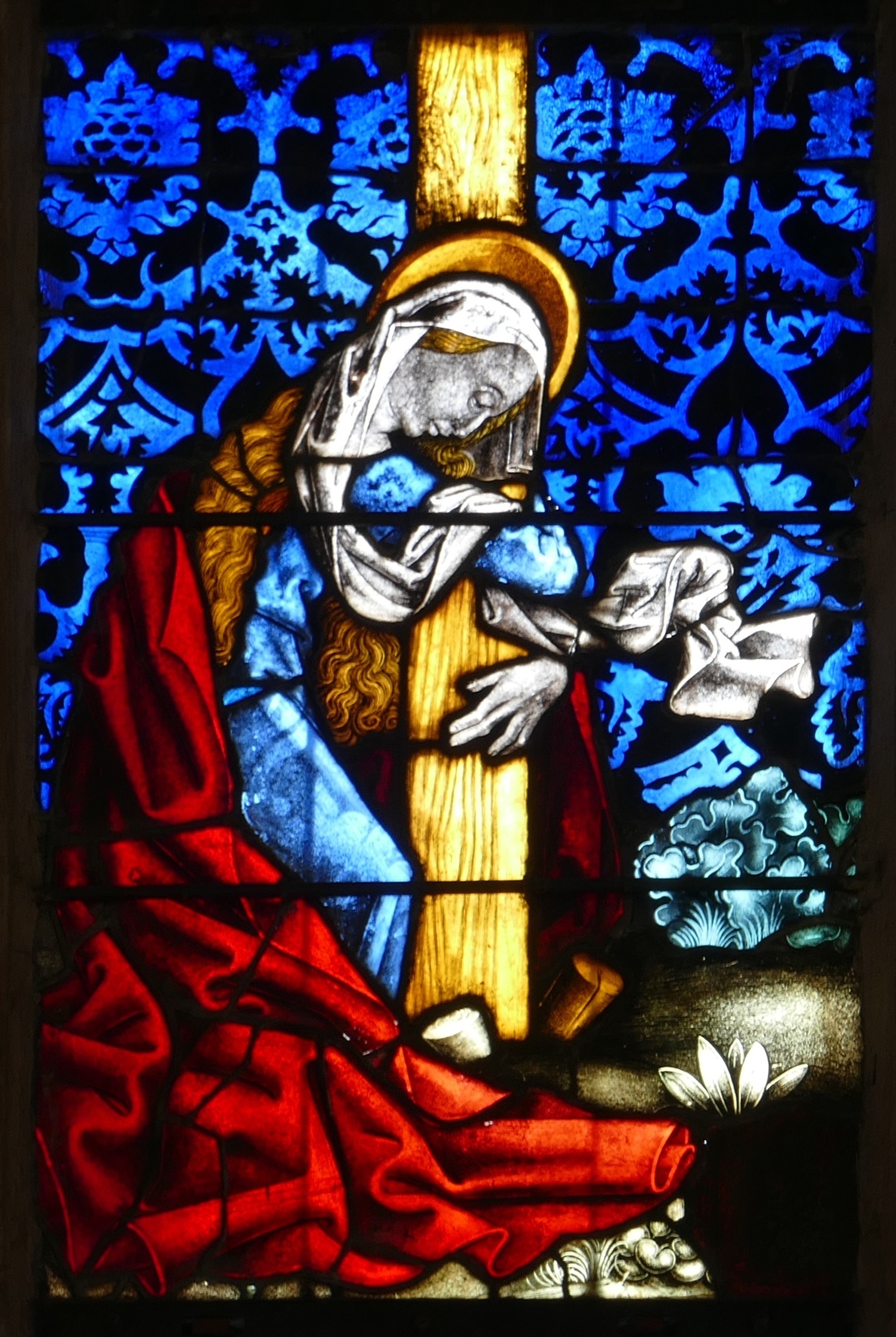
The image is a panel of a stained glass window depicting the crucifixion of Jesus at the Eglise abbatiale Sainte-Walburge, Walbourg, France.