
Story: High Tide

December 1, 2024

1 Thessalonians 3:9-13
Luke 21:25-36

The auku’u, or black crowned night heron, likes to eat. If you look out along the shallows of Hilo Bay, or in the rivers of the valleys, you’ll find auku’u perched on rocks or grass or just standing in the water looking for fish. Although they’re called “night herons” in English, in Hawai’i auku’u fish during the day, and do pretty well at it.

One auku’u, however, developed a somewhat unusual habit. He didn’t like being wet, which is a sad thing for a bird living in Hilo, and he discovered that if he waited for high tide he could spend less time with his feet in the water, since the water, as it were, brought the fish to him.

The thing about a high tide is that it happens just about twice a day, roughly twelve and a half hours apart. That means that sometimes high tide will be in the middle of the day, but a couple weeks later it’s well into the evening. At some times there would be two high tides during daylight, but at other times one high tide would be in the middle of the night. That meant he’d go over a day between meals. And that would make him hungry.

He was moping on the shoreline one morning, waiting for the next high tide (coming in at noon) when a friend landed near him. Noticing that he looked unhappy, she asked him what was wrong.

“I’m hungry,” he said.

She looked at him. Auku’u have been known to say, “I’m hungry,” but they usually say it while they’re on their way to start fishing. An auku’u sitting near the water and saying, “I’m hungry,” was a new and different experience. She didn’t know what to say.

“I haven’t eaten since about this time yesterday,” he said.

“For heaven’s sake, why? Aren’t there any fish?”

Then he explained about fishing at high tide.

“Let me get this straight,” she said. “You’re going hungry for hours because you don’t want to get your feet wet?”

“Do you like wet feet?” he demanded.

“I like being hungry a lot less,” she replied.

He was silent because, he realized, he like being hungry less than he liked having wet feet.

“Sometimes things are perfect,” she said, “like when you get to fish at high tide. But most of the time, we have to muddle along with things as they are. At those times you do the best you can, and look forward to it getting better later on.

“Now come with me,” she told him. “Let’s go fishing. I’m hungry.”

The two of them flew over to the shore.

by Eric Anderson

Watch the Recorded Story

I write these stories ahead of time, but I tell them from memory (plus improvisation), so what you’ve just read does not match what I said.

Photo of an auku’u in Hilo Bay by Eric Anderson.
Story: Perfectly Picky

April 14, 2024

1 John 3:1-7
Luke 24:36-48

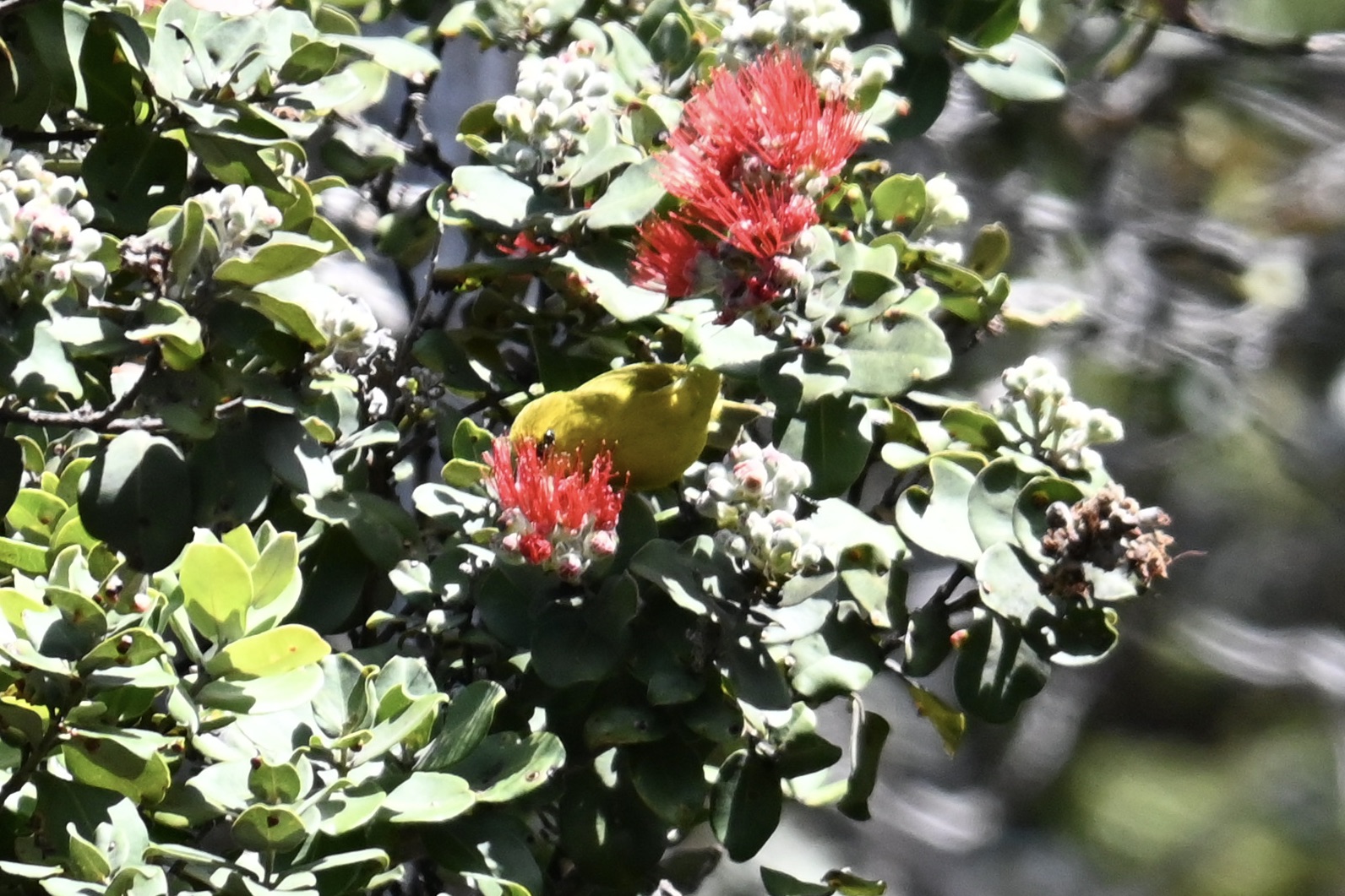
I believe I mentioned a few weeks ago that if there’s something edible up in the ohi’a and koa forests – bugs, berries, fruit, sap, nectar, caterpillars, and so on – there’s an ‘amakihi eating it. They’re not picky eaters. They’re enthusiastic eaters.

Except for one young ‘amakihi. She was perfectly picky.

I don’t know how it got started, but I do know that early on she’d only eat bugs that she’d seen fly. I guess that meant they were fresher, somehow? Which meant that she would no longer eat the crawling bugs or the caterpillars, and there would be no spiders in her diet.

I know. You’re thinking, good choice. Along with you, I am pretty happy not to eat bugs at all. We are people, though, and not ‘amakihi.

Then she wouldn’t eat tree sap that came from cracks in the bark. I know – again, it sounds like a good choice for a human. But if you’re not going to eat tree sap that comes from cracks in the bark, how are you going to get to it at all? An ‘amakihi beak isn’t a good shape for making holes in bark. She’d removed another entry from her diet.

Then she decided not to eat fruit or berries unless it was perfectly ripe. That cut out a whole lot of fruit that was almost ripe, and it cut out a lot of fruit that was just past ripe, all of which feed other ‘amakihi perfectly well.

Her family started to notice that she was maybe getting a little thinner.

When she decided that the only nectar she’d sip would be from perfectly formed ohi’a flowers, that really did it. Go up to the ohi’a forests and you’ll find plenty of flowers on the trees. But are they perfectly formed into red puffballs? Not exactly. Some flowers show just a few scarlet tendrils. Some form ovals or just plain look squashed.

She wouldn’t eat from them. She wouldn’t even eat the flying bugs that landed on them.

She was hunting through an ohi’a tree that was bright red with blossoms – but very few of them perfect blossoms – when the branch jumped with another bird landing. She looked up and saw her grandmother watching her. Grandmother watched her pick over a big bunch of lehua, sip from none of them, and hop over to another, and sip from none of them.

“What are you doing, granddaughter?” asked grandmother.

“Eating,” said the picky ‘amakihi. “I’m hungry.”

“Eating what?” asked grandmother, who hadn’t actually seen her granddaughter eat anything.

“Nectar,” said granddaughter.

“Where?” asked grandmother.

“From the good ones,” said her granddaughter. “I only eat from the perfect flowers, Tutu.”

Grandmother looked at the tree full of blossoms and didn’t see many perfect ones. “You won’t find many perfect ones, granddaughter,” she said. “Not here, and not anywhere.”

She watched the picky ‘amakihi skip perfectly good (if imperfectly formed) ohi’a flowers for a little longer and said, “I think you should eat from some of the imperfect ones, young one.”

Granddaughter, who was annoyed, poked her beak toward a flower that basically had two red tendrils and no visible nectar, and said, “You mean like that one?”

“No, child,” said grandmother. “Not like that one. There’s nothing there. But the question isn’t whether a flower is perfect or not. The question is whether it feeds you.”

The picky ‘amakihi thought about this a while. And she really was hungry. With a glance at her grandmother, she put her beak into a bright red ohi’a flower which, to be honest, wasn’t perfect, and fed.

by Eric Anderson

Watch the Recorded Story

I write these stories ahead of time, then tell them in worship without notes. As a result, they change in the telling.

Photo of an ‘amakihi feeding at imperfect ohi’a flowers by Eric Anderson.

Story: Imperfect

December 17, 2023

1 Thessalonians 5:16-24
Luke 1:46-55

She was making gingerbread cookies for the first time in her life – she wasn’t very old – and she was all excited about it. Her older brother had learned to make gingerbread cookies a few years before, and he’d got rather good at it.

This was her very first time.

She thought it was going pretty well, even if there sometimes seemed to be more flour on the counter than in the bowl. She might have miscounted the amount of ginger, too. She decided she’d better add some more to make sure there was enough. Yes. Just a little more. And a little more.

When she was cutting out the shapes – there were cookie cutters for people shapes, and for star shapes, and for reindeer shapes, and even for Christmas Tree shapes – she got things a little scrunchy. In transferring the cut-out cookies to the trays for baking, things got more disarranged. One poor gingerbread person lost their leg, and she tried to mash it back together.

Her older brother came by about this point and decided to make fun of her more oddly-shaped cookies. The two discussed it calmly and reasonably – well, no. The two of them were yelling by the time the cookies came out of the oven. Which might be why there were a little overdone.

She burst into tears.

Mother gathered her into her arms as she said, “They’re not perfect! They were supposed to be perfect!”

Indeed, they weren’t perfect. Some of the trees looked like they’d been through a windstorm. The mashed-together leg had come off in the baking. At least two of the stars had very bent points.

And, it had to be said, they were a little too brown. Not burnt, quite, but any longer in the oven and burnt they’d have been.

“They’re not perfect for Christmas!”

Mother, who thought about things like this, said, “Do you think Christmas is about being perfect?”

The girl said, “Isn’t it supposed to be?”

Mother told her that Jesus didn’t come into the world because it was perfect. It was full of people doing unkind, even cruel things to one another. Jesus came to show a better way, and help people find and live a better life here on earth and beyond. Jesus came to love the ones who didn’t think they were loveable.

“But my brother’s Christmas cookies are perfect.”

Brother, who was feeling sorry he’d picked on his sister, told her that they certainly hadn’t been perfect the first time. “I really burnt the first batch,” he said. “And the second batch wasn’t much better.”

“Let’s see how yours are,” said mother, and all three of them took a bite. She had, in fact, put in far too much ginger.

“I don’t think these are very good, Mommy,” she said, but she wasn’t crying.

“Not so good,” Mother agreed. “Shall we try again?”

In the meantime, her older brother reached for a second cookie. Mother and sister looked at him.

“I like lots of ginger,” he said. “Can I have the recipe?”

Imperfect we may be, but there’s love for us, too.

by Eric Anderson

Watch the Recorded Story

When I tell these stories, I tell them from what I remember of the story I’ve written. And… I make new things up as we go through. There will always be a difference between what I’ve prepared and what people hear.

The image of gingerbread people cookies is by ParentingPatch – Own work, CC BY-SA 3.0, https://commons.wikimedia.org/w/index.php?curid=24263325.