I wrote this song for worship on October 19, 2025, and it is based on the story of Jacob wrestling with God in Genesis 32.
[Chorus]
You’ve got to hold on, hold on Though your limbs are weary and your soul is tired You’ve got to hold on, hold on For the sun will rise and bless your eyes
[Verses]
Jacob sent all his riches ahead His brother had pledged to see him dead. How could he be safe? So he stayed behind Then he wrestled a man until the morning light.
[Chorus]
Jacob lost that match, and called the victor God. He held on to be blessed by eternal love. Now he walked with a limp but he strode out all right To reconcile with his brother in the morning light.
[Chorus]
When the shadows put you in fear Never forget: love is every near. It will come to your aid; it will never deny. You’ve got to hold on until the morning light.
Where I grew up on the shores of the Atlantic Ocean, there are birds that eat worms. In fact, a lot of birds eat worms. Some of them would eat worms (and bugs, and spiders) that burrow into trees. Some of these would use their beaks to dig holes into the bark to get those caterpillars out. Some would even carve pretty big holes in the wood.
Those birds are called woodpeckers.
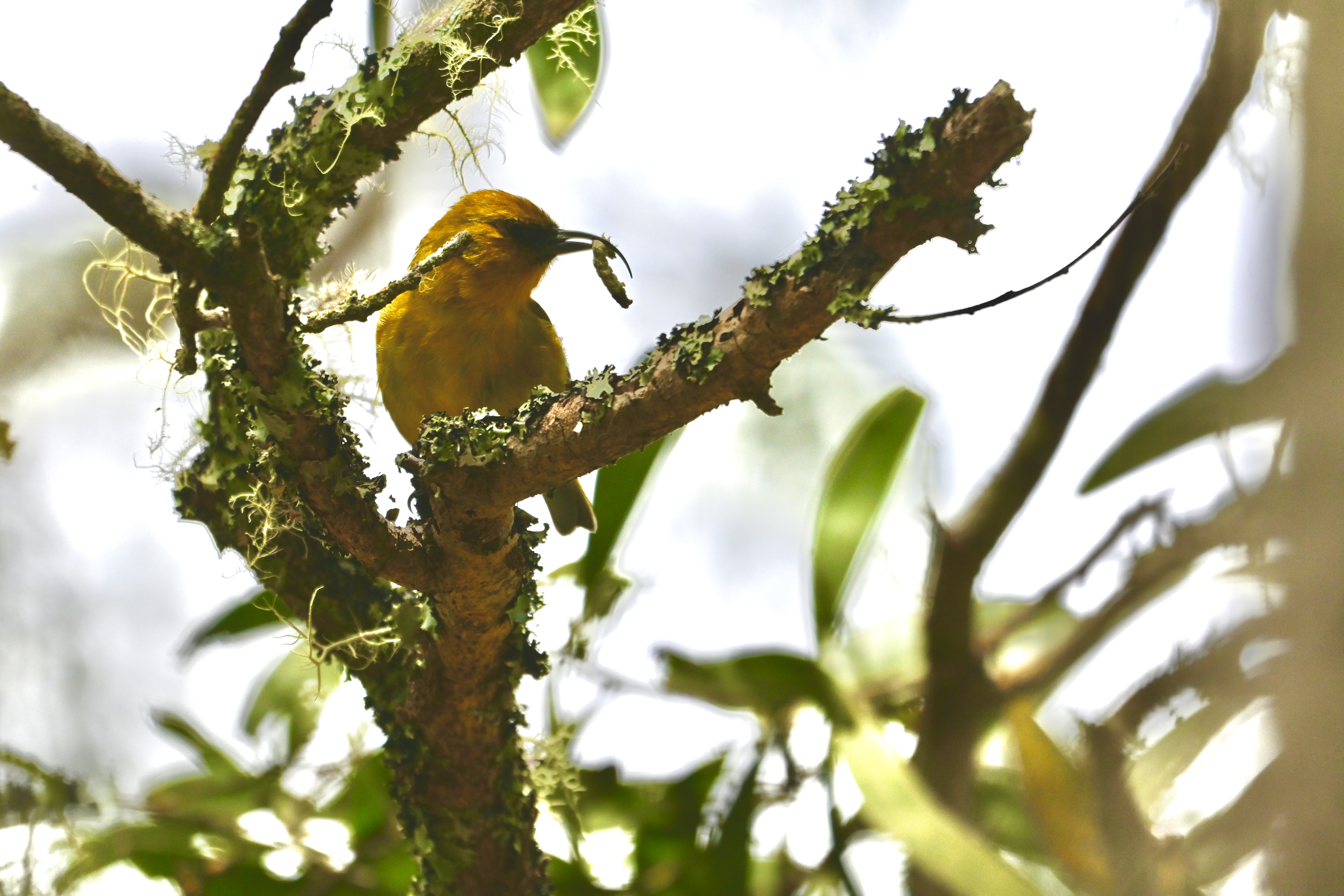
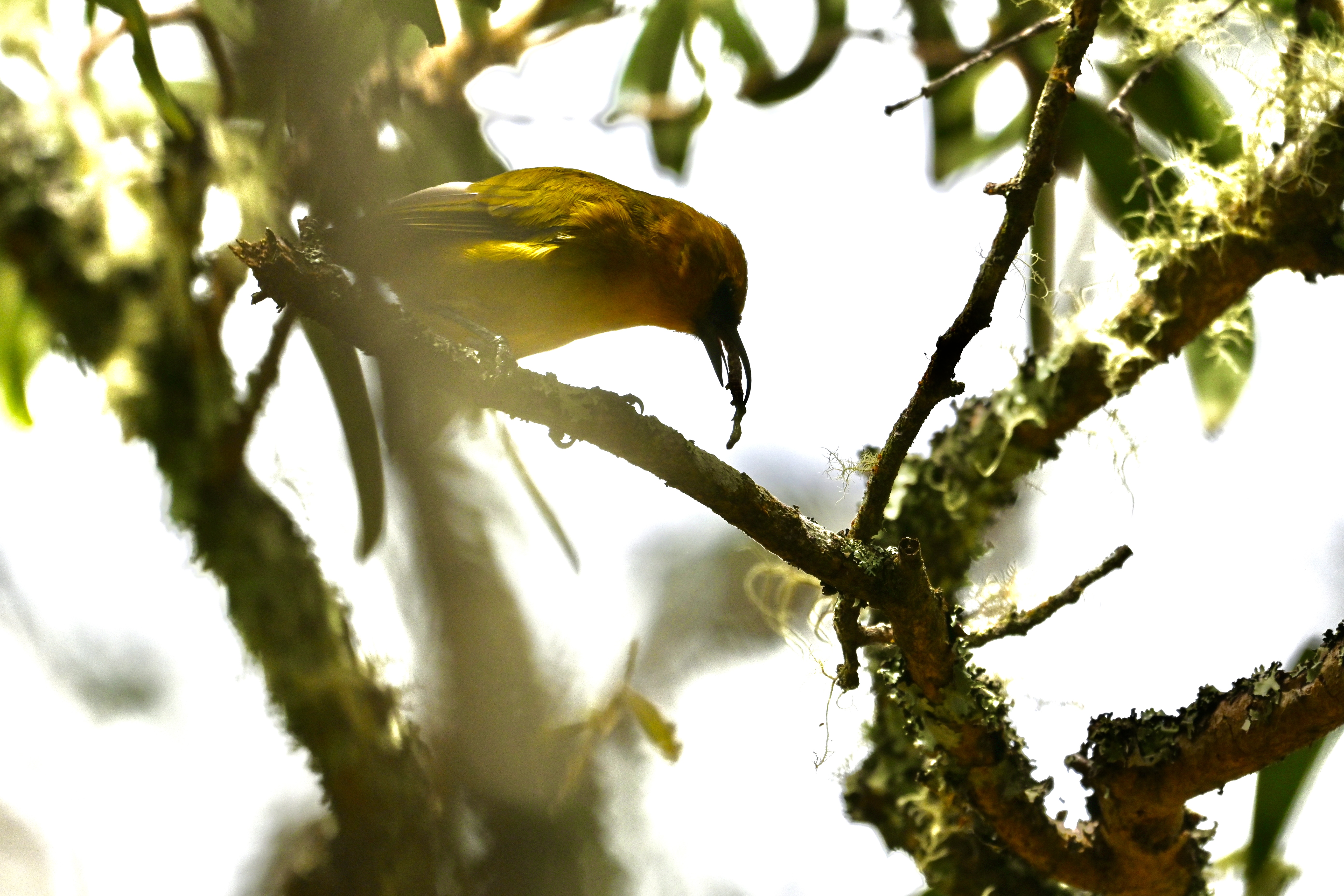
On our island, we don’t have woodpeckers, we have the ‘akiapola’au, and I think I’ve mentioned before that it’s a very rare bird. They only live on our island, and there are less than two thousand of them. They have a short lower beak, and they use that to dig into tree bark where caterpillars or worms might be hiding. When they find one, they use the curved top beak like a fishhook, only they’re catching the worm.
I guess you could say they use both the upper and lower beak to actually eat what they’ve caught.
One day an ‘akiapola’au caught a caterpillar, but he wasn’t alone when he did. There were several other birds around, and none of them had the unique beak of an ‘akiapola’au. Therefore they had a lot of different ideas about what the ‘akiapola’au should do with his newly caught caterpillar.
“It’s stuck on your beak,” said an ‘apapane. “You can’t eat it from there. How are you going to get it into your mouth?”
“He could put it down,” suggested an ‘amakihi, who may have said that because he was hungry and thought he could get to the caterpillar if it crawled off.
“Is it too big to eat?” asked an ‘elepaio, which isn’t a very big bird but neither is an ‘akiapola’au. “You could bite it into smaller pieces.”
“That sounds like a good idea!” said the hungry ‘amakihi, who hoped to get one of the smaller pieces.
The ‘akiapoloa’au swung the caterpillar around, using the twigs and branch to get it from the hook of his beak toward his mouth. The other birds chimed in with advice like “Left!” “Right!” “Up!” “Down!” which wasn’t very helpful.
The worst advice came from an i’iwi, whose beak curves pretty dramatically, too. “Just put the caterpillar down,” she said. “Get some flower nectar instead. I mean, yuck!”
The hungry ‘amakihi echoed her, but the ‘akiapola’au ignored them all, all except an ‘alawi, another bird that likes a menu of bugs and caterpillars, who simply said, “Hold on.”
Hold on.
The ‘akiapola’au held on as he used the twigs to get the caterpillar lined up just right, and then, well, he was a happier ‘akiapola’au because he wasn’t as hungry. He looked at the helpful ‘alawi, who was searching for a caterpillar of her own.
“When you find what you need,” he said, “hold on.”
There are plenty of things in life that it’s good to let go of. Hot pans. Mosquitoes. Sharp things. There are plenty of habits in life that it’s good to let go of. Greed. Making fun of other people. Eating too much sugar.
But when you find what you need, whether it’s the food for the body or the food for the soul, the best advice there is, is: “Hold on.”
by Eric Anderson
Watch the Recorded Story
I write these stories ahead of time, but I tell them from memory, so what I said will not match what I wrote.
Photos of an ‘akiapola’au (and his lunch) by Eric Anderson.
You know how it is with brothers and sisters and siblings of all kinds. Some days everybody gets along, and the next day nobody gets along. It’s squabbling from dawn to sunset, and on the following day everybody is happy again.
In one ‘apapane family, that wasn’t what happened.
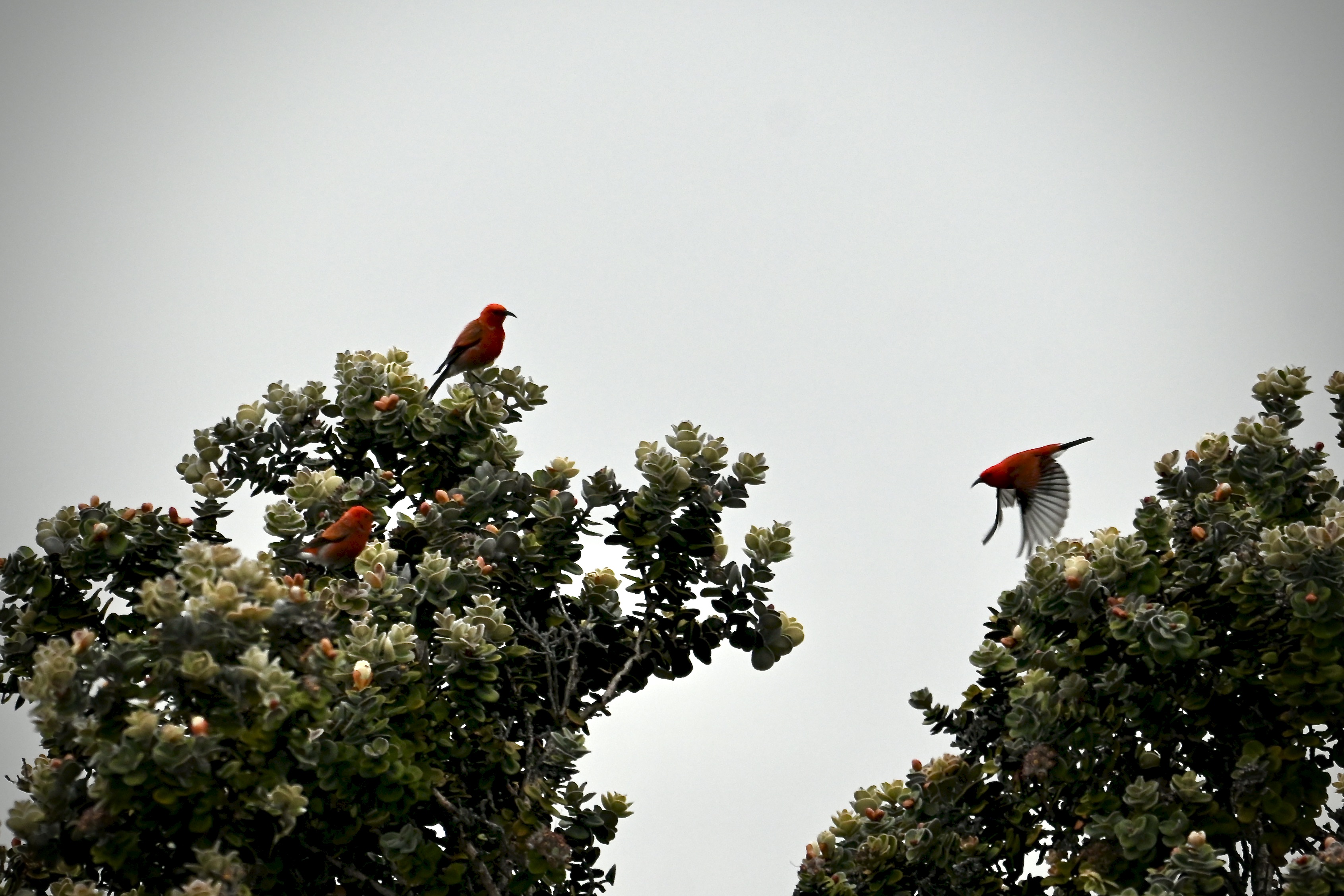
Mind you, they were pretty good to one another in the nest. They were cheerful most of the time when they were learning to fly and when they were getting their adult red-and-black feathers. Each of them felt very grown up as they paraded their bright colors through the ohi’a trees.
For a reason nobody ever discovered, that’s when things fell apart. The two younger ones – and younger is a very narrow thing when you hatch in the same nest just minutes or an hour apart – couldn’t speak a kind chirp to one another. “You’re impossible!” said the brother, who was the middle one. “You’re more impossible!” said the youngest, who was one of the sisters. “There’s no such thing as more impossible!” said her slightly older brother, and it went downhill from there.
The oldest one, an older sister, listened to them with a mixture of laughter at her younger siblings and a fair amount of sadness that they couldn’t get along.
It got worse during nesting season. For some reason some of the supplies were in short supply. Twigs were in plenty, and grasses for lining, but a lot of the mosses were hard to find. The younger sister and her husband had a lot of trouble. Her older brother and his wife, on the other hand, did pretty well. It was chance, pretty much, but they actually had more mosses than they could use and his sister didn’t.
That’s when she flew over to her brother’s nest and clamored and called for help.
“No!” he called. “Go away!” But her nest really needed the materials, and she really couldn’t find them.
“Help! Help us!” she said, and she kept calling and pecking at the branch by the nest until, at last, he couldn’t do anything but give her some mosses and watch her fly away to her own nest.
Of course she came back. She still needed more. One beakfull wasn’t enough, as both of them knew. She had to go through the same thing again. And again. Until he relented – again – and she flew off with the mosses.
That’s when big sister appeared at her younger brother’s nest.
“Are you going to make her go through that again?” she asked.
“She’s annoying,” said her younger brother, which sort of was and sort of wasn’t an answer to the question.
“And you’re not?” said older sister, to which younger brother could only mumble in reply.
“Did you grow these mosses?” asked his sister. “Did you grow this tree? Do you make the sun to shine or the rain to fall? Do you make the sweet nectar in the flowers? Did you make it so that eggs could hatch and fledglings fly?”
Of course the answer to all those questions was no.
“Be like the sun. Be like the rain,” said his older sister. “Be like the tree and the flowers. Don’t make her peck and poke for what the world provides. It’s easier, too. You’ll both feel better.”
When the younger sister came back, her brother had mosses ready for her, and even helped her carry some back to her own nest. And when, in another season, it was the younger sister who found lots of nesting materials and older brother who didn’t, she shared without fuss or complaint.
They were like the sun, the rain, and the trees.
by Eric Anderson
Watch the Recorded Story
I write these stories in advance, but I tell them in worship from memory and improvisation. As a result, what I wrote doesn’t match how I told it.
 ordainedgeek