About Five O’Clock

“And about five o’clock he [the landowner] went out and found others standing around, and he said to them, ‘Why are you standing here idle all day?’ They said to him, ‘Because no one has hired us.’ He said to them, ‘You also go into the vineyard.'” – Matthew 20:6-7

I know this isn’t about me. How could it be?
The tales that people talk about, they feature princes, kings,
princesses, queens, and emperors (however poorly dressed).
They do not linger on the laborers.

This story is about the one who wandered in
the marketplace five times, and each time hired
workers for the vineyard, even as the sun was headed
for the horizon.

The light upon the market stalls was tinged with gold
(the only gold I’ll see) when he came by and asked
why I was idle, as if I hadn’t sought a place all day
to work and earn some bread.

“No one has hired me,” I said, for it was true,
a truth that meant a troubled sleep with empty belly
for myself and for my daughter, wife, and son.
In idleness was my despair.

“Go work,” he said, and so I’ll go, to earn
what bread I can. It will not be enough to feed
my hunger let alone the others in our creaky home.
It is but what it is.

Tomorrow I will hope to find this vintner
or his manager much earlier, and earn
a full day’s wage, and maybe eke a living from
the hot and penetrating sun.

A poem/prayer based on Matthew 20:1-16, the Revised Common Lectionary Gospel Reading for Year A, Proper 20 (25).

The image is “The Parable of the Workers in the Vineyard” (central panel) by an unknown illustrator (11th cent.) – Codex Aureus Epternacensis, Public Domain, https://commons.wikimedia.org/w/index.php?curid=10315166.

Author’s Note: A number of commitments have prevented me from writing LectionPrayers in recent weeks, and it is more than likely that some added responsibilities around the office will prevent me from doing so in some weeks to come. I intend to resume this weekly reflection when I can return those tasks to other people. In the meantime, I consider a LectionPrayer in any week to be an accomplishment. Please bear with me.
What’s New, Beatitudes?

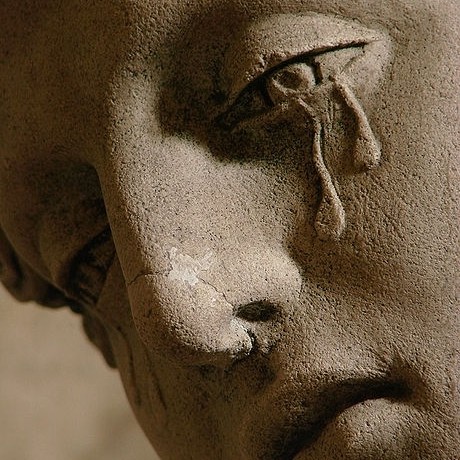
A stone statue face of a woman with two tears dripping from her left eye.

“[Jesus said,] ‘But woe to you who are rich, for you have received your consolation.'” – Luke 6:24

What’s new, Beatitudes?
Woe, woe, woe!

OK, Jesus. I’ll get serious with you,
since you’ve got serious with me.
I’m hardly rich, you know
(except by global standards).
I’m hardly full, except when I’ve
scraped bare my dinner plate.
Nor do I laugh, except, of course
at my own jokes (a punster’s lot).
And people don’t speak well of me,
or, well, I guess they do. From time to time.

What’s new, Beatitudes?
Woe, woe, woe!

I’d claim I do not need
this list of warnings if
I could maintain the case
that I would honor them without them.
And… as I’m relatively rich,
and definitely full, and able to
make merry, granted honor that
is probably beyond my worth,
it looks as if I haven’t taken heed
of warnings you have made.

What’s new, Beatitudes?
Woe, woe, woe!

Well, bring them on, these challenges
to what I’ve done and do.
Charge me once again to love
my enemies and pray for them,
to do them good and not bring harm.
I’ll note they do not do the same for me.
I’d rather not be struck upon the cheek,
but if it comes, I’ll not strike back.
I’ll turn the other way, and wait,
and hope my tears dissuade a second blow.

A poem/prayer based on Luke 6:20-31, the Revised Common Lectionary Gospel Reading for Year C, All Saints Day.

The image is a detail of the figure of Mary Magdalene in the sculpture The Entombment of Christ in the Church of St. Martin, Arc-en-Barrois, France. Photo by User:Vassil – File:Sépulcre_Arc-en-Barrois_111008_12.jpg, CC BY 3.0, https://commons.wikimedia.org/w/index.php?curid=16942922.

Mine?

You can stop right there, Jesus,
after beatitude/blessing/makarios
(Hey! I can pray in Greek!)
the first. You know as well as I
the poverty of my spirit.

No mustard seeds to see,
no pearls beyond appraisal,
no fields a-hundred-fold
to view for you. Just sighs
and bluster nearly equal there.

So you might want to think again
about this notion you would make
the realm of heaven mine. I can’t
conceive of an idea much worse
despite the virtues of the thinker.

For you to give the realm of God
to me is just as ludicrous
as if you gave the keys of heaven
to a fisherman named, “Rock.”

Oh. That’s right. You did.

A poem/prayer based on Matthew 5:1-12, the Revised Common Lectionary Gospel reading for Year A, Fourth Sunday after Epiphany.

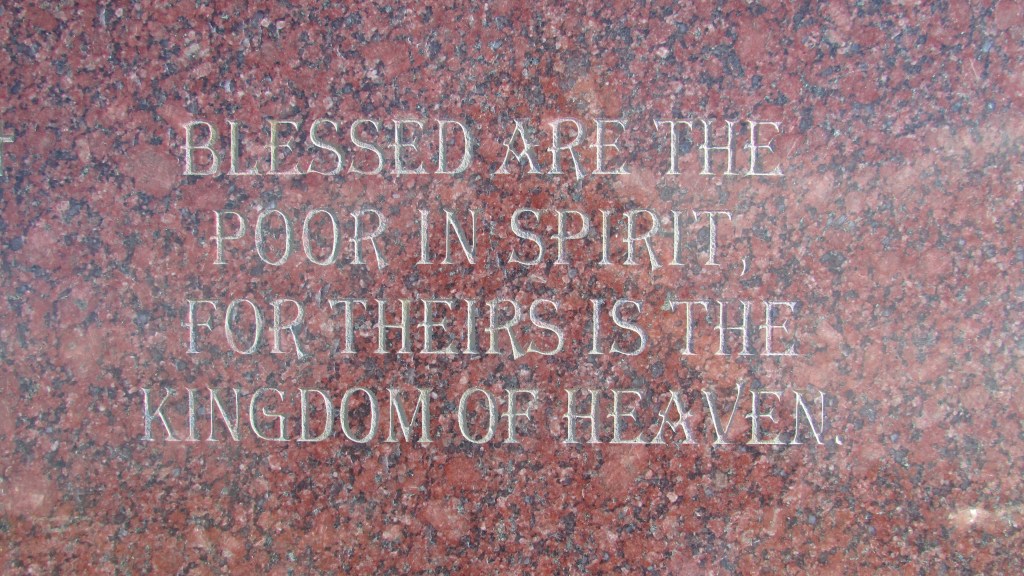
Photo is of a monument at Our Lady of Peace Shrine, Pine Bluffs, Wyoming. Photo by Chris Light – Own work, CC BY-SA 4.0, https://commons.wikimedia.org/w/index.php?curid=53688733.

On this Old Earth

“They shall plant vineyards and eat their fruit.” – Isaiah 65:21b

O God,
I’m doing fine.
Some days are long,
some short.
At each day’s end,
I eat and drink.
I am refreshed.

Yet half my neighbors,
half the households of this land,
bring home from labor
13% of total income,
while half the checks
increase the wealth
of 10% of earners.

They sweat and plant,
assemble and sell,
cook and clean,
press the grapes for wine
for wealthier homes
where wealthier people
eat and drink and sleep.

Do they not labor in vain?
Are not their children
born for calamity?
Where are those offspring
blessed by the LORD?
For, rich and poor alike,
are we not damned for this?

A poem/prayer based on Isaiah 65:17-25, the Revised Common Lectionary First reading for Year C, Proper 28.

Photo by fir0002/flagstaffotos – Own work, GFDL 1.2, https://commons.wikimedia.org/w/index.php?curid=135212.

Income statistics for 2016 from “What Wealth Inequality in America Looks Like: Key Facts & Figures” from the Federal Reserve Bank of Saint Louis.

At the Gate

Can God forgive what I will not repent?

“And at his gate lay a poor man named Lazarus, covered with sores…” – Luke 16:20

Silently hungry, silently suffering,
there at the gate.
Silently sick, silently homeless,
there at the gate.

They are the gates of nations.
They are the gates of cities.
They are the gates of families.
They are the gates of… me.

Silently hungry, silently suffering,
there at the gate.
Silently sick, silently homeless,
there at the gate.

Lay there, Lazarus, lay there.
Hold your silence. Hold your peace.
Hold your hunger. Hold your illness.
Hold your need. I…

I will hold my greed.

A poem/prayer based on Luke 16:19-31, the Revised Common Lectionary Gospel reading for Year C, Proper 21.

The painting is the Parable of Lazarus by Fyodor Bronnikov, ca. 1886 – http://etnaa.mylivepage.ru/image/411/12132_ПритчаоЛазаре._1886.jpg, Public Domain, https://commons.wikimedia.org/w/index.php?curid=9882122.