Story: Why Do You Fly So Far?

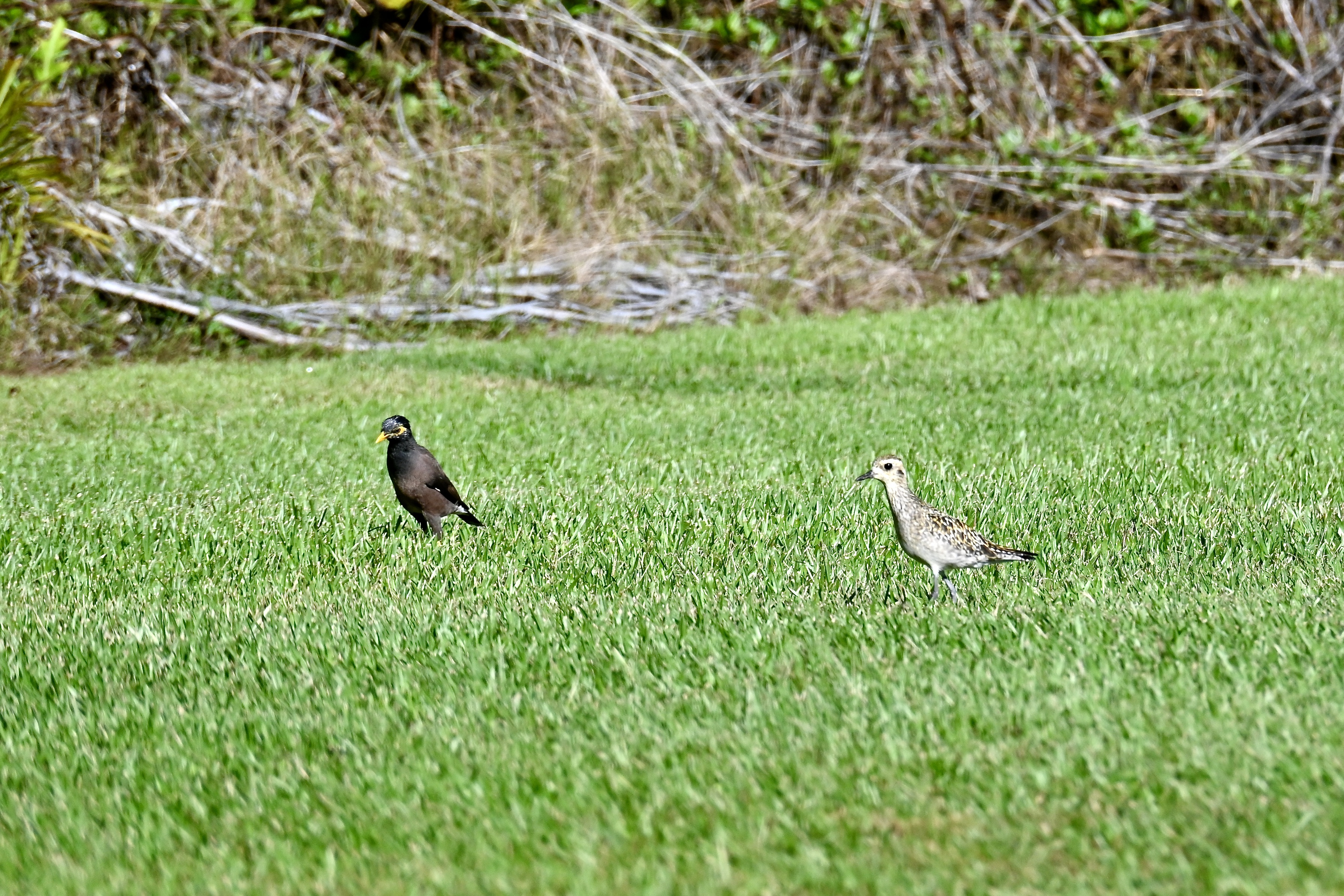
A myna (a dark colored bird with yellow feathers around the eye) and a kolea (Pacific Golden-plover, a light brown bird with darker brown spots) in a grassy field.

December 14, 2025

Luke 1:46-55
Matthew 11:2-11

The kolea is a pretty mellow bird. They’re not terribly skittish, though some will keep a sensible distance from people. We are a lot bigger than a kolea and probably look kind of scary to them.

The myna, on the other hand, is not a mellow bird. They sing a fair amount, but they also screech and argue. They’re pretty sociable with one another, and one moment everybody is happy and content, and the next moment everybody is hollering at one another.

Which makes them a lot like some people, now that I think of it.

Mynas fly, of course, but you could call them homebodies. They don’t tend to go very far. Kolea, on the other hand, fly long distances from where they nest in Alaska to where they spend the winter here in Hawai’i. If you’ve ever flown on an airplane to the North American continent, you know that’s a long flight. Well, kolea fly it with their own wings and they don’t go as fast, so it takes longer.

The mynas find it all rather puzzling and strange.

A myna was picking worms and seeds alongside a kolea one day. The two of them were quiet most of the time, because by chance most of the myna’s other friends had had a big argument and flown off to continue it somewhere else. So it was just the two of them.

“I’ve always wanted to know,” said the myna to the kolea. “Why do you fly so far?”

The kolea thought about it. “I’m not sure anyone has asked me that before,” he said.

“Well, I’m asking,” said the myna.

“I do like the change,” said the kolea, “and I know that it gets awfully cold in Alaska during the winter.”

“Then why not stay here?” asked the myna.

“There are different things there,” said the kolea, “and it just feels right to raise chicks there.”

“Then why fly all the way here?” asked the myna. “What do you come here to see?’

The kolea was quiet for so long that the myna was about to ask the question again, but then the kolea spoke:

“I come to see different trees, trees that blossom red and purple and gold. I come to see soaring mountains crowned with snow when there’s green all around the island. I come to see waterfalls that make rainbows. I come to see mountains with fire and beaches with black sand.

“I come to see birds that also live in Alaska, like ‘akekeke, and birds that don’t live in Alaska, like ‘apapane and nene and saffron finches.

“I don’t think I’d appreciated, though, that I also come to see mynas, and to be asked questions I was never asked. The next time I fly to Hawai’i, I’ll be coming to see you.”

“I’m glad,” said the myna. “Next time you fly from Alaska, I’ll be very glad to see you.”

by Eric Anderson

Watch the Recorded Story

I write these stories in advance, but I tell them from memory (and inspiration). The story you have just read is not identical to the story as I told it.

Photo of a myna (on left) and a kolea (on right) by Eric Anderson.
Story: Aloha for the ‘Iwa

September 28, 2025

Jeremiah 32:1-3a, 6-15
Luke 16:19-31

The ‘iwa, or great frigatebird, has a bad reputation among the seabirds around Hawai’i. ‘Iwa have been known to bully other birds to get them to drop their meals, which the ‘iwa then swoops down to eat. That’s pretty nasty. As a result, a flock of koa’e ula – red-tailed tropicbirds – had decided to have nothing to do with them.

When an ‘iwa flew by, they ignored him. Or her. They veered off to one side or another to keep their distance. When the ‘iwa called out a friendly “Aloha!” they said nothing in return. They called out to one another instead.

Except for one bird.

This koa’e ula decided that until an ‘iwa actually did anything mean, he’d assume that they were as worthy of a friendly “aloha” as any other bird. Seabirds tend to swoop around together a lot, which means that the air is full of “aloha,” which sounds a lot like lots of bird calls to us. A shore with lots of seabirds over it can be a very noisy place.

“Why are you greeting the ‘iwa?” asked his friends. “They’re bullies. They’re mean. They’re never going to give you an aloha.”

“I don’t know about any of that,” said the koa’e ula. “None of the ‘iwa I’ve greeted have done anything to me. Except to say, ‘aloha’ right back.”

Koa’e ula can fly for a long time, but they also like to spend some time resting on the ground, usually on smaller islands offshore from bigger islands like Kauai. There came a day when most of this particular flock was resting from some pretty vigorous flying and fishing. On that day something had happened a long way away that they didn’t know about. It was a big earthquake, and it kicked up the water into an ocean-spanning tsunami. All this was much too far away. The birds had no idea.

Hours later, a series of great waves approached the little island. A few of the koa’e ula were aloft, but they weren’t looking at the water closely. As the first wave came closer, an ‘iwa swooped low over the island, right over the place where the friendly koa’e ula had settled.

“Take off! Fly!” cried the ‘iwa. “There’s a big wave coming! Get into the air!”

“Take off! Fly!” shouted the koa’e ula to those near him, and he opened his wings and leapt into the air. Those near him did the same, and in a few moments the island was empty of birds and the sky was filled with them.

They looked down as the first wave washed over the entire island where they’d been. They were so shocked that they forgot to call “aloha” to one another as they circled. Without the warning of the ‘iwa, they’d have been there when the wave came.

“How did you know?” they started to ask the friendly koa’e kea, the one the ‘iwa had come to warn. “Hod did you know that the ‘iwa would know to warn us?”

“I didn’t know,” said the koa’e kea. “I just knew that everyone deserves an aloha. Everybody deserves aloha.”

As the ‘iwa swooped by with an anxious look to make sure her friend was all right, the koa’e ula called out, “Aloha and mahola nui loa to you!” The ‘iwa looked relieved and called back, “Aloha!” and she soared off once more.

I don’t know what other flocks do – there are ‘iwa and there are koa’e ula all around the world – but I can tell you that there’s been lots more aloha among those birds from that day to this, and long may it stay the same.

by Eric Anderson

Unfortunately, the video recording of worship for September 28, 2025, did not include audio, so there is no recording appended.

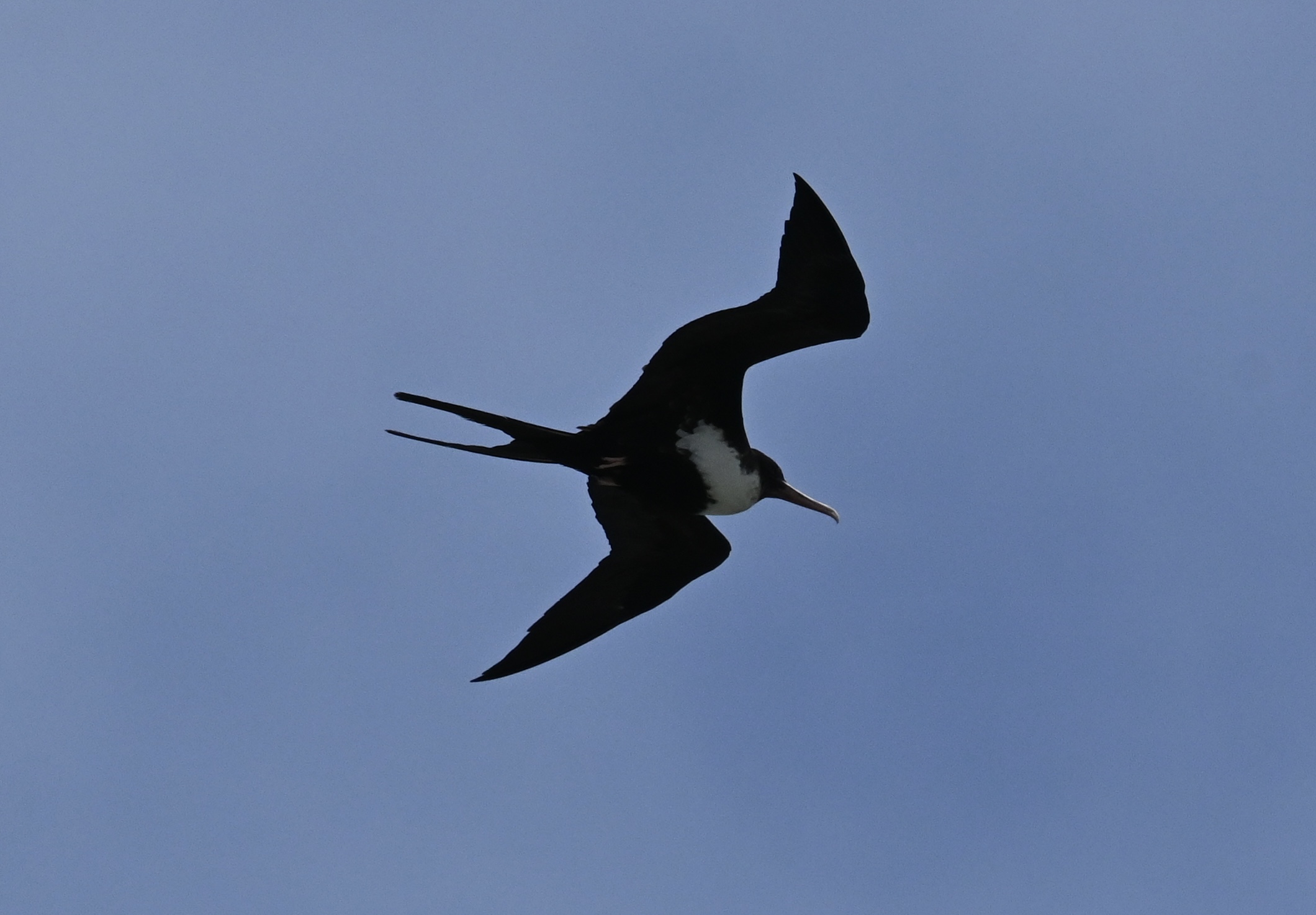
Photo of an ‘iwa (female) by Eric Anderson.

Story: Sun, Rain, and Trees

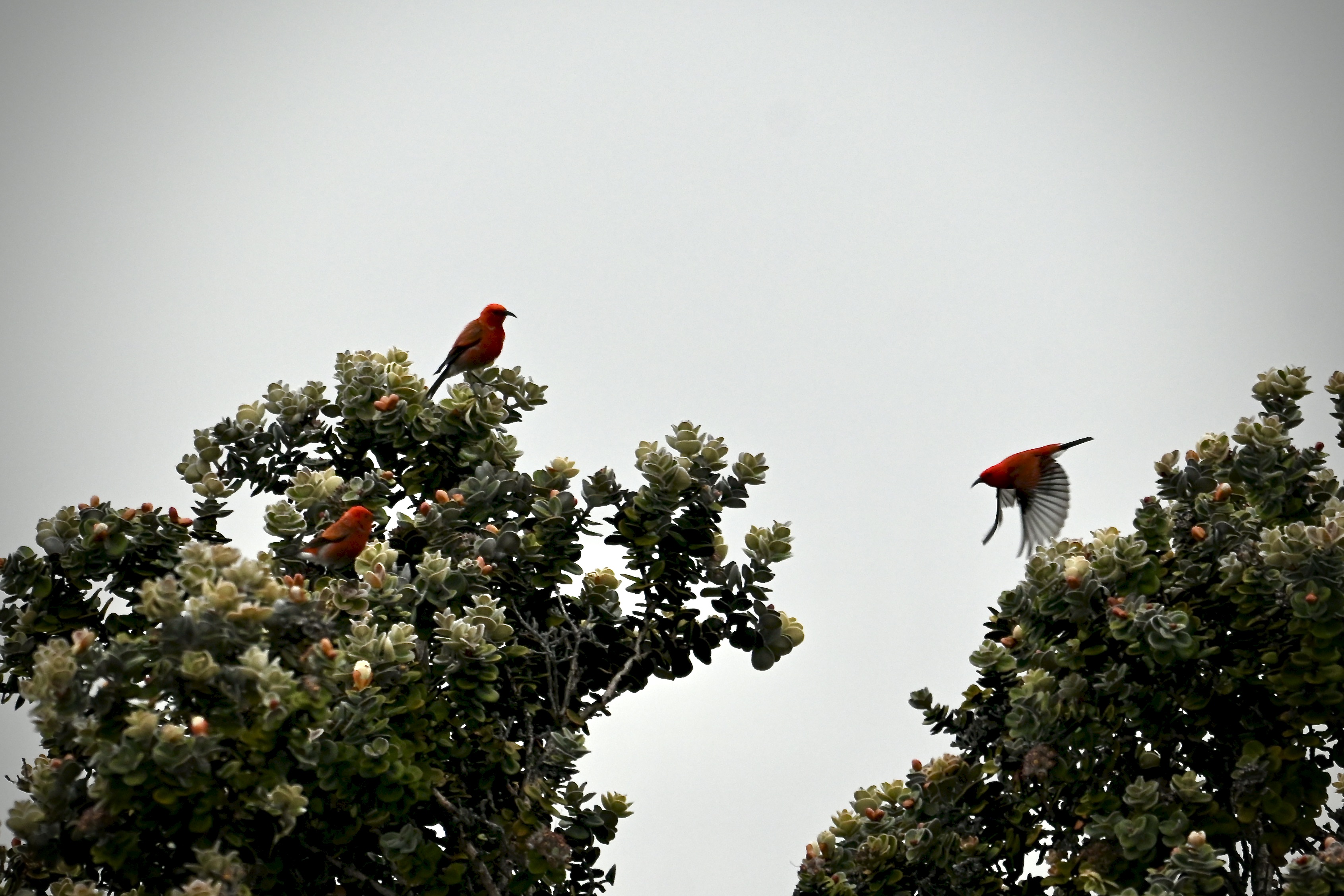
Three red birds with black wings, two perched in a tree top, with the third flying toward the other two from the right.

July 27, 2025

Hosea 1:2-10
Luke 11:1-13

You know how it is with brothers and sisters and siblings of all kinds. Some days everybody gets along, and the next day nobody gets along. It’s squabbling from dawn to sunset, and on the following day everybody is happy again.

In one ‘apapane family, that wasn’t what happened.

Mind you, they were pretty good to one another in the nest. They were cheerful most of the time when they were learning to fly and when they were getting their adult red-and-black feathers. Each of them felt very grown up as they paraded their bright colors through the ohi’a trees.

For a reason nobody ever discovered, that’s when things fell apart. The two younger ones – and younger is a very narrow thing when you hatch in the same nest just minutes or an hour apart – couldn’t speak a kind chirp to one another. “You’re impossible!” said the brother, who was the middle one. “You’re more impossible!” said the youngest, who was one of the sisters. “There’s no such thing as more impossible!” said her slightly older brother, and it went downhill from there.

The oldest one, an older sister, listened to them with a mixture of laughter at her younger siblings and a fair amount of sadness that they couldn’t get along.

It got worse during nesting season. For some reason some of the supplies were in short supply. Twigs were in plenty, and grasses for lining, but a lot of the mosses were hard to find. The younger sister and her husband had a lot of trouble. Her older brother and his wife, on the other hand, did pretty well. It was chance, pretty much, but they actually had more mosses than they could use and his sister didn’t.

That’s when she flew over to her brother’s nest and clamored and called for help.

“No!” he called. “Go away!” But her nest really needed the materials, and she really couldn’t find them.

“Help! Help us!” she said, and she kept calling and pecking at the branch by the nest until, at last, he couldn’t do anything but give her some mosses and watch her fly away to her own nest.

Of course she came back. She still needed more. One beakfull wasn’t enough, as both of them knew. She had to go through the same thing again. And again. Until he relented – again – and she flew off with the mosses.

That’s when big sister appeared at her younger brother’s nest.

“Are you going to make her go through that again?” she asked.

“She’s annoying,” said her younger brother, which sort of was and sort of wasn’t an answer to the question.

“And you’re not?” said older sister, to which younger brother could only mumble in reply.

“Did you grow these mosses?” asked his sister. “Did you grow this tree? Do you make the sun to shine or the rain to fall? Do you make the sweet nectar in the flowers? Did you make it so that eggs could hatch and fledglings fly?”

Of course the answer to all those questions was no.

“Be like the sun. Be like the rain,” said his older sister. “Be like the tree and the flowers. Don’t make her peck and poke for what the world provides. It’s easier, too. You’ll both feel better.”

When the younger sister came back, her brother had mosses ready for her, and even helped her carry some back to her own nest. And when, in another season, it was the younger sister who found lots of nesting materials and older brother who didn’t, she shared without fuss or complaint.

They were like the sun, the rain, and the trees.

by Eric Anderson

Watch the Recorded Story

I write these stories in advance, but I tell them in worship from memory and improvisation. As a result, what I wrote doesn’t match how I told it.

Photo by Eric Anderson.

Story: Independent

March 24, 2024

Psalm 118:1-2, 19-29
Mark 11:1-11

The ‘amakihi aren’t the most social birds in the world. They often forage by themselves, with their mate, or with a few family members. When the hatchlings have left the nest they sometimes join loose flocks of other ‘amakihi, ‘apapane, ‘akepa, and so on. But not always.

One young ‘amakihi took this a little further than most. He announced to his family and friends that he didn’t need anybody.

If you looked at things a certain way, that seemed true. An ‘amakihi doesn’t need a lot of help to find food in the forest. They eat pretty much anything. They’ll eat nectar. They’ll eat fruit. They’ll eat bugs. In fact, mostly bugs. If it’s edible on the mountain, the chances are that an ‘amakihi is eating it.

Although they will fly above the trees, the ‘amakihi are very nimble fliers. They can stop dead in the air, which is quite a trick. They don’t worry too much about the ‘io or the pueo. If they’re above the trees when they spot one, they can dip back into the trees pretty quickly and the ‘io doesn’t have the turning ability to keep up through the branches and trunks. It’s a careless ‘amakihi that becomes somebody else’s meal.

So the other ‘amakihi weren’t entirely surprised when the young one announced, “I don’t need anybody!”

“No help to find bugs?” asked one.

“No need!” he said.

“No help to find water?” asked another.

“No need!” he replied.

“No company?” asked his mother.

“No need!” he announced, but maybe a little too quickly and a little too loudly.

“All right,” said his grandmother, and the little group of his family and friends flew away and left him there alone.

It was fine for a day. He ate well. He kept an eye out for ‘io. He had good places to rest.

It was fine for a second day. He found an ohi’a grove nodding with blossoms.

It was starting to feel not so good on the third day. He hadn’t made his way through all the ohi’a yet, but he felt heavy and kind of sad. The sweetest bugs didn’t cheer him up.

On the fourth day he realized he was lonely.

He sat and sang a sad little song, one you don’t often hear from an ‘amakihi.

The branch he was sitting on bounced down and up, and he turned to see his mother perched there. She listened to him finish his sad little song. Then she waited.

“I think I need somebody sometimes,” he said.

“I’m not surprised,” she replied.

“Really?” he said.

“Everybody does. We don’t live by bugs and nectar alone.”

The two of them flew back to find the rest of the family and a less lonely future.

by Eric Anderson

Watch the Recorded Story

I write these stories in advance (it’s what you just read) but when I tell them it’s a time of re-creation, not recall.

The photo of an ‘amakihi is by Eric Anderson.