Up a Tree

“So he ran ahead and climbed a sycamore tree to see him, because he was going to pass that way.” – Luke 19:4

I didn’t think my hands could grip so tight.
I also didn’t think I’d ever be this high.
So let’s be clear that I regret this choice.
I wish I hadn’t scaled these heights.

Were I to fall, the people down below
would step aside. I grant you that not one
of them could cushion me. We’d both
be left in broken bones and tears upon the road.

I really wish I hadn’t climbed this high
into this tree or into my career.
I used to see my neighbors’ faces as
they doled out coins. Now I just see the coins.

Their faces turn away before I can
pronounce their names, but not before
I recognize their scorn, their bitter fear,
and their disgust at just how high I’ve gone.

Too high. Too high. When branches creak
at heights like this, the climber’s soul
sways unassuaged by creature comforts,
linen, gold, attentive slaves.

I got myself into this tree. I don’t know how
to get myself down to the ground.
My hands are knotted to this limb.
My breath is hoarse as I cling on.

Ignore me, Jesus, Just pass by.
Don’t look up. Don’t notice me.
Don’t speak. Don’t call. Don’t ask me anything.
Above all else, don’t ask me to come down.

A poem/prayer based on Luke 19:1-10, the Revised Common Lectionary Gospel Reading for Year C, Proper 26 (31).

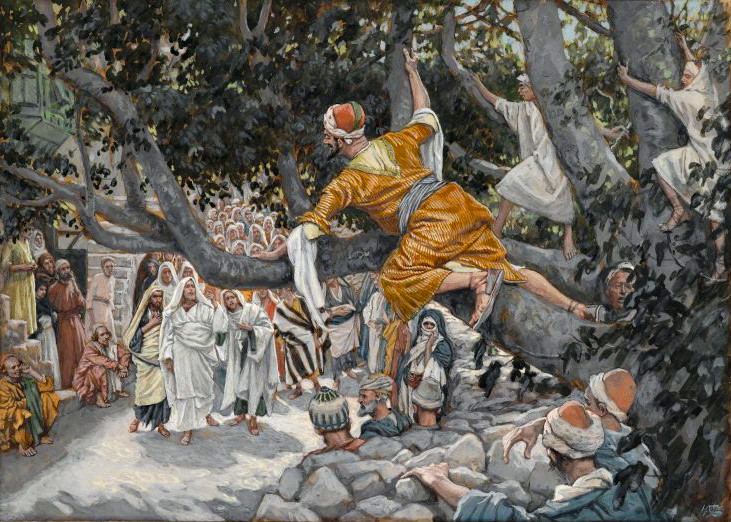
The image is Zachée sur le sycomore attendant le passage de Jésus (Zacchaeus in the Sycamore Awaiting the Passage of Jesus) by James Tissot – Online Collection of Brooklyn Museum; Photo: Brooklyn Museum, 2008, 00.159.189_PS2.jpg, Public Domain, https://commons.wikimedia.org/w/index.php?curid=10904526.
Send Me


“[Jesus said,] [The rich man] said, ‘Then I beg you, father, to send him [Lazarus] to my father’s house–for I have five brothers–that he may warn them, so that they will not also come into this place of torment.'” – Luke 16:27-28

O Holy One,

When I should find myself (again)
in torment I have made myself,
may my compassion and
my wisdom be enough to call
a warning to the ones I love,
and to the ones I don’t,
with my own voice, and not rely
upon the voice of those I have oppressed.

A poem/prayer based on Luke 16:19-31, the Revised Common Lectionary Gospel Reading for Year C, Proper 21 (26).

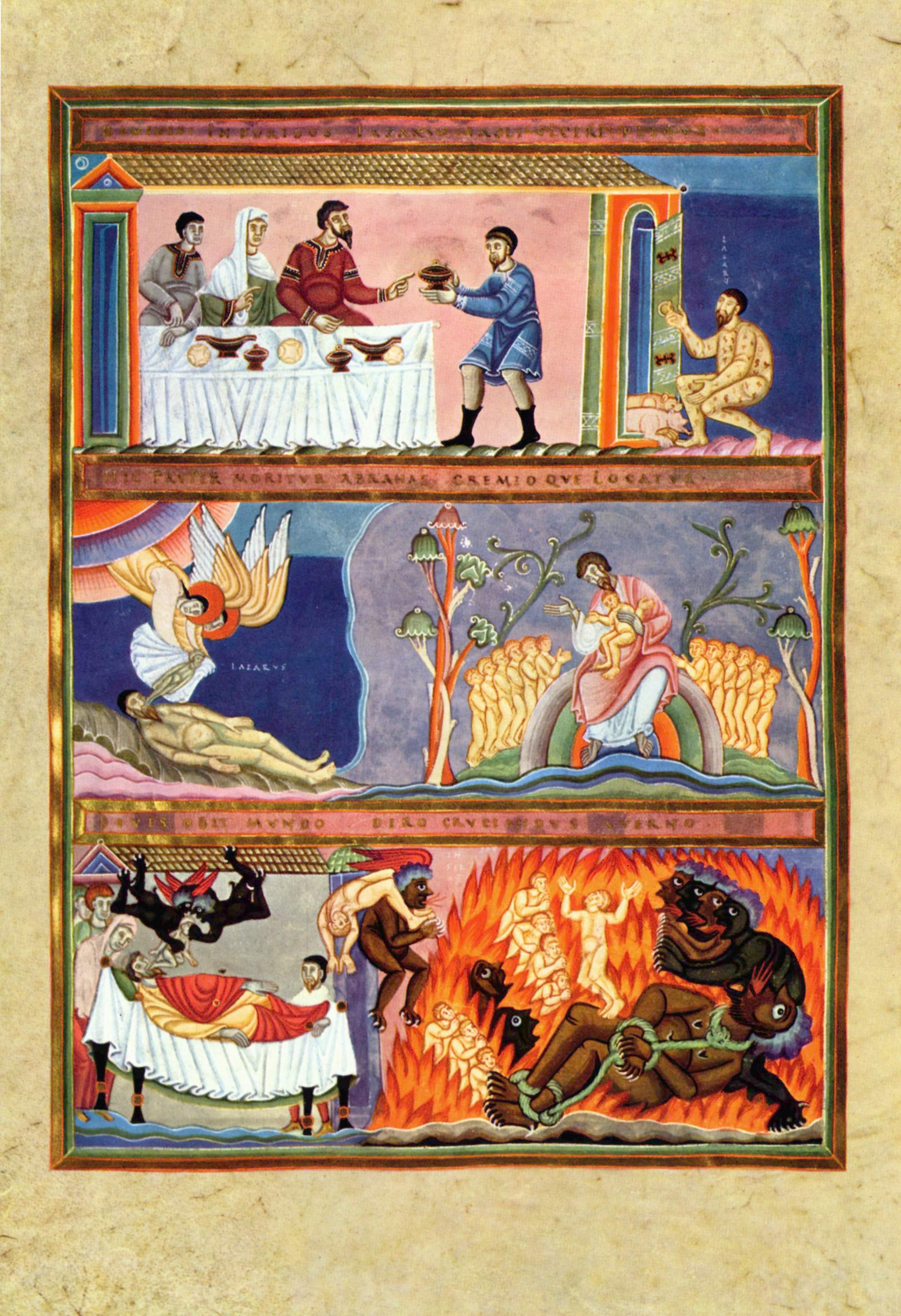
The image is “The Parable of the Rich Man and the Beggar Lazarus,” an illustration in the Codex Aureus Epternacensis (Golden Gospels), by the Master of Codex Aureus Epternacensis – The Yorck Project (2002) 10.000 Meisterwerke der Malerei (DVD-ROM), distributed by DIRECTMEDIA Publishing GmbH. ISBN: 3936122202., Public Domain, https://commons.wikimedia.org/w/index.php?curid=155243.

You Warned Us, John

John said to the crowds coming out to be baptized by him, “You brood of vipers! Who warned you to flee from the coming wrath?” – Luke 3:7

Who warned us, John? You did.
We heard your words through others,
much as those you called “a brood of vipers” heard
your words through rapid rumor’s run.

We heard your warning through
the memories and tongues and pens
of those you had impressed with word,
with deed, with baptism, with righteousness.

We heard because they passed along
your warning that to wash with water would
not cleanse the soul, but full repentance, all
enacted, would receive the nod of God.

They came to hear themselves.
They came to learn how they might change.
They came to leave upon a road that might look like
the one on which they had arrived, but was a road made new.

They came. They heard. They washed.
They went away and told the tale.
More came. More heard. More washed. More told.
Soon one would come to wash though you would tell him, “No.”

You warned us, John, across the years.
But tell me, we who follow him whom you baptized,
have we been heedful of your warning? Do
we bear the fruits of righteousness?

I fear, old harsh-voiced friend,
that you would find us heedless of your words
despite our claim to follow Christ. I fear you’d rail
once more at broods of serpents writhing in the dust.

I fear it would not only be
the ones I judge as frauds,
or casual extortionists,
or simply selfish souls withholding all their wealth,

But also me, secure in my
self-righteousness, and satisfied
with my reputed rectitude.
What sins do I ignore, refuse to cleanse?

Shout on, old Baptist friend.
Across the years, through others’ words
I hear your call. Shout on, and by the grace of God
may I repent, and wash, and bear good fruit.

A poem/prayer based on Luke 3:7-18, the Revised Common Lectionary Gospel Reading for Year C, Third Sunday of Advent.

The image is John Preaching in the Desert, a mosaic in the series of the Life of John the Baptist in the Florence Baptistery, Florence, Italy (ca. 1225-1330). Photo by Sailko – Own work, CC BY 3.0, https://commons.wikimedia.org/w/index.php?curid=41892069.

Harsh Prophet

Were I to descend to the riverside, John,
fiery prophet, baptizing fiercely,
were I to descend to seek holy forgiveness:
What would you call me? A viper? A snake?
What would you call me? A coward? A hoax?
What would you call me? Irrelevant? Dull?
What would you call me, religious authority…

And would I descend to the riverside, John,
fiery prophet, baptizing fiercely,
would I dare to seek holy forgiveness of you:
Not knowing if you would bring shame to my name.
Not knowing if you would despise my remorse.
Not knowing if you would discount my devotion.
Not knowing how deeply you see in my soul…

A poem/prayer based on Matthew 3:1-12, the Revised Common Lectionary Gospel reading for Year A, Second Sunday of Advent.

The image is a 19th century wood carving of John the Baptist preaching at the riverside in the Church of the Assumption and St Nicholas, Etchingham, England. Photo by Poliphilo – Own work, CC0, https://commons.wikimedia.org/w/index.php?curid=80795653.

At the Gate

Can God forgive what I will not repent?

“And at his gate lay a poor man named Lazarus, covered with sores…” – Luke 16:20

Silently hungry, silently suffering,
there at the gate.
Silently sick, silently homeless,
there at the gate.

They are the gates of nations.
They are the gates of cities.
They are the gates of families.
They are the gates of… me.

Silently hungry, silently suffering,
there at the gate.
Silently sick, silently homeless,
there at the gate.

Lay there, Lazarus, lay there.
Hold your silence. Hold your peace.
Hold your hunger. Hold your illness.
Hold your need. I…

I will hold my greed.

A poem/prayer based on Luke 16:19-31, the Revised Common Lectionary Gospel reading for Year C, Proper 21.

The painting is the Parable of Lazarus by Fyodor Bronnikov, ca. 1886 – http://etnaa.mylivepage.ru/image/411/12132_ПритчаоЛазаре._1886.jpg, Public Domain, https://commons.wikimedia.org/w/index.php?curid=9882122.

But Now…

I’ve never worried before, O God,
about the younger son’s repentance.
I’ve always gratefully assumed
he walked the roads of sackcloth
and of ashes. What a shock
his father’s welcome must have been!

But now… I wonder.

Was he another twister of the truth?
Was he another one who turns the world
around his little finger? Did Narcissus blush
with shame at his temerity, his lies?
And did the pounding of his heart betray
his gratitude or hidden glee?

And now… I wonder.

In that Great Somewhere, do you wait for me?
Do you wonder when I’ll lay aside deceit –
delusion sweet for me, unwitting lie to you –
and truly bring my starving soul back home?
Does the pounding of my heart betray
my gratitude or deeply hidden lies?

Yes now… I wonder.

A poem/prayer based on Luke 15:1-3, 11b- 32, the Revised Common Lectionary Gospel reading for Year C, Fourth Sunday in Lent.

Photo by Eric Anderson.

No, Seriously

I knew it. It’s all about them.

Well, not every them. Just some of them.

No, seriously, Jesus, wait: I’m talking now.

Their sins caught up with them, those Galileans,
when their blood got mingled with
their sacrifices; not to mention,
those unspeakably perverse and foolish
people crushed by falling blocks
when Siloam’s tower fell: Well.
I knew it would catch up with them.

No, seriously, Jesus, wait. I’m talking now.

Have you not said that God is just?
Have you not said that God is righteous?
Have you not said that God will not be mocked?
Not even mocked by cracked foundation stones?

No, seriously, Jesus, wait. I’m talking now.

When I’ve been foolish, yes, and sinful,
I’ve owned up. I’ve said, “I’m sorry,” even
(sometimes) made amends. I’ve done my best
(sometimes) to make things right with them and you.

Should not your justice fall on them
as well as me?

OK. I’ll wait. You’re talking now.

No, seriously, Jesus, are you kidding me?
They weren’t egregious sinners? They
weren’t different from me? And what?
It’s me you summon to repentance?

Oh, great. So I’m a fruitless fig tree now?
Have you not noticed all this time I spend
proclaiming your divinity,
your righteousness, your way?
And while you’re looking, see where they
bear far less fruit that I…

Well, no, I know, I’m not exactly perfect…

Well, yes, I know, I’ve many things to change…

And yes, I know that I’m the only one
who really can change me,
and yes, I know I really can’t change anyone
else but me, but…

No, seriously, Jesus, wait. I ache for this
poor broken world, for all this suffering Creation.
Why can’t the evil suffer for the ills they bring?
Why must the good endure the pain instead?

No, seriously: Why?

Why?

All right.
In ignorance unblessed,
I’ll keep my eye
on me.

A poem/prayer based on Luke 13:1-9, the Revised Common Lectionary Gospel reading for Year C, Third Sunday in Lent.

Photo of the And Jesus Wept statue at St. Joseph Roman Catholic Church in Oklahoma City, OK. Photo by Mike Krzeszak; used by permission under Creative Commons license.