“[Jesus said,] ‘Would you not rather say to him, “Prepare supper for me; put on your apron and serve me while I eat and drink; later you may eat and drink”?'” – Luke 17:8
Stand at your watchpost, Holy One, and see, if I have brought your sustenance to table where the hungry you have called are blessed by word, and heart, and bread.
Stand at your watchpost, by the door, to see if any leave with bellies pinched, with faces sad, with spirits quenched. See if your banquet has been served.
Stand at your watchpost, Jesus, to observe if I have nurtured that so precious seed of faith into a shelter for the birds and beasts and people. O Jesus, have I grown my faith in you?
A poem/prayer based on Luke 17:5-10, the Revised Common Lectionary Gospel Reading for Year C, Proper 22 (27), with an additional nod to Habakkuk 1:1-4, 2:1-4.
The image is a photo of the shrine at the Tomb of Habakkuk in Tuyserkan, Iran. Photo by hamid3 – Own work, CC BY 4.0, https://commons.wikimedia.org/w/index.php?curid=99699676. The tower may date to the 11th or 12th centuries, an architect’s attempt to render Habakkuk’s vision of the watchtower.
There was a tree, an ohi’a tree, that stood on the cliffside above Kilauea Iki. The tree had stood there long years. He was tall. He was grand. And he was proud.
He looked down upon the mostly flat black rock of Kilauea Iki and sniffed. There were ohi’a trees down there, too, but they were small and bushy. The tallest rose no more than eight or nine feet, less than a tenth of this tree’s one hundred foot crown.
“You’re so small,” he said to the little ohi’a trees below. “What difference can you make?”
Next to him stood another tree, just as tall, just as grand, but not so proud and rather wiser. “Don’t you remember?” she asked him. “This was no more than a pond of lava years ago. These trees had to catch every drop of rain. They had to make their own soil. Someday this crater will be filled with trees, and it will be because these trees got it started.”
“Well, all right,” huffed the other tree. “But what about these little bugs that crawl all over me? They’re even smaller. And they nibble at me. And they itch. They can’t be of any use.”
His neighbor looked him over and said, “These are the same creatures that attract the birds to you. Between the birds and the bugs, they carry the pollen around that means there will be ohi’a seeds.”
“Seeds,” huffed the proud tree. “What good are they? They’re even tinier than the bugs!”
“Seeds,” said the wise tree, “mean that there will be a future for our forest up here on the cliffsides as well as in the rocky bottoms of the craters. Seeds mean new trees where there hadn’t been any before.”
“Seeds,” she said softly, “mean that when we are measuring our height on the forest floor, there will be other trees rising over us.”
The proud tree huffed again. “There could never be a tree as grand as me,” he said, and he ruffled his branches in the breeze.
“Seeds,” said the wise tree, as she watched a little cloud of them dance in the wind from the proud tree, “Seeds mean that there will be a forest even grander than either of us.”
by Eric Anderson
Watch the Recorded Story
I write these stories ahead of time, but I tell them from memory (and a little bit of inspiration). What you have just read does not precisely match what you’ll see.
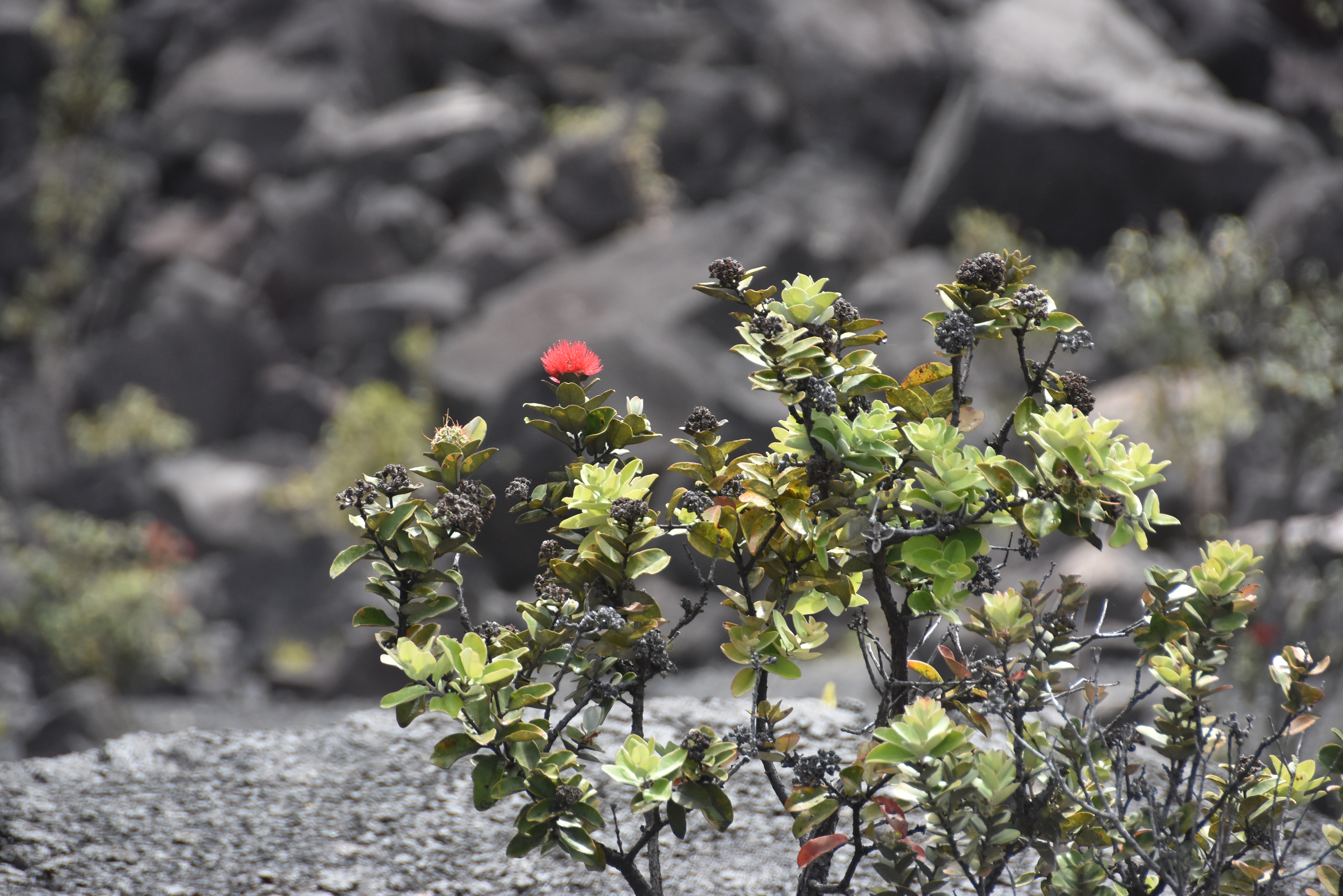
Photo of an ohi’a in the Kilauea Iki crater by Eric Anderson.
When the birds of the ohi’a forest start to flock together – which tends to happen when the chicks have learned to fly and left the nest – some of those flocks rotate leadership among the birds: an ‘apapane this week, an ‘akepa this week, and who knows? Perhaps an ‘alawi the next.
There came a week when one of the ‘amakihi was chosen to lead, and he was going to lead, by all that was feathered, he was. He had done a lot of watching and a lot of listening to the other leaders, and he knew he’d do a good job. He wouldn’t bully, and he wouldn’t brag, and he would get help from other birds to be sub-leaders, and above all else, he would keep an eye out for food, for shelter, and for danger.
He was, after all, the one in charge.
Things seemed to go just that way for the first couple of days. The other birds followed where he led, they sang cheerfully as they foraged for bugs and nectar, and they avoided both the nuisance of a cranky i’iwi and the dangers of two cats and an ‘io. On the third day, however, something seemed to be going… differently. The birds still followed where he led, but… it almost seemed like some of them were slightly ahead of where he was going. He thought they might just be faster fliers, but as the day went on he noticed that some of them seemed to open their wings just slightly before he did.
What puzzled him about all this was that, as he thought about it, it seemed… perfectly normal. The other flock leaders had also been just slightly behind two or three birds. Which seemed… perfectly normal and perfectly odd.
When the next day came, the same thing was happening, and he kept a close eye on things. Another ‘io came by over the course of the morning, so that a sudden alarm whistle sent everyone deep into the branches. A little while later, the same voice trilled that it was safe again, and the flock took wing for another ohi’a tree – one that he, the leader, hadn’t chosen. He probably would have tried that direction (because the ‘io went the other way), but he hadn’t chosen it. What was going on?
In early afternoon, it happened again. Two or three birds took off just before he did, and later on two or three more took off just before he did, but they were different birds. Still, he spotted what was the same: those birds had been close to another bird, an ‘amakihi, just before they flew.
So he landed right next to that bird when they got to a new tree and found… she was his mother.
“Are you… What are you doing, mother?” he asked. “Are you trying to take over as leader?”
“Not at all,” she said. “I’m following you, just like everyone else.”
“Then how come birds take off ahead of me from around you?”
“Well,” she mused. “I might be mentioning that you’re looking at a tree in a particular direction. They seem to think that’s a reason to go that way. You and I both have been paying attention to what’s safe and what’s in blossom.”
“Isn’t that leading?” he asked.
“It might be,” she said, “if leading is paying attention to what’s good for all the birds of the flock. Which you’re doing. But it’s something that all of us can do along with you. When your leadership time is over, you can do it, too.”
He was a good leader, they all agreed. They were surprised to find, however, that he was an even better follower when another bird’s turn came to lead. He did the best he could to see that all the birds were fed, warm, and safe – and so did his mother.
by Eric Anderson
Watch the Recorded Story
I write these stories ahead of time, but I tell them in worship from memory. Memory plus a fair amount of improvisation.
James and John, the sons of Zebedee, came forward to him and said to him, ‘Teacher, we want you to do for us whatever we ask of you.’ And he said to them, ‘What is it you want me to do for you?’ And they said to him, ‘Appoint us to sit, one at your right hand and one at your left, in your glory.'” – Mark 10:35-37
While you’re at it, Jesus, sign me up for that. For while I think I have one of the sittingest jobs there is, (I sit in chairs and cars and at so many meals), I’d really like to sit nearby to you and bask in glory.
Ahhhhhh…
Yes, I can follow you and what you do to find my place in glory, banquet marvelous, and if the places to your right and left are occupied already, I understand.
Ahhhhh…
So though I share the indignation of your other followers, I share as well their thought that it should not be them, but me, to sit at your right hand. Of course.
Ahhhh…
I’ve chosen to forget as James and John did then, so long ago, that you’d been laying out the likely forecast, which was stormy to be sure, a blow to carry you up on a cross.
Ahhh…
I’ve chosen to ignore again your call to servanthood and service. Humility, not arrogance, displays your Way. I’d be more comfortable, frankly, with my pride.
Ahh…
Instead, I sit dismayed. You’ve asked for all, for more than I prepared, for more than I have understood. It’s not enough, but in this moment, it is all I have to give.
Ah.
A poem/prayer based on Mark 10:35-45, the Revised Common Lectionary Gospel Reading for Year B, Proper 24 (29).
The image is “The Calling of the Apostles St. James and St. John,” print, Friedrich August Pflugfelder, after Johann Friedrich Overbeck (MET, 2004.451) (August W. Schulgen/ Josef Spithöver) – This file was donated to Wikimedia Commons as part of a project by the Metropolitan Museum of Art. See the Image and Data Resources Open Access Policy, CC0, https://commons.wikimedia.org/w/index.php?curid=60859225. Sadly, most artists’ renderings I could find of this interchange between Jesus, James, and John, favor Matthew’s version of the story, in which their mother made the request on their behalf.
Everyone thought she was one of the best singers among the ‘apapane. Her notes were clear, her improvisations were delightful, and she had the breath to sing long bubbling musical runs. Other ‘apapane used to listen for her in the mornings, and if they heard her, they’d take off in her direction.
It turned out that she used to sing loudest and longest when she found a grove of ohi’a with lots of blossoms, so everybody who flew into the neighborhood got a good meal. She’d sing, however, even in a tree between flowering times. When she did, the other ‘apapane – and the akepa, and the ‘alawi, and the ‘amakihi, and even the i’iwi – settled into nearby trees to listen.
It was like having a great concert every day.
She couldn’t help noticing that a fair number of birds got a free lunch, or breakfast, or dinner out of her songs. At the start she didn’t mind – she was pretty flattered that everyone flew to hear her sing – but as time went on it started to rankle. “Can’t they find their own trees?” she grumped to her brother one day, and if he had anything useful to say, she didn’t listen.
Then she had a bad scare. She’d landed on a branch near to the ground, which she rarely did, and began to sing. Suddenly the branch heaved with a heavy weight. She fluttered into the air, taken by surprise, and only then noticed the hunting cat which had leapt onto her branch and only just missed her.
She flew higher into another tree, whistling with alarm, and watched while the cat climbed back to the ground and disappeared into the forest.
The next day the sun rose, but her voice didn’t rise. The day grew brighter, but nobody heard her song. Other ‘apapane and ‘amakihi and mejiro and the rest begin to sing, but she remained silent.
She found a place deep within some leafy ohi’a branches and hid from the world.
They noticed that she wasn’t singing that day, the other birds did, but they mostly thought she’d gone to another part of the forest and would be back soon. But one day became two, and two became four, and four became over a week and nobody had heard her song. They began to look around, hoping to find her well, and terribly afraid that something bad had happened.
Her mother found her – mothers often have a talent for finding their children – still huddled in her ohi’a tree, silent and afraid. She told her mother about what had happened with the cat.
“I don’t want to sing ever again,” she said.
“Your songs are beautiful,” said her mother. “Everybody loves you for them.”
“Everybody follows me because they think they’ll eat well,” said the daughter. “Somebody else can do that. Not me.”
“Listen for a moment, daughter,” said the mother, and the two were quiet. The forest, however, was not. The calls and songs of the forest birds sailed out over the trees.
“Listen to that,” said mother. “It’s everybody’s song.”
“Won’t they attract cats?” asked the singer.
“They might,” admitted her mother, “but there are ways to sing beyond their reach. Mostly, though, realize that it’s your voice, and your melodies, but it’s not really your song. It’s everybody’s song when you share it, greater and more wonderful than you know.
“What do you think, daughter? Can you sing with everybody’s song?”
In answer, the young ‘apapane opened her beak and sang.
by Eric Anderson
Watch the Recorded Story
I write these stories in advance, but I tell them in worship from memory and from improvisation. What you’ve just read will not match what you watch.
“Then they came to Capernaum, and when he was in the house he asked them, ‘What were you arguing about on the way?’ But they were silent, for on the way they had argued with one another who was the greatest.” – Mark 9:33-34
Sitting in your house, you catch my eye. I see the smile play upon the corners of your lips. “That argument you had along the way. Now tell me: What were all those snarling words about?”
Now, I don’t want to tell. You see that, right? Your eyes move on from mine to James, and John, to Andrew, Philip, Matthew, Simon, James, Bartholomew and Thaddeus, Thomas, Judas, too.
“So tell me!” you repeat and smile, still. You know, I know, because my frozen face declares it. So do all the faces of the twelve. You shake your head at our embarrassed silence.
“Would you be great?” you ask me, and I need not answer. Yes, I would! I’d be the warrior at the side of Christ, to fight and even die if need be. I would live in glory.
“If you’d be great,” you say, and lift the ragged cuff of my left sleeve, “you won’t be first, but last. You’ll be the servant of the least of these.”
All right, you’ve said such things before, and we had nodded, for your words were wise. I somehow never thought that they’d apply to me. I somehow never thought I’d die in poverty.
I may have held my tongue since your rebuke of “Get behind me, Satan!” but I do not yet accept your forecast of betrayal and a cross. I’d overcome those evils, not embrace them.
I see again, however, you and I have taken sides in opposition here. My greatness is not yours. Your greatness is not mine. I can’t think what to do.
Whatever happens, I will not abandon you. I’ll wrestle with these things I do not want to understand, and maybe one of us will change their mind. In honesty?
I hope it’s you.
A poem/prayer based on Mark 9:30-37, the Revised Common Lectionary Second Reading for Year B, Proper 20 (25).
Saffron finches don’t fly about in larger flocks like mynas, but they certainly do gather in small groups to feed and chirp and, one assumes, share the news of the saffron finch world. One little group was having a problem with not one, but two, of their members.
The first one who bothered them was, well, unwashed. Routinely. A finch is going to get dust and bits of grass and, I suppose, the occasional bug wing on their beak and face, and he did that. They’ll also get dirty feet and, if they’re hopping about on muddy ground, get dirty feathers. He did that, too.
Most saffron finches find ways to wash it off. They’ll clean with beak and toes and let the rain wash them off when they can. On a gray day a saffron finch is a pretty bright sight. But not this guy. Somehow a rain shower left him muddier. If he pushed bug wings off his head he’d get dirt in the feathers.
He was a sight, let me tell you.
The other troublesome bird was clean and bright. He not only got himself clean, somehow he avoided most of the dust and dirt that the other birds had to deal with. And… he let you know it.
“Are you going to clean those feet?” he asked. “There’s a bug wing on your beak,” he said. “Can you believe it? You’ve got a speck of mud on your feathers,” he commented.
He went on and on about the finch with the dirty feathers. “Look at that, he’s a disgrace,” he’d say, and “I’m so glad I’m not like him.”
They say “Sticks and stones may break my bones, but names will never hurt me,” but you know? Words hurt. And nearly every bird in the little flock of saffron finches felt the sting, with our dirty finch feeling it the worst.
What to do?
They got together, the other finches. They talked it over while the dirty finch and the absolutely clean finch were elsewhere. They come up with some possibilities. They made some decisions. They got ready to offer some options.
They called the whole flock together, including our two problem finches, and said, “We’ve got to see some changes here. First,” they said to the dirty finch, “we’re going to give you some help, because clearly you need it. We’ll help you with the preening and the cleaning and make sure you stay both healthy and show off your bright feathers.
The dirty finch, who thought he was going to be kicked out of the flock, chirped a grateful “Mahalo!”
The absolutely clean finch huffed, “I can’t believe you’re going to put up with him and his filth. You’re as bad as he is.”
“What we’re not going to put up with,” said the spokesfinch, “is your bullying any longer. You’ve been hardest on this finch here, but you’ve been at all of us at one time or another. Yes, your feathers are always immaculate, and no, our aren’t always at their best. But your tongue is never at its best, and that needs to change. Now.”
The absolutely clean finch was speechless for a moment (which was a good thing, if you think about it), and then he burst out with a harangue that few have ever heard. I’m afraid he didn’t learn his lesson, and I’m afraid he couldn’t stay with that flock.
When it came down to it, the things that make a finch dirty from the outside are things they could help with. But the things that make a finch dirty from the inside, all the harshness and bullying, those are the things that have to go.
by Eric Anderson
Watch the Recorded Story
I write these stories ahead of time, but I tell them from memory – memory and inspiration. What I’ve written does not match how I tell it.





 ordainedgeek