Story: One Might Know

May 10, 2026

Acts 17:22-31
John 14:15-21

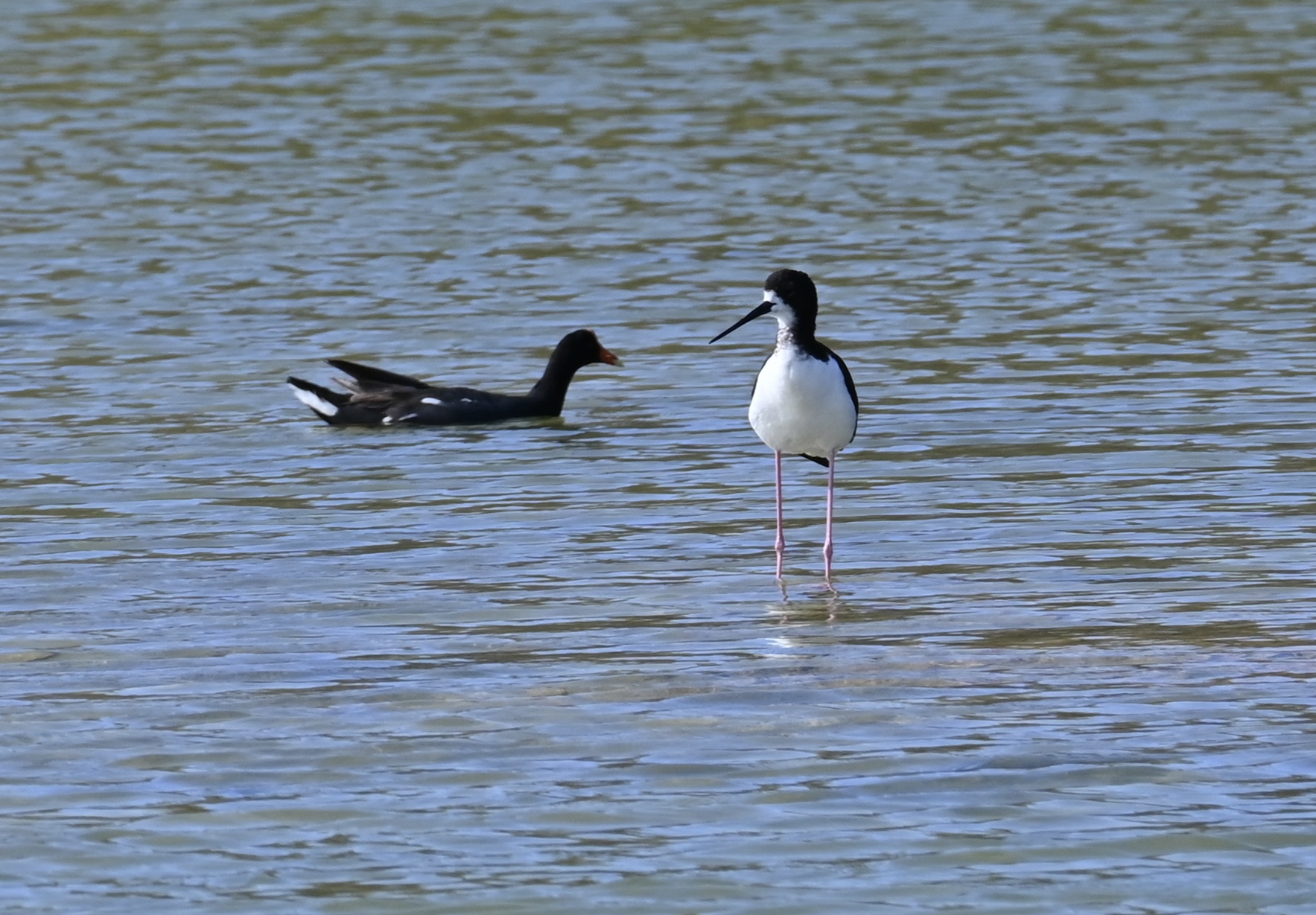
This story didn’t take place on our island, because although one of the birds in it lives on Hawai’i, the other doesn’t. I took this picture on Kauai, though both birds also live on O’ahu.

The one on the left, swimming in the water, with its red beak and red on its forehead, is an ala’e ‘ula, or Hawaiian gallinule. The one on the right, standing on long thin pink legs with white and black feathers and a very long straight black beak, is an ae’o, or Hawaiian black-necked stilt.

Both of them like to search for food in roughly the same kinds of places: relatively still and shallow water, like old fish ponds or coastal marshes. They don’t eat the same food, however. The ala’e ‘ula likes plant roots and seeds and shoots, and enjoys a snail or two. The ae’o mostly looks for fish, but will snap up water insects when it finds one.

Actually, the ala’e ‘ula will eat those insects, too, but neither of them is so fond of a diet of bugs to get very upset about it.

On this day the ae’o was getting somewhat upset, but not about bugs. It was fish. He couldn’t find many. Oh, one or two swam his direction, but where were the rest of them? He was getting hungry, and he was also getting irritated with the world. Being hungry does that to some people, and to some birds as well.

“Where are the fish?” he squawked in frustration.

“You can’t find fish?” asked an ala’e ‘ula a short way away.

“No, I can’t, and is that any of your business?” he said rudely.

“No, I suppose not,” said the ala’e ‘ula, who’d been feeding quite happily on roots and shoots and therefore wasn’t hangry with the world. “Would you like me to tell you if I find some fish?”

“You do what you want to do,” said the ae’o irritably, and as the ala’e ‘ula swam off to another section of the fishpond, grumbled to himself, “It’s not as if you’ll be of any help.”

It wasn’t very long, though, before the ala’e ‘ula swam back toward the hungry, grumpy ae’o. “Say, friend,” he said. “Take a look over there. There’s a good sized school of fish milling around eating flies.”

“How would you know?” demanded the ae’o, who couldn’t make out the flies on the water from where he stood.

The ala’e ‘ula shrugged. “One might know if one looks under water,” he said. “I was pulling up a root and there they were, all around. When I got my head out of the water I saw the flies swimming on the surface.

“I suppose you could make a meal of the flies if you have to,” he said thoughtfully, “but I imagine you like the fish better.”

“One might know,” muttered the ae’o as he stepped over to where the ala’e ‘ula had been, “but one probably doesn’t. More fool I.”

Then he saw the milling flies, and he saw the ripples where the fish had risen to the surface. He saw the water swirl as they swam beneath. In a moment he was there, and dipping his beak, and catching his fish, and feeling better than he had all day.

“I guess one might know at that,” he said when the ala’e ‘ula found him again shortly after.

“One might know,” said the ala’e ‘ula.

“Even better,” said the ae’o, “one might share what one knows. And the world gets a little bit better than it was.”

by Eric Anderson

Watch the Recorded Story

I write these stories in full ahead of time, but I tell them in worship from memory and improvisation. The story as written and the story as told are not identical.

Photo of an ala’e ‘ula (Hawaiian gallinule) and an ae’o (Hawaiian black-necked stilt) by Eric Anderson.

Angels

“Then [Elijah] lay down under the broom tree and fell asleep. Suddenly an angel touched him and said to him, ‘Get up and eat.'” – 1 Kings 19:5

Be the angel, O God,
when I am weary and frightened,
when the burdens oppress me,
and I despair of my life.

Bring me food.
Bring me water.
Let me rest.

When another is weary
and frightened, O God,
when the burdens weigh down
the hope of new life,

May I bring food.
May I bring water.
May I bring rest.

May I be your angel.

A poem/prayer based on 1 Kings 19:1-15a, the Revised Common Lectionary First Reading for Year C, Proper 7 (12).

The image is Elijah in the Wilderness by Frederic, Lord Leighton (1877-1878) – uQG9WGfbc10kDw at Google Cultural Institute maximum zoom level, Public Domain, https://commons.wikimedia.org/w/index.php?curid=21878932.

Story: The Easy Way to Fly

November 17, 2024

Hebrews 10:11-25
Mark 13:1-8

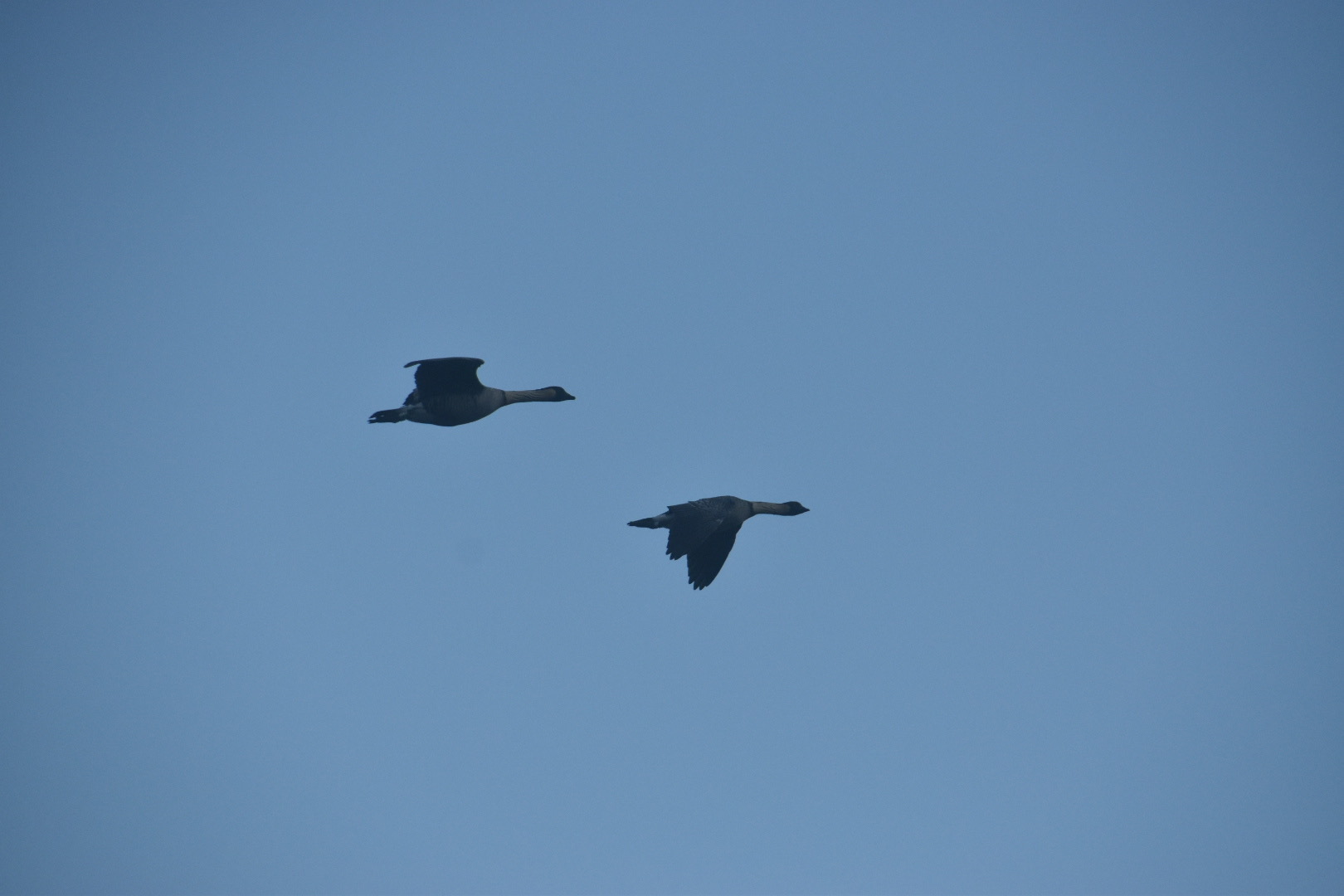
I’m afraid it’s true that there are not many nene. They are easily outnumbered by the ‘apapane, and more than easily outnumbered by people. You may wonder why, if there aren’t that many of them, you hardly ever see them one at a time. I mean, wouldn’t you expect that a nene would go its own way from time to time, just to find some ‘ohelo berries of their very own?

One nene thought that independence sounded like the way to go.

He’d been to nene school, so he thought he knew it all. He knew how to find food. He knew how to fly. He’d done the drills at formation flying without getting excited about it. He was going to be the nene who made his own way, without relying on (and, you know, sharing with) the other nene.

So off he went to find his own spaces.

There’s a lot more of Hawai’i Island than there are nene, so it wasn’t difficult. If he spotted a little flock of nene in the air or on the ground, he’d just go somewhere else that they weren’t. That was lots of places, and plenty of those places had food, and water, and places to rest and relax. All in all, he thought he was having a pretty good nene life.

One day as he was in the air looking for another place to relax and eat, he heard the calls of some nene behind him. Glancing back, there was a little “V” shape of five geese flying in formation. They called out a friendly greeting, to which he replied – he liked being alone, but he wasn’t going to be rude about it.

What surprised him, however, was that the little “V” of nene was catching up with him. In fact, they passed him in the air, still calling out their “Hello!” He thought he was a pretty good flier, but they sped on by and he couldn’t keep up. It didn’t take long before they’d disappeared into the clouds.

How had they flown past him so fast?

Sometimes when you don’t know something and you don’t have Google, the best thing you can do is ask someone who should know. So he sought out his nene school teacher. When he found her, she was just finishing up a formation flying class. He waited, mostly patiently, until she was done, and told her about being passed by those other nene.

“Am I just so slow?” he asked her.

“No,” she said. “You’re not slow. You’re alone. Flying together – in that ‘V’ formation – allows us to fly more easily. The wings of the birds in front create good flying air for the birds behind. It makes a difference. We can put more strength into it. We fly better together.”

“You mean,” he said, “that if I always fly alone, I’ll always fly harder and slower?”

“That’s exactly what I mean,” she told him. “Together is the easy way to fly.”

Never let it be said that nene won’t learn. He found his own place in a little flock, and there in its “V” he flew easier and faster than he could remember doing before. Together is the easy way to fly.

by Eric Anderson

Watch the Recorded Story

I write these stories ahead of time, but I tell them from memory plus inspiration. The story you just read will not match the recorded telling of it.

Photo by Eric Anderson