
Story: Teacher’s Example

November 16, 2025

Isaiah 65:17-25
2 Thessalonians 3:6-13

It’s been a while since I’ve talked about nene school, which hasn’t changed what’s gone on there a bit. Goslings have gone to school, they’ve learned about advanced eating and flying, and some of them have wondered about becoming nene teachers themselves.

There was a time when there were just two nene teachers. Both of them were solid at the job. They could coax a timid flyer into dramatic aerobatics. They could coach a fussy eater into finding a much wider diet – sort of a nene version of heavy pupus. They held their students’ attention. They taught their lessons. Best of all, the students learned.

That’s the mark of a good teacher, when the students learn.

One of the students noticed something else, too.

Both teachers taught that it was important for nene to care for the flock. If you see a storm coming, they said, warn your neighbors. If it looks like a mongoose might be close to a nest, drive them away. If you found a good clump of ‘ohelo berries, call your friends over. Take care of the flock. The other members of the flock will take care of you.

That was an important lesson, and they mentioned it every day.

One of the teachers, though, seemed a little confused about its application. When her students were learning about finding food, she was very helpful. “Look for these colors as you’re flying about,” she’d say. And when they found some, she gave them lots of praise. “Well done, my friends!” she’d say to the beaming young nene.

And then she’d eat the food they’d found.

The other teacher did things differently. He was helpful about finding food, too. “These are the colors to watch for,” he’d say. “Make sure to look side to side.” And like his colleague, he had good things to say to his students when they found that tasty clump of ‘ohelo. “That’s exactly right,” he’d tell them. “Well spotted.”

But then he said, pretty much every time, “Call the other students in. Is anybody hungry?”

As I said, one of the students notice this, and one day he asked his parents about it. “My teachers help me a lot,” he told them, “but when we find food, one of them eats it. I suppose that’s OK; she is the teacher, after all. But the other one invites us to share. Which one am I supposed to learn?”

His parents looked at one another, and then they looked back at him. “Which one makes you feel better?” they asked. “Which one makes you feel like you’re an important part of the flock? Which one seems to be strengthening the flock as a whole?”

“Well, that’s easy,” said their son. “It’s the one who invites us to eat.”

“So which example will you follow?”

He thought about it.

“I spotted some ‘ohelo a few minutes ago,” he told them. “Are either of you hungry?”

by Eric Anderson

Watch the Recorded Story

I write these stories in full ahead of time, but I tell them on Sunday morning from memory and inspiration. The recording does not match the prepared text.

Photo of two nene in flight by Eric Anderson.
Story: Imitation

May 11, 2025

Acts 9:36-43
John 10:22-30

How is a young bird, or a young turtle, or a young person supposed to figure out how to be an adult bird, or an adult turtle, or an adult human being? People, at least, get some instructions from their elders. We get taught how to get dressed, and what things are good to eat (or at least good for you to eat; opinions differ on whether things that are good for you are tasty enough to eat), and especially important things like, “Don’t touch the boiling tea kettle on the hot stove!”

Birds probably don’t get quite that much teaching. Certainly they don’t get the years of it that we do as we’re growing up.

A young ‘akekeke was learning how to be an ‘akakeke. He’d already made one trip from Alaska to Hawai’i, just as the kolea do, and he’d been sleeping and eating and flying about ever since. But he was confused.

You see, there were creatures who did very different things than ‘akekeke did, and he wondered if their ways might be better.

Mind you, there were plenty of creatures who did very similar things. Kolea and hunakai and ‘akekeke all hunted through the grasses and tidepools and rocks for insects, snails, and so on. If he imitated them, things went pretty well. He tried to imitate the ae’o, but he didn’t have long pink legs to hold his body out of the water of the fishpond and he ended up gasping and spluttering as he flapped his miserable way to shore.

The least successful of all was when he tried to imitate a honu. He flopped into the water in a calm spot and lingered below the surface. Then he tried to eat some seaweed on the underwater rocks. He choked on the water, of course, and once more hauled his bedraggled self onto the beach.

He looked about and saw his mother.

She asked, “What are you up to, son?”

“I’m learning,” he said. “I’m learning to be an ‘akekeke.”

She looked around at the other ‘akakeke on the shore, none of whom were trying to feed like a honu. “How?”

“By imitating what I see,” he said.

“Are you learning anything?” she asked.

“I’m learning that some things don’t work,” he said, and coughed up a little more water.

“I’m not saying you can’t learn anything from a honu,” said his mother, “but for basic things like eating and flying, I don’t think there’s much they can teach you. I don’t think you can eat the way they do, and they certainly can’t fly the way you do.”

“I suppose not,” said the ‘akekeke, who was a little sad about not learning anything with his imitations that day.

“You have taught me something today, something I can imitate,” he said.

“What’s that, son?” asked his mother.

“You’ve taught me to be kind.”

Whether we wear feathers, shells, or rubbah slippahs on our running feet, let’s all imitate those who are kind.

by Eric Anderson

Watch the Recorded Story

I write these stories ahead of time, but I tell them from memory (plus improvisation) during worship. What you have just read is not necessarily how I told it.

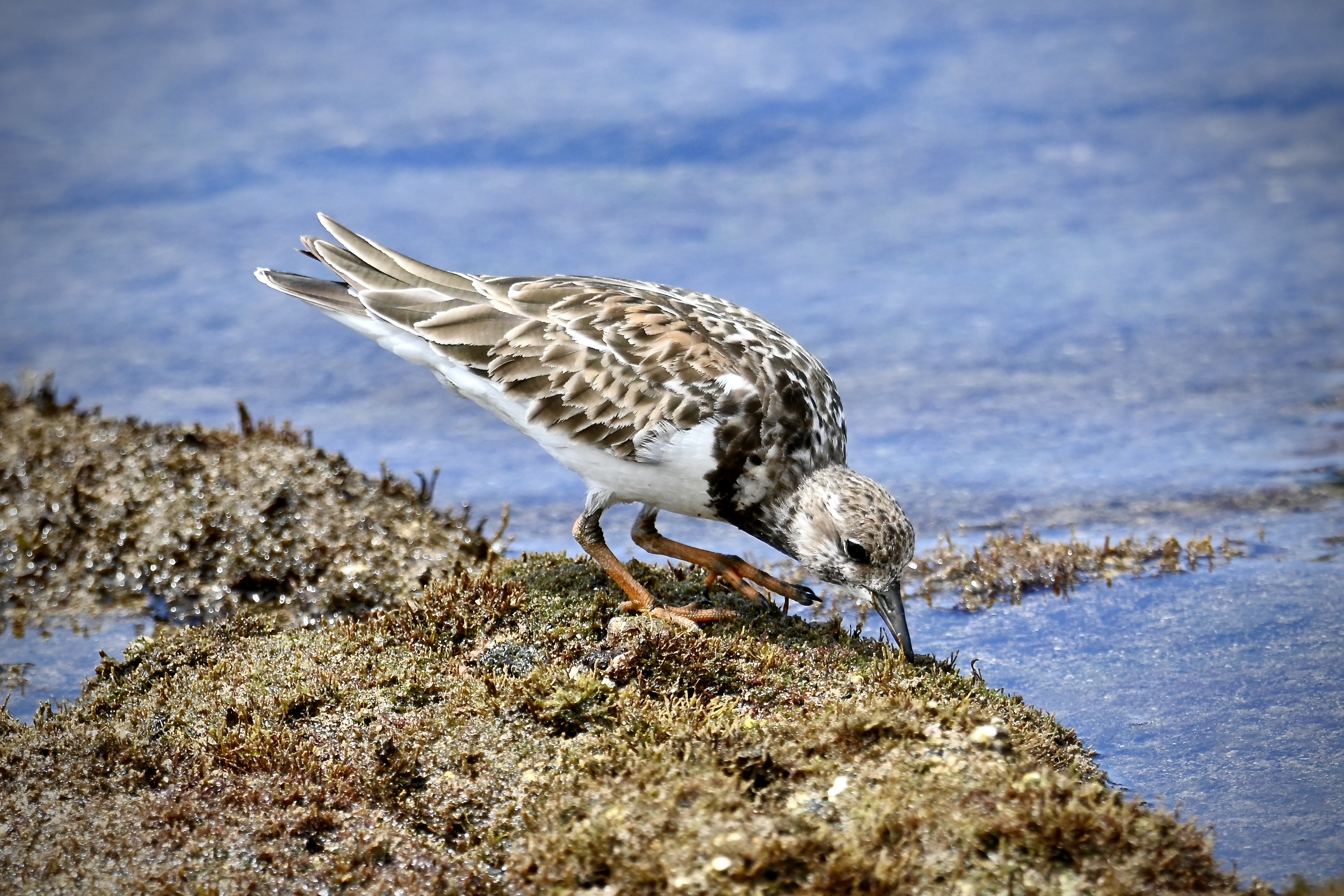
Photo of an ‘akekeke (ruddy turnstone) by Eric Anderson. Not far away, grazing in a shallow pool, there was a honu (green sea turtle).

Story: Nene Students

A photo of a nene, a wild Hawaiian goose, standing by a pond facing away.

January 15, 2025
(for a meeting of the Hawai’i Conference Committee on Ministry)

Nene School was in session. There was a new teacher that year, but he was getting help from a more experienced nene. She had been his teacher some years before. And because he was new, he had a relatively small class. Just three students.

Two of them were siblings, a brother and sister. The third was immediately interested in Food Identification part of the curriculum – Nene School basically consists of Flight and Food. The new teacher thought he’d be a good student, but mostly he was hungry. Time after time the teacher would have to rush over as the student reached out for yet another inedible item.

It kept him hopping.

He hoped that the brother and sister would be good flight students, since they’d already learned to fly together. His hopes were dashed, however, the first time they took off for basic formation flying. Honks of “You’re took close!” and “Get away from me!” resounded over the rocks and forest. He could barely be heard over them to try to coach them into position. Eventually there was a collision, and the two bruised siblings settled down to the ground to continue their recriminations.

The teacher could feel his teacher’s eyes on the back of his head, watching him as his class turned into a full-fledged disaster – that’s a disaster with feathers on. Or fluttering down from the sky because they didn’t stay on.

This went on for a week, and things didn’t get better. The hungry young nene never seemed to listen or retain what he’d been told. The siblings fought on the ground, climbing, cruising, descending, and on the ground again. The watching teacher said nothing. The young teacher got desperate.

As the class ended with more flying feathers, more angry honking, and a certain amount of vomit from an ill-considered berry, he burst out in fury: “You are the worst nene I’ve ever met! You’ll never learn! I’m sorry you were ever hatched!”

Shocked, the students flew away.

He turned to find his teacher standing right behind him. He couldn’t read the look in her eyes. “What?” he challenged.

“I’m disappointed,” she said.

“I’m disappointed in them, too,” he growled.

“I’m disappointed in you,” she said.

“What?”

“Haven’t you noticed that the siblings have been carefully listening to every word you’ve said about finding food? Haven’t you noticed that they never ask you twice about it? That they’ve learned so much in just a week?”

He hadn’t noticed.

“Haven’t you noticed that the third one sticks right by you in flight? He was awkward the first day, but he’s been right off your wingtip ever since. Haven’t you noticed?”

He hadn’t noticed.

“When they come back tomorrow, what are you going to say?” she asked, and then left him to consider.

The next morning, the three students stood anxiously before their teacher. They almost hadn’t come back. The older nene had persuaded them to come.

“I’m very sorry for what I said yesterday,” he said. “I had no business saying any of that. You’re here to learn, and I haven’t been teaching you very well.”

“Youngster,” he said to the hungry student, “I want you to keep an eye on the brother and sister here. They’ve done really well at learning what’s good to eat and what’s not. You can trust what they do.”

“And you two,” he said to the siblings, “can learn a lot from this youngster here. He’s been keeping good formation on me since the second day. Watch him. He’ll show you what to do.”

I won’t tell you that things went absolutely smoothly after that – there were still ruffled feathers and feelings, and the hungry student only gradually gave up whatever looked good at the time – but I will say that the students learned. All the students. One of whom was the teacher.

by Eric Anderson

I wrote this story as the opening devotional for a meeting of the Hawai’i Conference UCC Committee on Ministry Chairs.