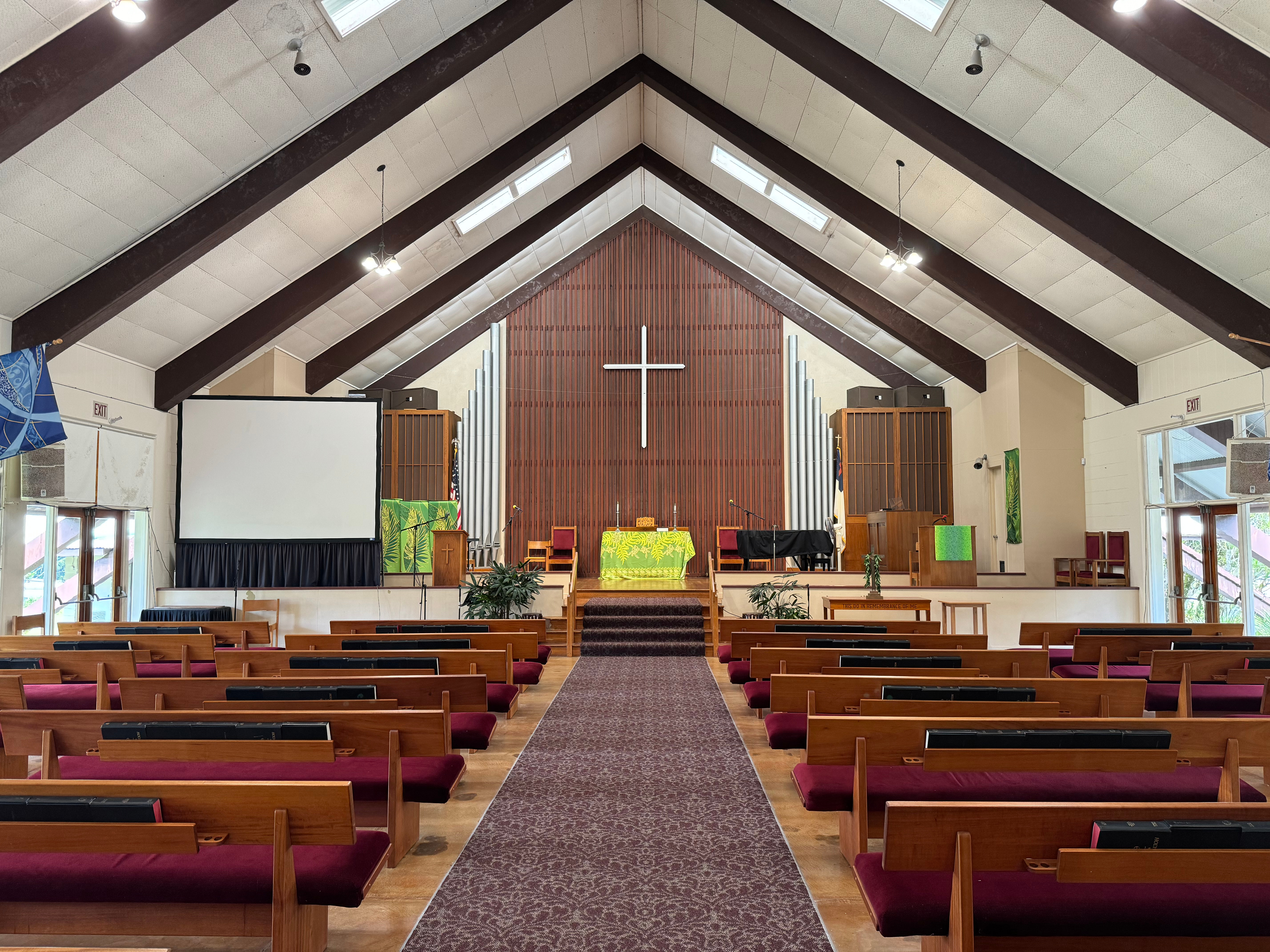
The last installment of this series, to my surprise, is nearly four years old. Since July of 2020 Church of the Holy Cross UCC returned to online-only worship when COVID infections rose dramatically that summer. In-person worship did not resume until April 2022.
When people returned to the sanctuary, we restored some, but not all, of the pews to the room, maintaining wider spacing. Eventually we returned nearly all of them. We continue to make masks and hand sanitizer available, and we have a policy that dictates when we will require masks, and when we will require online-only services. In the last two years, we have not had to implement that policy.
We found solutions to a number of our challenges during those two years of streaming. Having moved to the pulpit and lectern in the summer of 2020, we remained there, to give more of an in-person feel. We added more music. When people came to the sanctuary, we made some additional changes.
Moving the Consoles
With only the worship team in the sanctuary, we could place the mixing console with its PC, ATEM mini switcher, and remote control for the sound board where it was convenient for cable runs. As I’d noted in the previous piece in this series, we were near the limits of HDMI cable length. With a congregation in place, however, we needed to move the technical station, preferably to the back of the room. How could we get the camera signals there, however?
The answer was fiber-optic HDMI cables, whose prices had plummeted over the last few years. They carried signals over 100′ with no degradation. We initially laid them across the floor with cable covers, but then moved them along the walls above the windows.
In the meantime, Blackmagic Design had issued a series of upgraded ATEM Mini units. We purchased an ATEM Mini Pro. Its four inputs gave us the ability to connect three cameras plus the feed from our internal slides. Best of all, this piece of hardware can display a multiview on an external monitor, allowing us to retire the field monitors.
Camera Upgrades
The little Canon video cameras had done good service, but they were showing problems. They used a mini-HDMI connector, and it was not built for the strains of moving the camera back and forth. We began to suffer short dropouts on cameras, and I began to worry that one or both of the connectors would fail. In addition, we faced the need to move the cameras further back in the sanctuary as people returned. We looked for a better long-term solution.
We invested in three Blackmagic Design Studio Camera 4K Plus cameras. We equipped two of them with longer power zoom lenses and one with a wide power zoom. The wide lens camera stands raised at the back of the sanctuary and provides a shot of the entire room. It has no operator. Volunteers point the other two, permitting us to continue streaming a three camera production. I have really welcomed these new cameras, because for the first time I know which one is active. I recently discovered that a small tweak to their color balance has really improved the look.
Sound
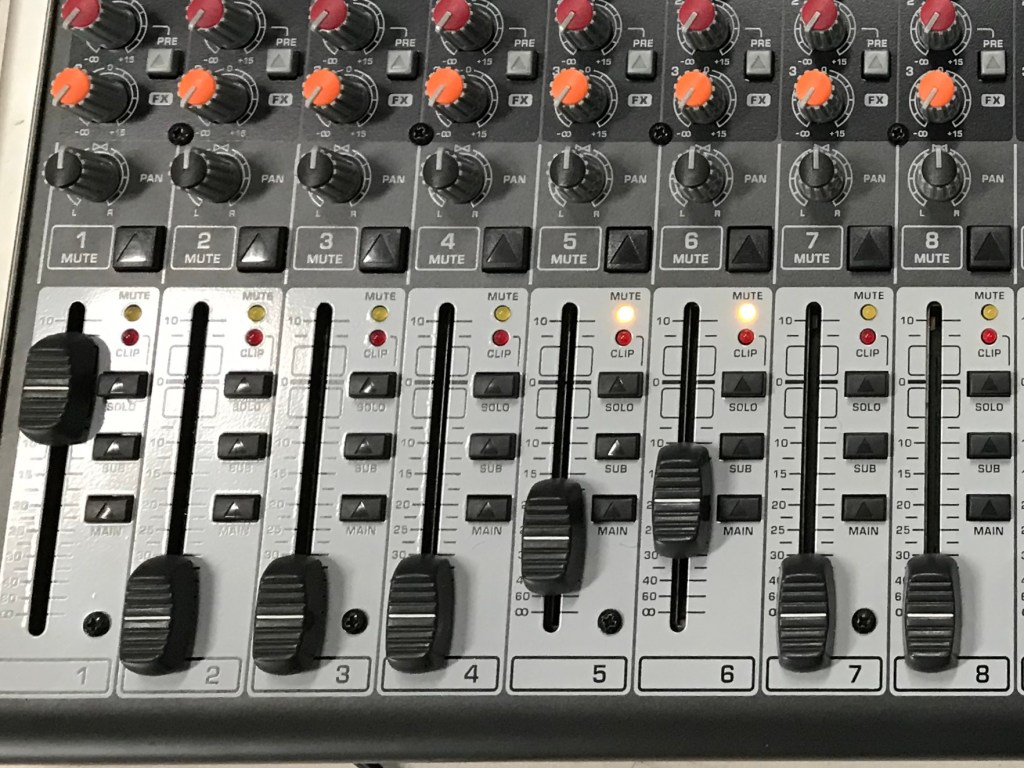
Our Soundcraft Ui24R has continued to serve us well, allowing us to send separate mixes to the speakers in the room and to the live stream. Moving the control console forced us to a new solution for getting the feed to the stream. We’re much too far from the physical mixer to use USB. Instead, we run an analog connection from the appropriate Auxiliary Out port to the back of the room, where it connects to a sound input on the ATEM Mini Pro. With a little bit of delay to compensate for the delay built into HDMI, we have solid sound.
We did add a “house sound” microphone to the mix. It hasn’t been a rousing success. We haven’t been able to place it so that it picks up the congregation without picking up the internal sound as well. We use it primarily during responsive readings, but not much otherwise. I’d still like to improve that somehow.
Movement
When a congregation returned in 2022, one of our members led them in movement, generally to one of the hymns or a musical anthem. As we increased the number of hymns in the service, this became less needed, and eventually we began to schedule the hula with an anthem. Sadly, the member then went through surgery, and we haven’t got her back on the calendar.
On the other hand, there is more movement in the service. The candle lighters go back and forth, and we stand and sit for prayers and hymns. We seem to have returned to that balance of stillness and striding that fosters a sense of worship.
Lights
We replaced the lights illuminating the sanctuary and the chancel with brighter LEDs that have a consistent color temperature. That has improved the video quality as well as the experience of worshipers in the room. It also led us to replace our sanctuary projector. The brighter overhead lamps made it much more difficult to read the screen, and the old projector wasn’t bright enough.
On Video a Lot
In 2016, when I began to serve Church of the Holy Cross, I began a video series called What I’m Thinking, a short improvised reflection on the Scripture text for the coming Sunday. That series recently exceeded 350 episodes. That makes one appearance in front of the camera in a week.
On Wednesdays, I’ve continued to offer A Song from Church of the Holy Cross. I began this program to test camera and microphone solutions, but also to provide some music in what I anticipated would be an all-too-musicless pandemic environment.
On one Friday a month, I offer a one hour Community Concert, which includes songs in the public domain (because copyright) and a few original pieces.
And of course on Sunday, I’m there before the cameras with worship. I’d never imagined becoming a televangelist, but I have to admit I’ve become one.
 ordainedgeek