“Then the devil left [Jesus], and suddenly angels came and waited on him.” – Matthew 4:11
He challenged you, Jesus. Summon the angels! They won’t let you fall. You won’t have a bruise on your heel, Nor a strike from a snake.
You said no. No to bread. No to flight. No to glory (that fails to transcend all the kingdoms of earth).
Then he left. And who came? Yes, the angels. The angels. They were hovering ’round, And they brought you relief.
Well, Jesus, I’m tempted. So tempted, you know, so hungry and weary, confused and distressed.
Where are the angels? Will they tend my bruises? Will they feed my hungers? Where are the angels, Jesus the Christ?
“There are angels hov’ring ’round.”
A poem/prayer based on Matthew 4:1-11, the Revised Common Lectionary Gospel Reading for Year A, First Sunday in Lent.
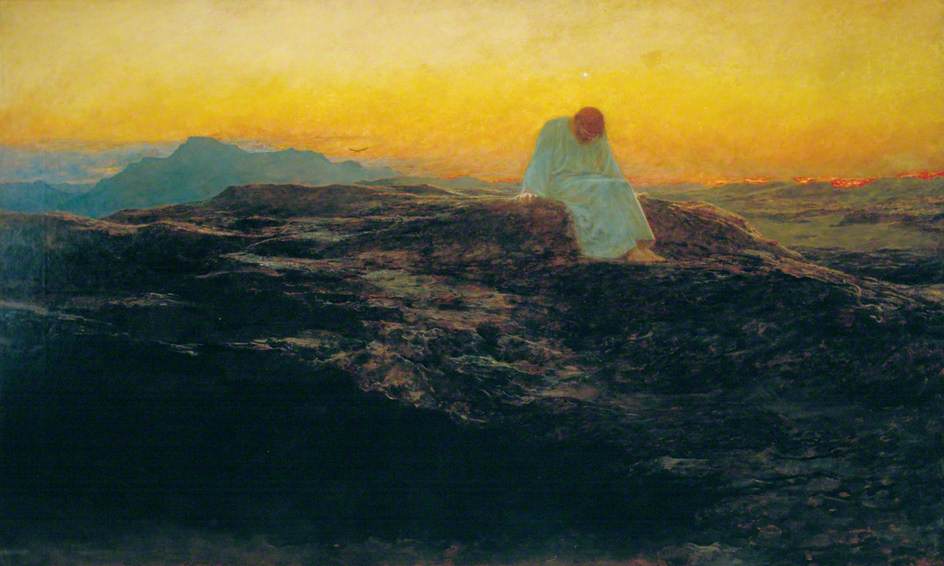
The image is Weite Gebirgslandschaft mit der Versuchung Christi (Vast Mountain Landscape with the Temptation of Christ) by Jan Brueghel the Elder – dorotheum.com heruntergeladen am 30. September 2012, Public Domain, https://commons.wikimedia.org/w/index.php?curid=21801997.
COL; (c) City of London Corporation; Supplied by The Public Catalogue Foundation
“He was in the wilderness forty days, tempted by Satan; and he was with the wild beasts; and the angels waited on him.” – Mark 1:13
Why did I come to Jordan?
My life in Galilee was nothing much. I did my work. I paid attention to my mom. I read the texts and prayed upon their words. If nobody was eager to accuse me of great sin, I can’t say anybody was inclined to say, “Here’s one who’s lived a life untarnished.”
My mother, to choose one, would never say those words.
Still, my conscience rested easy. My sins were bearable enough to wait until the day of offering within the Temple, and even then I’d struggle some to name my sins. So why did I accept the labor of the miles and seek a baptism, repenting for my sins?
The Spirit drove me dripping to the wilderness.
I’d had a life which had its just rewards, its comforts, and its faithfulness, but now my heart will never rest at “home.” The softest bed will scratch my soul until I set once more upon the road to speak to new assemblies, gathered for the Word.
My life will be a wilderness.
Oh, can I not just take the road to home? Can I not set aside the heavenly words as meant for someone else, and not for me? Must I embark upon a journey, knowing that it leads to only one imaginable destination: a shameful death upon a cross?
There’s little mercy in the laws of Rome.
I’d cry out, “Get behind me, Satan,” but temptation is behind me, and before me, and at either side. It’s graven deep within my bones which long for hearth and home. What do I care for bread, for power, or for Messianic name? All I want, my God, is to go home.
But now my home is wilderness in truth.
Oh, you can come now, angels. Wipe my sweat-soaked brow, and dry my streaming eyes. Supply the bread I’ve done without and gently satisfy my body’s thirst. Just like the prophet long ago, I take your nourishment. I take the highway of the wilderness,
From this day forth, and always.
A poem/prayer based on Mark 1:9-15, the Revised Common Lectionary Gospel Reading for Year B, First Sunday in Lent.
I think you may have heard the story I’m not telling, the one about when the Tempter tried to tempt Jesus. He challenged him to turn stones into bread because Jesus was hungry, and Jesus said, “No.” He challenged him to prove he was the Messiah by jumping off the Temple roof, and Jesus said, “No.” He challenged him to rule the nations of the world by worshiping him, that is, Jesus worshiping the Tempter, and Jesus said, “No.” Then the Tempter went away.
But I’m not telling you that story.
I’m telling you what happened next, which is that the Tempter was angry and fed up and feeling like a failure. What do people do when they need a break? That’s right. They go on vacation in Hawai’i.
I promise you that most of the visitors aren’t angry Tempters.
But the Tempter walked the koa and ohi’a forests and tried to feel better about things, which wasn’t working. One of the problems with being a Tempter is that you never really do find peace inside yourself. So he decided that instead of peace, he’d find success. He’d tempt something, and this time he’d win.
He went searching, and he found an ‘apapane.
“’Apapane,” he said, “have I got a deal for you. I will give you the power to turn these stones into bread. Just do that, and you’ll never worry about being hungry ever again.” The Tempter demonstrated by turning some lava rock into bread. The scent rose into the air.
The ‘apapane gave it a sniff, and then flew a short distance to an ohi’a tree, where he sniffed at the nectar from a bright red blossom. He gave it a taste.
“No, thank you,” he said. “I’ll stick to nectar.”
The Tempter was very disappointed with this, but not ready to quit. He brought the ‘apapane to the top of the highest tree in the forest. “All you have to do is prove that God takes care of all God’s creatures,” the Tempter said. “Throw yourself down from this tree, and let the angels catch you.”
The ‘apapane looked at the ground far below, stretched out his wings, and flew. “I think I’ve got that one covered already,” he said.
The Tempter realized that this temptation had been a bad mistake, and he was rattled. Still, he was undaunted. He was going to have a success. This time he swept the ‘apapane all the way to the summit of Mauna Kea, and there he showed the bird all the nations and forests and mountains of the world. “Worship me,” said the Tempter, “and all of this will be yours.”
The ‘apapane shivered in the cold, and pecked experimentally at a small bug on a rock. “I’d rather live in the ohi’a forest,” he said. “It’s warmer and things taste better there.”
At that the Tempter gave up, both on tempting an ‘apapane and on his Hawaiian vacation. I believe he went to sulk in Antarctica, where there’s a lot of empty space to sulk in.
The ‘apapane went back to the forest and, when other birds asked him about his adventure, simply said, “I just chose to be myself, to enjoy my life and its nectar. It’s not really much of a temptation to be something or someone else than myself.”
If you’re tempted, friends, choose to be yourself, the best and truest self you can be. Send the Tempter sulking to Antarctica.
by Eric Anderson
Watch the Recorded Story
I write the story. I tell the story. In the telling, there are departures from the writing.




 ordainedgeek