Story: Considering and Preparing

September 7, 2025

Philemon 1:1-21
Luke 14:25-33

People, in general, don’t do well if they eat a lot of food quickly. It’s a good way to feel sick. Sometimes, somebody who eats a lot of food really quickly will get sick.

Ick.

The young ‘akekeke had learned something similar from his parents as they led him and his sister and brothers around the Alaskan tundra near where they’d hatched. There they found the bugs and worms that filled their bellies and kept them growing. Both mother and father, however, warned them against eating too much, and after one of his brothers ignored their advice and got a nasty stomachache the rest of the chicks decided their parents knew something after all.

As the summer wore on, it became time for the trip to Hawai’i. The four chicks became fledglings, learned to fly, and watched as more and more of the ‘akekeke began flying toward the coast. Their mother joined in with lots of the other mothers, leaving them with their father to finish flight school with him.

Even more birds departed before their father gathered them along with some other youngsters into a little flock and said, “It’s time to get ready.” They flew to the shoreline where they found a number of other groups of ‘akekeke probing through the shallows for small fish and shrimp.

“It will be time soon,” said their father, “to make the long flight to Hawai’i. You’ll need all the energy you can get for this. So eat. Eat all you can. Eat more than you think you can.”

“But wait,” said his son. “You’ve been telling us for weeks not to eat too much. In fact, when our brother tried it anyway, he got sick. Are you telling us that was wrong?”

“It was wrong then,” said father, “but now we’re doing something very different. We’re making a long flight and there’s nowhere to stop and eat until we get there. This is the time to plan. This is the time to prepare. This is the time to get ready.”

The young ‘akekeke wasn’t convinced. He wasn’t convinced that eating a lot was a good idea, even though his sister and two brothers had plunged right into an outcrop of mussels. He also wasn’t sure that taking such a long flight was a good idea, even if so many of the adults had already gone. His father looked at him with sympathy and with love.

“There’s some time, youngster,” he said. “Take time. Consider. I don’t think you’ll enjoy staying here for the winter – it gets cold, you see. But think it over. I hope you’ll join us.”

The young ‘akekeke thought about it. He thought about being cold, which he couldn’t really imagine. He thought about eating more than he ever thought possible, which he couldn’t really imagine, either, but he could see that his father, sister, and brothers didn’t seem to have any troubles as they ate their way along the shoreline. He thought about Hawai’i, which he also had trouble imagining, since he’d never been there before. Mostly he thought about being the only ‘akekeke in Alaska when everybody else had gone.

A little while later he was industriously feeding himself alongside his father.

“I’ve thought it over,” he said, “and I’ll stick with you.”

by Eric Anderson

Watch the Recorded Story

I write these stories ahead of time, but I tell them without notes, so the text I prepared does not match the way I told it in worship.

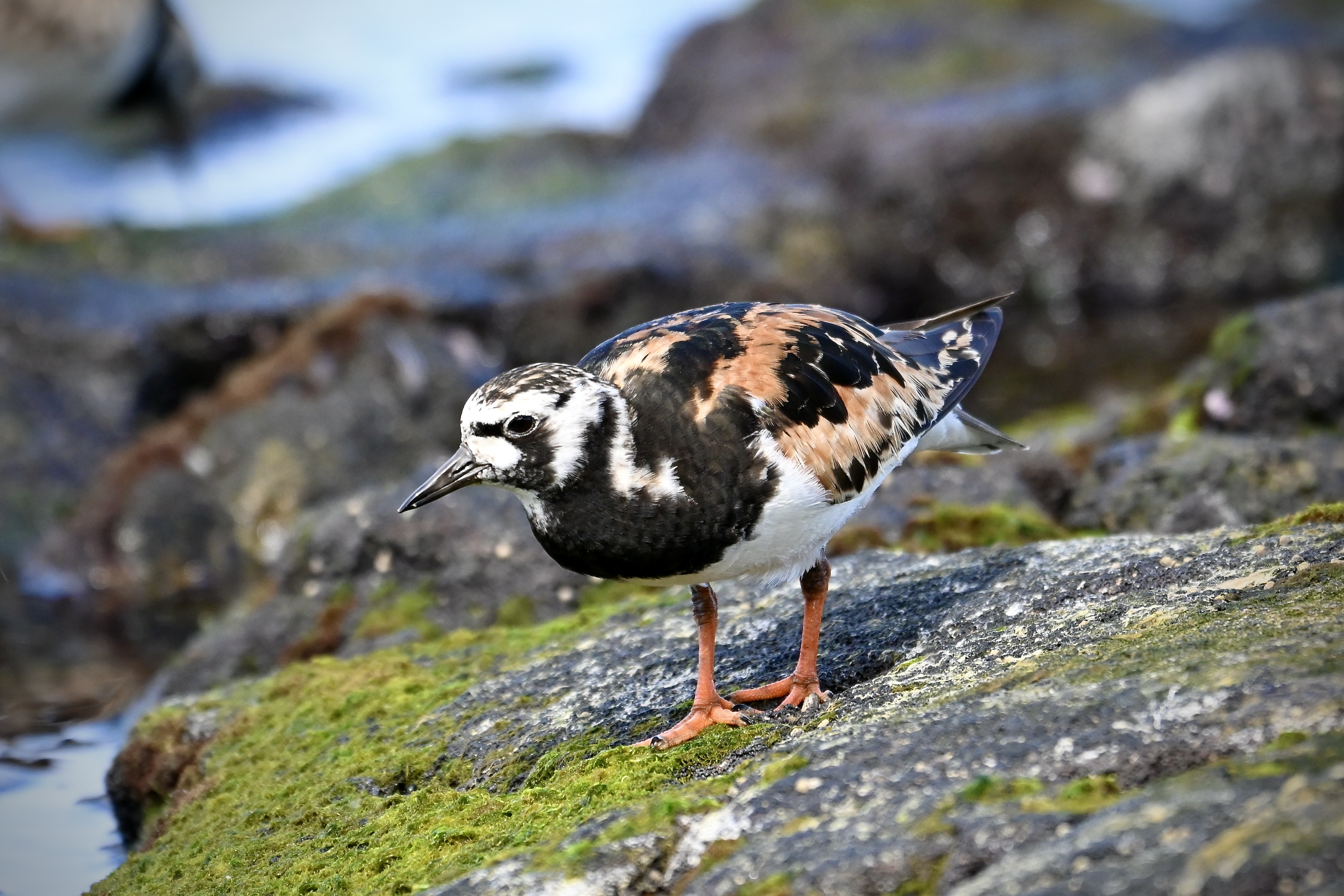
Photo of an ‘akekeke (ruddy turnstone) on Hawai’i Island by Eric Anderson.
Story: Following the I’iwi

August 17, 2025

Jeremiah 23:23-29
Hebrews 11:29-12:2

During the summer, plenty of the forest birds form small flocks which may include ‘apapane, ‘amakihi, ‘akepa, and so on. Plenty of those birds may fly about and forage by themselves as well, but one little flock on the slopes of Mauna Loa was having a bad day. They just weren’t finding much in the way of food.

“I’m hungry,” complained an ‘amakihi.

“We all are,” replied an ‘apapane, and the other birds agreed.

“What are we going to do about it?” asked the first ‘amakihi.

“Does anyone have any good ideas?” asked another ‘apapane, looking around at the other birds. From the shaking heads, nobody did.

That’s when the heard they heard the squeaky sound of an i’iwi. They watched as he rose from a nearby tree – one which didn’t have much in the way of flowers on it, circled once or twice, and flew off.

“What was that about?” asked an ‘apapane.

“I don’t know,” said an ‘akepa.

“How about we follow him?” said the first ‘amakihi, the one who was hungry.

Nobody could think of a good reason not to, so the little flock took to the air and flew in the same direction the i’iwi had taken. For a little while they just flew over flowerless trees, but then a few ohi’a blossoms appeared. Things were looking up. Eventually the i’iwi settled in a tree just dripping with flowers, surrounded by plenty of other blossoming trees as well.

The i’iwi squawked a little unpleasantly at them – they’re not great singers, the i’iwi – but didn’t come out to chase them away as they settled into surrounding trees and began checking the flowers for nectar and the branches for bugs. There wasn’t much sound for a while other than some satisfied songs and wing flutters as they shifted from branch to branch.

“How did you know?” said an ‘apapane to the ‘amakihi.

“How did I know what?” said the ‘amakihi.

“How did you know that the i’iwi would lead us to flowers?”

The ‘amakihi shrugged. “I didn’t know,” he said, “but as sad as it is that the i’iwi isn’t a great singer, and as nasty as they can get when they’re upset about something, they’re really good at finding trees in blossom. I’d trust them to find food any day of the week.”

“You’d trust an i’iwi?” said the ‘apapane in wonder.

“I trust an i’iwi to do what an i’iwi does,” said the ‘amakihi. “And look. This one did.”

The i’iwi, who had overheard all this, let out a contented squawk, hopped to another flower, and settled in to sip the sweet nectar.

by Eric Anderson

Watch the Recorded Story

I write these stories in advance, but I tell them from a combination of memory and improvisation, so what I wrote and how I told it do not match.

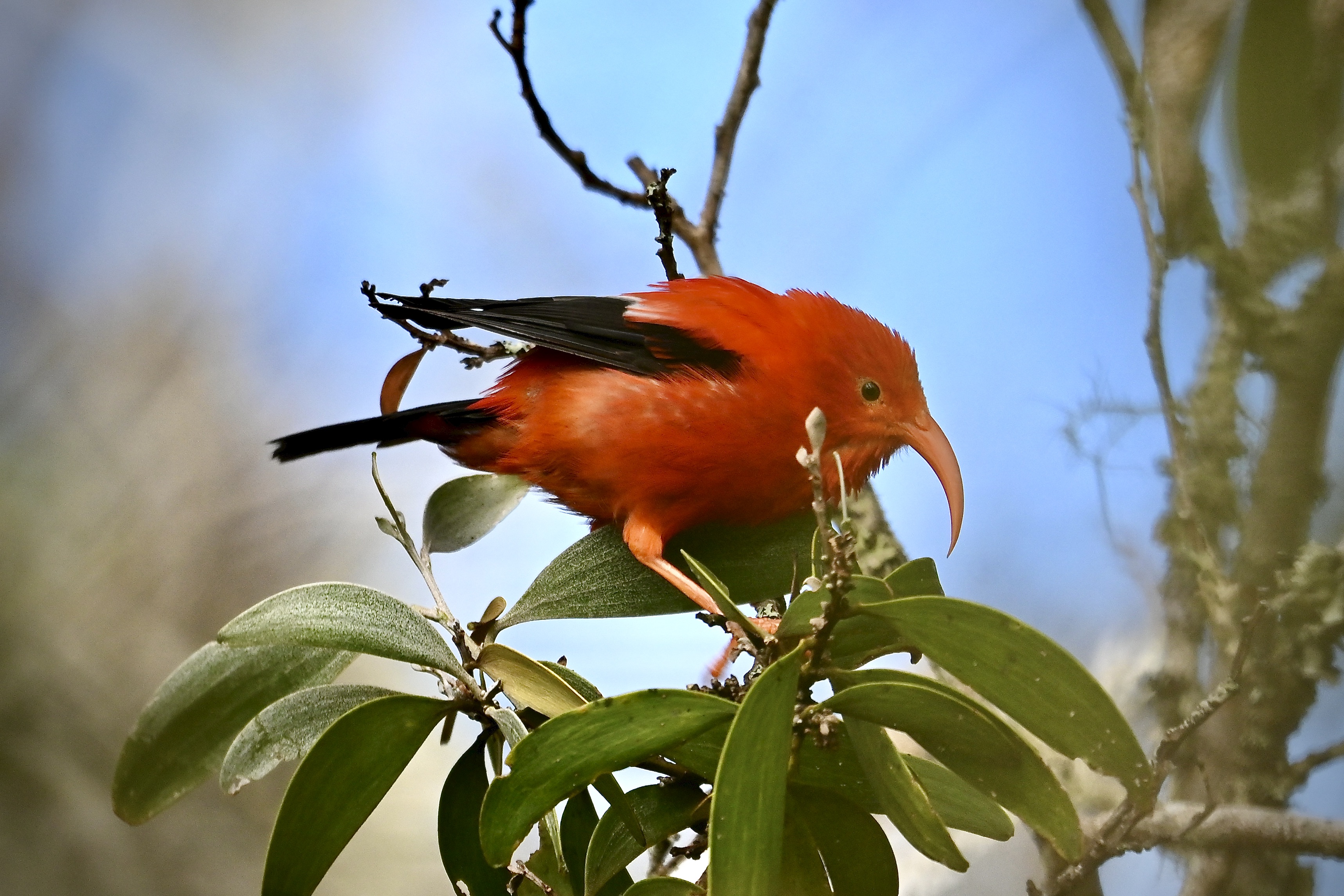
Photo of an i’iwi by Eric Anderson.

Don’t You Care?

“But he was in the stern, asleep on the cushion; and they woke him up and said to him, ‘Teacher, do you not care that we are perishing?'” – Mark 4:38

For once, it wasn’t me.
I’m known, of course, for saying all
the dumb things I could say to Jesus.
This time, it wasn’t me.

(And wouldn’t you know, the time
it wasn’t me, they left the culprit
unidentified. I ask you,
was that fair to me or not?)

No, I was busy with the flying rig,
and leaning hard to counter all
my lubberly companions who
knew nothing of the balance of a boat.

I thought it best to wake him, too.
I couldn’t calm the lubbers down.
Perhaps he could, and then old James
and John and Andrew might have saved the day.

Not even I, with all my lack of sense,
would dare to utter what he did
(I, too, will shelter here the guilty one).
“We’re perishing! Or don’t you care?”

Though rope ran slick along my bloody palm,
I winced to hear those words. I’d said them
to my mother once, and only once.
“I don’t believe you care at all!”

I knew that Jesus would respond
no better than my mother had.
Like her, he fixed the problem first,
the wind and sea subsided,

But then he turned that steely glare
upon us, one and all, even those
who never would have mouthed
those ill-considered words, and said:

“Why are you mewling cowards? Do
you ask me if I care? Have you no sense?
No confidence? No faith?”
And we said nothing back at all.

In truth, my confidence was lacking then.
I trusted in my seaman’s skills
in preference to God. But none of us
appreciated then what he had asked of us.

He asked us not to trust in him awake,
but trust in him asleep. He asked not to trust
in God when fiery pillars stride, but when
the way is still unknown.

He asked us not to trust in signs,
but in their absence. He asked us not
to trust in prophecy, but in
the new things prophets had not said.

We asked the question, “Who is this?”
as if the answer mattered more
than how we meet the challenges of life
encouraged by our trust in God.

A poem/prayer based on Mark 4:35-41, the Revised Common Lectionary Gospel Reading for Year B, Proper 7 (12).

The image is Stillung des Sturmes durch Jesus (Jesus Calms the Storm), a relief on the exterior of the Stuttgart Stiftsckirche (Collegiate Church of Stuttgart), 1957, by Jürgen Weber. Photo by Andreas Praefcke – Self-photographed, CC BY 3.0, https://commons.wikimedia.org/w/index.php?curid=15039823.

Story: Unconvinced

April 16, 2023

Acts 2:14a, 22-32
John 20:19-31

The saffron finch was unconvinced.

He’d had a long conversation with the kolea as they both searched for food in the grass. They were mostly looking for the same things: seeds, bugs, and so on. Fortunately there was plenty to be found, so the saffron finch’s dissatisfaction had nothing to do with how much or how little he was getting to eat. No.

It was that the kolea was preparing for the journey to Alaska, and the saffron finch thought this sounded like a bad idea. I mean, a Bad Idea with Capital Letters.

“Have you ever been in Hawai’i over the summer?” he demanded of the kolea between mouthfuls.

“No,” said the kolea. “Have you ever been in Alaska during the summer?”

The saffron finch had no reply to this. “It couldn’t be better than Hawai’i during the summer,” he insisted.

“It might not be,” agreed the kolea. “But it’s where I’ll be.”

“It’s such a long way!” moaned the saffron finch, “and your wings might be bigger than mine, but they’re nothing like a nene’s, and they don’t fly to Alaska.”

“I know how far it is,” said the kolea, who knew it much better than the saffron finch could, since he’d flown it and the finch hadn’t. “And I know it can be done.”

“What will you eat there?” demanded the saffron finch, who had just plucked some very tasty seeds out of the grasses.”

“Much the same as here,” answered the kolea, though it was a little hard to hear because his mouth was full.

“I say you should stay here,” announced the saffron finch. “Hawai’i is the place to be.”

“It’s a great place to be,” said the kolea, “but…”

“But nothing!” interrupted the saffron finch.

“But… said the kolea, “it’s where I was hatched, and where my parents were hatched, and where my grandparents were hatched. Other birds, even other kolea, lay their eggs in other places. I know it can be done. But this is how we do it, and we know it works for us.”

“It’s really strange, you know,” said the saffron finch.

“It’s not so strange,” replied the kolea. “There are other birds here that make much the same journey – the akekeke, for one – and I’ve met birds in Alaska that make long journeys to spend the winters in very different places than Hawai’i.”

“I’m not convinced,” said the saffron finch.

“You don’t have to be,” said the kolea. “It’s still something I have to do, even if you don’t like it or understand it.”

The saffron finch was quiet for a while and finally said, “I’ll miss you.”

The kolea gave a kolea smile – birds don’t have lips, after all – and said, “I’ll miss you, too, and I’ll be back in the fall to pluck seeds from in front of you again.” And he pulled a seed out right in front of the saffron finch’s beak.

“You’ll be welcome,” said the saffron finch, and he plucked a seed from in front of the kolea.

He remained unconvinced, but he remained satisfied, too, that his friend would come back once more.

by Eric Anderson

Watch the Recorded Story

The story in the recording was told from memory of this text – imperfect memory coupled with affection for improvisation…

Photos of a kolea (left) and a saffron finch by Eric Anderson.

Story: The Suspicious Noio

July 24, 2022

Genesis 18:20-32
Luke 11:1-13
 
The young noio was hungry pretty much all the time. That’s not all that uncommon for a young noio, of course. He was growing very fast, going from just a little thing at hatching to about the size and weight of an adult in three weeks. At three weeks’ end he weighed six and a half times what he’d weighed when he broke the shell of his egg.
 
So he ate. A lot.
 
You and I wouldn’t find his diet very appetizing, but he certainly thrived on it. His parents would fish in the ocean, slurping down the fish and squid into their bellies. Then they’d go back to the nest, where they’d open their beaks and he’d poke his beak into their mouths. And then, well, the food would return.
 
Yeah, I know. Yuck. I’m glad we don’t do it that way, either.
 
To the young noio, however, this was how it was done. This was the way to eat. This was tasty (I know, yuck) and nutritious and, more than anything else, it was really successful. I mean. Imagine eating enough in three weeks to grow six times your size. That’s impressive.
 
It still took some time for the feathers to grow out and for his wing muscles to develop, so he took his first flight when he was six weeks old. The first flight was a little ragged, but he soon got better. He loved being out in the air, and zooming low over the sea, and coming back to the nest.
 
For some weeks, though, his parents continued to feed him. I know. Yuck. But he had to develop his flying skills before he could develop his food-finding skills. Noio don’t dive into the water to catch food. They fly low over the surface and pluck it from the water.
 
It turns out that for this young noio, that was a problem. He had no problems with the flying skills. But his first reaction to seeing a school of fish in the water below was… Yuck.
 
“That’s what we eat,” said mother.
 
“You have got to be kidding,” said her son. “That’s disgusting. Is there anything else?”
 
“Well,” she said, “there’s muhe’e (that’s squid). Shall we try those?”
 
I know. Squid. Yuck. As it happens, the young noio agreed with us.
 
“That’s even worse!” he said. “I can’t believe I have to spend the rest of my life eating these disgusting things!” He wouldn’t even try to catch one in his beak.
 
Mother and father both tried to persuade him that he should at least try these things, that they really were tasty, and that he’d been eating them without knowing it since he hatched (I know, yuck), but he was not persuaded. He kept feeding the way he’d always known (yuck) and wouldn’t even consider catching a fish.
 
While his parents were out fishing for themselves (and for him) and trying to think of something they could do, tutu came by. His grandmother had been very pleased and proud of him, and her daughter had asked her advice. She came right to the point.
 
“So you think your parents are lying to you?” she asked.
 
“Lying?” he said.
 
“So you think they’d offer you bad food when you’re hungry?” she asked.
 
“Bad food?” he said.
 
“So you think they don’t know how to show you what is good?” she asked.
 
He was silent.
 
“Have they done this before?” she asked.
 
“No,” he said. “Of course not.”
 
“Then why would they do it now?”
 
He said nothing.
 
“Fly with me,” said tutu noio.
 
When his parents got back to the nest, they found grandmother and grandson returned from his first successful fishing trip.
 
“I should have realized you wouldn’t lie to me,” he told them. “Now I know that you didn’t.”
 
by Eric Anderson

Watch the Recorded Story

When recorded, I was delivering the story from a memory of this text – which means they’re not the same. It is distinctive, however, for including the coining of the word, “tentacally,” which sadly, isn’t in the prepared text.

Photo of a noio (black noddy) by Eric Anderson.

Returning Tide

June 5, 2022

Genesis 11:1-9
Acts 2:1-21

The opihi – do you know about opihi? They’re a shellfish, a little bit like scallops or clams. Scallops and clams, of course, have two shells and a hinge. They’ve got protection from creatures that like to eat them on top and on the bottom. And when things are safer, they can open up and let the water bring the little bits of seaweed and tiny creatures to them.

An opihi, however, only has one shell. I suppose it’s a little bit like a hat, only it’s a hat that covers the entire creature. An opihi – they’re called limpets in English – finds a spot on the rocks and holds tight as its shell grows over its top. And then it continues to hold tight. It might move a little bit to get to another spot on the rock with more algae, but you and I might not even notice them on the move.

And they don’t talk much. There’s not a lot to talk about, when you’re an opihi.

Here’s the thing: they like to live in the shallows along the shorelines of our islands. In those places, the tides come in, and the tides go out. Sometimes when the tide goes out, an opihi is in a pool of water. But sometimes, it finds itself above the water after it drains away. Sometimes it just sits there in the open air.

A honu pulled itself up on a rock to nap in the sun one day and found an opihi already there. I’m a little surprised it noticed. A honu is a lot bigger than an opihi. But they both have shells, so the honu felt a little bit of sympathy for this opihi, stranded on the rock outside the water.

“Do you need help?” the honu asked. “I see you’re out of the water here.”

The opihi wasn’t used to conversation – there’s not a lot to talk about when you’re an opihi (I may have mentioned that). But finally it found a reply:

“No. I’m fine.”

“Isn’t being out of the water a problem?”

“Well, not so much. If it went on a long time, that would be a problem,” said the opihi.

“How do you know it won’t be a long time?”

The opihi thought about this. “Honestly, I don’t know that it won’t be a long time. I suppose it could be. This isn’t the first time I’ve been left high and dry. Some of those times really did seem pretty long.”

The honu waited. Finally the opihi finished:

“The tide has always come back. I trust the tide more than I trust myself to swim if you swept me off the rock into the water.

“The tide has always been good to me. I’ll hold on here until it returns again.”

by Eric Anderson

Watch the Recorded Story

The story is told from memory of this prepared text – and thus will never be quite the same.

Photo of opihi in Honokanaia, Kahoolawe, Hawaii, by Forest & Kim Starr, CC BY 3.0 us, https://commons.wikimedia.org/w/index.php?curid=71815389.

So Hard to Believe

13th century manuscript illustration of picking cherries.

“When [Jesus’] mother Mary had been engaged to Joseph, but before they lived together, she was found to be with child from the Holy Spirit.” – Matthew 1:18b

It’s all very well for me, you know.
He gave the plot away, the evangelist did,
for all his readers to know what Joseph could not:
Mary told the truth.

I feel no gut-wrenched shock, no rising fire,
no heart-destroying grief and pain
to close my mind against the simple fact that
Mary told the truth.

“Hey, Joseph,” I whisper over the centuries,
“What need of angels visiting in dreams
if you could only hold your faith and trust that
Mary told the truth?”

What need, indeed? Except that I rely far more
upon my keen discernment of the world’s
condition. It took Matthew to assure me that
Mary told the truth.

Officiously I do declare that voices often
silenced – women, children, refugees –
should be attended, but: would I have trusted
Mary told the truth?

For love, perhaps. For faith, perhaps.
For trust, perhaps. For God, perhaps.
For obeisance of a cherry, then:
Mary told the truth.

A poem/prayer based on Matthew 1:18-25, the Revised Common Lectionary Gospel reading for Year A, Fourth Sunday of Advent.