Story: Truth and the ‘Akiapola’au

June 15, 2025

Proverbs 8:1-4, 22-31
John 16:12-15

Birds are pretty honest creatures. They sing when they’re happy, and they screech when they’re mad. They give alarm calls when they’re scared, and they make hungry noises when they’re hungry.

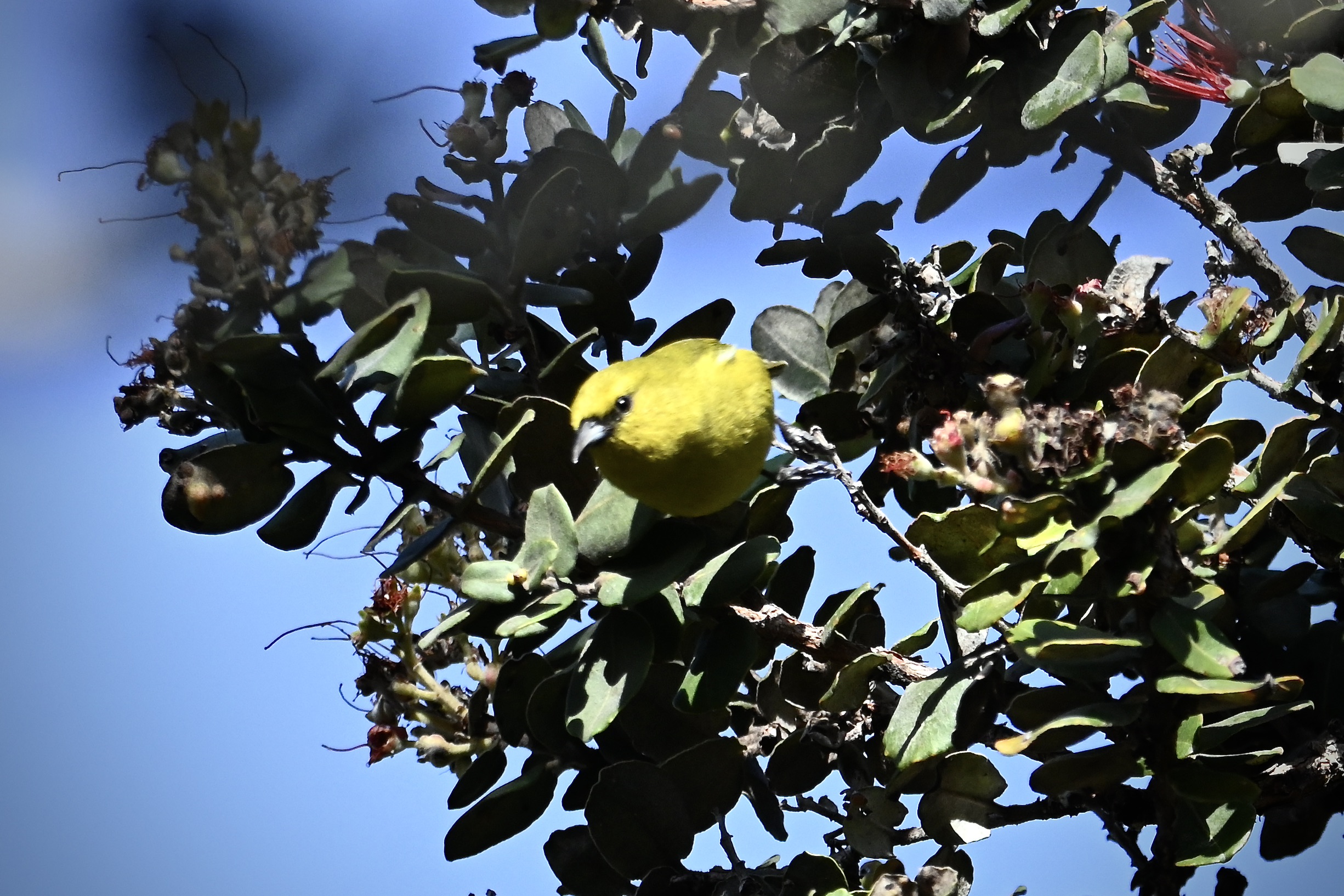
An ‘akiapola’au  used to follow ‘elepaio through the forest to find food. The funny thing is that ‘elepaio and ‘akiapola’au don’t eat the same things. ‘Elepaio like bugs and spiders, which I don’t, to be honest. ‘Akiapola’au will eat those, it’s true, but they prefer the worms, caterpillars, and bugs that burrow into the wood of koa trees. It’s been noticed that a tree full of bugs and spiders is probably also one that’s full of burrowing insects, too. The Hawaiian canoe makers knew that, and the ‘akiapola’au knows it, too.

The ’elepaio could be trusted to tell the truth.

This one ‘akiapola’au, however, came up with a new idea one day. You see, while he was following the ‘elepaio, other birds were following him. He worried that they’d eat all the food before he did. The fact that none of them ever left the trees hungry didn’t seem to make a difference. He had to protect his food.

He thought.

Not that it was his food before he ate it, but anyway.

So he developed the habit of tapping at tree branches that didn’t have bugs in them. ‘Akiapola’au do that to find where things have burrowed into a tree, but he started doing it, and then digging where he hadn’t found any. It attracted other birds. They’d come in to see.

And he’d fly off to some other tree where he’d try to find something he could actually eat.

The result was a fair number of frustrated birds, who’d look around where he’d been tapping and find fewer spiders and insects than they expected. They went to bed somewhat hungry.

He was pretty satisfied with his trick when his auntie turned up after a day of tapping on insect-free trees. “Nephew, why are you spending so much time hunting in trees without food?” she asked.

“Don’t tell anyone, but I’m drawing the other birds away from the good trees,” he said. “I don’t want to run out of food and be hungry.”

“So you’re lying to them?” she asked. “And before you say, ‘No,’ don’t think about lying to me.”

“I don’t think I’m lying to them,” he said.

“You’re acting as if there’s food where there isn’t. You don’t have to say a word. It’s still a lie. It’s a lie that’s bringing hunger to our forest when it isn’t necessary. There’s plenty to eat. Isn’t there?”

“I guess so,” he said.

“As for you, you’re spending so much time in trees without food: how hungry are you when you go to sleep?” she asked.

He realized that, in fact, he spent so much time in trees without caterpillars that he was hungry at the end of most days. His lie meant that he wasn’t eating enough.

“No lying, nephew,” said auntie. “It’s not worth it and it never was. Go find the trees with food in them, and share the word with the other birds around us. We’ll all be better for the truth.”

by Eric Anderson

Watch the Recorded Story

I write these stories in advance, but I tell them from memory and inspiration. On this particular day, I’d happened to speak to one of the young people the night before on a video call, where I told him that I’d be telling him a story the next day.

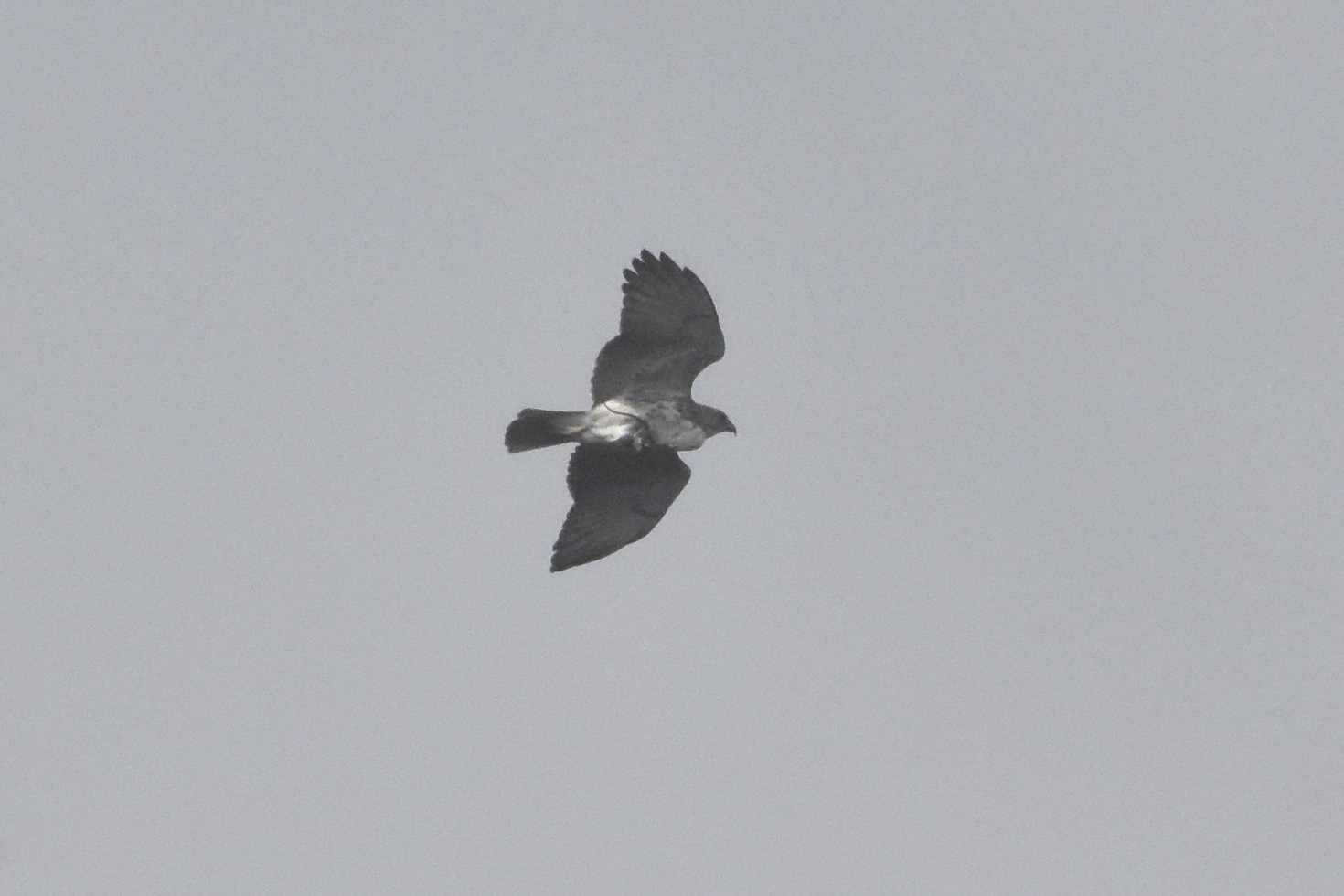
Photo of an ‘akiapola’au (adult male) by Eric Anderson.
Story: The ‘Io and the ‘Amakihi

November 10, 2024

Ruth 3:1-5, 4:13-17
Mark 12:38-44

There is a lot to learn when you’re a young bird. Or a young human, of course. But this story is about a young bird.

He was an ‘amakihi, and he’d hatched, fledged, and flown. He’d toured around with a little flock of various forest birds, and he’d seen plenty of sunrises and sunsets. All in all, he thought he was pretty wise.

Then he saw a creature he hadn’t seen before. It was big. It was impressive. It soared along in the air on broad wings. He watched it from an ohi’a branch with awe. Such presence. Such grace. Such magnificence. Such size.

To his surprise, it landed in a neighboring tree, where it seemed to rest.

“What are you?” asked the young ‘amakihi.

“I’m an ‘io,” said the big bird. “Haven’t you heard about me?”

In truth, the young ‘amakihi had been told about the ‘io, but he hadn’t been paying attention. These things happen sometimes, have you noticed?

“I can’t remember hearing anything about you,” said the ‘amakihi with some truth. “What are you like?”

“Oh, I’m a very friendly bird,” said the ‘io. “I fly around overhead and watch out for all the other birds in the forest. All the birds are safe when I’m around.”

“That’s really great,” said the young ‘amakihi. “And what do you eat?”

“Oh, this and that,” said the ‘io. “Kind of like yourself.”

“You mean, bugs and nectar and fruit?”

“Kind of like that,” said the ‘io.

“I’m a little hungry myself,” said the ‘amakihi, “and this tree has been pretty well picked over. If you don’t mind I’ll see you later.”

“That’s fine,” said the ‘io, who fortunately for the young ‘amakihi wasn’t hungry at the moment. “I’ll catch you later.”

The ‘amakihi flew off, and the ‘io didn’t chase him, fortunately. A little later he found his grandmother, and told her about the bird he’d just met.

“The ‘io told you he protects the other birds?” said his Tutu.

“Oh, yes,” said her grandson.

“Don’t you remember what your mother and father said about the ‘io?” asked his grandmother sternly.

“I’m afraid I don’t,” said the young ‘amakhi. “I may not have been listening all that well.”

“That wasn’t a good time to not listen,” she said. “Didn’t you notice the ‘io’s beak, and the talons on his feet? Do you think those are good for eating bugs and nectar?”

And she told him what an ‘io eats. He was horrified and pretty surprised that he’d survived that conversation.

“Those who are danger to you won’t always tell you so,” said Tutu. “Sometimes they’ll lie about it. Listen to the warnings of those who love you. We may not always be right, but we will always tell you what we know and what we believe we know.

“And keep an eye out for those ‘io.”

by Eric Anderson

Watch the Recorded Story

I write these stories in advance, and I tell them from memory during Sunday worship. Therefore, the story you’ve just read will likely differ from the story as I told it.

Photos of an ‘amakihi (top) and an ‘io (smaller photo on right) by Eric Anderson.

Promise Unfulfilled…?

But this is the covenant that I will make with the house of Israel after those days, says the LORD: I will put my law within them, and I will write it on their hearts; and I will be their God, and they shall be my people. – Jeremiah 31:33

Of all the promises you’ve made, O God,
through human speech of ancient poets, this
I wait for most expectantly. Oh when, I ask,
will human hearts be oriented to your will?

From Jeremiah’s day to this, I do not see
a sudden change in human righteousness.
Not even Jesus’ resurrection prompted us
to set aside our greedy lust for power,

Our tolerance for prejudice,
enshrining it in law that breaks the Law
I yearn to feel a-written on my heart.
How bright would be the dawn of such a day!

But God, I fear that knowledge of your law
within the heart would do no better than
to write it on papyrus, paper, wood, or stone.
We learn it, and we know it, and we break it.

So did you, have you, written on our hearts,
and did we find a way to curtain it away,
as centuries of Christians have ignored
the Savior’s last command to love?

I tremble that this promise is fulfilled.

A poem/prayer based on Jeremiah 31:31-34, the Revised Common Lectionary First Reading for Year B, Fifth Sunday in Lent.

The image is Cry of prophet Jeremiah on the Ruins of Jerusalem by Ilya Repin – http://www.art-catalog.ru/picture.php?id_picture=11437, Public Domain, https://commons.wikimedia.org/w/index.php?curid=3257688

What is Truth?

DSC_0238If You should say,
“I come to testify
and tell you what is true,”

And were I to say
just, “What is truth?”
and walk away,

I would know
nothing more of truth
than I had before.

So why, O Lord
of truth, do I do
exactly that?

A poem/prayer based on John 18:33-38a, the Revised Common Lectionary Gospel reading (though it actually stops at verse 37) for Year B, Reign of Christ Sunday.

Photo by Eric Anderson


Imitatio Dei

B_Sabbatini_Kräizwee6

“Therefore be imitators of God,
as beloved children, and live in love,
as Christ loved us…”

In these days, Jesus? Really?

As press and presidents declaim,
“You speak untruth!”
As anger/outrage/ire dominate
our “civil” civic discourse.
As we enshrine successful thieves,
incarcerating petty ones,
and pay as little as we may
to those who work the hardest.
As we elect those who speak evil,
can we be shocked when they speak evil
over and over and over,
can we be shocked when they do evil
over and over and over,
can we be shocked when “little” evils
become our harsh new “normal?”

When bitterness and wrath and anger,
wrangling, slander, all the breadth of malice
take the center role,
how can we honestly believe, O Christ,
in imitatio dei?

Would you imprison children?
Would you reject the refugee?
Would you enrich the rich?
Would you empower the white?
Would you disenfranchise the woman?
Would you bring death to the guilty?
Would you bring death to the innocent?

“…And live in love, as Christ loved us,
and gave himself up for us…”

Imitatio dei?
I feel more like an imitation…

A poem/prayer based on Ephesians 4:25-5:2, the Revised Common Lectionary Epistle reading for Year B, Proper 14.

The image is of “Jesus falls” from the Stations of the Cross in Église Saints-Pierre-et-Paul (Bertrange) by Bettina Scholl-Sabbatini. Photo by Sultan Edijingo – Own work, CC BY-SA 4.0, https://commons.wikimedia.org/w/index.php?curid=49262753

Don’t Feed the Ego of the Ruler

Recently, a pastor of a large church on the mainland — the Rev. Dr. Robert Jeffress of First Baptist Church (SBC) of Dallas, Texas — wrote this to the Christian Broadcast Network News:

“When it comes to how we should deal with evil doers, the Bible, in the book of Romans, is very clear: God has endowed rulers full power to use whatever means necessary — including war — to stop evil. In the case of North Korea, God has given Trump authority to take out Kim Jong-Un.”

The passage to which he refers is Romans 13:1-7. I’ll include it in full at the close. He’s given us a very shallow reading of the text, and considered absolutely none of its context. In Romans 8, for example, the apostle Paul (the writer) notes that there are other powers in the world that are clearly unauthorized by God. Paul urges people to bless those who persecute them in Romans 12, maintaining a theme found elsewhere in the letter that suggests the Christian community in the imperial capital was under stress. Lots of stress.

Dr. Jeffress also ignores the context of Paul’s life and death. He was executed by the rulers whose “God-given authority” Paul so blithely commends in Romans 13. Does Dr. Jeffress really mean to say that Roman persecution of the early Church, which claimed the lives of so many of its earliest leaders, was God-driven? Does he mean to imply that their arrests, detentions, and executions were the result of their “bad conduct”?

Dr. Jeffress, were he to look, could find abundant Biblical examples of good conduct being rewarded with bad treatment at the hands of authorities. The people of Israel enslaved by Egypt… The prophet Elijah pursued by King Ahab and Queen Jezebel… The prophet Jeremiah imprisoned by King Zedekiah… Jesus…

Paul was simply wrong. Authority is no indicator of God’s favor, endorsement, or direction. As I read this text, I actually hear Paul trying to restrain a burgeoning movement toward violent rebellion. He’s attempting to restrain a violent response to an increasingly violent persecution by the governing authorities. Governing authorities, I note once more for Dr. Jeffress’ sake, that took his own life unjustly.

But truthfully, I didn’t need to do much Biblical research to know that Dr. Jeffress was wrong, because his public statement giving Divine approval to authority applies both to the U.S. President and to the Supreme Leader of North Korea.

Most troubling for a servant of Christ, the public statement serves only to inflate the ego of the President. It provides no new information about the situation. It gives no moral guidance. It offers no alternatives to death and destruction.

Dr. Jeffress, Jesus is not about inflating the ego of rulers.

Dr. Jeffress, Jesus is not about uncritical moral decision-making.

Dr. Jeffress, Jesus is not about death and destruction.

Hear me when I say this:

If you are feeding the ego of the ruler, and you are not feeding the ruler with wisdom, then you are a stranger to the heart and mind of Christ.

I’ll say it again:

If you are feeding the ego of the ruler, and you are not feeding the ruler with wisdom, then you are a stranger to the heart and mind of Christ.

Dr. Jeffress: Repent.

Ego without Wisdom

Romans 13:1-7

Let every person be subject to the governing authorities; for there is no authority except from God, and those authorities that exist have been instituted by God. Therefore whoever resists authority resists what God has appointed, and those who resist will incur judgment. For rulers are not a terror to good conduct, but to bad. Do you wish to have no fear of the authority? Then do what is good, and you will receive its approval; for it is God’s servant for your good. But if you do what is wrong, you should be afraid, for the authority does not bear the sword in vain! It is the servant of God to execute wrath on the wrongdoer. Therefore one must be subject, not only because of wrath but also because of conscience. For the same reason you also pay taxes, for the authorities are God’s servants, busy with this very thing.

Pay to all what is due them—taxes to whom taxes are due, revenue to whom revenue is due, respect to whom respect is due, honor to whom honor is due.

Wisdom found on Kilauea

apapane-1_crop2

An ‘apapane

Yesterday, as promised, I took myself to the Hawai’i Volcanoes National Park and specifically to the summit area of Kilauea, to hike through groves of ohi’a and sandalwood, and refresh myself with reality and truth.

Walking down a trail to the serenade of songbirds, and later looking down into the furnace that is Halema’uma’u Crater, and hiking back to my car through the dark woods (poor planning, that), I thought about things I’d learned:

Birds sing their songs. If they don’t sing, they don’t live – the next generation doesn’t happen. They sing different songs. They sing to exist.

We must sing our songs.

What you don’t see is still there. Reality exists whether I see it – or you see it – or not.

Look closely. Don’t assume we’ve seen all there is to see.

Going up is more work than going down. Going down you’re more apt to fall.

Let’s be careful about going down. Let’s summon up our strength to go up.

Beauty grows at the edge of devastation.

Let’s appreciate truth and beauty where we find it.

Steam fogs your glasses, making it even harder to see the holes at the side of the trail (which are also steam vents).

Heated words may distract us from truth. We need to look for the realities they hide, and focus on them lest they trip us up – and never fail to name the heated words for what they are.

20170121-womens-march-1

Marcher’s eye view of the Women’s March in Hilo

Now today – today I marched.

Not as far as I hiked yesterday, I grant you. Hilo has a small downtown! But I marched because our new President has already made clear that not all citizens’ rights will be respected, and not all people’s worth will be considered. He has already taken steps to hamstring the Affordable Care Act, without presenting a replacement plan. Millions could lose access to insurance, and those who are now protected from being denied coverage because of their health now face a terrible risk of losing their insurance again.

Today both he and his press secretary repeatedly asserted an untruth. They would accept no evidence to the contrary; they would brook no contradiction. And it is a lie. The crowds at the inauguration today were significantly smaller than those eight years ago.

Women – people of color, both men and women – non-Christians – Christians who refuse to praise the President – journalists who do their jobs with diligence and integrity: These people have all faced the President’s ire.

And so I marched. To face the ire. To declare the truth. And most of all:

To sing my song.

What I’m Doing on Inauguration Day

20160908-pmp1_-9What should I do on Inauguration Day?

I thought and thought about this question. It was not an easy or comfortable debate. Close to my core is a deep love for the democratic forms of this country. The fact that we change policy through the application of the vote, and not through the advances of armies, makes this nation precious to me more than the coincidence of my birth into it. I value the peaceful transfer of power (a phrase I’ve heard several times this past week). I honor it.

Does that mean I need to watch it?

Yes, it would be virtuous of me as a citizen to celebrate the peaceful transfer of power. Yes, it would be virtuous of me as a political creature (i.e., human being) to listen carefully to his words, and assess my appropriate response of support or resistance to particular policies or proposals. Yes, I probably should watch the inauguration.

I don’t want to.

It could be sour grapes. It could be a petulant reaction to a political disappointment.

It could be solidarity. As a candidate, the man who will be inaugurated tomorrow insulted broad swathes of human beings in ways I thought should doom his candidacy. His political senses are better than mine; he won the office. But he left great numbers of people in great anxiety that their economic well-being, their physical health, and their liberties were at risk. They’ve called for a boycott of his inauguration, and as I believe that they should retain their economic well-being, their physical health, and their liberties, I would be proud to stand in solidarity.

Yet I think that will probably wait for another day (most likely the next day, if I can get to the Hilo edition of the Women’s March on time).

Because in truth, I just don’t care to be lied to. I need to spend the day with some truth.

“All politicians lie,” I hear you say, and as generalizations go, this one has more to support it than most. The man who will take the oath of office tomorrow, however, gets caught in falsehoods all the time and it makes no difference to him. He contradicts himself on matters of fact, on assertions of causation, and on predictions of policy with no apparent concern.

He never apologizes. He never says, “I had that wrong, and now I’ve come to a new conclusion.” He simply says the new thing, denies he ever said the old thing (for heaven’s sake, hasn’t a reality television star heard of recordings?) and moves on.

To me, that means that there’s no point to what he says tomorrow. His views on those topics could change by Sunday – or the end of the day Friday. Or they could be the guiding principles for his decisions for months. Who knows? I don’t. I wonder if he does…

Originally, I’d planned to simply say, “I’m working; I don’t have time to watch the inauguration. Oh. Darn,” and go on. I’ve found myself with a day off, however, after working over the weekend. So. Now I’ve had to make the choice.

As it happens, I’ve got a gathering to go to for lunch, but when it’s over, I’ll point my car toward the summit of Kilauea and drive. Rather than listen to lies, I’ll spend the afternoon in contemplation of Truth.

Truth that human beings are, after all, very small creatures on a very powerful planet.

Truth that the world is building itself, and reshaping itself, and reforming itself. It has done so before; it will do so again.

Truth that the world is also fragile. The ground can open in great rifts; the air can be poisoned; the water can blast forth in gushes of steam to scald all those about. It can be molded, and molded badly, by human hands.

Truth that I, though small, and frequently reshaped, and sharing the fragility of my home, can also choose.

Who knows? I may learn some new Truths up there.

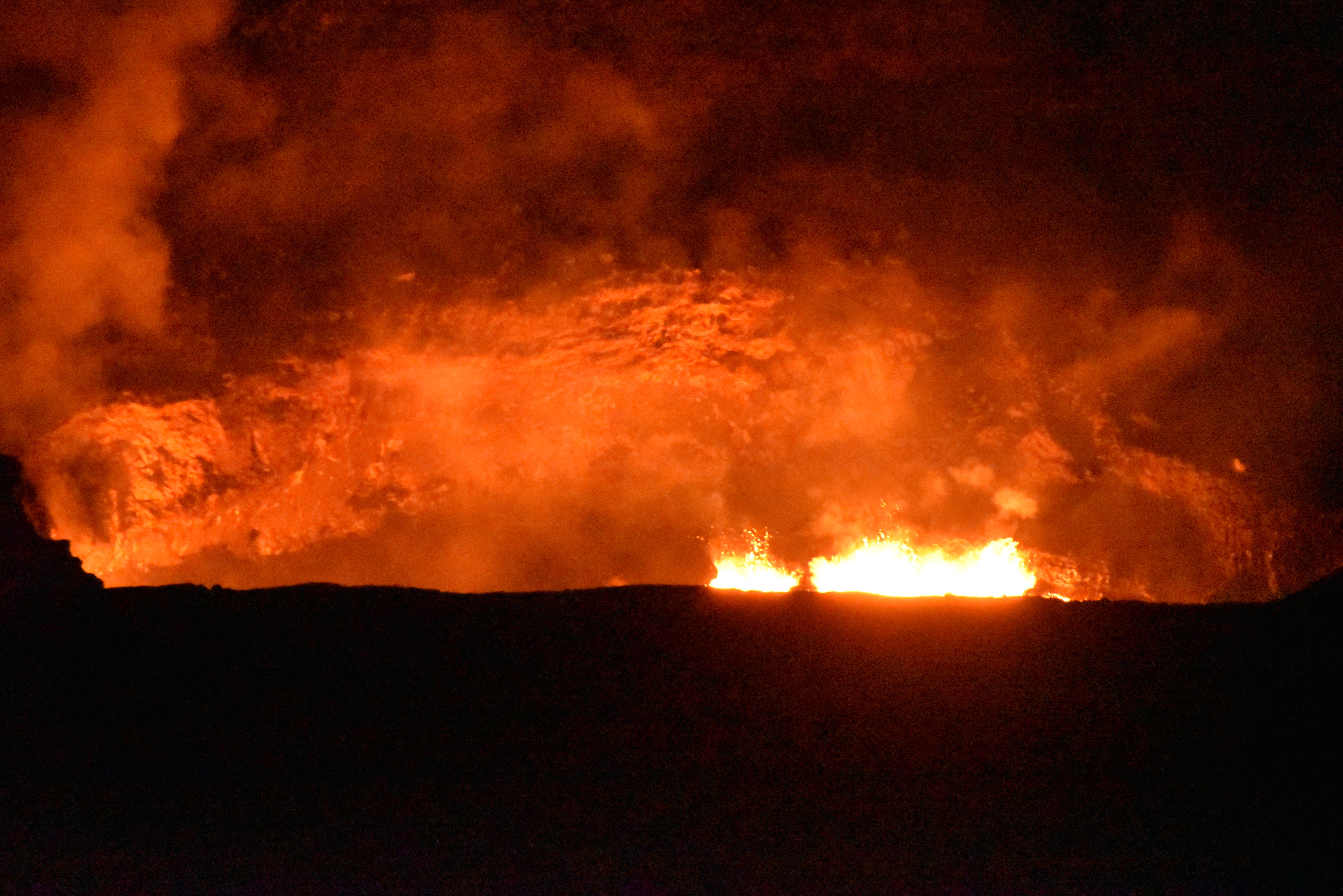
With this Truth, I will stand to watch the orange glow from the crater, with its promise, and its peril, and its power.