Story: Truth and the ‘Akiapola’au

June 15, 2025

Proverbs 8:1-4, 22-31
John 16:12-15

Birds are pretty honest creatures. They sing when they’re happy, and they screech when they’re mad. They give alarm calls when they’re scared, and they make hungry noises when they’re hungry.

An ‘akiapola’au  used to follow ‘elepaio through the forest to find food. The funny thing is that ‘elepaio and ‘akiapola’au don’t eat the same things. ‘Elepaio like bugs and spiders, which I don’t, to be honest. ‘Akiapola’au will eat those, it’s true, but they prefer the worms, caterpillars, and bugs that burrow into the wood of koa trees. It’s been noticed that a tree full of bugs and spiders is probably also one that’s full of burrowing insects, too. The Hawaiian canoe makers knew that, and the ‘akiapola’au knows it, too.

The ’elepaio could be trusted to tell the truth.

This one ‘akiapola’au, however, came up with a new idea one day. You see, while he was following the ‘elepaio, other birds were following him. He worried that they’d eat all the food before he did. The fact that none of them ever left the trees hungry didn’t seem to make a difference. He had to protect his food.

He thought.

Not that it was his food before he ate it, but anyway.

So he developed the habit of tapping at tree branches that didn’t have bugs in them. ‘Akiapola’au do that to find where things have burrowed into a tree, but he started doing it, and then digging where he hadn’t found any. It attracted other birds. They’d come in to see.

And he’d fly off to some other tree where he’d try to find something he could actually eat.

The result was a fair number of frustrated birds, who’d look around where he’d been tapping and find fewer spiders and insects than they expected. They went to bed somewhat hungry.

He was pretty satisfied with his trick when his auntie turned up after a day of tapping on insect-free trees. “Nephew, why are you spending so much time hunting in trees without food?” she asked.

“Don’t tell anyone, but I’m drawing the other birds away from the good trees,” he said. “I don’t want to run out of food and be hungry.”

“So you’re lying to them?” she asked. “And before you say, ‘No,’ don’t think about lying to me.”

“I don’t think I’m lying to them,” he said.

“You’re acting as if there’s food where there isn’t. You don’t have to say a word. It’s still a lie. It’s a lie that’s bringing hunger to our forest when it isn’t necessary. There’s plenty to eat. Isn’t there?”

“I guess so,” he said.

“As for you, you’re spending so much time in trees without food: how hungry are you when you go to sleep?” she asked.

He realized that, in fact, he spent so much time in trees without caterpillars that he was hungry at the end of most days. His lie meant that he wasn’t eating enough.

“No lying, nephew,” said auntie. “It’s not worth it and it never was. Go find the trees with food in them, and share the word with the other birds around us. We’ll all be better for the truth.”

by Eric Anderson

Watch the Recorded Story

I write these stories in advance, but I tell them from memory and inspiration. On this particular day, I’d happened to speak to one of the young people the night before on a video call, where I told him that I’d be telling him a story the next day.

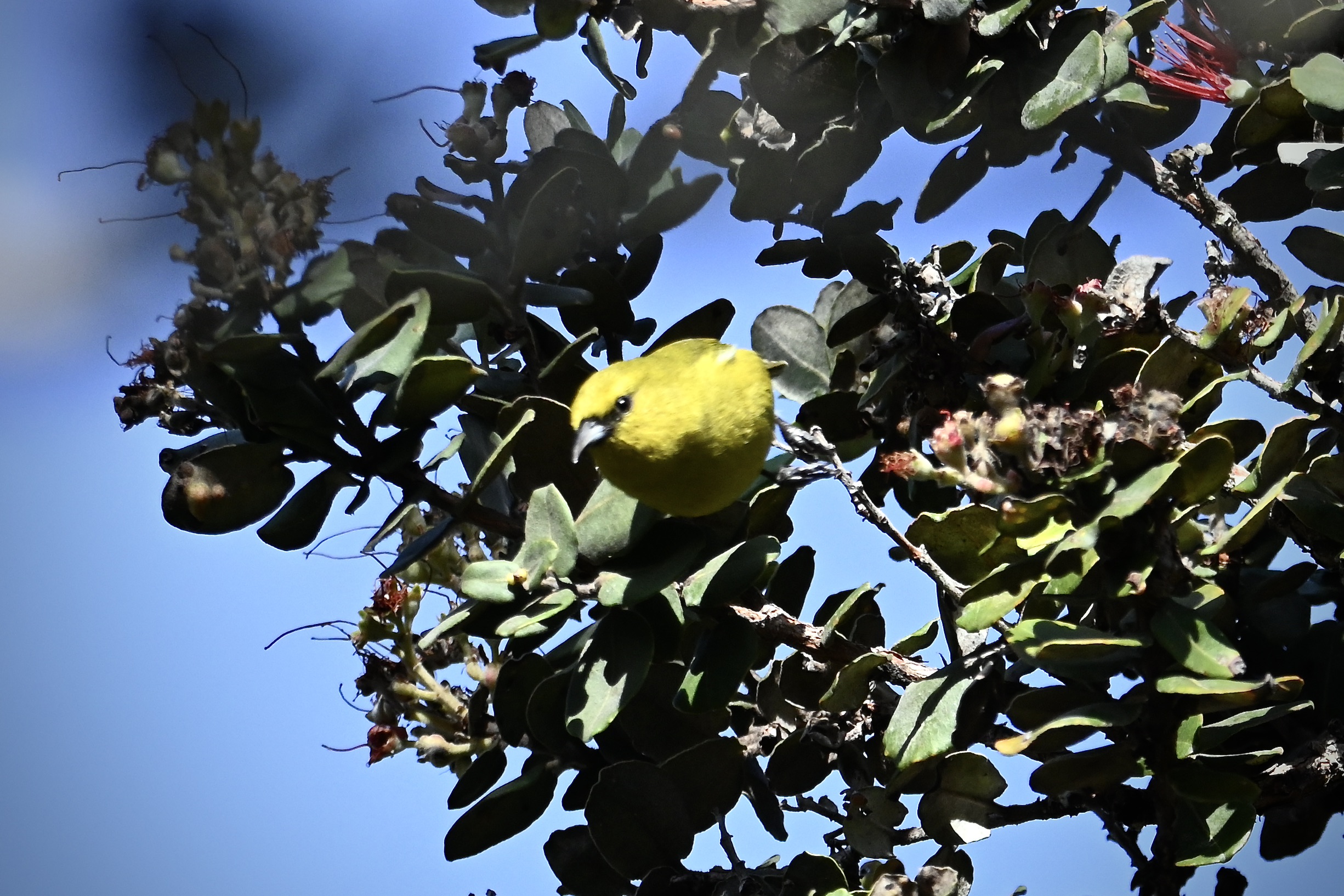
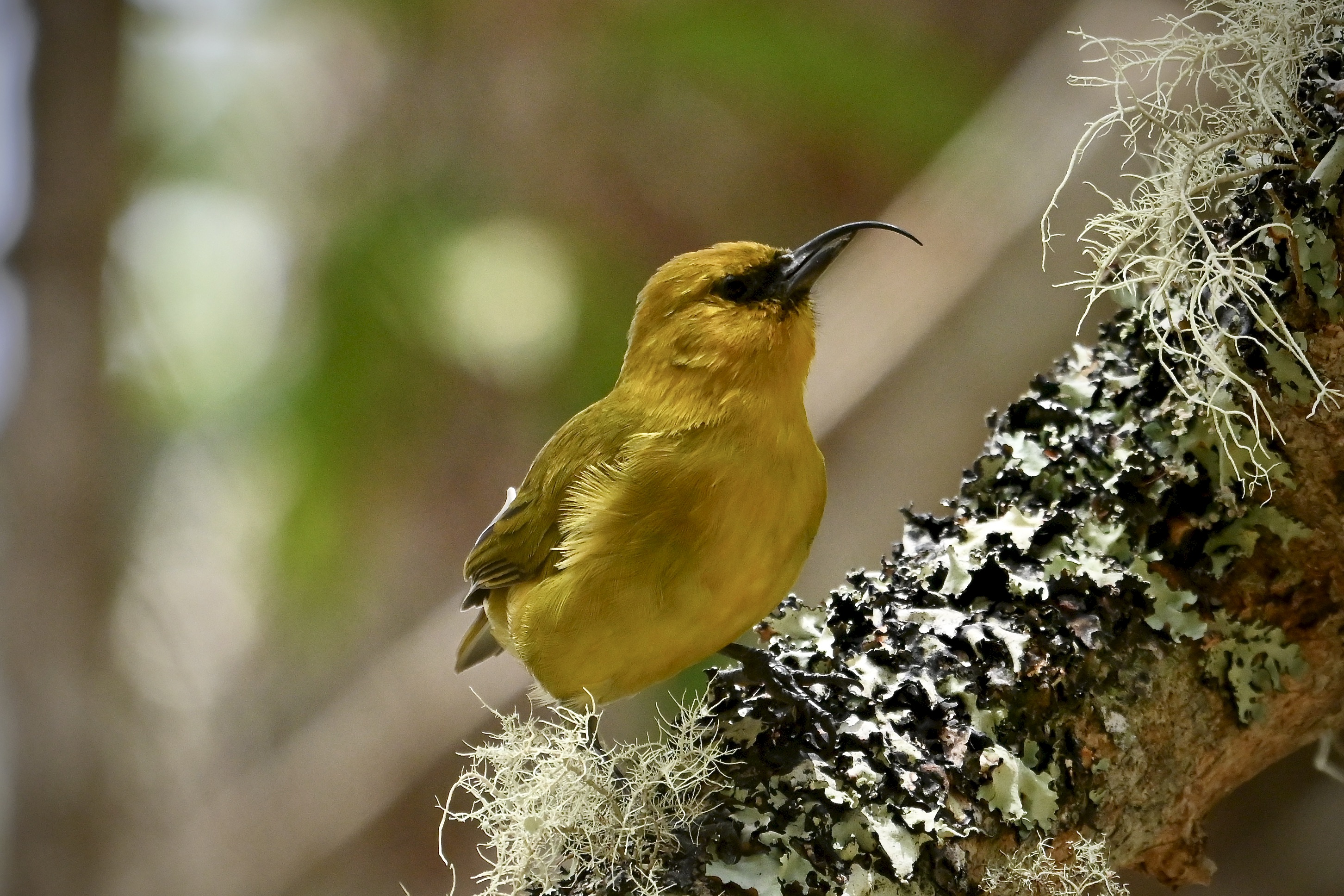
Photo of an ‘akiapola’au (adult male) by Eric Anderson.
Guide to Truth

“[Jesus said,] ‘When the Spirit of truth comes, he will guide you into all the truth; for he will not speak on his own, but will speak whatever he hears, and he will declare to you the things that are to come.'” – John 16:13

May the Spirit of Truth visit me, O Holy One,
for I live squinting into trees, struggling to
discern the movements of the Spirit’s wings
from the motions of the tossing wind,
a wind which might reflect the Spirit, too.

I strain to disentangle fern and feather, branch and beak,
blossoming lehua from the nectar-feeder there.
Through magnifying glass and brightening screens
you’d think I’d recognize the truth above,
but still I struggle to keep focus on the Truth.

Perhaps I should lay down the lenses and
the sensors that record the light, set my ears
to listen to the Spirit’s various calls,
and find the Truth in other medium
than sight.

A poem/prayer based on John 16:12-15, the Revised Common Lectionary Gospel Reading for Year C, Trinity Sunday.

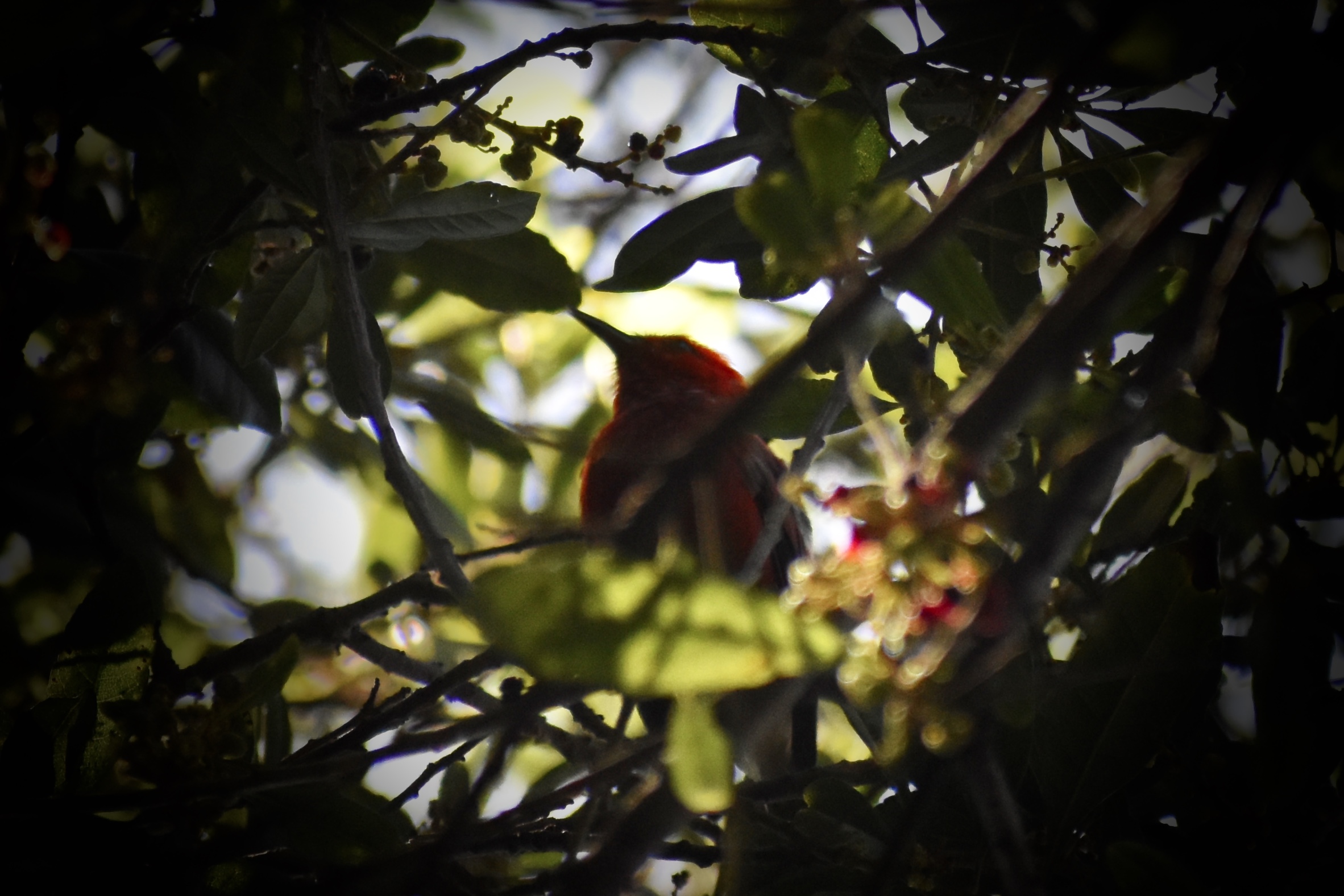
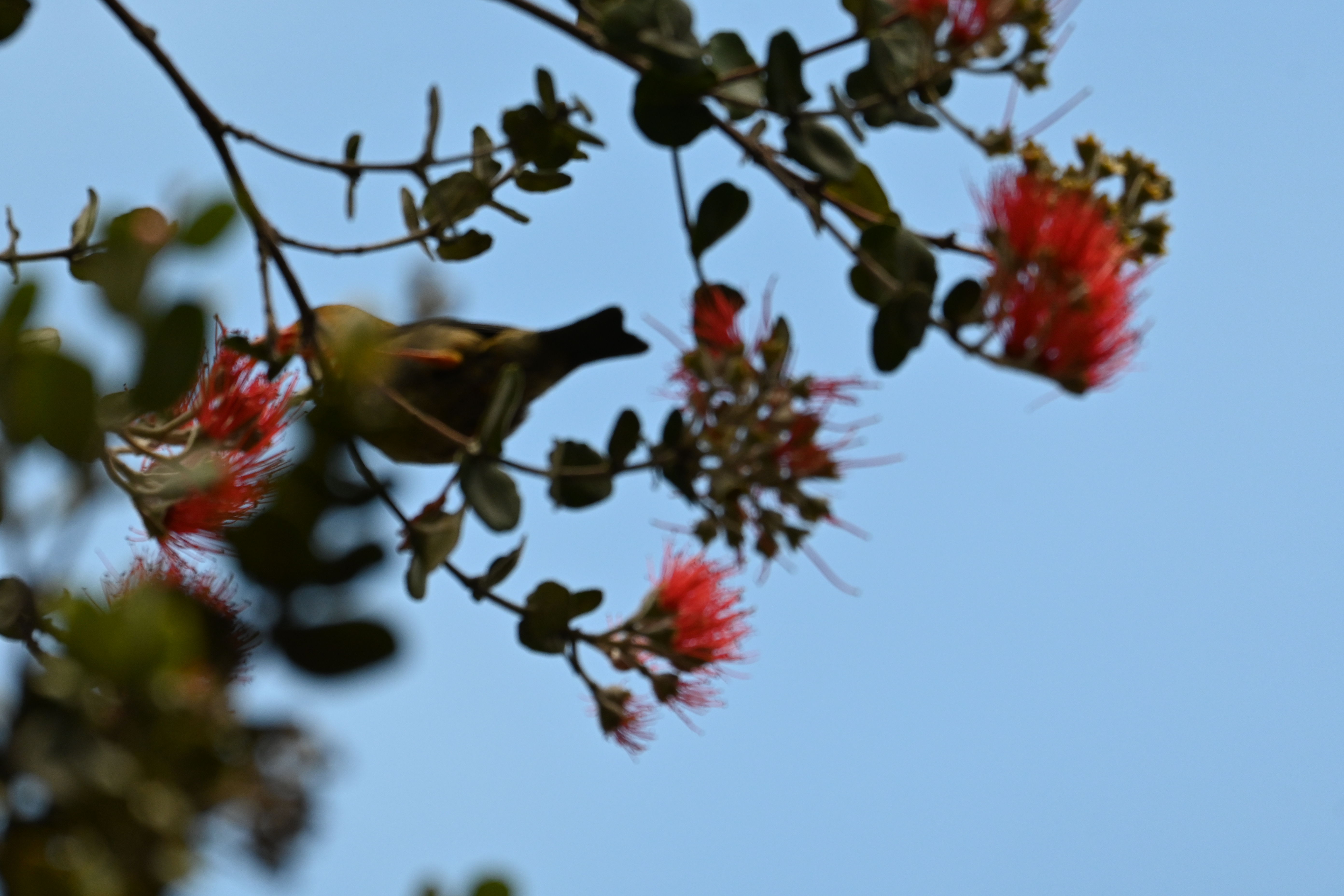
Blurry photo of an i’iwi in juvenile plumage by Eric Anderson.

Paragon

The God of Israel has spoken;
the Rock of Israel has said to me:
“One who rules over people justly,
ruling in the fear of God,
is like the light of morning,
like the sun rising on a cloudless morning,
gleaming from the rain on the grassy land.”
Is not my house like this with God?

– 2 Samuel 23:3-5

My eyes no longer see as far as they once did.
My hands are creaky, laid upon the strings.
My knees and elbows crack, and truth to tell,
I’d rather spend the day in memory than rule.

The time will surely shortly come when I
shall make my bed in Sheol rather than
within this palace of my grandeur. No more
shall Abijag console me with her warmth.

But then, no longer must I listen to
the not-so-welcome words of Nathan. There
are benefits to dying. Such as making peace
with shame and guilt (if not with those I slew).

And so:

Was not my reign a paragon of right?
(Ignore the tales of rape and sons’
rebellion, though another looms e’en now.)
Did I not shine as dew reflects the morn?

Who now will contradict my words? They’ll hold
them close and celebrate how wise I was
when, near the end, I sang the truth
that earthly power, even mine, is judged by God.

How will they know that as I played
my fingers caught upon the strings, my voice
was husky with the tears that streamed, because
I knew the truth and then composed the lie.

A poem/prayer based on 2 Samuel 23:1-7, the Revised Common Lectionary First Reading for Year B, Reign of Christ.

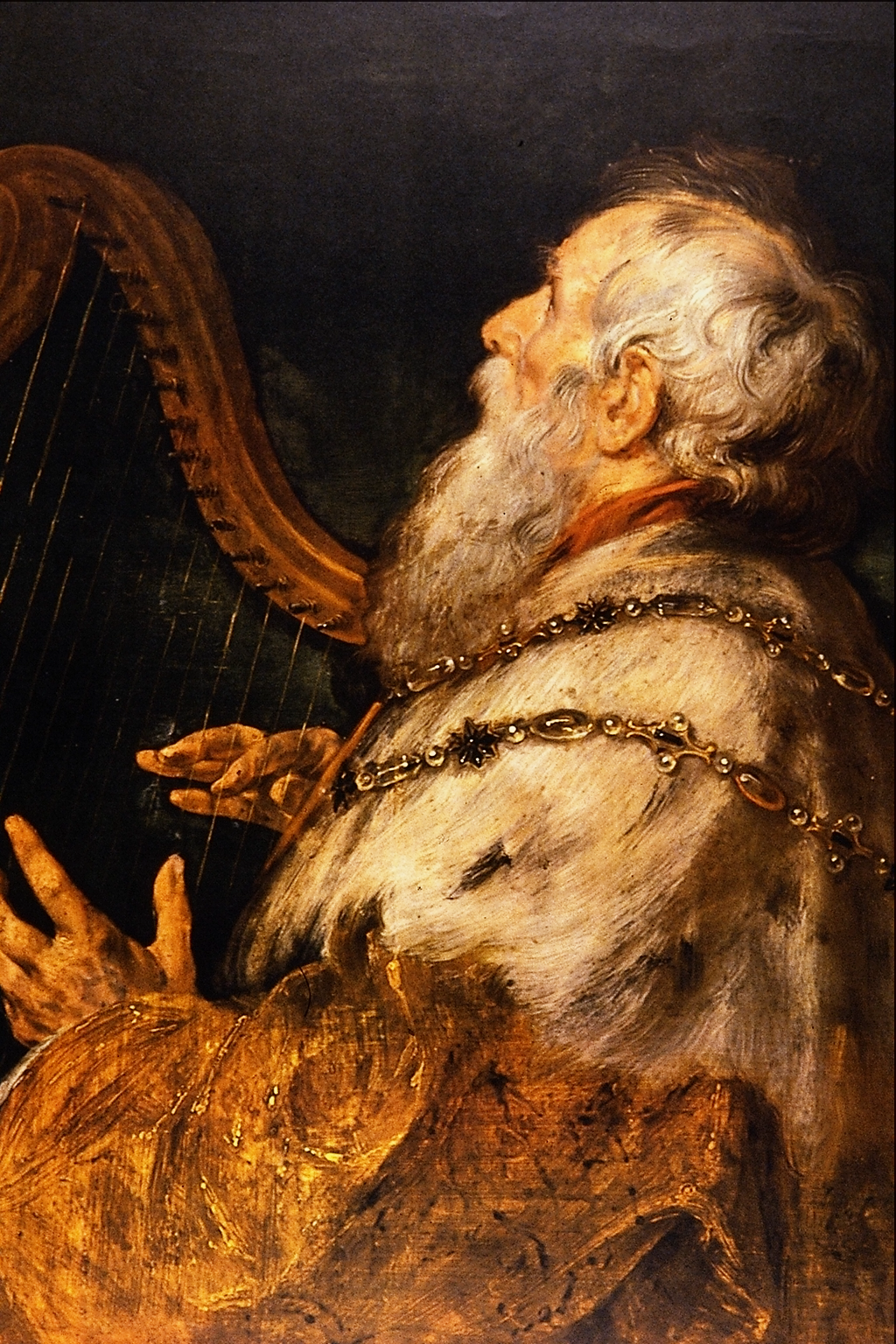
The image is King David by Peter Paul Rubens (by 1640) – Corel Professional Photos CD-ROM, Public Domain, https://commons.wikimedia.org/w/index.php?curid=10324682.

Story: The ‘Io and the ‘Amakihi

November 10, 2024

Ruth 3:1-5, 4:13-17
Mark 12:38-44

There is a lot to learn when you’re a young bird. Or a young human, of course. But this story is about a young bird.

He was an ‘amakihi, and he’d hatched, fledged, and flown. He’d toured around with a little flock of various forest birds, and he’d seen plenty of sunrises and sunsets. All in all, he thought he was pretty wise.

Then he saw a creature he hadn’t seen before. It was big. It was impressive. It soared along in the air on broad wings. He watched it from an ohi’a branch with awe. Such presence. Such grace. Such magnificence. Such size.

To his surprise, it landed in a neighboring tree, where it seemed to rest.

“What are you?” asked the young ‘amakihi.

“I’m an ‘io,” said the big bird. “Haven’t you heard about me?”

In truth, the young ‘amakihi had been told about the ‘io, but he hadn’t been paying attention. These things happen sometimes, have you noticed?

“I can’t remember hearing anything about you,” said the ‘amakihi with some truth. “What are you like?”

“Oh, I’m a very friendly bird,” said the ‘io. “I fly around overhead and watch out for all the other birds in the forest. All the birds are safe when I’m around.”

“That’s really great,” said the young ‘amakihi. “And what do you eat?”

“Oh, this and that,” said the ‘io. “Kind of like yourself.”

“You mean, bugs and nectar and fruit?”

“Kind of like that,” said the ‘io.

“I’m a little hungry myself,” said the ‘amakihi, “and this tree has been pretty well picked over. If you don’t mind I’ll see you later.”

“That’s fine,” said the ‘io, who fortunately for the young ‘amakihi wasn’t hungry at the moment. “I’ll catch you later.”

The ‘amakihi flew off, and the ‘io didn’t chase him, fortunately. A little later he found his grandmother, and told her about the bird he’d just met.

“The ‘io told you he protects the other birds?” said his Tutu.

“Oh, yes,” said her grandson.

“Don’t you remember what your mother and father said about the ‘io?” asked his grandmother sternly.

“I’m afraid I don’t,” said the young ‘amakhi. “I may not have been listening all that well.”

“That wasn’t a good time to not listen,” she said. “Didn’t you notice the ‘io’s beak, and the talons on his feet? Do you think those are good for eating bugs and nectar?”

And she told him what an ‘io eats. He was horrified and pretty surprised that he’d survived that conversation.

“Those who are danger to you won’t always tell you so,” said Tutu. “Sometimes they’ll lie about it. Listen to the warnings of those who love you. We may not always be right, but we will always tell you what we know and what we believe we know.

“And keep an eye out for those ‘io.”

by Eric Anderson

Watch the Recorded Story

I write these stories in advance, and I tell them from memory during Sunday worship. Therefore, the story you’ve just read will likely differ from the story as I told it.

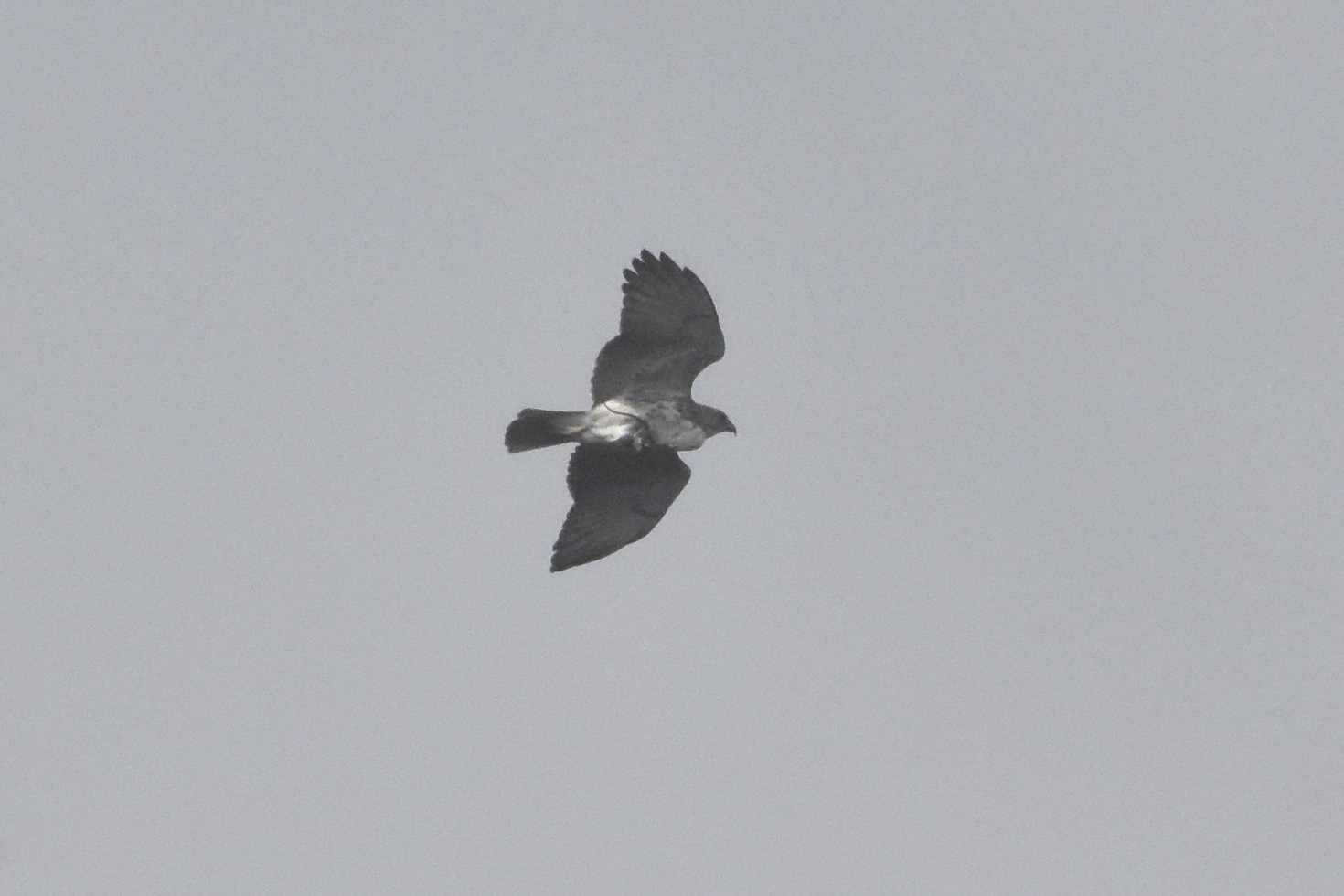
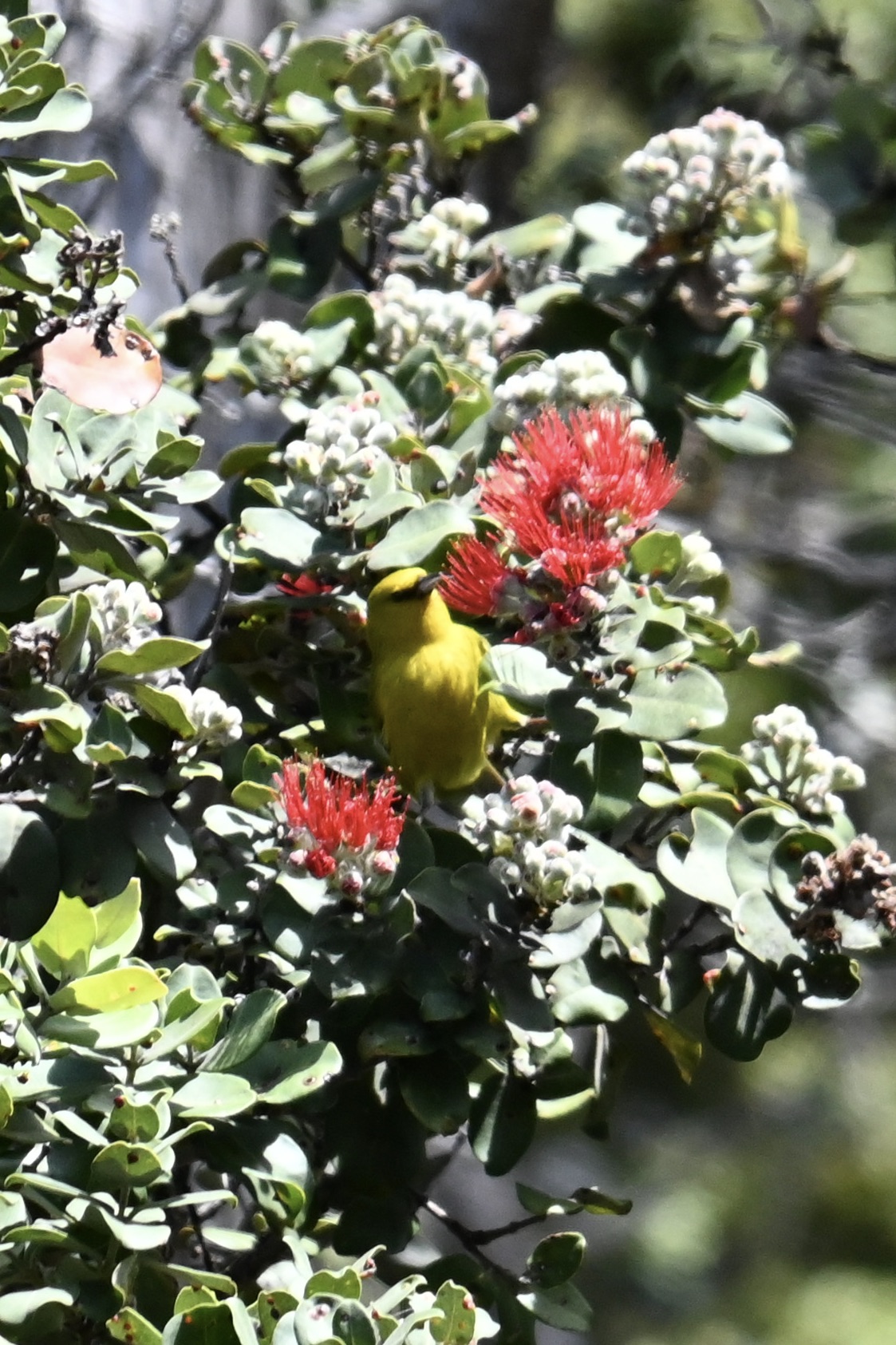
Photos of an ‘amakihi (top) and an ‘io (smaller photo on right) by Eric Anderson.

Story: Attempt to Deceive

May 12, 2024

Acts 1:15-17, 21-26
John 17:6-19

As I’ve said before, the ‘amakihi likes to eat lots of different things. I think it’s fair to say that the ‘amakihi likes to eat, and fortunately for the ‘amakihi, it has a wide range to its taste. Nectar is always good, and so are bugs and spiders, caterpillars, tree sap, fruits and berries. It will even eat pollen sometimes, which people with pollen allergies will find truly mysterious and a little uncomfortable.

But there was one ‘amakihi who didn’t eat nectar from ohi’a trees.

If that seems weird to you, it seems weird to me, too. There are a lot of ohi’a trees on the mountain slopes, and they have a lot of flowers. It’s a great food source for ‘amakihi and ‘apapane and ‘akepa and lots of birds up there. They’d happily perch near those flower clusters and merrily feed on the nectar while this one ‘amakihi watched.

He watched, and he felt sorry for them.

“Poor birds,” he told himself, “to be so desperately hungry that they’ll feed on ohi’a. I feel really sorry for them.”

Why, you ask, did he feel sorry for them, eating ohi’a nectar? Well, I’m afraid it’s because one day when he was young, and before he’d actually sampled any ohi’a nectar, he perched near an i’iwi. I’iwi can be kind of mean sometimes, and they will chase ‘amakihi away from a tree they want to feed at. This i’iwi, however, was feeling rather full and didn’t want to get up off his perch and chase this young ‘amakihi away. He decided to try words instead.

“Planning to feed at this tree?” he asked the young ‘amakihi.

“Oh, yes, uncle,” said the ‘amakihi. I’m afraid the i’iwi wasn’t happy to be called “uncle” by an ‘amakihi.

“You should search somewhere else if you want something good,” said the i’iwi. “This is a bad tree.”

“Ohi’a is bad?” said the young ‘amakihi.

“I’m afraid so,” said the i’iwi. “The nectar is sour, except when it’s bitter. When it gets old, it’s really bad. It will keep a bird going, of course, but nobody eats ohi’a nectar until they’re desperate.”

“Really?” said the ‘amakihi.

“Really,” said the i’iwi. “You can trust me. Go find something else you’ll like better. I’m sure it will be better for you, too.”

Misled by the i’iwi, the ‘amakihi avoided ohi’a from that day on. Eventually his mother noticed, and he told her the story.

“So one i’iwi told you this story, and you never checked it with anyone else, or tried ohi’a yourself?” she asked him in surprise, “even when so many other birds eat its nectar every day without signs of complaint?” Put that way, it did sound a little odd.

“Come along, son,” said Mother firmly. “You need to try what you’ve been avoiding, and see what you think yourself.”

Of course he found it delicious, which was a good thing to learn. But he also learned that some birds, and some people out there, will lie to you when it serves them, and sometimes you need to test their stories with the ones who love you and with your own experience, to learn the truth.

by Eric Anderson

Watch the Recorded Story

I write these stories ahead of time, then tell them from memory – well, lack of memory plus improvisation. The video does not match the text you’ve just read.

Photo of an ‘amakihi in the midst of ohi’a blossoms by Eric Anderson.

Story: It Starts with Truth

September 17, 2023

Romans 14:1-12
Matthew 18:21-35

They were building their first nest together as an ‘apapane couple. An ‘apapane nest is a pretty impressive piece of engineering, taking a week or even a day or two more. That’s a lot of grass and twigs and moss to move.

They weren’t the only ones, of course. In a tree not far away his sister and her husband were also building a nest, their first one, too. They’d got started a little earlier, so their nest was taking shape while the brother’s nest looked pretty ragged. Everyone was having trouble finding the grass and moss and twigs for their nests, and flying farther to find them.

That’s when he got his clever idea.

When his sister and her husband (and his own wife) were away looking for more material, he flew quickly over to his sister’s nest. He pulled out a particularly nice twig that would be perfect for his own nest and flew back. When his wife returned she found him proudly settling that twig into position.

“Well done!” she said.

“There’s more,” he said.

They both flew off, she to search the forest and he to his sister’s nest. Before his wife came back he’d made three trips to it, taking grass and moss as well as another good structural twig.

“Where are you finding this so quickly?” his wife wondered.

“I found an old nest that nobody’s using,” he said.

“Oh, good! Show me and I’ll come, too.”

“I wish I could. This was the last of it,” he told her.

But he went back to his sister’s nest again for more.

He was careful to make sure his sister and her husband were absent. It was clear that they had had a difficult time replacing the things he’d taken. They were still ahead in their nest’s construction, but not so much as before.

He pulled a piece of moss from his sister’s nest and turned around. There, sitting silently on a nearby branch, was his wife.

“Abandoned nest?” she said.

“I’ll stop with this one,” he said.

“That’s not enough,” she told him. “You have to put that piece back, first of all. Then you have to wait for your sister and her husband and tell them what you’ve been doing. Then you have to help them build this nest that you’ve been stealing from.”

“Isn’t it enough that I just stop and let it be?” he asked.

“No, it isn’t. It’s nowhere near enough. You’ve been pulling their nest apart and you need to help them put it back.”

“Couldn’t I just do that? Leave out that I’ve been taking things?”

She gave him a very sharp look indeed. “She’s your sister. Do you think she’d be content with a lie?”

He admitted that she wouldn’t.

“Ask anyone among the ‘apapane,” she said. “We can live together when we make mistakes and make amends for them. We can’t live together with lies. It begins with truth. So tell the truth.”

He told the truth. His sister had some true and truly angry things to say to him about it, but she did accept his help in repairing the damage and, during family gatherings, was sometimes heard to say, “It begins with truth. Thank you, brother, for the truth.”

by Eric Anderson

Watch the Recorded Story

I write these stories ahead of time, but I tell them from memory rather than reading them. As a result, they change.

Photo of an ‘apapane by Eric Anderson.

Story: The ‘Apapane Who Lied

July 30, 2023

Genesis 29:15-28
Romans 8:26-39

Generally, ‘apapane are pretty honest birds. They give warning calls when there’s danger near, they sing “Waiting for the rain to end” songs when it’s raining, and they sing “Oh, look what I’ve found!” songs when they’ve discovered a tree particularly rich in ohi’a blossoms.

One day an ‘apapane had a different idea. He had sung his “Waiting for the rain to end” song when it was cloudy, not raining, mostly because he was sure it was going to rain. Even though nothing ever fell from the sky, a number of birds, ‘apapane but also i’iwi and ‘amakihi, took shelter for a few minutes. It didn’t take long for them to come out again when the rain didn’t happen, but it started him thinking.

A day or two later he found a lovely ohi’a tree just dripping with nectar and already attracting a number of the bugs he liked to eat as well. He told some members of his family and a few close friends to wait for him in a certain spot, while he flew over to a place where there were trees with a few blossoms on them, but nothing like what he’d found on that one tree.

There, surrounded by mostly greenery, he sang his “Oh, look what I’ve found!” song.

When he heard wings approaching he flew off low to one side and circled back around to where his friends and family were.

“Somebody’s found something,” said his sister. “We should go see.”

“I just found something better,” he said. “Follow me.” And they did.

As a result, their little group of ‘apapane had quite some time enjoying the nectar-rich flowers before other birds discovered it – as a result, I should say, of them singing their own, “Oh, look what I found!” song.

He repeated the trick a few days later when he discovered another very nice tree, and about two days after that, and a couple days after that, and he was very pleased with himself.

He was caught, of course, and that was by his grandfather. There were rumors going about that some of these “Oh, look what I found!” songs seemed to be overly optimistic at best and downright deceptive at worst. Grandfather had perched at the top of a tall ohi’a and heard the early morning call from a group of trees he knew was pretty sparse for flowers. He looked for the flash of red and black wings, and when he spotted it, he followed. To his surprise, they led first to a little flock of his own family, and then to a tree that glowed red in the morning light.

As the birds fed, he perched next to his grandson. “Come,” he said, pointing to a neighboring tree. “We need to talk.”

When they both had landed on a branch with enough flowers for a breakfast that wasn’t nearly as extravagant as the other tree, the younger ‘apapane wanted to know what it was about.

“Grandson,” said the elder. “You’ve been lying.”

“Not to you, tutu,” protested the younger one. “Not to any of our family or my friends.”

“I appreciate that,” said grandfather, “but truth isn’t just for family or friends. Truth is for everyone.”

“What’s the harm?” demanded the grandson. “Everyone is getting fed. I haven’t prevented anyone from finding good trees. I mean, I haven’t driven anyone away.”

“You’ve misled them – and concealed that it was you doing it,” said grandfather.

“Well, sure. Because then they wouldn’t trust my song,” said the younger one, and that was when he realized.

“Because I wouldn’t be worthy of trust, would I?” he asked.

Grandfather said nothing.

“Because I haven’t been worthy of trust, have I?” he asked.

Grandfather and grandson sat quietly for a few moments.

“I’ll be worthy of trust, Tutu.”

“I know you will.”

by Eric Anderson

Watch the Recorded Story

I tell these stories from memory of what you’ve just read – without a manuscript or notes. Inevitably, it varies from the text I’ve prepared, as it does today.

Photo by Eric Anderson

Author’s note

I found myself with a real quandary in developing a story that comments on Genesis 29, a text with so much that just makes me stop and go, “That’s not right.” Bringing its themes to children (or even to adults) looked impossibly difficult. Finally I settled on one theme of Jacob’s saga, something that happens again and again to cause pain and distress to the people involved: deception and lies. Thus this story about lies and truth.

Another World

“If my kingdom were from this world, my followers would be fighting…” – John 18:36b

O Lord, a disingenuous remark, perhaps?
There was some fighting in the garden when
you were arrested, yes? When Malchus lost
an ear, which you restored with just a touch.

It’s funny how nobody mentioned that
before the Roman governor. It’s like
the movie. “They cut off my ear!” “Your ear?
Your ear is fine.” “Well. It got better.”

In the best taste? Well, no, perhaps. You told
your old friend Peter to re-sheathe his sword,
then he and they decamped while you
were taken to the priests and then to Pilate.

Now, Pilate knew quite well just what to do
with you, Messiah. Crush the serpent’s head;
the rest will follow it to death. What need
a trial for pretenders to Israel’s throne?

What need? The need for truth, of course,
the truth that you defined Messiah unlike those
before, or those to come. You refused
to found your throne upon a frame of shattered bones.

Instead, you said, your reign’s foundation would
be truth itself, and truth its sign, and truth its aim.
To which the governor would scoff, attention gone,
the bitter question, “What is truth?”

Another world you rule indeed, Messiah King,
where those in power seek to rule in truth.
In this our world – and Pilate’s too – the truth
is clay to be reshaped as fits the day’s desire.

May we, unlike the governor who left the room,
his question echoing unanswered, give
the time and concentration to discern the truth.
Truth’s Author waits for us to ask – and learn.

A poem/prayer based on John 18:33-37, the Revised Common Lectionary Gospel Reading for Year B, Proper 29 (34), Reign of Christ Sunday.

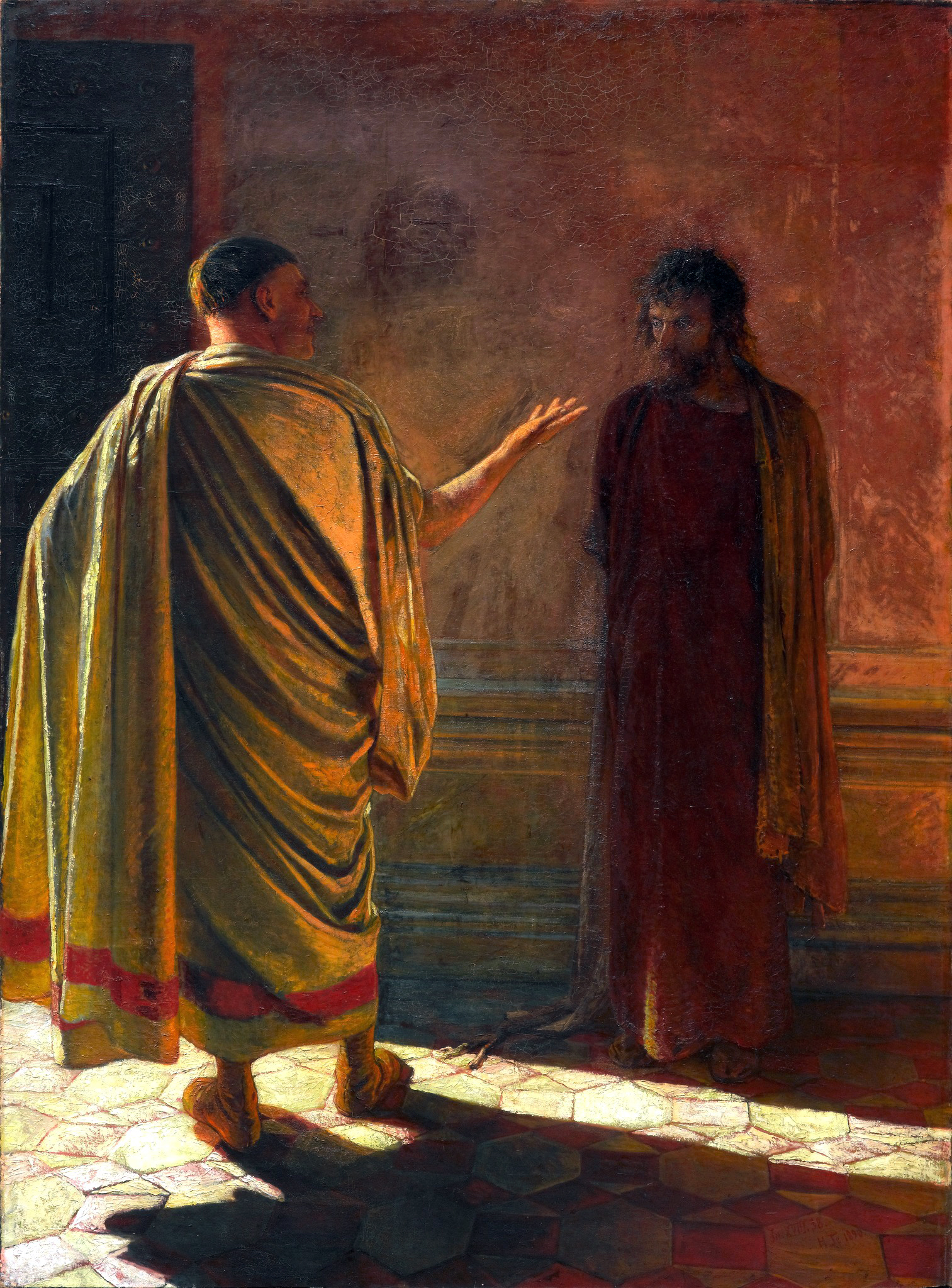
The image is What is Truth? Christ before Pilate by Nikolai Ge (1890) – http://www.picture.art-catalog.ru/picture.php?id_picture=7515, Public Domain, https://commons.wikimedia.org/w/index.php?curid=426635.

Weighed Down

“Put on the whole armor of God, so that you may be able to stand against the wiles of the devil.” – Ephesians 6:11

“Saul clothed David with his armor; he put a bronze helmet on his head and clothed him with a coat of mail. David strapped Saul’s sword over the armor, and he tried in vain to walk, for he was not used to them. Then David said to Saul, ‘I cannot walk with these; for I am not used to them.’ So David removed them.” – 1 Samuel 17:38-39

Truth? You want me to wear truth?
That’s a heavy burden to carry on the belt.
My hips are groaning just to think
of carrying the truth. I cannot walk with these.

Righteousness? You want me to wear righteousness,
to face the world with generosity presented
as my face? I can’t imagine feeling any more
vulnerable than that. I cannot walk with these.

Faith? You want me to bear faith?
I tell that, as bucklers go, faith wears a little thin.
The barbed and flaming arrows pierce it through
even as I strain to lift it. No; I cannot walk with these.

Salvation? You want me to wear salvation?
This one sounds good, I grant you, but it bows the head.
I’d rather revel in my sovereignty than yours,
which makes me bow. I cannot walk with these.

The hardest of all to wear are the shoes
that make me ready to proclaim the gospel of peace.
Where might they take me? Into what risks?
And what protection do they offer? None.

No and no and no. I cannot walk with these.

And yet… I try.

A poem/prayer based on Ephesians 6:10-20, the Revised Common Lectionary Second Reading for Year B, Proper 16 (21).

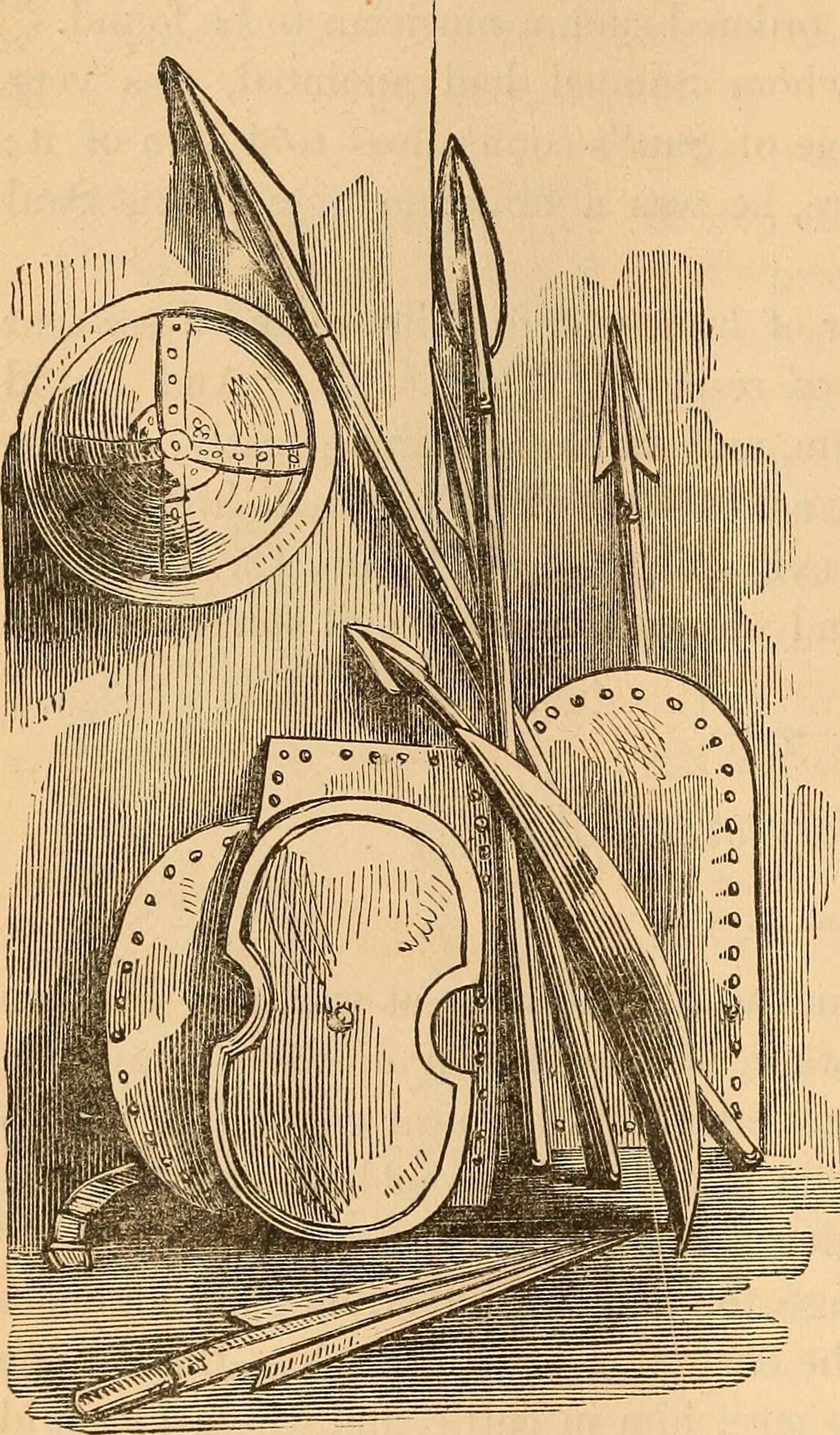
The image is Philistine Shields and Spears from The pictorial Bible and commentator: presenting the great truths of God’s word in the most simple, pleasing, affectionate, and instructive manner, by Ingram Cobbin, Daniel March, L. P. Brockett, and Hesba Stretton. Image obtained through the Internet Archive Book Images – https://www.flickr.com/photos/internetarchivebookimages/14763830682/ Source book page: https://archive.org/stream/pictorialbibleco00cobb/pictorialbibleco00cobb#page/n301/mode/1up, No restrictions, https://commons.wikimedia.org/w/index.php?curid=43907449.

But Now…

I’ve never worried before, O God,
about the younger son’s repentance.
I’ve always gratefully assumed
he walked the roads of sackcloth
and of ashes. What a shock
his father’s welcome must have been!

But now… I wonder.

Was he another twister of the truth?
Was he another one who turns the world
around his little finger? Did Narcissus blush
with shame at his temerity, his lies?
And did the pounding of his heart betray
his gratitude or hidden glee?

And now… I wonder.

In that Great Somewhere, do you wait for me?
Do you wonder when I’ll lay aside deceit –
delusion sweet for me, unwitting lie to you –
and truly bring my starving soul back home?
Does the pounding of my heart betray
my gratitude or deeply hidden lies?

Yes now… I wonder.

A poem/prayer based on Luke 15:1-3, 11b- 32, the Revised Common Lectionary Gospel reading for Year C, Fourth Sunday in Lent.

Photo by Eric Anderson.