November 17, 2024
Hebrews 10:11-25
Mark 13:1-8
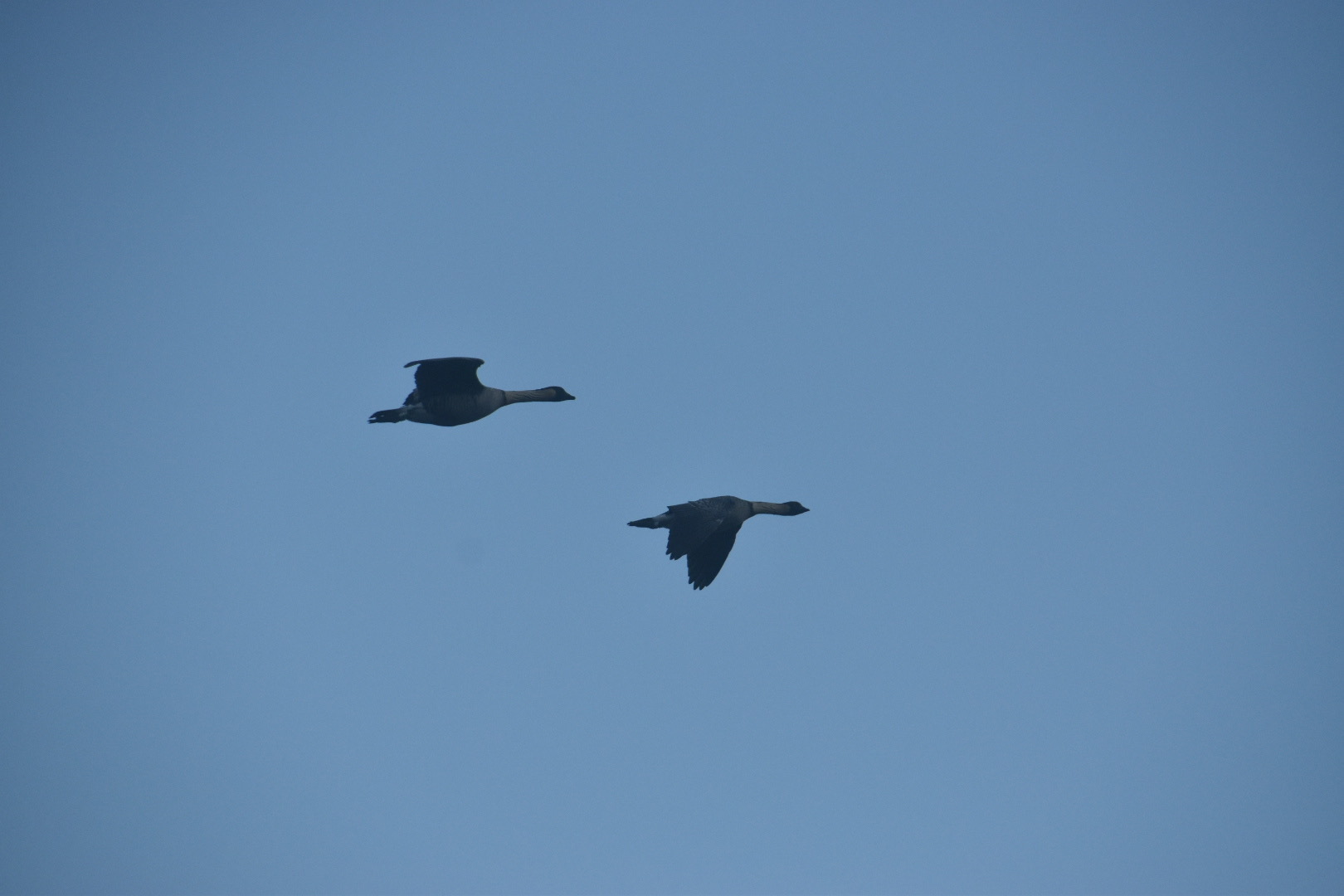
I’m afraid it’s true that there are not many nene. They are easily outnumbered by the ‘apapane, and more than easily outnumbered by people. You may wonder why, if there aren’t that many of them, you hardly ever see them one at a time. I mean, wouldn’t you expect that a nene would go its own way from time to time, just to find some ‘ohelo berries of their very own?
One nene thought that independence sounded like the way to go.
He’d been to nene school, so he thought he knew it all. He knew how to find food. He knew how to fly. He’d done the drills at formation flying without getting excited about it. He was going to be the nene who made his own way, without relying on (and, you know, sharing with) the other nene.
So off he went to find his own spaces.
There’s a lot more of Hawai’i Island than there are nene, so it wasn’t difficult. If he spotted a little flock of nene in the air or on the ground, he’d just go somewhere else that they weren’t. That was lots of places, and plenty of those places had food, and water, and places to rest and relax. All in all, he thought he was having a pretty good nene life.
One day as he was in the air looking for another place to relax and eat, he heard the calls of some nene behind him. Glancing back, there was a little “V” shape of five geese flying in formation. They called out a friendly greeting, to which he replied – he liked being alone, but he wasn’t going to be rude about it.
What surprised him, however, was that the little “V” of nene was catching up with him. In fact, they passed him in the air, still calling out their “Hello!” He thought he was a pretty good flier, but they sped on by and he couldn’t keep up. It didn’t take long before they’d disappeared into the clouds.
How had they flown past him so fast?
Sometimes when you don’t know something and you don’t have Google, the best thing you can do is ask someone who should know. So he sought out his nene school teacher. When he found her, she was just finishing up a formation flying class. He waited, mostly patiently, until she was done, and told her about being passed by those other nene.
“Am I just so slow?” he asked her.
“No,” she said. “You’re not slow. You’re alone. Flying together – in that ‘V’ formation – allows us to fly more easily. The wings of the birds in front create good flying air for the birds behind. It makes a difference. We can put more strength into it. We fly better together.”
“You mean,” he said, “that if I always fly alone, I’ll always fly harder and slower?”
“That’s exactly what I mean,” she told him. “Together is the easy way to fly.”
Never let it be said that nene won’t learn. He found his own place in a little flock, and there in its “V” he flew easier and faster than he could remember doing before. Together is the easy way to fly.
by Eric Anderson
Watch the Recorded Story
I write these stories ahead of time, but I tell them from memory plus inspiration. The story you just read will not match the recorded telling of it.
Photo by Eric Anderson

 ordainedgeek