Value

“[Jesus said,] ‘Or what woman having ten silver coins, if she loses one of them, does not light a lamp, sweep the house, and search carefully until she finds it?'”

What is the value of a single coin?
Not much today, when we make money
with printing upon paper, or with
electronic imagination.

What is the value of a single coin?
It might be little even in those ancient days,
unless, of course, it was a tenth
of everything she owned.

What is the value of a single coin?
It might be food to take me through the day,
or into a coming week,
or possibly next year.

What is the value of a single coin?
Enough to set me searching high and low,
to bear the cost of burning oil in the lamp,
to celebrate the sudden silver gleam amidst the dark.

What is the value of a single coin?
A better question might be this:
What is the value of a single human soul?
Enough, said Jesus, for the heavens to rejoice.

A poem/prayer based on Luke 15:1-10, the Revised Common Lectionary Gospel Reading for Year C, Proper 19 (24).

The image is Parable of the Lost Drachma by Domenico Fetti (1618) – Web Gallery of Art:   Image  Info about artwork, Public Domain, https://commons.wikimedia.org/w/index.php?curid=15453383.

Story: Welcome

May 18, 2025

Acts 11:1-13
John 13:31-35

The young ‘amakihi was nervous. She had been busy growing up, which ‘amakihi do a lot quicker than human beings do, but there was a lot to pack into that time. There was eating, and learning what to eat. There was taking care of her feathers, which changed when she molted and the feather lengths changed. And of course there was flying.

Then she had to learn about eating again, because there were things she could get to with working wings that she couldn’t get to in a nest. She learned about new bugs, new fruits, and new flowers. She’d been too busy to be nervous.

She was nervous now, though, because her parents had announced that the family would join a flock for the summer. She wasn’t really used to other birds. She’d met an auntie or an uncle or two, and of course her tutu, but these would be strange ‘amakihi. Would they like her? Would they be mean to her?

It made her more nervous to realize that the flock wouldn’t include just ‘amakihi. It would include ‘akepa, ‘alawi, and scariest of all, ‘apapane. She knew there were a lot of ‘apapane around. She’d seen far more of them than she had ‘amakihi. She’d also seen them chase ‘amakihi through the forest, even her own father. “I got too close to their nest,” he’d explained, and that made sense because she’d seen him chase other birds away from her nest, but still. The ‘apapane made her nervous.

“It will be all right,” said her father. “It’s different when birds aren’t worried about nests and eggs.”

“It will be all right,” said her mother. “You’ll make it all right.”

The day came when she and her brother and her parents flew over to an ohi’a tree filled with other birds. There were other ‘amakihi, and she knew some of them because her tutu were there. There was ‘akepa and ‘alawi showing off their green and bright orange feathers. Mostly, though, there were ‘apapane. They hopped through the branches, singing their beautiful songs, and looking very sharp in their red and black feathers.

One of them, who was keeping rather quiet, hopped over to the branch where she was sitting, keeping very quiet and hoping nobody would notice her.

“Hi,” said the ‘apapane. “What kind of bird are you?”

“I’m an ‘amakihi,” she said. “And you’re an ‘apapane.”

“I am,” he said, and looking rather nervous, said, “I feel really dumb. I’ve never seen most of these birds before. Do you know any of them?”

“Well, I know my family,” she said, “and I’ve seen a couple of these other birds before,” – she didn’t mention that they’d been chasing her father away from their nest – “but most of these birds are as new to me as they are to you.”

“Oh, good,” said the ‘apapane. “I guess this is new to most of us youngsters?”

“I think it is,” said the ‘amakihi. “I’ve been worried that nobody would like me.”

“You’ve made me feel better,” said the ‘apapane. “I think most birds would like you for that.”

“And you’ve made me feel welcome,” said the ‘amakihi. “Thank you so much for that.”

Mother had known, after all. She had made it all right.

by Eric Anderson

Watch the Recorded Story

I write these stories ahead of time, but I tell them from a combination of memory and improvisation. As a result, what you’ve just read will not match what you hear.

Photo of an ‘amakihi by Eric Anderson.

What Peter Didn’t Say

So when Peter went up to Jerusalem, the circumcised believers criticized him, saying, “Why did you go to uncircumcised men and eat with them?” – Acts 11:2-3

You think I wanted to eat with them?
I didn’t want to go at all.
I was riding pretty high, you know,
elated with a woman’s resurrection.
OK, the only place they’d put me up
was with a tanner, but a fisherman’s smelled worse.

Yes, I was riding high, and trying not
to think about the things that happen when
you’re riding high, the way success becomes
a series of new challenges, new obligations. I
was smelling those amidst the tannery.
It came for Jesus; it would come for me.

I didn’t know that I could lie in dreams
or visions, waking or asleep. I claimed
I’d never eaten food that was unclean,
and knew full well I’ve eaten shellfish when
the Romans hadn’t purchased all my stock.
And let’s ignore the grain I plucked on Sabbath Day.

A vision or a dream; regardless, it
would summon me to something new
I knew. I did not know what it would be,
but who gets visions for a trivial thing?
I didn’t know what that dream meant.
I knew I’d go where I’d not wish to go.

The house of a centurion was not
within my plan. Who knew what I would find
when I reached there? Most likely was
a naked sword to seek my naked gut.
Why trouble with a cross when you
can drain a troublemaker’s life without?

I had no plan to speak of Jesus there until
they asked, but ask they did, and I
pulled in my breath, and breathed it out,
and spoke with sometimes trembling voice
of Jesus, of his healing touch, his mercy to
such fools and failures as I am.

I certainly did not expect the fire of
the Spirit in a Roman house, of one
who marshals military might against
the people of this land. They said that he
feared God, but this? The Holy Spirit, lit
in him as it had been in me? Who knew?

And now, my friends, I have no plan for you.
I didn’t want to go. I went. I didn’t want to speak.
I spoke. I didn’t know the Spirit would appear.
She did. I didn’t know that God had welcomed them,
the Gentiles, just as openly as us. And now,
I have no words for you, except

To tell my tale again.

A poem/prayer based on Acts 11:1-18, the Revised Common Lectionary First Reading for Year C, Fifth Sunday of Easter.

The image is St. Peter and Cornelius the Centurion by Bernardo Cavallino (1640s) – Web Gallery of Art:   Image  Info about artwork, Public Domain, https://commons.wikimedia.org/w/index.php?curid=15452357.

Story: The I’iwi in the Flock

February 25, 2024

John 15:16

It was summertime. The nests around the ohi’a and koa forests had had their eggs, had had their cheeping chicks, and had been emptied. Young birds were flying about with their parents and aunties and uncles. The summer flocks were coming together.

Much of the year, the honeycreepers of the Hawaiian forests don’t gather in big flocks. They move about by themselves or in twos or threes. But in summertime, they gather, and they gather ‘amakihi with ‘akepa with ‘alawi and even some ‘apapane. But not, most of the time, i’iwi. When nesting time comes back around the flocks disperse. In summer, they fly together.

A young i’iwi watched a flock of ‘amakihi and ‘akepa and ‘apapane skimming the trees as they searched bugs and blossoms. He turned to his grandfather. “Should we fly with them?”

“Oh, no!” humphed his grandfather. “They don’t have the right kind of beak.”

In fact, none of the birds in the flock had the long curving bill that the i’iwi did.

He asked his grandmother, “Should we fly with them?”

“Oh, no!” said his grandmother. “They don’t have the right color feathers.”

The ‘apapane came closest, but he had to admit that you could see the difference.

“Should we fly with them?” he asked his friends, and they all said, “No! They can’t do what we do!” in different ways.

A day later, all by himself, he approached the flock, and perched next to an ‘amakihi.

“You don’t have a long curved bill,” he remarked.

“No,” said the ‘amakihi, somewhat puzzled. “I don’t.”

“It seems to work well enough,” said the i’iwi.

“It works pretty well, I think,” said the ‘amakihi.

“It might be awkward to get into an ohi’a blossom from below,” said the i’iwi, and the ‘amakihi admitted this was true.

“You don’t have bright red feathers,” said the i’iwi.

“True,” said the ‘amakihi. “Mine are bright yellow.”

“Do they get you places?” asked the i’iwi.

“They got me here,” said the ‘amakihi.

“Can you do all the things I can do?” asked the i’iwi.

“Probably not,” said the ‘amakihi. “Can you do all the things I can do?”

“Probably not,” said the i’iwi.

Then he asked, “Do you mind if I fly along with your flock?”

“With your red feathers and curved beak and things I can’t do?” said the ‘amakihi. “Join us and welcome.”

That’s how an i’iwi became part of a summertime flock.

by Eric Anderson

Watch the Recorded Story

I write these stories, then tell them from memory. Since my memory can be erratic, the stories as told rarely match the stories as written.

The photo of an i’iwi is by HarmonyonPlanetEarth – I’iwi|Pu’u o’o Trail | 2013-12-17 at 12-43-196. Uploaded by snowmanradio, CC BY 2.0, https://commons.wikimedia.org/w/index.php?curid=30241883

“Breakfast” – Sermon for Apr. 10, 2016

Preached at
Church of the Holy Cross UCC
Hilo, Hawai’i
April 10, 2016

Text: John 21:1-19

Some of you have, I suspect, had a question on your mind for half hour or so:

Is he really going to wear a tie every Sunday?

Some of you may have followed this question with another, more personal one:

Is he going to expect me to wear a tie every Sunday?

I can answer the second question immediately: No. I have no intention of introducing a new dress code for worship at Church of the Holy Cross. That’s a mistake the early missionaries to Hawai’i made, and I don’t care to repeat it. The important thing is to worship God, and clothes should not be a barrier to that. Wear what makes you worshipful. That might be what makes you comfortable, but it might not. Wear what helps you focus on the love of God.

As for myself: that’s one of the things I’ll be learning as time goes on. I’ve worshiped wearing a jacket and tie, or a pastor’s robe and tie, for over forty years. I’m pretty sure that’s going to change now, but I’ll be frank: I don’t know what I’m going to look like in worship next week, let alone next year.

Which brings us to the disciples. Jesus had been crucified, which left them terrified and paralyzed. Then Jesus had been raised, which left them exalted and amazed. They hardly knew what to believe.

This week finds them not knowing what to do. When Jesus appeared to all his disciples, including Thomas, who must really have regretted missing that earlier gathering, he’s startlingly vague about what they’re to do next. They’re joyful, they’re exultant, they’ve renewed their courage – but they’re not committed to any particular direction. So they return to Galilee, which had been home for many of them, and the fishermen among them take up fishing again, with no great success until Jesus appears. This time he’s got a commission, and they won’t use nets to fish ever again.

Gathered for Thanksgiving in 2014

Gathered for Thanksgiving in 2014

They’re on the road to change.

So are we. You and I, the faith community of the Church of the Holy Cross in Hilo, and Eric Anderson born in Middletown, Connecticut. We have met, and we have committed to follow the leadership of Christ together. Christ will change us, and we will change each other. Just what we will look like, and how it will all happen, is still ahead. God knows, but I do not.

I do know that there are more of you than there are of me, and that means I’ll change more than you.

But this is where I come from:

Shirley Anderson

Rev. Shirley Anderson

Lynn Anderson

Rev. Lynn Anderson

This is my family gathered for Thanksgiving a couple years ago at my brother’s house in New Haven. My father, Lynn Anderson, worked as a public school educator for over 30 years, retired early, and entered the ministry. My mother died quite some time ago, and around twenty years ago, while in seminary, my father met and married Shirley Anderson. Both of them have served churches in New England, and they’ve both reached their second retirement. So there are three ordained ministers in my immediate family. I’m the youngest, and I’ve also been ordained the longest.

Rebekah and Brendan Anderson

Rebekah and Brendan Anderson

It was my cousins who bought this tie for me, in celebration of my call to Hawai’i. They made the selection for the bright colors, of course, which can be found in the aloha style, but I don’t think that a large paisley pattern is really Hawaiian – and, of course, it’s a tie. We don’t really know a great deal about Hawai’i back east. I come to this ministry aware that I have a lot to learn!

Incidentally, one of those things is how often to water the plants in the parsonage. They’re all new varieties to me, and I’d value some pointers!

These are my adult children. Brendan on the right is twenty-three, a graduate of the University of Vermont, and has been volunteering in a 3rd grade classroom in Boston this school year. Rebekah is in her third year at Hampshire College, and she wants to be a writer. They are simply two of the most wonderful people I know.
Glastonbury Choir

The choir at First Church in Glastonbury

Rev. Kate VanDerzee-Glidden and Rev. David Taylor

Rev. Kate VanDerzee-Glidden and Rev. David Taylor

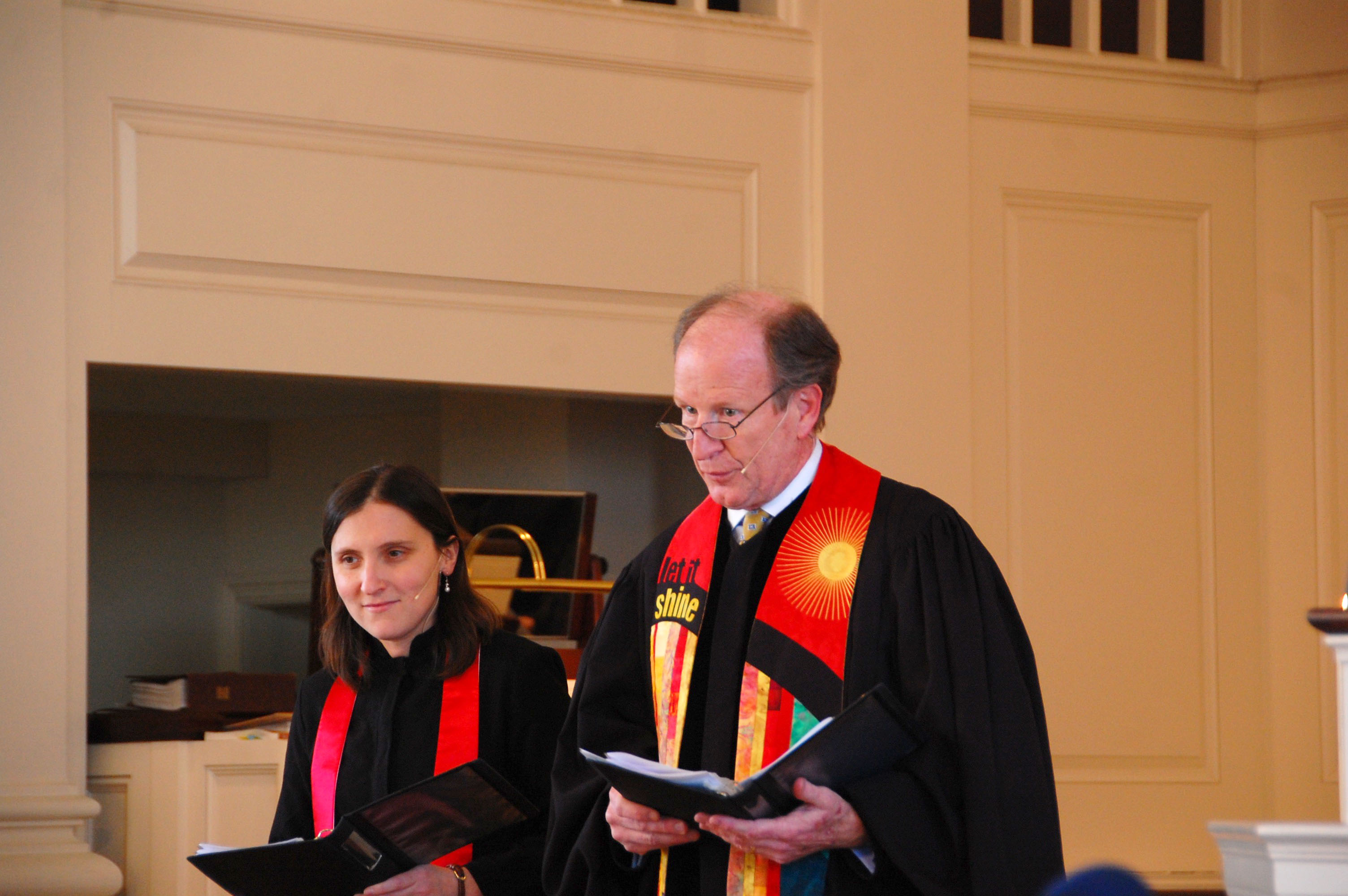
David Taylor and Kate VanDerzee-Glidden are the pastors of First Church of Christ Congregational UCC in Glastonbury, Connecticut, where I’ve worshiped for the last ten years or so. They gathered people together to present me with this stole, which celebrates both New England and Hawai’i. On the back, church members and friends wrote their blessings and best wishes for me, and I’ve been reading them with tears in my eyes.

This is the choir at First Church in Glastonbury singing at the service the Connecticut Conference held to celebrate my ministry. You’ll notice that they all donned leis for the occasion – and had one for me. What you can’t see in the photo is the gift certificate they gave me for a music shop here in Hilo, to purchase an ukulele and start to learn to play it.

And I’ve even gone out to buy it!

Eric and Paul Bryant-Smith

Eric and Paul Bryant-Smith

And this is my friend Paul Bryant-Smith. He’s pastor of a church in Danbury, Connecticut, and also a hospital chaplain. The two of us have made music together for twenty years. In this picture, also from that farewell service, I’m playing him wearing heavy winter clothing, and he’s being me, playing ukulele. We are, of course, singing “Somewhere Over the Rainbow.”

And then there’s this photo. I took it at the Hilo airport. Because my flight was early, which I gather isn’t common, some of you who came to greet me hadn’t arrived yet when I took this picture. I think I was also wearing at least two more leis when I left the airport.

This picture has been liked 235 times on Facebook. I’m pretty sure that’s the most affection any photo has ever received on my Facebook account.

I’m showing you all this to make sure you know something very important about me: I know what it is to be loved. I have been blessed to live among loving people. In these smiles and waves and leis, I know that I am blessed to live among loving people again.

Church of the Holy Cross members welcome Eric Anderson to Hilo.

Church of the Holy Cross members welcome Eric Anderson to Hilo.

Jesus asked the impulsive, jump-into-the-water Peter this question: “Do you love me?”

It’s a tough question for him, and in fact Peter does some linguistic gymnastics with words for “love” that don’t translate from Greek to English.

That’s for another time. It doesn’t matter what kind of love Jesus asks about, and it doesn’t matter what kind of love Peter declares, because every time Jesus insists: “Feed my sheep.”

“Do you love me? You do? Feed my sheep.”

Or he might have put it this way: “Do you love me? You do? Love those around you.”

Feed my sheep.

There are a lot of ways to be hungry in the world: the hunger of the stomach, the hunger of the mind, the hunger of the soul.

The hunger of the stomach seems simple, doesn’t it? I get hungry. I eat. Problem solved. But the hunger of the stomach is not so simple, not by half. For one thing, food alone won’t do. I need to drink water as well, and my officemates back at the Connecticut Conference are still telling stories about my need for coffee.

Yet there’s another important question to ask: When people are hungry, why are they hungry? Why don’t they have access to food, or water, or work, or support? How can we prevent today’s hunger from becoming a pattern, or an apparently permanent condition?

Feed my sheep.

The hunger of the mind, likewise, may not be satisfied by the delivery of books or the establishment of schools. People learn differently, and techniques that work well for vast numbers of people may be utter failures with some others. You can see the frustration build when someone’s trying to learn in a way that doesn’t work well for them. If you’re trying to learn something from me, and it’s not working, let’s try it again, but this time, let’s try something different. And if I’m trying to learn something from you, and it’s not working, let’s try it again, and this time, we’ll try something different.

Pastor Eric in his tie and stole - and first Sunday lei.

Pastor Eric in his tie and stole – and first Sunday lei.

And there’s the hunger of the soul. When it comes right down to it, confronting this human need is my calling. My place among you is to help you satisfy the hungers of your soul.

Most of the time, I will not be able to meet that need myself. It would be lovely if I could do it in a sermon, but no. Not in one sermon, and most likely not in twenty years of sermons either. If I’m doing well, from time to time I’ll say something that feeds you just a little, and on the days when I don’t, hopefully I’ve said something to feed someone else.

The sermon isn’t the only source of spiritual food, however, and it’s my role to help you try things that might feed you. There are many different approaches to prayer, and some might bring you closer to God than others. Music has astonishing power to fill the soul. I’ll do my best, and work with the leadership, to lead worship that is authentic and engaged. We can study the Bible and other spiritual works. We can take retreats. We can engage in public service and public witness. We can sit together and talk about baseball, or your grandchildren, or your job. If your soul hungers, let’s work together, and find ways to fill your spirit.

The risk of having a satisfied soul is that Jesus summons them. He says, “Feed my sheep.” We’re not the only ones who hunger in body, mind, or spirit. There are others, near and far.

Our work together as the Church of the Holy Cross United Church of Christ in Hilo, Hawai’i, is to answer the call of Jesus, and labor to see that those who hunger – in body, mind, or spirit – are fed.