The kolea is a pretty mellow bird. They’re not terribly skittish, though some will keep a sensible distance from people. We are a lot bigger than a kolea and probably look kind of scary to them.
The myna, on the other hand, is not a mellow bird. They sing a fair amount, but they also screech and argue. They’re pretty sociable with one another, and one moment everybody is happy and content, and the next moment everybody is hollering at one another.
Which makes them a lot like some people, now that I think of it.
Mynas fly, of course, but you could call them homebodies. They don’t tend to go very far. Kolea, on the other hand, fly long distances from where they nest in Alaska to where they spend the winter here in Hawai’i. If you’ve ever flown on an airplane to the North American continent, you know that’s a long flight. Well, kolea fly it with their own wings and they don’t go as fast, so it takes longer.
The mynas find it all rather puzzling and strange.
A myna was picking worms and seeds alongside a kolea one day. The two of them were quiet most of the time, because by chance most of the myna’s other friends had had a big argument and flown off to continue it somewhere else. So it was just the two of them.
“I’ve always wanted to know,” said the myna to the kolea. “Why do you fly so far?”
The kolea thought about it. “I’m not sure anyone has asked me that before,” he said.
“Well, I’m asking,” said the myna.
“I do like the change,” said the kolea, “and I know that it gets awfully cold in Alaska during the winter.”
“Then why not stay here?” asked the myna.
“There are different things there,” said the kolea, “and it just feels right to raise chicks there.”
“Then why fly all the way here?” asked the myna. “What do you come here to see?’
The kolea was quiet for so long that the myna was about to ask the question again, but then the kolea spoke:
“I come to see different trees, trees that blossom red and purple and gold. I come to see soaring mountains crowned with snow when there’s green all around the island. I come to see waterfalls that make rainbows. I come to see mountains with fire and beaches with black sand.
“I come to see birds that also live in Alaska, like ‘akekeke, and birds that don’t live in Alaska, like ‘apapane and nene and saffron finches.
“I don’t think I’d appreciated, though, that I also come to see mynas, and to be asked questions I was never asked. The next time I fly to Hawai’i, I’ll be coming to see you.”
“I’m glad,” said the myna. “Next time you fly from Alaska, I’ll be very glad to see you.”
by Eric Anderson
Watch the Recorded Story
I write these stories in advance, but I tell them from memory (and inspiration). The story you have just read is not identical to the story as I told it.
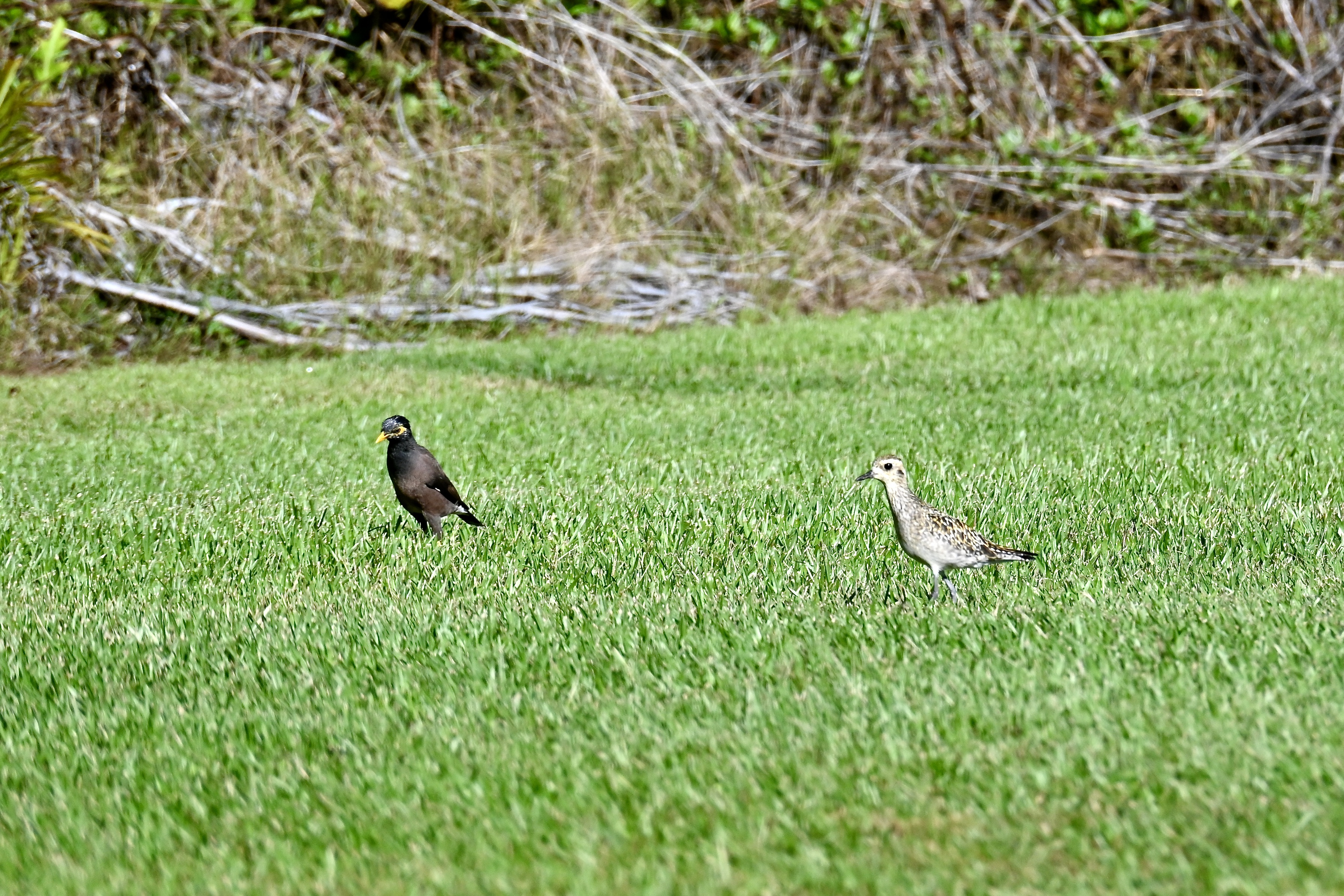
Photo of a myna (on left) and a kolea (on right) by Eric Anderson.
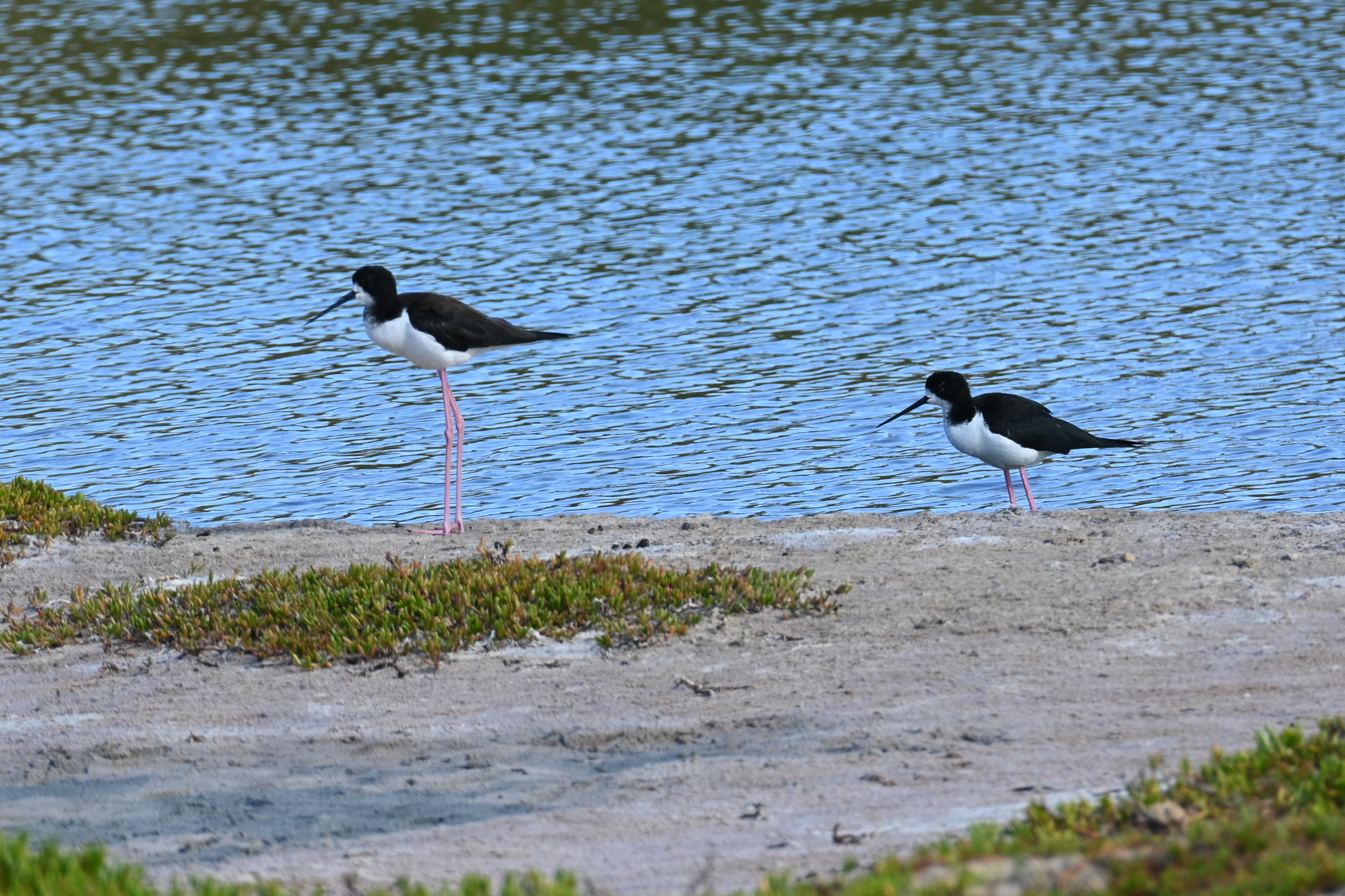
How would an ae’o (that’s a black-necked stilt in English) even think about getting rich? You might be wondering, and I would be wondering, too. This particular ae’o had been listening to some human beings who were visiting the Hawaiian shoreline near where she hunted for shrimp and bugs in an old fishpond. The people had been talking about how wealthy they were and how glad they were to be rich.
I’m afraid a lot of it was pure foolishness, and some of it was pure hard-heartedness, because they talked about how they paid their workers as little as possible and bought things for low unfair prices and sold things for high unfair prices. Frankly, most of that went over the ae’o’s head, despite how long her neck and her bright pink legs were. Still, the humans seemed pleased about it, so she determined to get rich.
“How would an ae’o get rich?” she wondered.
She wondered about it as she and her husband prepared a nest. An ae’o nest is pretty simple. They make a hollow in the ground, then line it with grasses and even some of their downier feathers. As they were working, she noticed something bright on the ground. It was a white pebble.
“I know how to be rich!” she said. “I’ll line our nest with bright things.”
Her husband had no idea what to make of that, and even less when she flew out and around and returned with odd things that didn’t make much sense in an ae’o nest. She found more pebbles, which poked at you when sitting on the nest. She found plastic bottle lids, which weren’t any more comfortable than the pebbles. She brought in crushed soda cans that someone had carelessly dropped somewhere, which took up a lot of room, and she brought in bits of discarded paper with the shiny photos of visitor brochures.
“Why are you doing this?” asked her husband. “To get rich,” she told him, and had no better answer.
It was her grandmother, of course, who came by at last to take a look at the bright and shining nest. She was settled uncomfortably into it, wedged in by cans and bottles and avoiding the sharp bits of glass that a sensible bird would have left where they were.
“You call this being rich?” said tutu ae’o.
“Of course,” she replied.
“It looks more like this nest is demanding more of you than it’s giving you in return. It’s supposed to protect your eggs. Is it doing that?”
Indeed, the eggs were going to have a hard time finding space amidst all the hard and sharp surfaces in the nest. Even our rich ae’o had to admit that.
“This isn’t how an ae’o gets rich anyway,” said tutu. “We get rich with family. We get rich with sunshine. We get rich with a big school of shrimp. We get rich with the things the world gives us, things that are never ours, but which we enjoy when they come.
“Give up this empty nest, granddaughter,” she said. “Come lay your eggs someplace comfortable and safe. Then you’ll be rich with a new generation.”
Without a word, the ae’o stood up and walked off to build a new nest with her husband. She never looked back. She looked ahead to being rich in love.
by Eric Anderson
Watch the Recorded Story
I write these stories in full ahead of time, but I tell them from memory plus improvisation. As a result, what you just read does not precisely match the way I told it in the video.
On February 1st, I begin a three month sabbatical, a time to lay down my responsibilities as Pastor of Church of the Holy Cross UCC in Hilo, and to use the time to learn, to renew, and to take on some projects that I haven’t been able to accomplish amidst the daily tasks of ministry. I described my sabbatical objectives in today’s edition of What I’m Thinking embedded above; there is a transcript available here.
What, if anything, does my sabbatical mean for Ordained Geek?
I will be posting less material here. The weekly #lectionprayers are a part of my sermon preparation process. With no sermons to write for three months, I don’t plan to compose those poem/prayers. Likewise I don’t expect to write new stories for worship during this time. Again, I prepare those for worship services I won’t be leading in February, March, and April. The stories and the poem/prayers will certainly return in May, when I resume both my preaching responsibilities and my preparation practices.
That doesn’t mean I’ll have no posts during that time. I may share a story or two that I haven’t before. There are some stories I’ve written elsewhere, or never actually written in full, that I want to consider for the collection which is one of my sabbatical objectives. I anticipate posting them here to help me review them.
I also expect to write some other reflections. I have committed myself to commenting on injustices when I see them, and I already see them. It’s possible that I may turn to poetry for those, and it’s possible that I will write additional essays. One is taking shape in my head, and I expect to post it before long.
I may also prepare some other pieces arising from my sabbatical experience. I didn’t do that when I last took a sabbatical in 2014, but in those days I worked in electronic communications. I had to set much of that aside in order to find refreshment in the time. That’s less true now, so we’ll see how that goes. Besides, I rather hope to share a few photos from my travels around the Hawaiian Islands.
It is also vaguely possible that I’ll write and share new songs during this time. It’s not a part of my sabbatical plan, but I hope that some of my refreshment may come through music. If so, I may post them here.
And finally, I will commit to a Lenten discipline of some kind. I don’t know what it will be, but the chances are good it will be visual (for me, that usually means photography). If it makes sense, you’ll probably see the results here.
You’ll see less from me these three months, but there will be new things coming during that time, and certainly once May has arrived.
Just a brief warning: this essay claims to share no great wisdom. It won’t give you either step-by-step hints about technology (a la An Ordained Geek Becomes a Televangelist) or assist you with deep reflection on a subject (a la… um). If you know you are interested in the way a pastor/writer/musician’s life works, this seems like something you’d appreciate. If you’re not, or don’t think you are, it’s harder to predict. Give it a try. Who knows? As well as learning something about me, you might learn something about you.
One of the most frequent descriptions people apply to me is: “storyteller.” It’s a title I receive with gratitude. I like telling stories. I like listening to stories. I like preparing stories for others to hear. I like interacting with them while I do.
As a pastor, I have always told stories, most often as part of a “Children’s Time” or “Moment with the Children” in worship. I’ve told stories in other contexts as well – places like summer camp or vacation Bible school – but for the most part they’ve had a place in worship.
For many, many years of my ministry, I prepared no more than a sketch for each story. I preached from notes. For stories I used no notes at all. Occasionally I would take time afterward to write the narrative in full, but that usually only happened when I’d had a specific request. As much as people told me they appreciated the stories, those requests were rare.
Then the stories became rare. For about fifteen years of my ministry I did not serve a local church. My responsibilities as a member of a UCC Conference staff did not include a great deal of worship leadership. I preached little and I told stories less – in part, because I developed the habit of telling one particular story the first time I spoke anywhere (that story isn’t on this blog, which I ought to correct at some point).
In 2016 I laid down my responsibilities in New England and took up the pastorate of Church of the Holy Cross UCC in Hilo. For the first time in a long time, I had to prepare a weekly sermon. For the first time in a long time, I had to prepare a weekly story.
During the preceding years, I’d made a big shift in my preaching practice. I’d switched to preparing a full manuscript rather than using notes. I’d done it, in fact, when I was invited to the pulpit of the church in which I worshiped. They had two Sunday morning services and the timing was a little tight. I had to control for time. A manuscript did the job. By the time I came to Hilo, I’d settled into the pattern and was happy with it.
I had not, however, made a similar adjustment with stories. The stories received no more than a few sparse notes. Within a few weeks I decided that I did want to share a written version of each one, so I began writing each story up on Sunday afternoon. The first was “Sun Astonished” in May 2016.
It turned out that this work process of Sunday afternoon note expansion wasn’t sustainable. Many of the church’s boards and committees met on Sunday afternoons, further separating the writing from the storytelling. Putting the sermon online required more work as we added an audio recording. The church’s electronic newsletter demanded attention on Sunday afternoons so that the office manager could send it Monday mornings. Gaps began to appear. In November 2018 “The ‘Apapane’s Own Song” became the last story to appear on this blog for over three years.
How have they returned?
Thank you, COVID.
When Church of the Holy Cross moved to an online-only worship format in March 2020 in the first days of the pandemic, I made a new shift in preparing sermons and stories. A streamed worship service, I felt, needed to take less time. I dropped several elements, mostly hymns and musical responses. I also merged the story with the sermon, or rather, I led the sermon with the story. For over two years the first words out of my mouth after the Scripture had been read were the first words of a story.
I began to craft the story as part of the sermon, and that meant that it would receive a full manuscript in its composition. That made sense for my writing process but it also made sense for the worship experiences I was trying to support. Along with the worship outline and response materials, I posted a written text of my sermon to the church website before worship each Sunday. Those with hearing difficulties or technical difficulties would have the sermon text to read as well as that of the pastoral prayer.
And, because it was the first thing in the sermon manuscript, they had the story.
On April 24, 2022, we resumed worshiping with a gathered congregation. On that first Sunday I continued the practice of combining the story and the sermon. I received some feedback, some very clear feedback, that that would not do. The young people liked the stories, but they also liked the time with their pastor, a time which said that they were important to me and to the Church and to God. Time with the Children returned on May 1.
When it did, I did not return to my long-time practice of brief notes. I kept writing the full manuscripts, and I also write the story before beginning the sermon proper. We continue to live-stream the service over the Internet, and that means a backup copy could easily be helpful. So now each worship service on our website includes a manuscript of the sermon, of the pastoral prayer, and of the story.
Those experiences do not and cannot match. In a virtual worship service, I could and did (mostly) read the story as written. With a congregation present – with children present – I do not use notes for the story except to remember certain words I’m likely to forget. I may have written a complete text, but I am still working from an outline in my memory.
Sunday afternoon has gained a new task. I still post the sermon text to the church’s website along with a video of the worship service. Side by side with that I post the prepared story text to Ordained Geek, accompanied by video of how the story was actually told in worship.
And that’s why stories have returned to Ordained Geek.
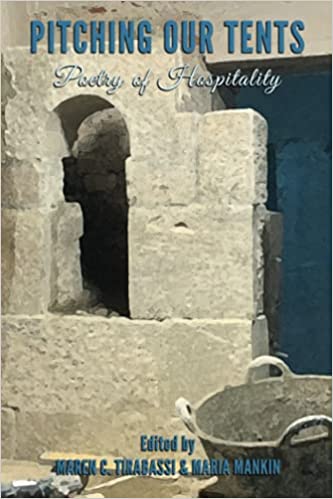
Pitching Our Tents: Poetry of Hospitality Edited by Maren C. Tirabassi & Maria Mankin
Pitching Our Tents: Poetry of Hospitality is a special project of Maria Mankin and Maren C. Tirabassi supporting interfaith reconciliation and shared ministry in the Middle East. Specifically, the book will help fund the Peace Cathedral (Baptist) in Tbilisi, Georgia, in its quest to build spaces to include a small synagogue and a small mosque beneath its roof.
The chapbook (I had to look that up; it’s a short paperback booklet) features the work of thirty-two contributors from seven countries beyond Georgia. Their poems rise from roots in experiences of inclusion and connection. I am honored to be among the writers.
Maren Tirabassi writes, “Peace Cathedral in the Republic of Georgia was established as First Baptist Church of Tbilisi in 1867. Its history is full of dangerous activist stands, and it has been involved in interfaith work for more than twenty years, trusted by Muslim, Jewish, Yezidi and other religious traditions, in a context where the more dominant Christian culture often responds violently against minorities. They are constructing a mosque and a synagogue under the roof of their church building to turn it into a spiritual home for Abrahamic faiths. In addition, there is a Centre for Interfaith Dialogue, an interfaith adult library and a children’s library with programming and summer camps. Their pilgrimage program brings people to visit the Republic of Georgia to learn about the hopes and struggles of people of all of these faiths.”
In these days of complicated publishing, obtaining a copy of the chapbook is fairly straightforward – making sure that the purchase funds the Peace Project may be a little more difficult. Follow these steps:
1. Go here to donate to the Peace Cathedral via the Alliance of Baptists. The suggested gift is $10.00.
2. To pay by credit card, select 1. On the second line of the form, where it states, “Other Designation,” please write in Peace Project – Tbilisi. To pay by check, choose 3, and write in Peace Project – Tbilisi on the Memo line.
3. Use this Book Funnellink to receive your free electronic copy of Pitching Our Tents: Poetry of Hospitality with a choice of e-book formats or a PDF, in thanks for your support of the Peace Cathedral.
4. If you would like a print copy, it is available on Amazon. The cost is as low as Amazon will allow (this only covers the printing cost). The authors do not receive royalties from this, nor will the proceeds go to the Peace Cathedral, so if you’d like to support them, please follow the donation steps above.
Published
In some ways I consider this my first foray into being a published author. I mean, look: I’m in a book! In truth, though, I’ve been a published author for a long time. I spent seventeen years writing for the Connecticut Conference of the United Church of Christ (now part of the Southern New England Conference UCC), eventually becoming senior publications editor. My by-line appeared on newsprint and on glowing screens, and it has also appeared in United Church News.
My work as a poet has appeared almost entirely on my personal blog. So is that… published? Well, I think it is. It’s potentially visible to far more people than ever saw my columns in the print editions of ConnTact. I grant you (with a ruleful smile) that the readership has, well, not risen to its potential.
What sets this moment apart for me is not the format or the publisher, but the invitation. I have admired the work of Maren Tirabassi for longer than either of us care to admit. Her compliments on my work published in this blog have filled me with deep gratitude. To have her ask me to contribute… Well. I practically fell over myself to say yes. And write something.
Behind the Poem
Photo by Eric Anderson, August 28, 2017
For the moment, I’m not sharing the poem here. I will eventually, unless I forget, which is possible. I encourage you to gain access to the poem by supporting the Tbilisi Peace Project with a donation; that’s the purpose for which I wrote the poem in the first place. I will, however, tell something of the story behind the poem.
On August 12, 2017, the “Unite the Right” rally sparked racist violence to Charlottesville, Virginia. Marchers chanted Nazi slogans against non-whites. They chanted slogans targeting Jews. They raised the flags of slave-holding and rebellion. One sped deliberately into a crowd, and Heather Heyer died.
The nation’s leadership failed to condemn the racist and anti-Semitic platforms of the marchers, famously claiming there were “good people on both sides.” Demonstrations sprung up around the country condemning the white supremacist foundations of the Charlottesville rally, calling for repudiation of racist ideology, policy, and activity. Among the places was Hilo, Hawai’i. Interfaith Communities in Action gathered a small group for an hour’s roadside sign-waving on Monday, August 28, 2017.
What the planners, including me, had not expected was a counter-protest.
A smaller group gathered across the street, purportedly protesting against abortion but with signs, speech, and a bullhorn clearly opposing the anti-racist stand of ICIA and its participating communities. They chose one name to shout, taking it from the press release announcing the rally. That name was mine. I heard it clearly shouted in tones of threat.
A few of the counter-protesters even ventured across the street to confront us directly. There was no violence, but for weeks afterward a photo of myself appeared in the group’s materials, identified as a false minister. I reflected on the events in a Pastor’s Corner in Church of the Holy Cross’ The Messenger.