Story: On the Wind

October 29, 2023

Deuteronomy 34:1-12
Matthew 22:34-46

He was a recently hatched pueo and he didn’t want to fly.

As far as he was concerned, nest living was plenty good. His father came by with food. His mother got it into bite-sized bits that he, well, bit. He had two sisters in the nest with him and their mother stayed with the three of them. When it was cold her feathers spread over them kept them nice and warm. When the sun got too strong during the day her wings gave them shade. When it rained they were all snug beneath her body and wings.

He didn’t mind leaving the nest. Once his legs were strong enough, he’d hop out and go exploring. So did his sisters. They didn’t go far so they didn’t find much except grass and rocks and more grass, but it made them feel like bold adventurers.

But he didn’t want to fly.

The problem was the wind. The nest was in a spot in the saddle between Mauna Loa and Mauna Kea, and the mountains funneled the wind between their slopes and peaks so that it just howled them. When he’d first stood up to go exploring, a few stronger gusts had knocked him down three times. His legs got stronger after that so it didn’t happen again, but that wind kept going and he didn’t feel any better about it.

“If that wind is going to blow like that,” he said, “I’m not flying. The ground will work just fine for me.”

His mother didn’t quite believe him, so she ignored it when he said this. His sisters took this as an opening to tease him, so they did, but they didn’t take it seriously, either. “Not going to fly, right,” they told him as they settled down to sleep. “You’ll change your mind about that soon enough.”

But as they started to exercise their new-feathered wings, flapping them up and down and front and back, he didn’t do anything of the kind. “This is going to be so cool!” one of his sisters told him.

“Cold, more likely,” he said, “without Mom’s feathers to keep you warm.”

They day his sisters took their first flight, he stayed in the nest. “I’m not going to fly,” he told his mother. “As long as that wind is blowing, the ground is fine for me.”

She might have stayed to argue but her daughters were hopping up and down and squawking about taking their first flight, so she had to pay attention to them. It didn’t take long before all three were in the air, climbing away from the nest.

“As long as the wind is blowing like this,” he said again, “I’m staying on the ground.”

The wind, in fact, blew harder. He had to lean forward into it to stay upright. It dropped to almost nothing so that he stumbled and spread his wings for balance. In that moment the wind blew a great big gust that billowed under his wings and lifted him into the air.

He was so startled that he froze with his wings still extended, rather than folding them right there and getting an uncomfortable return to the ground. He soared higher up, the wind lifting him without so much as a wingbeat. With some small movements of his tail feathers, he turned one way and another, rose up and swooped down.

When he returned to the ground and the nest, his sisters and mother were there. “You’re not going to fly, huh?” his sisters teased.

“The wind is still blowing,” said his mother.

“It lifted me up,” said her son. “I didn’t think it would do that.”

His mother nodded. “Welcome, son,” she said, “to creatures who are held on the wind.”

There are plenty of uncomfortable and even scary things in the world. Some of these things – like God – are much bigger than we are. They may make us feel overwhelmed. And some of these things – it’s best to figure out what they are – will be there to lift us up and help us fly. One of those great powers is God. The Spirit blows as it will, it’s said, and the Spirit blows to help us fly.

by Eric Anderson

Watch the Recorded Story

I write these stories ahead of time, but I don’t read them when I’m telling them. My memory leaves things out and my creativity adds things, so what you read and what you hear will not be the same.

Photo of a pueo in flight by HarmonyonPlanetEarth – Pueo (Hawaiian Owl)|Saddle Rd | 2013-12-17at17-45-012. Uploaded by snowmanradio, CC BY 2.0, https://commons.wikimedia.org/w/index.php?curid=30241884.
Unknown Grave

“Then Moses, the servant of the LORD, died there in the land of Moab, at the Lord’s command. He was buried in a valley in the land of Moab, opposite Beth-peor, but no one knows his burial place to this day.” – Deuteronomy 34:5-6

Note: The Hebrew text can be read that the LORD buried Moses after his death.

“Lay it down, Moses. You have walked and climbed
and spoken and shouted and struck and fed
and led for many, many years. Lay it down, old friend.
Your limbs have carried you, and now you rest.”

In view of promises that he had spoken, he
gently took a breath, and let it go. Unequaled
prophet of the once enslaved, now free,
his spirit spread its wings in eager flight.

They mourned him thirty days down in the valley,
never knowing where his flesh, at last at rest,
remained. Did Joshua ascend the slopes to dig,
or did an angel’s hands move dust for Moses’ clay?

In decades past, they’d panicked when he’d disappeared
upon the rumbling heights. With Moses’ final song
still shivering in their ears, they wept and grieved,
and if they climbed, they never found the prophet’s grave.

Today you’ll find a monument to Moses at
the summit of Mount Nebo, a shrine to mark
a grave at Nabi Musa near the road to Jericho,
but Moses’ grave was hidden from the folk he’d led.

They mourned this time without an idol’s aid,
not even the small comfort of a tended grave.
The leadership had passed unto another generation.
Was that enough to satisfy their grief?

Or was it simply that they’d seen, at last,
through passing of the years, that Moses’ legacy
was they, themselves, the once enslaved now free,
their lives his monument less brittle than the stones.

Though Moses died, his people lived. Though Moses died,
his people found a home. Though Moses died,
another generation rose. Though Moses died,
and though I die, the grace of God lives on.

A poem/prayer based on Deuteronomy 34:1-12, the Revised Common Lectionary Alternate First Reading for Year A, Proper 25 (30).

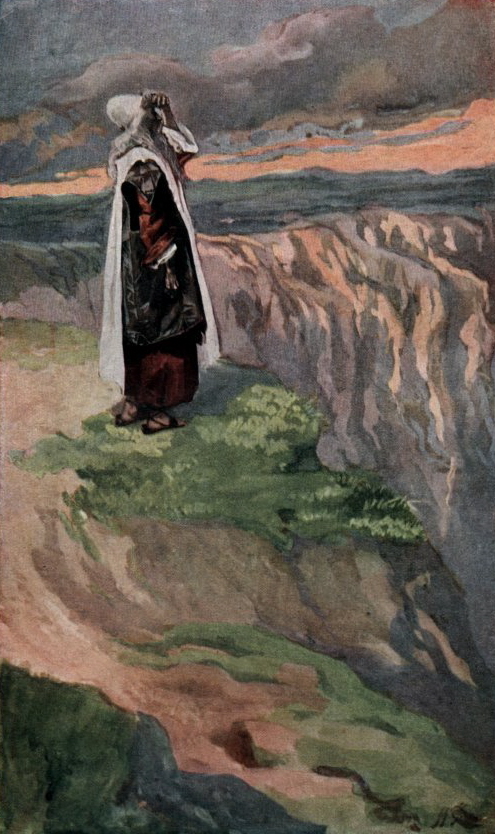
The image is Moses Sees the Promised Land from Afar, as in Numbers 27:12 by James Tissot (before 1903) – http://www.wcg.org/images/tissot/tissland.jpg, Public Domain, https://commons.wikimedia.org/w/index.php?curid=7154558.

Story: That’s Mine

October 22, 2023

Exodus 33:12-23
Matthew 22:15-22

‘Amakihi are generally inoffensive birds. They fly with other birds, they feed with other birds, and they even allow other birds to get pretty close to their nests – though they’ll chase off a bird that gets closer than, say, about three feet.

One ‘amakihi, however, must have been watching i’iwi, perhaps, or more likely people, because he chose and ohi’a tree and said, “That’s mine!”

I told a story a while ago about an i’iwi trying to protect an ohi’a tree and you might remember that it didn’t work. And I’ve told a story about an i’iwi trying to keep other birds away from a tree in blossom and how an ‘amakihi found a way that other birds could eat there, too. Those trees were in full blossom, with the scent of nectar drawing the honeyeaters of the forest in from all around. This tree, however, the one that the ‘amakihi chose as his? It was not at all tall, and barely had a flower on it. Nobody was terribly interested.

Except for this one ‘amakihi, who told everyone who came near: “It’s mine!”

He ate the bugs from it, and sipped nectar when it blossomed, but he couldn’t really feed himself entirely from this one tree, so he’d forage around the forest. As soon as he was satisfied, however, he’d be right back to his chosen tree, to chase away any bird that was getting “too close,” whatever that meant at the time.

“Why are you doing that?” asked his sister.

“The tree is mine!” he told her.

“How is the tree yours?” asked his father.

“It’s mine!”

That’s an argument you can have for a long time.

His grandfather came by and circled the little tree while he was perched there. He didn’t get too close, so his grandson didn’t get upset. He landed a little bit away in another small tree and called out, “Can we talk, grandson?”

The ‘amakihi wouldn’t even let his own grandfather perch in “his” tree, so he flew to where grandfather was.

“That’s your tree, is it?” asked grandfather.

“Yes, it is,” said the grandson.

“How did you plant it?” asked Tutu.

“I didn’t,” said the grandson.

“Then you must have watered it,” said Tutu.

He hadn’t done that, either.

“Or fed it to make it grow,” said grandfather, but the grandson hadn’t.

“All right then,” said the grandson, “maybe I can’t claim the whole tree. I’ll just claim this branch.” He flew over and perched on it, singing out, “It’s mine!”

Grandfather flew to another branch and said, “You must have done a lot of work to get it large enough to hold you.”

“This flower cluster is mine!”

“Well done for making it blossom!”

The grandson fell silent.

“Even among the humans, grandson, who argue about who owns what among the things of the Earth, and who turn some things into other things and who do make things grow where they didn’t, even among the humans, they know that they didn’t make the land, and they didn’t create the seeds, and their claims to own things are… a problem.

“You’re an ‘amakihi. You’ll build a nest and you’ll raise chicks. Even those won’t be ‘yours;’ they’ll be their own. Let it go, grandson. Let the tree be its own.”

“I think it’s a wonderful little tree,” said the grandson.

“Love it all you like,” said Tutu. “Let the tree be its own.”

by Eric Anderson

Watch the Recorded Story

I tell these stories from my memory of what I’ve written. As a result, what I said in the recording may be very different from what I’d previously written.

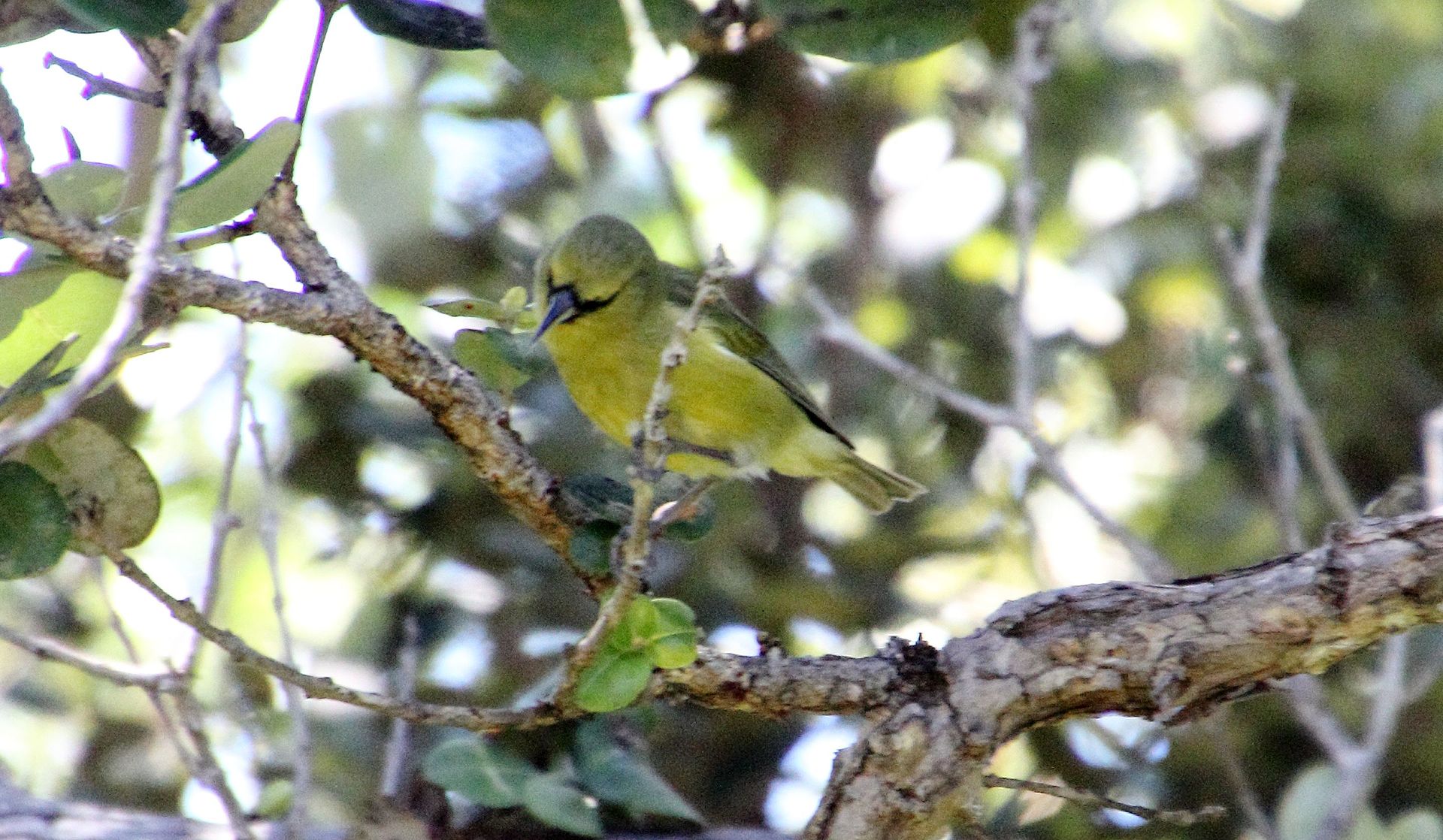
Photo of an ‘amakihi by Dominic Sherony – Hawaii Amakihi (Chlorodrepanis virens virens), CC BY-SA 2.0, https://commons.wikimedia.org/w/index.php?curid=52150186.

Whose Image?

Then [Jesus] said to them, “Give therefore to the emperor the things that are the emperor’s, and to God the things that are God’s.” – Matthew 22:21

Nobody asked, “What things are God’s?”
for fear, perhaps, you’d speak the answer then:
“All things belong to God; all things, including you.”

Two millennia we’ve focused our attention
on the first, imperial, clause, debating what
the monarch, governor, or mayor should receive,

As if what they received did not belong to God,
both when the coins were in our hands and when
they’d dropped into official palms. They still belong to God.

As crimson cascades in its gruesome torrents
from the slain of Israel and Gaza, of Ukraine,
Myanmar, Maghreb, of Russia and Sudan,

Of Mexico and Ethiopia, and dozens, scores,
of nations bled by fewer deaths but still,
too many when the the only number should be, “none,”

What do you tell us now, in our imperial power?
Do you hold out the twenty dollar bill and say,
“Please, not like this. Oh, not like this”?

Or do you drop your head into your hands
and in a river of frustrated tears
weep for the desecrated images of God?

A poem/prayer based on Matthew 22:15-22, the Revised Common Lectionary Gospel Reading for Year A, Proper 24 (29).

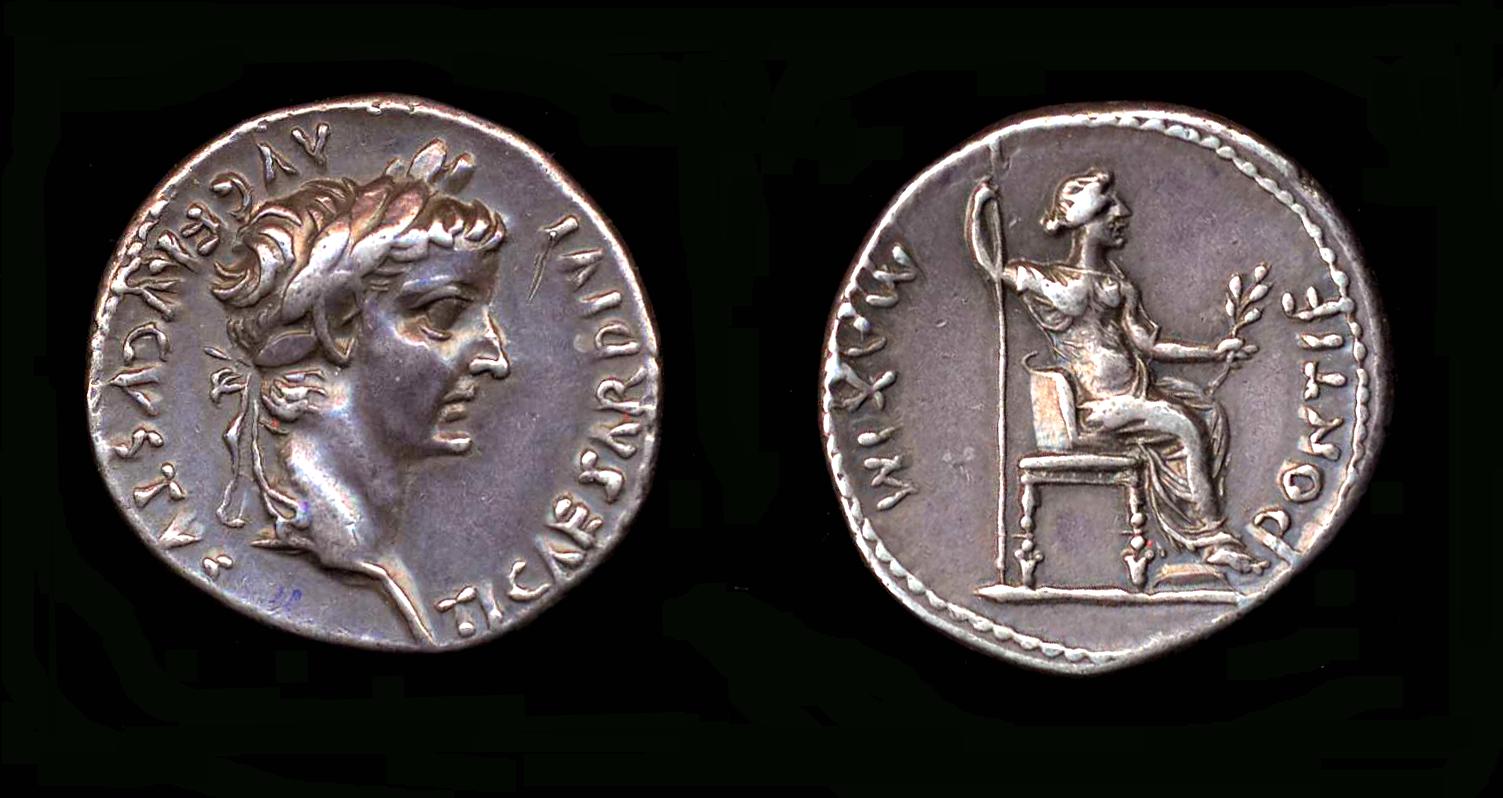
Photo of a first century denarius of the Emperor Tiberius by Portable Antiquities Scheme from London, England – Tiberius, R6195, BMC 49. Uploaded by Victuallers, CC BY 2.0, https://commons.wikimedia.org/w/index.php?curid=10817585.

Story: The ‘Akepa who Needed Comfort

October 15, 2023

Exodus 32:1-14
Philippians 4:1-9

The young ‘akepa was eager, so eager, to fly. He’d been fascinated by the idea ever since he first saw his father fly to the nest with food, and then fly away again to get more. As his wings feathers grew on his wings he got more and more excited, even if they did come in first as greenish-grey, the same color as his mother’s wings, and not the bright orange of his father. He didn’t worry about the color. He just wanted to fly.

His nest was a hole high up in a koa tree where a storm had brought down a big branch long before he was hatched. He poked his beak out from time to time to watch the other birds fly, and from time to time he’d stand on the edge and stretch out his wings and imagine what it was like. When the breeze ruffled his feathers he held his wings out to see what it felt like with the wind pressing against them. So many times he nearly hopped away to take to the open air, but somehow he refrained.

It might have had something to do with his sister, who was an hour older and, sadly, somewhat bossy. I’m an older child myself, and my younger brother would probably tell you that when I was young, I was somewhat bossy. “Don’t you do it!” she snapped at him. “You know your wings aren’t strong enough yet.”

“How do you know that?” he asked crossly.

“Because mine aren’t, and I’m older than you,” she said.

“By an hour.”

“It could be by a minute and they still wouldn’t be ready, and yours aren’t ready, so don’t go hopping out of the nest,” she said, and, well, they bickered.

I’m sure you never bicker with your brother or sister or friends, do you?

Both their parents were away from the nest one afternoon and he was perched on the edge of the hole in the tree watching some other birds when a small group of people walked through the forest below. He didn’t pay any attention to them – they didn’t fly, after all – when one of their cell phones rang. The ring tone was an electric guitar riff.

He’d never heard a noise like that before. It was loud – the phone was at top volume – and fierce, and harsh. Startled, he hopped up and away – but not backwards into the hole in the tree, but forwards into the open air. He desperately opened his wings, but found that his sister was right. He didn’t have the strength for level flight. Flapping desperately, he managed to slow himself down enough to grab some twigs close to the ground. There he huddled miserably beneath some leaves as his sister called from above.

His mother found him there not long afterward. “Get me back to the nest!” he begged. “I promise I won’t try to fly again!”

She looked him over and said, “How?”

There wasn’t a way for her to carry him, or for his father to carry him, or for the two of them together to carry him, and he knew it.

“Will you leave me here?” he asked.

“Your father and I are going to take care of you right here,” his mother said, “until your wings are strong enough to fly – which won’t be all that long. You’ll be less comfortable here than you would have been in the nest, and you’ll have to keep out of sight of the ‘io, but you’ll be fed and you will grow.”

That’s what happened. He wasn’t comfortable. The branch was drafty and the leaves let the rain through and the sun got plenty hot. Plus he could hear his sister calling “I told you so,” from time to time, which wasn’t very pleasant.

But then his father or mother would arrive with something to eat, and with some reassuring sounds, and the warmth of their feathers against his. He wasn’t comfortable, but he was comforted.

A couple days later he could fly just fine, and one more comforting thing happened. His sister, who’d been badly frightened when he fell from their nest in the hole in the tree, said she was sorry for calling “I told you so.”

by Eric Anderson

Watch the Recorded Story

I write these stories ahead of time, but tell them on Sunday mornings from memory and from improvisation. This is a morning when the telling sounds rather different than the writing.

Photo of an ‘akepa by Tony Castro – Own work, CC BY-SA 4.0, https://commons.wikimedia.org/w/index.php?curid=56759511.

It Seemed So Easy

“[The people said,] ‘Come, make gods for us, who shall go before us; as for this Moses, the man who brought us up out of the land of Egypt, we do not know what has become of him.'” – Exodus 32:1

Those Ten Commandments seem so clear.
I hardly even needed to take notes
(though in all honesty my memory
is unreliable about the honor due to parents) to
live righteously with just a few missteps.
I certainly would never worship figurines.

Before I criticize those people in the desert wastes,
perhaps I’ll walk a mile in their shoes,
uncertain whether when the day is gone,
that water may be found, and whether on
the morrow manna will appear, to satisfy
the hungry travelers of Sinai.

The man whose staff wrought miracles
had vanished in the clouds that wrapped
the mountain’s height, in billowed fire
that no one could contemplate surviving.
In his absence who could speak to God?
Who could interpret God to them?

“Make for us gods,” they said, and so would I,
for with a leader vanished and the desert fierce
at hand, I’d seek – I’d want – to crystallize
my hopes, to incarnate my faith, to be
the comfort of my fears. A calf? Why not?
It symbolizes promise, strength, and growth.

You’ll find no statue of a calf among
the decorations on my wall or door.
You’ll find the cross – a symbol only, right? –
and yes, some artwork of my favorite stories, like
the walk with Jesus to Emmaus, and
the supper Jesus held with his close friends.

No, these for all their imagery, are not
my idols. I look for comfort rather more
in tasks completed, praises given me,
for though I blush at them, I trust in them
to keep me safe and soothe my soul
amidst the pains and sufferings of life.

They do not work. Oh, they will stimulate
a flush of pleasure in the moment, but
the feeling fades. I know if I rely
on human approbation, I will put my heart
in danger of starvation – I’ve been parched
when human love ran dry before.

It’s human, I suppose, to seek a way
to make the evanescent tangible,
to hold in hand or ear or brain or heart
a solid thing, a symbol sensible,
like praise or wealth or sex or dignity.
These are our ordinary golden calves.

Forgive us, Holy One, as we have failed to learn
how legion are the idols we will make,
how much they look like faithfulness they ape,
how little they will heal or comfort us.
Forgive us, God, and by your grace
dissolve our idols and restore our souls.

A poem/prayer based on Exodus 32:1-14, the Revised Common Lectionary First Reading for Year A, Proper 23 (28).

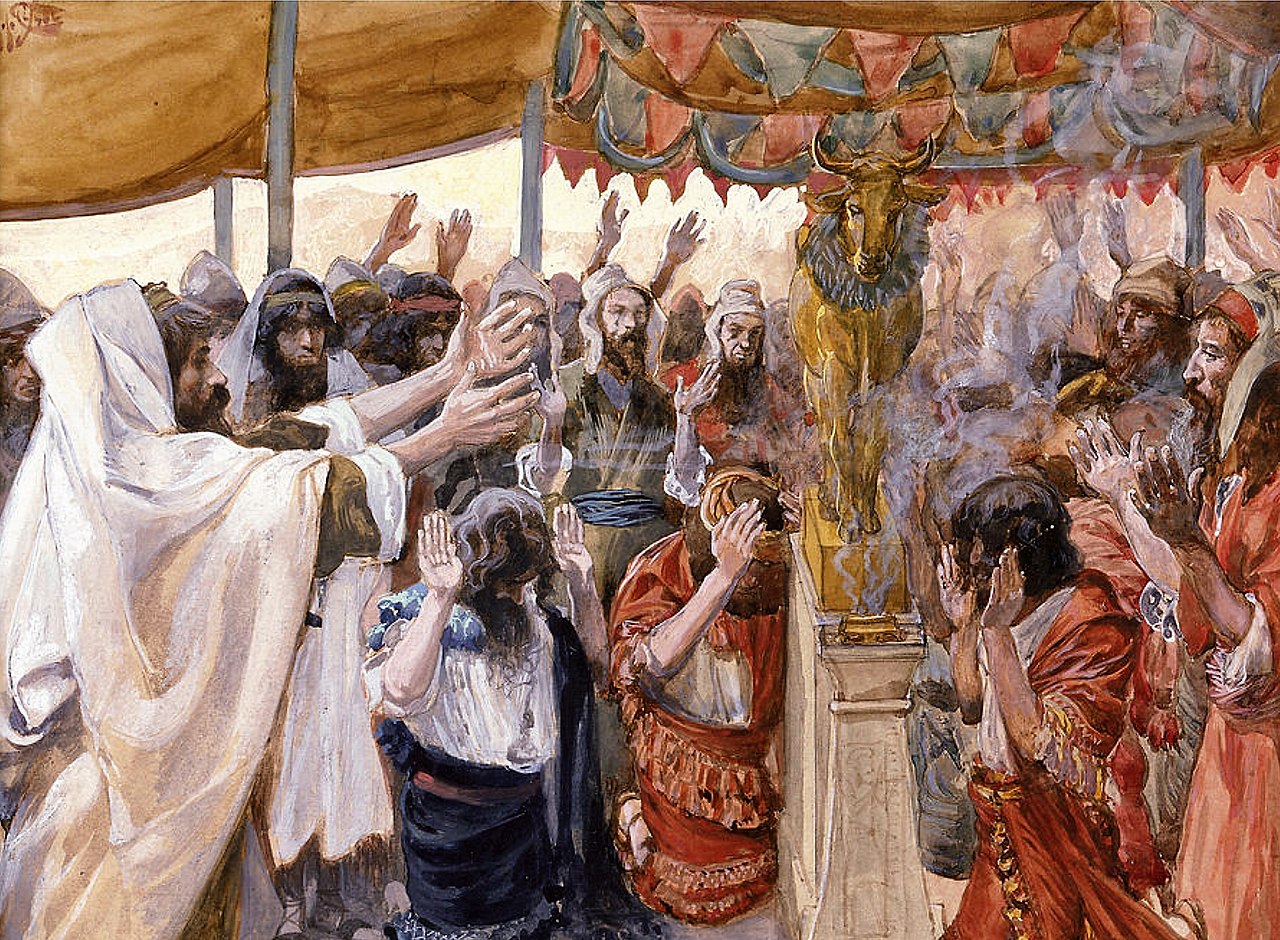
The image is The Golden Calf by James Jacques Joseph Tissot (French 1836-1902) – https://thejewishmuseum.org/collection/26377-the-golden-calf, Public Domain, https://commons.wikimedia.org/w/index.php?curid=7180440.

Story: The Loyal Myna

October 8, 2023

Isaiah 5:1-7
Matthew 21:33-46

While they were young, a myna and a saffron finch struck up a friendship. It wasn’t all that unusual, to be sure. Mynas and saffron finches hunt and peck for seeds and bugs and so on side by side quite often. Along the way they chat about this and that, that and this, at least until the flock of mynas gets riled up about something and start an argument among themselves.

This young myna didn’t much care for the myna arguments and even less for the major arguments, so she would hop off to one side with her friend the saffron finch, and the two of them would talk about food, and bugs, and the silly things mynas do, and the silly things saffron finches do, and the completely undecipherable things that humans do.

The myna liked her friend a lot. The saffron finch liked her friend a lot. Even when they weren’t talking about anything terribly important, they loved their time.

One of the mynas in the flock became, if not the leader, one of the more popular mynas among them. He was often loud and boisterous, and he tended to win the arguments. But he also got the mynas together. When a cat came by, he was the one who organized everyone to screech at it and dive at it until it went away. He kept an eye out for ‘io overhead and for mongoose on the prowl. If one of the mynas was missing, he’d search until he found them (which rarely took long; they tended to be behind a bush or under the eaves of a roof).

As time went on, he became more and more the leader of the flock, and all the other birds came to value his time and attention. That included the myna who was friends with the saffron finch. One of the things she’d talk to her friend about was the times when he’d talk to her.

“He’s an important bird,” said the saffron finch, before they went on to talk more about which was the best flavored bug that day.

One day, however, the leader myna hopped over to the myna who was friends with the saffron finch. “Hey,” he said, only with more myna screech to it. “I hear that you’ve got a friend who’s a saffron finch.”

“That’s right,” she said.

“No, that’s not right,” he told her. “Your friends should be mynas, not saffron finches. It’s one thing to put up with them – after all, they’re so small they don’t eat much – but it’s another thing to be friends with them. It’s time you dropped her. Tell her to stay away from you.”

“Why would I do that?” said the myna with a saffron finch for a friend.

“Because it’s what you should do,” said the leader myna, “and if you don’t, we can’t have you in the flock.”

At this moment the saffron finch landed nearby. The leader myna told her, “Say goodbye to your former friend. She’ll have her friends among the mynas now.”

“There’s no goodbye,” said the myna. “You’re my friend as long as you want to be.”

“I told you to drop her!” he said.

“You can say that all you want,” she replied. “I choose my friends, not you.”

“We’ll see what the flock has to say about that,” he said, and called them over. “This sad bird has a friend who’s a saffron finch,” he sneered to them. “Are we going to put up with that in our flock?”

The myna looked at her friends. She didn’t say anything. They looked at her, and they looked at their leader.

Unexpectedly, the saffron finch spoke up. “Don’t you have a friend who’s a spotted dove?” she asked one, who nodded. “And aren’t you friends with a yellow-beaked cardinal, and you with a northern cardinal?” she asked two more. They nodded as well.

“Are you going to let this bird choose your friends?” she asked, and all the mynas shook their heads.

That was the end of one myna’s leadership, and the continuation of a number of friendships, because of one loyal myna, and then many loyal mynas, in that flock.

by Eric Anderson

Watch the Recorded Story

I write these stories in advance, then tell them with a combination of memory and improvisation on Sunday mornings.

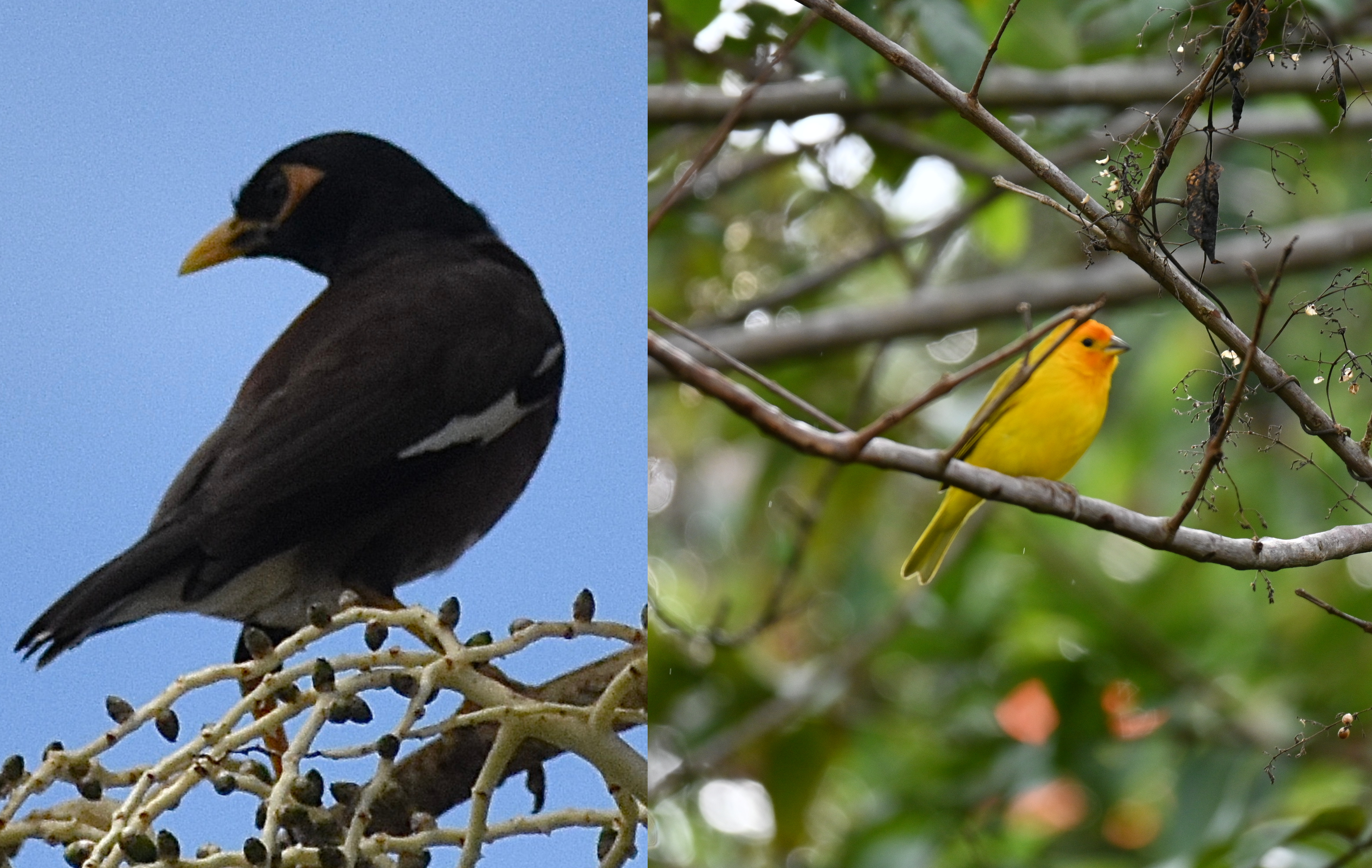
Photos of a myna (l.) and saffron finch (r.) by Eric Anderson.

Ownership

“When the chief priests and the Pharisees heard his parables, they realized that he was speaking about them.” – Matthew 21:45

I’ve never owned land. I’ve never had a tenant.
I’ve been the tenant. I’ve been the replacement tenant.
I’ve felt the urge to seize control.
I’ve seen what happened to those who tried.

When Jesus told this story, God, did those
all-powerful people hear the landlord as themselves?
Did they nod with satisfaction as they gave the story’s end:
“He’ll put those wretches to a miserable death.”

I wonder what a shock it must have been to hear
that they were not the owner, but the tenants,
that they did not possess the power or
the ownership they thought they had.

O Heavenly Gardener, may I tend this vineyard
you have given me to cultivate with care,
and neither seek to seize it for my own,
or punish those who take it for themselves.

A poem/prayer based on Matthew 21:33-46, the Revised Common Lectionary Second Reading for Year A, Proper 22 (27).

The image is Le fils de la vigne (The Son of the Vineyard) by James Tissot – Online Collection of Brooklyn Museum; Photo: Brooklyn Museum, 2007, 00.159.139_PS2.jpg, Public Domain, https://commons.wikimedia.org/w/index.php?curid=10957416. Of all Tissot’s paintings of Jesus’ life, death, and teachings, I find this the most chilling.

Story: The Best

October 1, 2023

Philippians 2:1-13
Matthew 21:23-32

She was the best. Everybody knew it. When young koa’e kea began learning to fly, they aspired to fly like her. She was the best.

Koa’e kea move awkwardly on land, and so did she, but the grace with which she’d take off had everyone gasping with amazement. One moment she was stationary on the ground, the next moment she was in the air, moving as if she’d never been anywhere else. When fishing, she would dive straight down, and only stray to the side to intercept the moving fish in the water below. Her take-offs from the water were as seemingly miraculous as her take-offs from land. One moment bobbing in the waves, the next moment climbing to the skies.

When young koa’e kea tried to race her, they rapidly fell behind. When they tried to turn more sharply than she, they either skittered away or fluttered helplessly down until they’d caught themselves and controlled their flight again. She landed so gently that her legs barely flexed. From time to time she’d gently roll through the air. Those who imitated her went through day after day of struggle, turning this way and that and descending rapidly, until they finally mastered those subtle movements of the feathers. Then they’d roll, but never with the same grace and power.

When she wanted to relax, she’d catch the rising air above Halema’uma’u Crater, soaring in rising circles with barely a wingbeat, higher than any of the other koa’e kea dared to go, a spot of white against the blue sky.

She was the best.

One young koa’e kea was determined to be her successor – in fact, to fly even better than she did. He studied every move she made. He exercised his wings. He spent hours facing into the trade winds and seeing what happened when he moved this feather like this, or that feather like that. He was going to be the best.

There was one difference, though. He announced it.

“I will be the best!” he said at some point during just about any conversation. He knew he wasn’t the best, not yet, but every koa’e kea on the mountainside knew what he aspired to be.

As for the best flyer among them? She said nothing, did nothing, but flew her best over the ocean, and over the pali, and over the mountain. When someone asked her help or advice she gave it (she was a willing teacher), but there was never a word from her about who the best flyer among the koa’e kea was.

There were plenty of words from the younger one. “I’ll be the best!” he said. “I’ll be the best very soon!” And indeed, that seemed like it might be true. He was taking turns almost as sharply as she. His take-offs were almost as magical. When he soared, he rose nearly as high.

So his grandmother took him aside one day. “Grandson,” she said, “I am very proud of you. You are the best flyer of your generation, and you may become the best flyer of us all. I’m so proud of all your hard work.”

“I’ll be the best,” he said.

“But one thing, grandson,” she said, “will prevent you from being the best if you keep doing it.”

“What’s that?” he asked. “Is it the way I hold my tail on takeoff? I’ve been working on that.”

“No,” she said. “It’s the way you keep talking about becoming the best.”

He was confused. “If I’m the best, or nearly the best, shouldn’t I say so?”

“Does the best flyer among the koa’e kea need to say it?” his grandmother asked.

As he thought about it, he realized that she never said a word about it. Even when she was doing something showy – like those rolls through the air – she never did it in a way that upset the other birds. She relaxed through those rolls, and in those rising circles, so that nobody ever thought her skill was a taunt or an insult to them. It was just an expression of her joy in flight.

“No, I don’t think she does,” he replied.

“You’re more than a good enough flyer,” said his grandmother, “that you don’t need to say a thing about it, either.”

It took a while to break the habit – bad habits are hard to break, aren’t they? – but on the day that his soaring circle reached higher than hers, he said nothing about it. She did – she congratulated him on his skill – and the two of them were the wonder of the koa’e kea of Hawai’i Island, rising, turning, diving, and soaring so beautifully that everyone else watched in wonder and in awe.

by Eric Anderson

Watch the Recorded Story

I write these stories first, and tell them from memory – which means things change. Today that includes the addition of sound effects.

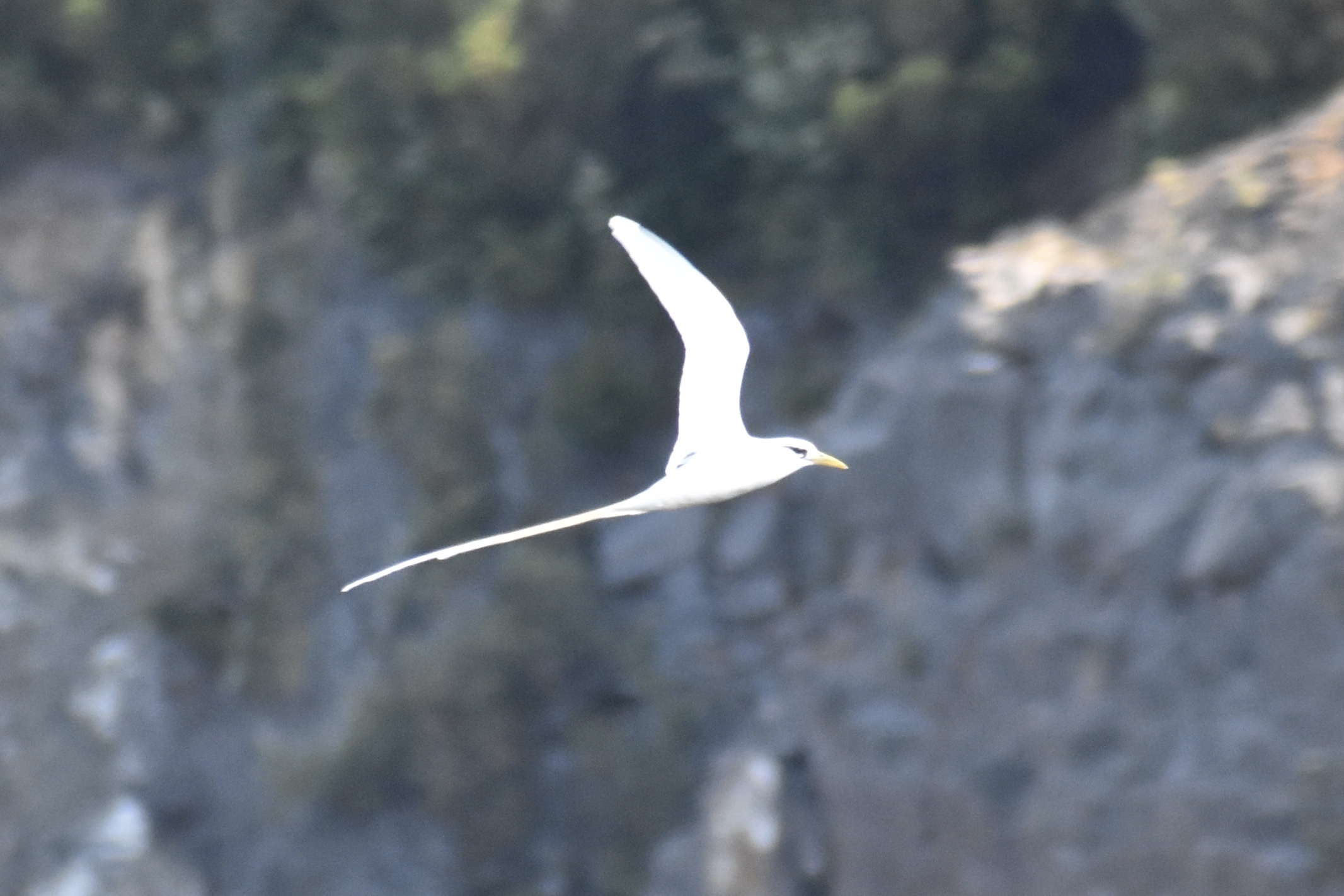
Photo of a koa’e kea (white-tailed tropicbird) by Eric Anderson.