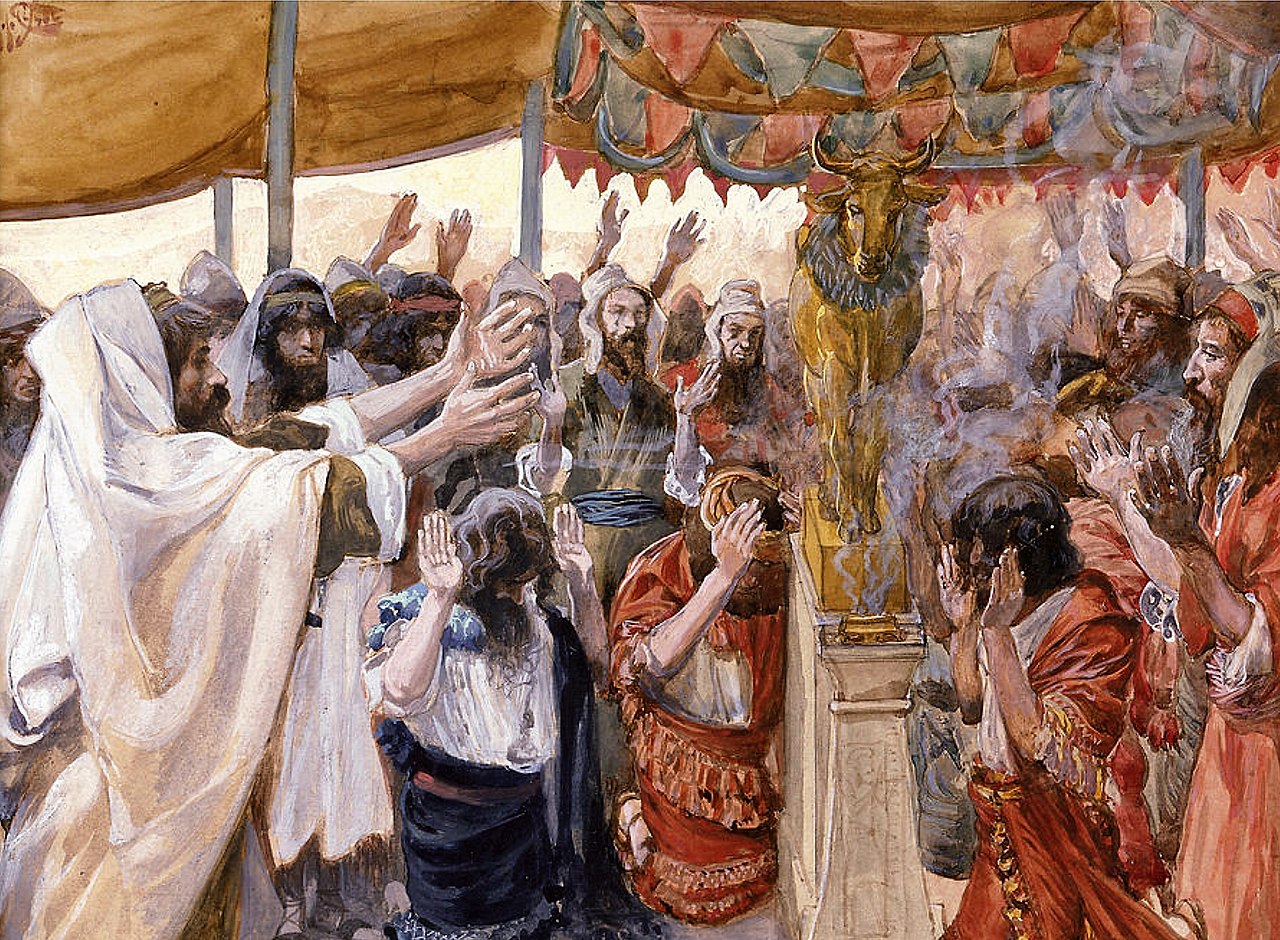
“[The people said,] ‘Come, make gods for us, who shall go before us; as for this Moses, the man who brought us up out of the land of Egypt, we do not know what has become of him.'” – Exodus 32:1
Those Ten Commandments seem so clear.
I hardly even needed to take notes
(though in all honesty my memory
is unreliable about the honor due to parents) to
live righteously with just a few missteps.
I certainly would never worship figurines.
Before I criticize those people in the desert wastes,
perhaps I’ll walk a mile in their shoes,
uncertain whether when the day is gone,
that water may be found, and whether on
the morrow manna will appear, to satisfy
the hungry travelers of Sinai.
The man whose staff wrought miracles
had vanished in the clouds that wrapped
the mountain’s height, in billowed fire
that no one could contemplate surviving.
In his absence who could speak to God?
Who could interpret God to them?
“Make for us gods,” they said, and so would I,
for with a leader vanished and the desert fierce
at hand, I’d seek – I’d want – to crystallize
my hopes, to incarnate my faith, to be
the comfort of my fears. A calf? Why not?
It symbolizes promise, strength, and growth.
You’ll find no statue of a calf among
the decorations on my wall or door.
You’ll find the cross – a symbol only, right? –
and yes, some artwork of my favorite stories, like
the walk with Jesus to Emmaus, and
the supper Jesus held with his close friends.
No, these for all their imagery, are not
my idols. I look for comfort rather more
in tasks completed, praises given me,
for though I blush at them, I trust in them
to keep me safe and soothe my soul
amidst the pains and sufferings of life.
They do not work. Oh, they will stimulate
a flush of pleasure in the moment, but
the feeling fades. I know if I rely
on human approbation, I will put my heart
in danger of starvation – I’ve been parched
when human love ran dry before.
It’s human, I suppose, to seek a way
to make the evanescent tangible,
to hold in hand or ear or brain or heart
a solid thing, a symbol sensible,
like praise or wealth or sex or dignity.
These are our ordinary golden calves.
Forgive us, Holy One, as we have failed to learn
how legion are the idols we will make,
how much they look like faithfulness they ape,
how little they will heal or comfort us.
Forgive us, God, and by your grace
dissolve our idols and restore our souls.
A poem/prayer based on Exodus 32:1-14, the Revised Common Lectionary First Reading for Year A, Proper 23 (28).
The image is The Golden Calf by James Jacques Joseph Tissot (French 1836-1902) – https://thejewishmuseum.org/collection/26377-the-golden-calf, Public Domain, https://commons.wikimedia.org/w/index.php?curid=7180440.


You turn over so many places in the heart for this great poem of empathy and self-conviction.
Thank you, Maren. It’s taken me a long time to see what I suspect are just some of my golden calves.
Pity wordpress only has “like” — I would prefer “heart.”
❤
That’s why you are “ordainedgeek” and I am “ordained-luddite.” Have a good day.
I love the way you walk a mile in their shoes, and then look hard to see where your own shoes pinch, and mine too. I am prone to what you identify as your idols: praise, approbation, making the evanescent tangible. Yet those experiences can support our faithfulness, hence the value of our artistic work and our supportive comments to one another!