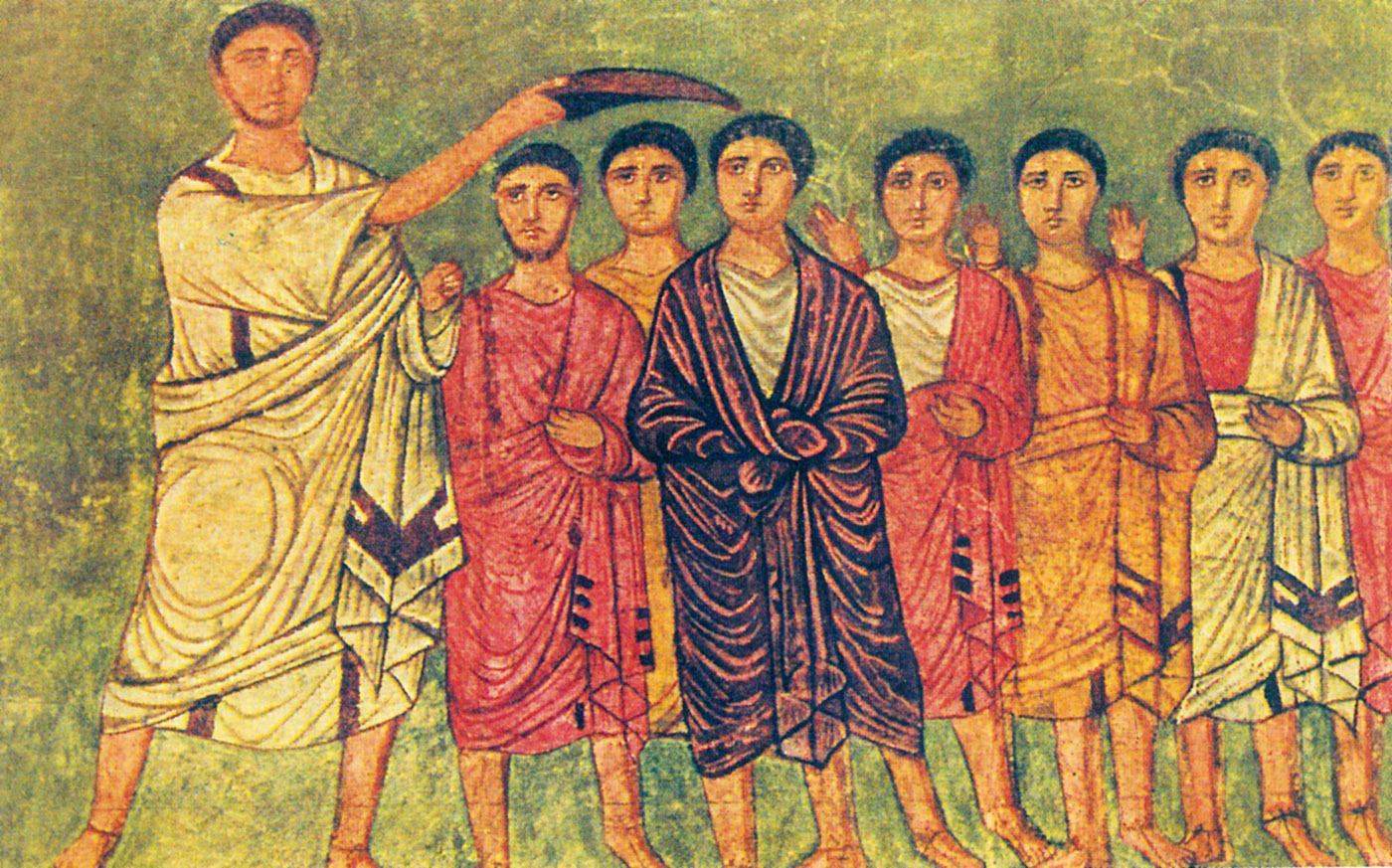
“Jesse made seven of his sons pass before Samuel, and Samuel said to Jesse, ‘The LORD has not chosen any of these.'” – 1 Samuel 16:10
Eliab, no. Abinadab: rejected, too. Perhaps Shammah? Well, no. Not he. Four more paraded past their father and the prophet and of those seven sons you chose, O God,
Not one.
I wonder if they knew. I wonder if they guessed, since all seemed to have heard that king and prophet were at odds. Were they at all concerned that You, O God, sought to incite rebellion?
Maybe one?
You told the prophet you peer in the heart, where humans cannot comprehend (my own heart is a mystery). Full seven times you looked, and saw, and told the prophet, “No.
“Not this one.”
What did you see in David, God, for he committed sins that Saul had never dreamed. A hasty spear that missed is terrible. Conspiracy to cover up a rape is so much worse, as David did.
This one.
They fade away from this account: Eliab and Abinadab, Shammah as well. Four brothers’ names have fallen from the tale. I wonder, though, how many breathed a soul-relieving sigh that they were not anointed by the sage, that they were not
The one.
A poem/prayer based on 1 Samuel 16:1-13, the Revised Common Lectionary Gospel Reading for Year A, Fourth Sunday in Lent.
I don’t know precisely why the ae’o was upset. I don’t know whether someone had squawked something at her, or if one of the fish she caught tasted bad, or whether the sun was too hot for her that morning. I suppose she might have been frustrated by a fish that got away, or by the sun’s glare in the sky, or by a friend who forgot to say, “Hi.”
It could have been any of these things or more. For whatever reason, she was upset and she let everybody else know it.
She squealed and she squawked. Ae’o can be very loud about that. She hollered at the fish she was hunting. She hollered at the ala’e ke’oke’o in the water. She screeched at ‘auku’u and the cattle egrets and the kolea and the akekeke. To be honest she yelled at so many different birds that I can’t name them all.
She was upset and everybody knew it.
Her family couldn’t get anywhere with her. Brothers, sisters, parents, even tutus all flew over to her and asked her what was wrong. She didn’t tell them anything – she just shrieked at them without words and they unhappily retreated. They didn’t like being yelled at. They also knew that as long as she was yelling at them she wasn’t getting less upset, so they went away.
“I don’t know what to do for her,” said a brother.
“I didn’t get anywhere,” said a sister.
“She even yelled at me,” said her grandmother.
“Let me try,” said one of her friends.
“Are you sure?” asked the ae’o’s mother. “She’s just getting more upset with everybody.”
“I think there’s one thing I can try,” said the friend, and she flew to be a little closer to her upset friend.
She didn’t get very close. She just settled onto the shore and started poking at the grasses for bugs and worms. Her friend huffed, but didn’t scream.
Gradually, the friend took one or two steps at a time toward her upset friend. Each time she poked her beak down to peck at a bug. Each time she paused before taking any more steps.
Eventually the two birds were standing much closer to one another. The upset one hadn’t screeched. Her friend hadn’t said anything. She just drew a little closer to her friend, so she could see she wasn’t alone.
Neither of them spoke for a long time. It was the upset bird who broke the silence.
“Thank you,” she said.
“You’re welcome,” said her friend.
“I’ve been so upset,” said the first bird.
“I know,” said her friend. “And you’re not alone.”
“That’s good,” said the first bird. “It’s good to know it, too.”
by Eric Anderson
Watch the Recorded Story
I write these stories in advance and tell them from a combination of memory and improvisation. The story as I wrote it is not precisely as I told it.
Photos of ae’o (Hawaiian black-necked stilts) by Eric Anderson.
Saltiness, sweetness, bitterness, and sourness. Those are the four senses of the human tastebuds. I’ve told stories about the first three over the last three weeks. Shall we go for sour?
Let’s go for sour.
He was the fasted akekeke in his generation (the English name is ruddy turnstone, and there is some reddishness in their brown feathers, and they do turn stones when looking for food). Yes, the fastest akekeke in his generation, and everybody knew it.
After hatching and fledging he’d quickly begun winning races among his siblings and cousins and friends in Alaska. They’d made a short journey to the shoreline where they’d munched on crabs and fish and snails before making the long flight to Hawai’i. That had been his first time, so even though he could fly very fast, he stayed with the other birds and they arrived on the island together.
But as spring approached and the return to Alaska, he started to think about winning.
“I’m going to win the race,” he announced to his friends and cousins.
“What race?” they asked.
“The race back to Alaska,” he said. “I’m going to win.”
“There’s a race?” they said, and they looked at one another in confusion.
“And I’m going to win,” he said firmly, and leaped into the air to practice.
“What are you talking about, son?” asked his father later on. “What race are you flying in?”
“The race to Alaska,” said the young bird. “I’m going to win.”
“But there’s no race,” said his father. “We just fly to the same place.”
“What good is that?” said the fastest akekeke in his generation. “There has to be a race. And I’m going to win.”
And that was that. His father, his mother, his sisters and brothers, his tutus, his cousins, his friends: Nobody could convince him that there wasn’t a race, that there wasn’t anything to win.
“I’m going to win the race,” he insisted.
When the day came for the akekeke to begin their flight to Alaska, he was among the first to take to the sky. He pressed on hard, and rapidly drew to the front of the flock, then beyond it. He was the fastest flyer in his generation, after all.
It wasn’t long before he couldn’t make out the other birds behind him. He was alone in the sky. He was confident, though, that he knew where he was going, and he was also right. He did. It was a long tiresome journey, but he made a successful landing on the Alaskan shores and began hunting for food.
He’d won.
But as he satisfied his hunger, he realized that another hunger remained unsatisfied. He’d won, but there was no celebration. There was nobody there. He was the only akekeke on a long empty beach. He was lonely. It was a sour victory.
It took quite some time before the other akekeke began arriving. It took longer for his father to find him. “How was your race?” he asked his son.
“The flight was all right,” he said, “but you’re right. It wasn’t a race.”
“The victory wasn’t what you thought?” said the father.
“It was sour,” said the son.
“How about now?” asked the father, “with everybody else here?”
The son looked around at the busily feeding akekeke, and the sourness subsided. He felt good again.
“Everybody is in the same place,” he told his father. “We’ve all won.”
by Eric Anderson
Watch the Recorded Story
I write these stories ahead of time, but I tell them from a combination of memory and improvisation. On this day, for example, one of the youngsters raced up to the front, which was a little unfortunate given the theme of the story.
“For this reason the promise depends on faith, in order that it may rest on grace, so that it may be guaranteed to all his descendants, not only to the adherents of the law but also to those who share the faith of Abraham (who is the father of all of us, as it is written, ‘I have made you the father of many nations’), in the presence of the God in whom he believed, who gives life to the dead and calls into existence the things that do not exist.” – Romans 4:16-17
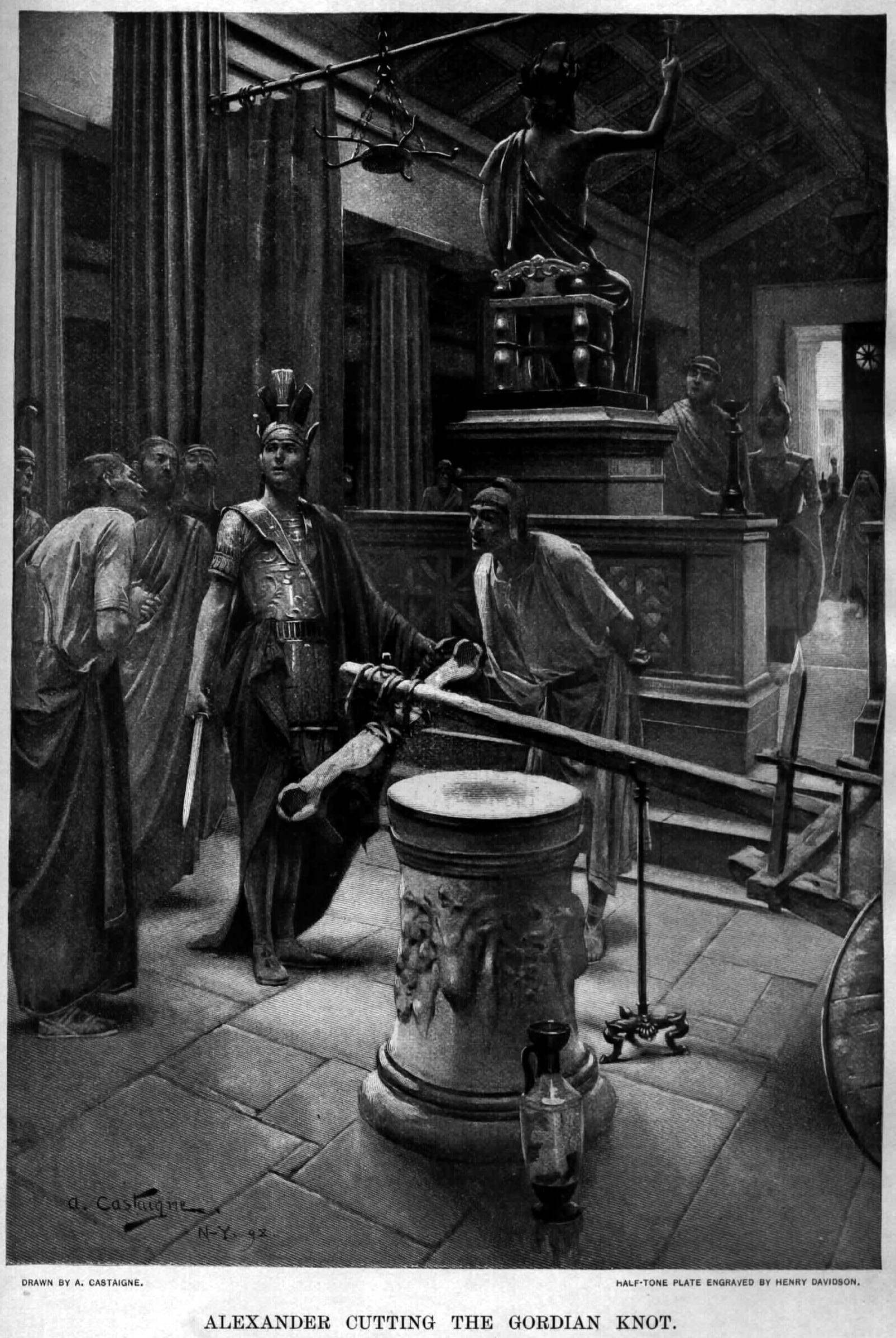
An ox-cart won for Gordias the crown of Phrygia, so they say, and Midas tied the cart’s yoke with a knot so intricate removing it would win a continent.
Great Alexander, so they say, could not untie the knot. Perhaps he pulled the pin. Perhaps he sliced it open with his sword. His death released the Asian lands he’d won.
Three centuries and some, along came Paul with no ambition toward war and rule, but faced with as intractable a knot as Midas ever tied to hold a cart.
The knot held some, he thought, in servitude, in hopeless effort to be righteous when “not one is righteous, no, not one… they all have turned aside from kindness, every one.”
The knot barred others from the knowledge of their failure to do good (though honestly they should have known through what Creation tells of God’s eternal justice, wrath, and power).
How to release this knot? How meld these two communities into a house of faith? How reconcile circumcised with those uncircumcised, with mutual distrust?
How else? He tied a knot of elegant and pirouetting thought, a logical connection that would bind the Church in one, close fastened, one and all, to Jesus Christ.
What loving, faithful pains he took to show we travel in one boat, we worship just one God, we are one Church, wherever we began our faith’s life’s journey, Jew or Greek.
I wonder, though, if tying up new knots is all that useful when the animal needs water, and the lead is all too short, when dinner waits beyond the leash’s length.
I wonder if the Messianic fingers had already loosed the knot dividing us, and if, with all this elegance of thought, poor Paul re-tied it hopelessly again.
Some months ago upon a mountain trail I came upon a fence and gate, which served to give endangered plants a chance to grow, not be consumed by wandering ungulants.
The gate was closed by string, and at first glance I thought it held by a close-fastened knot, and reached toward it, fingernails prepared to pull and loosen its constricted coils.
But then I looked again. The knot did not secure the gate. It closed a loop, which I quite easily unwrapped and wrapped again, continuing along the mountain trail.
Dear Paul: Is that what you have tried to do? Is this a loop we can unwrap to make our way along the Way? Is grace beyond accessible to us despite the knot?
A poem/prayer based on Romans 4:1-5, 13-17, the Revised Common Lectionary Second Reading for Year A, Second Sunday in Lent.
Saltiness, sweetness, and yes, I’m visiting another one of the taste buds. I’m afraid it’s bitterness. That’s not a favorite for many people.
Now, coffee drinkers do tend to like some bitterness to it, but the birds of the mountain forests don’t drink coffee. Instead, they drink nectar, and as I mentioned last week, nectar is basically sugar, so it’s sweet. ‘Apapane and ‘amakihi both like the nectar of ohi’a and koa and mamane and lots of other flowers and flowering trees of the forest, as well as some of the fruits.
Those trees don’t flower all at the same time, and they don’t flower all the time, so the birds have to move to and fro to find the ones in blossom. If you’ve got wings to fly with, that’s not so bad, but when those birds can’t find flowers, they look for other sources of food. Mostly, that’s bugs and spiders.
To which I say, yuck.
As it happened, so did an ‘amakihi.
Plenty of birds, ‘apapane and ‘amakihi and others, like the taste of bugs. They like the flavor. They like the crunch. Best of all, they like the way that after they eat some, they don’t feel hungry, which is a very good thing.
This ‘amakihi didn’t like feeling hungry, it’s true. Unfortunately, he really didn’t like the crunchiness of a bug meal. And he didn’t like the flavor at all.
“It’s bitter,” he complained.
“It’s not that bad,” said a friend.
“I rather like it,” said another friend.
“Yuck,” said our ‘amakihi. “It’s bitter and nectar is so much better. I don’t want to deal with a crunchy life.” So he flew off to look for flowers.
It was a bad day for nectar. Most of the trees were in seed, not flower. The trees that did have flowers also tended to have grumpy i’iwi in them who’d chase him away. He’d get a sip or two from a lonely flower on a lonely tree, then fly off again, sometimes with an i’iwi behind him.
It was a bad day for nectar, and it was a bad day for him.
Sitting on an ohi’a branch, he spotted a spider’s web. That had made for a bad day for some bugs, but now the ‘amakihi was hungry enough that he’d manage the bitterness. He poked his beak about until the spider came out, and a moment later he’d eaten it, bitter crunch and all.
“Yuck,” he said, but his heart wasn’t in it. That bit of food inside him made him feel so much better, so much better than he’d expected. He found another spiderweb and another spider, and he caught a couple of flying bugs as well.
“How are things going?” asked one of those friends he’d flown away from a couple hours before when he went to search for nectar. “Did you find what you were looking for?”
“Not really,” he said. “I didn’t find many flowers, and the ones I found were claimed by i’iwi who chased me away. I found something better, though.”
“What’s that?” asked his friends.
“I can deal with the bitter when I have to,” he told them. “I can hold on until a better day. I can appreciate being fed even when it’s not so sweet. I can even savor the crunchiness of life.”
by Eric Anderson
Watch the Recorded Story
I write these stories in full, but I tell them from memory and from interaction. The story as you read it does not match the way I told it.
Photo of an ‘amakihi (and a spider) by Eric Anderson.
Having selected my Lenten discipline of giving up judgmentalism (and writing about it), I was promptly challenged to keep that discipline. I hadn’t even finished the first essay about the project when I encountered this story on Religion News Service by a reporter I follow on the BlueSky social network, Jack Jenkins: “400 Christian leaders urge resistance to Trump administration on Ash Wednesday.”
One of the reasons I chose to examine judgment and judgmentalism this Lent is that I’ve been challenged for judgmentalism. I’ve been taken to task for criticizing some behaviors while excusing others. I’ve been told that some of the things I protest in some have been done by others – did I protest them?
The critique has sometimes been fair. I can’t say I was aware of all the examples that I didn’t protest (which makes it harder to protest them), but it’s also true that those wouldn’t have circulated in places where I pay attention. Limit your attention; limit your awareness. That’s something to consider as I continue this Lenten reflection on judgmentalism.
There on the very first day I had to discern and judge, because the statement invited religious leaders to sign on. Whether I signed or not, I would be making a judgment.
I hadn’t expected it to happen so fast. I hadn’t expected to face a significant decision before I’d laid up some intellectual foundations. Ah, well. As Robert Burns wrote to a mouse:
But Mousie, thou art no thy-lane, In proving foresight may be vain: The best laid schemes o’ Mice an’ Men Gang aft agley, An’ lea’e us nought but grief an’ pain, For promis’d joy!
When I first considered this question over pork chops and mashed potato, the first thing I thought of as a feature of discernment was time. Before choosing, give it time. Before deciding, give it time. Before acting, give it time. I expect to spend more time on this element (see what I did there?) through the next six weeks, but even as I thought it over I realized that we make a number of decisions in the moment and rightly so. When I finished my meal I drove home. I made decision after decision in those few minutes without reflecting on it for more than an instant. If I hadn’t, I’d have run the front of my car into a car in front of me.
Likewise, I have to admit that I have spent long periods of time considering my actions and ended up deeply regretting what I’d chosen. Time is no panacea.
Nevertheless, I decided I would consider the decision over a day.
(I decided I would decide. See what I did there?)
I read the statement “A Call to Christians in a Crisis of Faith and Democracy” several times. It’s not a subtle piece. “We are facing a cruel and oppressive government,” it claims. “This political crisis is driven by people who have fallen for the temptation of absolute power,” it asserts. “Governance is being hollowed out and replaced with corruption, loyalty tests, intimidation, and the normalization of lawlessness,” it states. Strong words. Strong judgments. The authors of the statement have looked at the acts of the administration and made conclusions about the character of those acts: cruel, oppressive, corrupt, and lawless. Further, they have asserted that the temptation of absolute power is a driving factor for those who direct those acts.
I face the question: Do I concur with those judgments? Do I agree with their characterization of these acts? Do I accept the diagnosis of the motives?
Further, I read the list of signatories. Although I’ve been in ministry a long time, I didn’t recognize all the names. I saw many that were familiar, including quite a few whose words and work I’ve greatly admired. I also saw a number of people from organizations I’ve never heard of. I saw that representatives of the “mainline” Protestant churches clearly predominated, with a lot of leaders from ecumenical settings. A number of the people who signed come from my own denomination, the United Church of Christ, including our General Minister and President. Some of the signers are colleagues I deeply respect. Some are dear friends.
I face the question: Are these people whose discernment I trust? While I still have to do my own work, can I trust the work they have done?
The statement is not simply a diagnosis of our condition. It is also a call to action. Those who signed made eight commitments. The authors expanded more on them than I have here:
Protect and stand with vulnerable people,
Love our neighbors,
Speak truth to power,
Seek peace,
Do justice,
Strengthen democracy,
Practice hope, and
Ground our discipleship in prayer and inward journey.
I face the question: Are these commitments I can make? Are they consistent with my understanding of Christianity? Are they things I have the power to do? Are they things I have the will to do?
I slept on it. I read the statement again (and again). I reviewed the names. I found more names I knew. I considered the commitments.
Here’s the thing: I knew I was inclined to add my name to the list when I read Jack Jenkins’ headline. That was my first judgment, my off-the-cuff discernment. But was it judgmental? Particularly given the strong language about the political and spiritual condition of the nation?
Also, was I (am I) merely reinforcing my own pre-established conclusions? On the Sunday after the election, I said, “The United States has re-elected as President a devourer of widows’ houses. Plain and simple. Already his followers have sent messages to African American children telling them to report for sale as slaves. Already his followers have sent messages to women: ‘Your body. My choice.’”
Of the three areas of discernment I’ve named here, I had no problems with the commitments. I’ve held those as virtues consistent with Christianity for many years (which raises the problem of reinforcing my conclusions again). There were more than enough people whose judgment I trust in the list to make their willingness to sign compelling. The sticking point was: Do I agree enough with the diagnosis section to sign on to it? Do I need to learn more that either confirms or refutes that characterization of the administration’s acts?
This morning I sat with it again, considered it again. And I came to the same conclusion with which I’d started: I believe I know enough. I agree with the characterization. I need to make the commitment.
I take both sides of the annual Lenten argument about whether it is better to give things up or take things on. The point of Lenten discipline, I believe, is to invite God’s love, guidance, and compassion into your soul. That doesn’t happen the same way for every person, and for that matter, it doesn’t happen the same way for any one person at different times in their life. I’ve ruefully observed that when I’ve tried to repeat successful Lenten disciplines in later years, I haven’t been able to keep them. Familiarity may not breed contempt, but for me, novelty holds my attention better.
I still wish I could repeat the year I gave up anxiety for Lent. I’d like to give up anxiety for good.
Each year I choose two things. One is something to give up for the Lenten season. That has included different foods and beverages, activities, and yes, one year I gave up anxiety. The second is something to take on for the Lenten season. I’ve taken photos, written poetry, composed songs, exercised. With the two disciplines to either side, I’ve looked within each and between them both for the presence of God. Sometimes I just find myself – which isn’t a bad achievement, mind you. Sometimes I get a glimpse of eternity.
Another element of the practice is what I say about them. The “take on” projects tend to be visible (or audible, the year I wrote songs). I often acknowledge them and reflect on them during the season. In contrast, I say as little as I can manage about the “give up” disciplines. I’m trying to avoid public piety for public piety’s sake. It’s so easy to “look good” by spotlighting Lenten practice. Some people can do that and do that well. I prefer to keep a windy distance between my private devotion and public reputation.
That brings me (finally; what a long introduction this has been) to this year’s discipline. I’ve thought about things I could give up this year. I’ve thought about things I could take on. As I lingered over some delicious mashed potatoes with mushroom sauce, I considered giving up potatoes. That would have been quite a challenge for me, and definitely a challenging discipline. I may take it on in some other year.
Another challenge has presented itself recently, and I found myself lingering over that even more than over the mashed potatoes. Judgmentalism. It’s not a new struggle, and it’s not a new temptation for me. The first time I ever heard what I identified as the voice of God, it challenged a judgment I’d made. God told me I was wrong.
Given my inclinations, I’m not sure I can give up judgmentalism without great effort, even for forty-six days. I’m quite confident that the effort is worth it (is that judgmental?). I also think I need to struggle with it “out loud,” as it were, because I rapidly realized that it’s a complicated project.
Human beings can’t live without making judgments – quite literally. We have to make choices between options of food, drink, thoughts, approaches to tasks, even relationships. If I gave up making decisions for Lent, people would rightly accuse me of irresponsibility.
So what do I need to do to make an appropriate judgment that isn’t judgmental?
That is my Lenten project. I will write a series of essays on discernment, judgment, and judgmentalism with the goal of reducing the last and strengthening the first. I have no outline for the project other than to somewhat aimlessly predict that there will be six essays, one written during each week in the season. It’s possible there may be more, as one way of considering these questions is to work through actual issues I’m considering rather than consider the issues in the abstract.
So that’s my Lenten discipline, spread out before you. I pray God’s blessings upon you in your own practices through this time and all time.
Oh, one other thing. I decided that each essay would be accompanied by a new original photo. As I learned during last year’s sabbatical, photography has been good for my soul, so I need it in this project.
“Then the devil left [Jesus], and suddenly angels came and waited on him.” – Matthew 4:11
He challenged you, Jesus. Summon the angels! They won’t let you fall. You won’t have a bruise on your heel, Nor a strike from a snake.
You said no. No to bread. No to flight. No to glory (that fails to transcend all the kingdoms of earth).
Then he left. And who came? Yes, the angels. The angels. They were hovering ’round, And they brought you relief.
Well, Jesus, I’m tempted. So tempted, you know, so hungry and weary, confused and distressed.
Where are the angels? Will they tend my bruises? Will they feed my hungers? Where are the angels, Jesus the Christ?
“There are angels hov’ring ’round.”
A poem/prayer based on Matthew 4:1-11, the Revised Common Lectionary Gospel Reading for Year A, First Sunday in Lent.
The image is Weite Gebirgslandschaft mit der Versuchung Christi (Vast Mountain Landscape with the Temptation of Christ) by Jan Brueghel the Elder – dorotheum.com heruntergeladen am 30. September 2012, Public Domain, https://commons.wikimedia.org/w/index.php?curid=21801997.
Last week it was saltiness. This week it’s sweetness. We’re making our way around the taste buds, I guess. I don’t actually have plans to visit sourness or bitterness, but who knows?
An i’iwi was having a hard time. They’re used to sipping nectar from ohi’a flowers and koa flowers and mamane flowers and lots of other flowers, and nectar is basically flower sugar. It’s pretty sweet. It does change, though, a little like the way that some oranges are sweeter than others. It’s got to do with the rainfall or lack of it, and the soil nourishment, and lots of other things that I don’t know about and the i’iwi doesn’t know about and the tree might know about but trees don’t talk about that sort of thing very much.
In any case, the i’iwi wasn’t finding much in the way of sweet nectar. Nectar, yes. Enough to keep her from getting hungry, yes. Sweetness that satisfied: not so much.
So she went looking for sweetness.
It’s not uncommon for the nectar-feeding birds of the mountains to fly about looking for nectar. She had a somewhat different agenda, though: sweeter nectar, and not just nectar. For whatever reasons, though, the nectars she sampled tasted much the same: a little dry, a little bland. She could eat it, but she really wanted something better. It was the difference between your grandmother’s chocolate chip cookie, and the cookie you ate the reminds you how much better grandmother’s chocolate chip cookies are.
She didn’t find it.
She was sitting grumpily on a branch complaining about this to her mother. I’iwi can be pretty good at being grumpy birds, and she was putting in the practice to get really good at it. Her mother, I must say, wasn’t a particularly grumpy bird and didn’t want to be.
“So you want to find sweetness?” she asked her daughter. “Where have you looked?”
Her daughter described her flights up the mountain, and down the mountain, and along the slopes of the mountain, and how the nectar just wasn’t what she wanted or hoped for.
“Those are the only places you checked?” said mother.
“Where else?” said the daughter. “I could fly farther but will that work out any better?”
“I don’t know,” said her mother, “especially because I think you can find sweetness much closer to home.”
“Where?” demanded her daughter. “Where is there sweetness here?”
“There’s the warmth of the sun on your feathers,” said her mother, “and the sound of the rain on the leaves. There’s the scent of mamane on the wind, the great blue of the clear sky, and the dramatic greys of the cloudy sky.”
“Those are ordinary things!” her daughter protested.
“Well, there’s also the way your father loves you, and your grandparents love you, and the way I love you,” mother said. “Is that ordinary?”
“It is,” said the daughter, “but it’s special, too.”
“Best of all,” said mother, “is the sweetness that’s inside you. It goes with you wherever you fly. You never have to worry that it will run out. Even when no one is around, even in the coldest, darkest night, even when none of the trees are in blossom, there is sweetness in your heart.”
“You helped put it there,” said her daughter.
“Sip that sweetness when you need to, daughter,” said her mother. “Sip it and be refreshed.”
by Eric Anderson
Watch the Recorded Story
I write these stories ahead of time, but I tell them from memory and improvisation. The story as you have read it is not identical to the way I told it.









 ordainedgeek