Whom Shall I Fear?

The Lord is my light and my salvation; whom shall I fear?
– Psalm 27:1a

Well, God, how about I make a list?

  • Zealots with guns.
  • Leaders of nations unrestrained by law, compassion, or mercy.
  • A changing climate.
  • Greedy self-interest unrestrained by regard for neighbor.
  • Greedy self-interest empowered by injustice.
  • Greedy self-interest.
  • “We can win this nuclear war.”
  • I’m OK with heights, but please don’t drop me into the depths.
  • Greedy self-interest.
  • An asteroid on a collision course with Earth.
  • A plugged snorkel tube.
  • Routinized injustice.
  • And… Greedy self-interest, including my own.

With so many and so much to fear –
including the greed of my own heart –
let me take courage in your light.
May I find strength in your salvation.

Do not cast me off,
do not forsake me,
O God of my salvation!

Psalm 27:9c

A poem/prayer based on Psalm 27:1, 4-9, the Revised Common Lectionary Psalm reading for Year A, Third Sunday after Epiphany.

“Earthrise” photo by NASA/Bill Anders – http://www.hq.nasa.gov/office/pao/History/alsj/a410/AS8-14-2383HR.jpg, Public Domain, https://commons.wikimedia.org/w/index.php?curid=306267.
You Want to Know Where I’m Staying?

Well, no. I don’t.
Well actually I do. Because it’s heaven, right?
But no. Not now. It doesn’t really matter because
what I really want to know is:

Who you are.

He said to them, “Come and see.” (John 1:39a)

A poem/prayer based on John 1:29-42, the Revised Common Lectionary Gospel reading for Year A, Second Sunday after Epiphany.

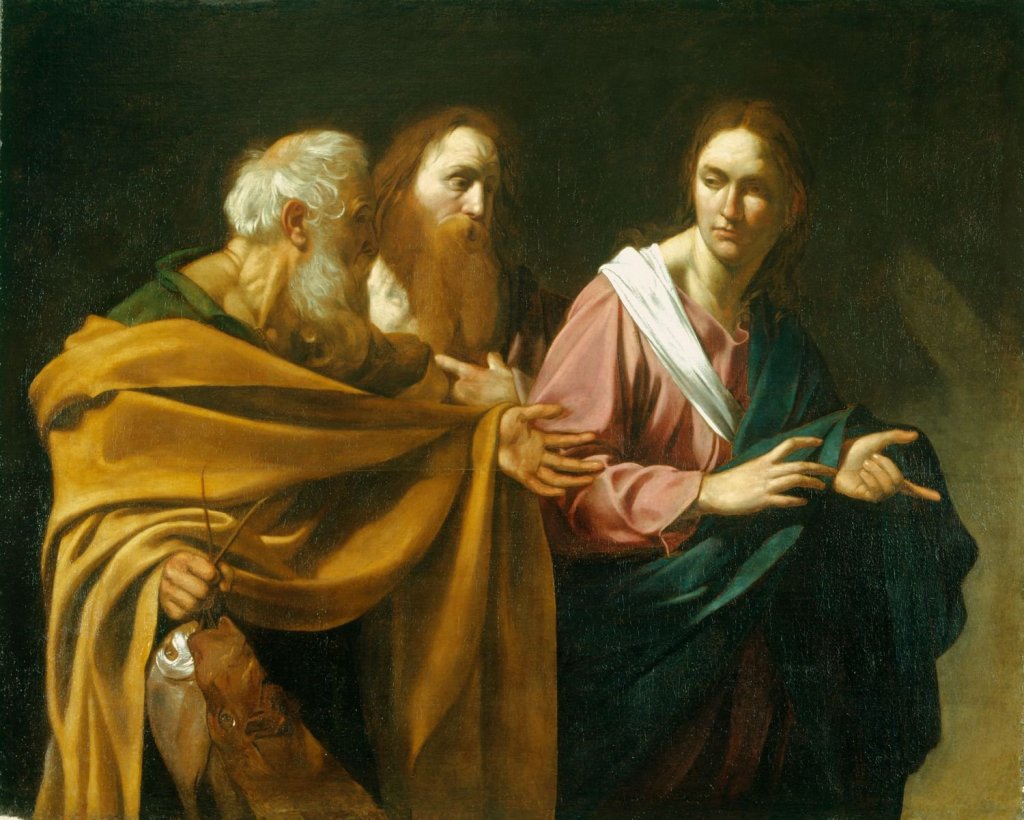
The image is The Calling of Saints Peter and Andrew by Caravaggio – Public Domain, https://commons.wikimedia.org/w/index.php?curid=1734712.

It Begins

In the manger of Bethlehem, the infant sleeps.
On the Judean hillsides, the shepherds seek their flock.
Which of the parents dozes? The father?
The mother? Neither one? Both?
Love made flesh, power made weak,
Majesty made lowly, will soon awake in tears,
Seeking the warmth of skin and blood and milk.

Let that infant grow within our hearts.
Let that love take form within our purpose.
Let that mercy take shape in what we make.
Let that peace enfold those we embrace.
Let that grace shine forth just like that star:
Let the work of Christmas begin in me.
Let the work of Christmas begin in us.

A poem inspired in part by Luke 2 and in part by “The Work of Christmas” Howard Thurman. This poem was written for the Christmas Eve meditation of December 24, 2019, at Church of the Holy Cross UCC, Hilo, Hawai’i.

The image is The Birth of Christ (between 1570 and 1603) by Joos van Winghe – https://skd-online-collection.skd.museum/Details/Index/888833, Public Domain, https://commons.wikimedia.org/w/index.php?curid=81597171.

Christmas Eve 2019

A woman and an infant in the foreground of a stable.

“He promised me the Son of God, the angel did,”
she murmured to the sweating, focused midwife.
“Promise anything they will,” she answered,
not noticing her charge had spoken with an angel.
“Now push!” she cried. “And push again!” For in
the cries of birth what angel could be heard?

At length the growls and the gasping cease,
though night remains unblessed by silence. No.
“The Savior has good lungs,” the watching Joseph notes
and winces at his piercing tones, distressed
by all this labor and this hunger and this cold,
now swiftly stifled at the weary Mary’s breast.

“The angel promised me a Savior,” now she sighs
as Son of God tries once and twice and squalls,
frustrated, not to grasp the nourishment he seeks.
She gasps, adjusts the infant’s head by order
of the midwife, sighs. At last. The slurping sounds
distract her as the midwife mops away.

“Angels, now,” the midwife sighs. “There’s all too few of them.”
She gazes at the wincing man, wonders if this “angel”
hides a demon, decides to take the mother’s word.
“Come, angel. Pile up the straw behind your wife.
He’ll nurse much better once her back is straighter.”
“I’m not an angel,” says the man, redundantly. She knows.

“He promised me the Son of God.” Now Mary’s eyes
arrest the midwife’s gaze. “Of course he did, my love,”
she coos, finishes the cleaning, readjusts her gown.
“They’re all the Child of God, you know, and this one
is for you.” “Oh, no,” the mother says, as flatly as
a waveless sea. “This One is for us all.”

A meager coin in hand, the midwife steps into the night.
Another one convinced their baby is the Promised One,
she thinks. What sorrow for his mother if he follows
that drear road! She draws aside to let a band of grimy men
pass by. One asks about a baby in a manger, “So the angel said.”
She watches as they turn into the stable. Now: she wonders.

A poem based on Luke 2:1-20, the Revised Common Lectionary Gospel reading for Year A, Christmas Eve.

The image is The Nativity by Eleanor Fortescue-Brickdale – Bonhams, lot 420, 19 March 2008, Chester, Public Domain, https://commons.wikimedia.org/w/index.php?curid=45143477.

So Hard to Believe

13th century manuscript illustration of picking cherries.

“When [Jesus’] mother Mary had been engaged to Joseph, but before they lived together, she was found to be with child from the Holy Spirit.” – Matthew 1:18b

It’s all very well for me, you know.
He gave the plot away, the evangelist did,
for all his readers to know what Joseph could not:
Mary told the truth.

I feel no gut-wrenched shock, no rising fire,
no heart-destroying grief and pain
to close my mind against the simple fact that
Mary told the truth.

“Hey, Joseph,” I whisper over the centuries,
“What need of angels visiting in dreams
if you could only hold your faith and trust that
Mary told the truth?”

What need, indeed? Except that I rely far more
upon my keen discernment of the world’s
condition. It took Matthew to assure me that
Mary told the truth.

Officiously I do declare that voices often
silenced – women, children, refugees –
should be attended, but: would I have trusted
Mary told the truth?

For love, perhaps. For faith, perhaps.
For trust, perhaps. For God, perhaps.
For obeisance of a cherry, then:
Mary told the truth.

A poem/prayer based on Matthew 1:18-25, the Revised Common Lectionary Gospel reading for Year A, Fourth Sunday of Advent.

Shall Be Glad

All I want for your birthday, Jesus,
is your mother’s dream.
To see the lowly raised up high,
the proud confused, dispersed.
To see the drunk with power deposed,
the hungry without hunger any more.

All I want for your birthday, Jesus,
is the prophet’s dream.
A desert blooming beneath the sun,
a rainbow soaring above the sand,
the rocks a-blossom, the weeds a-fruit,
the shaken knees no longer afraid.

All I want for your birthday, Jesus,
is to believe in ancient dreams.
To trust in the promise, trust in
the promises, trust in assurances
repeated, repeated to Mary,
through Mary, to me, through me.

A poem/prayer based on Luke 1:46b-55 and Isaiah 35:1-10, the Revised Common Lectionary alternate reading and first reading for Year A, Third Sunday of Advent.

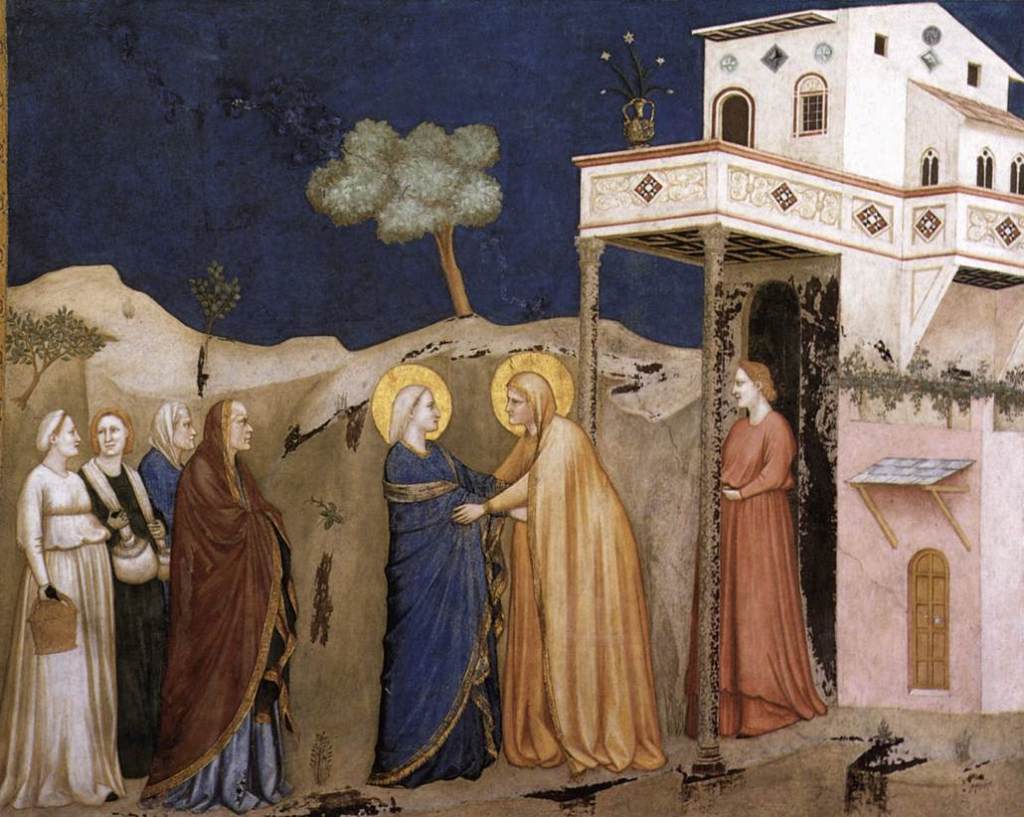
The image is The Visitation by Giotto di Bondone (1310s), found in the lower church of Saint Francis in Assisi, Italy – Web Gallery of Art: Image Info about artwork, Public Domain, https://commons.wikimedia.org/w/index.php?curid=12219735.

Harsh Prophet

Were I to descend to the riverside, John,
fiery prophet, baptizing fiercely,
were I to descend to seek holy forgiveness:
What would you call me? A viper? A snake?
What would you call me? A coward? A hoax?
What would you call me? Irrelevant? Dull?
What would you call me, religious authority…

And would I descend to the riverside, John,
fiery prophet, baptizing fiercely,
would I dare to seek holy forgiveness of you:
Not knowing if you would bring shame to my name.
Not knowing if you would despise my remorse.
Not knowing if you would discount my devotion.
Not knowing how deeply you see in my soul…

A poem/prayer based on Matthew 3:1-12, the Revised Common Lectionary Gospel reading for Year A, Second Sunday of Advent.

The image is a 19th century wood carving of John the Baptist preaching at the riverside in the Church of the Assumption and St Nicholas, Etchingham, England. Photo by Poliphilo – Own work, CC0, https://commons.wikimedia.org/w/index.php?curid=80795653.

No One Knows… But…

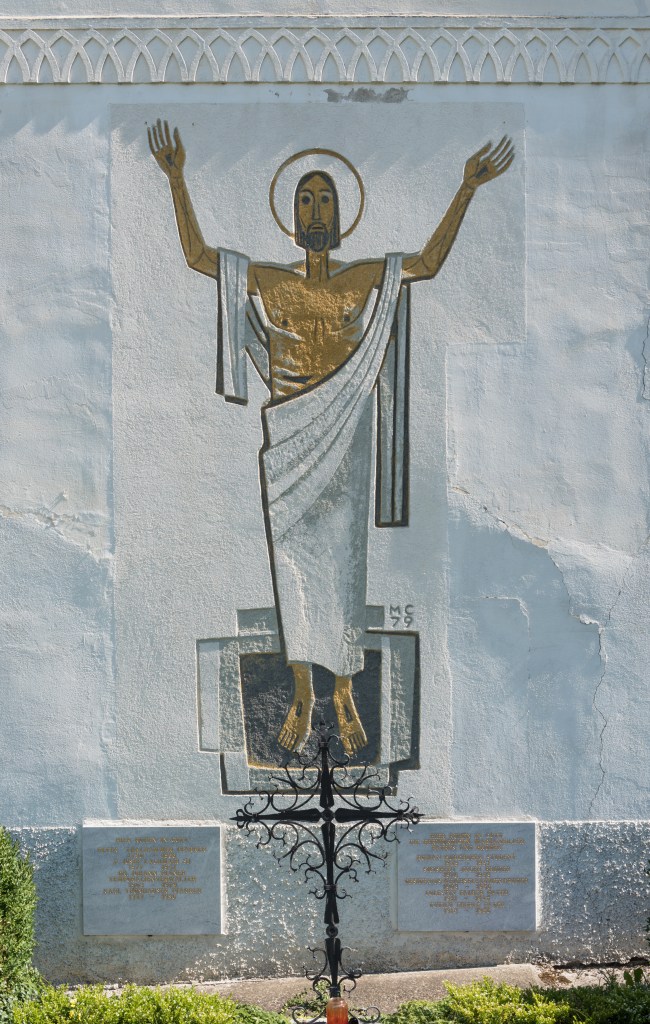
A painting of a full figure of Christ, arms raised with brown-gold skin, on a white wall.

OK, I get it.
Nobody knows
the day or the hour,
not even the angels of heaven.

(Not being
one of the angels of
heaven, I know I don’t
know when that hour will come.)

And Jesus,
I know that you
know not the hour or the
day, but God alone has time’s command.

But to be perfectly honest, now,
if you could say to God, “Today
would be Just Fine
to return…”

That would be fine with me.

A poem/prayer based on Matthew 24:36-44, the Revised Common Lectionary Gospel reading for Year A, First Sunday of Advent.

The image of Christ is painted on the outside wall of the Church of Saint James the Greater, Sankt Georgen am Langsee, Carinthia, Austria. Photo by Johann Jaritz / CC BY-SA 4.0, CC BY-SA 4.0, https://commons.wikimedia.org/w/index.php?curid=43256814.

Today I am with You

Today I am with you, dear Jesus, drenched
with tears to see the shepherd-wolves, the ones
who bay and scatter all the desperate flock,
rapaciously defending their carnivorous pack.

Today I am with you, dear Jesus,
looking for that so elusive Righteous Branch,
and longing that the fear may fade in those
who seek a refuge from the flood incarnadine.

Today I am with you, dear Jesus, though
I hang not on a cross of my deserving,
save as witness horrified at this:
humanity’s appalling inhumanity.

I turn to look at you, dear Jesus, and
I see your tortured arms, your blood-streaked face,
and say, “Remember me, O Jesus, on
that precious day you come into your holy realm.”

And then, O Jesus, pray: What do you say?

A poem/prayer based on Luke 23:33-43, the Revised Common Lectionary Gospel reading for Year C, Proper 29, Reign of Christ Sunday.

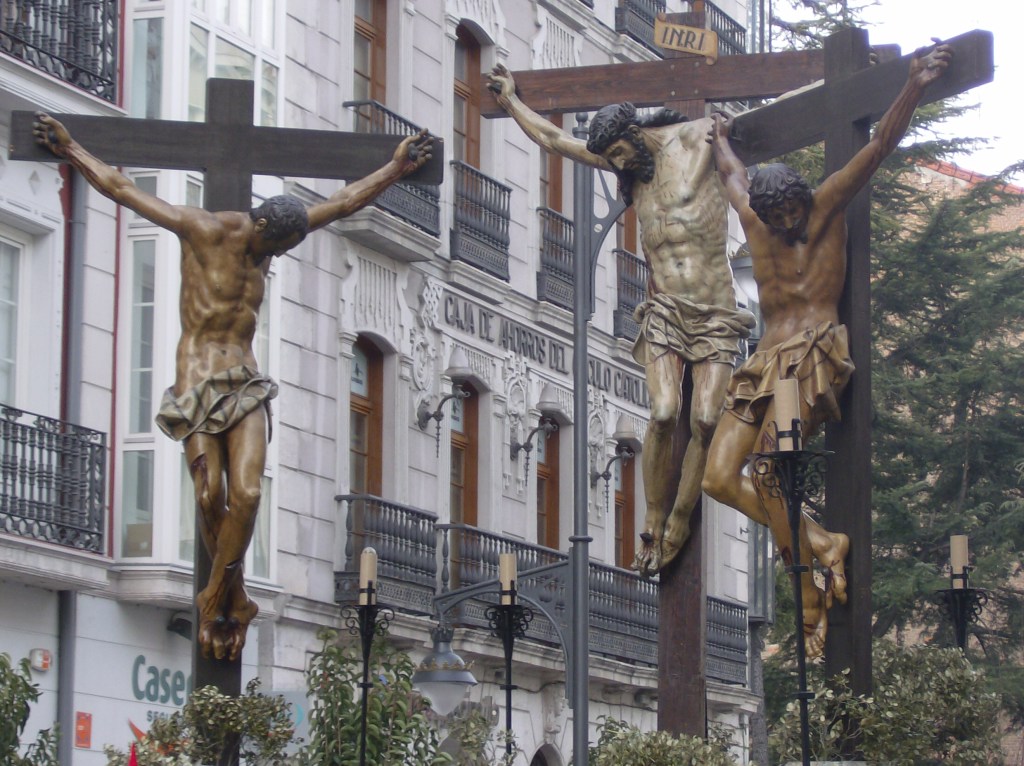
Photo of a Holy Week procession in Valladolid, Spain, by Porquenopuedo – Own work, CC BY-SA 3.0, https://commons.wikimedia.org/w/index.php?curid=2066881.

On this Old Earth

“They shall plant vineyards and eat their fruit.” – Isaiah 65:21b

O God,
I’m doing fine.
Some days are long,
some short.
At each day’s end,
I eat and drink.
I am refreshed.

Yet half my neighbors,
half the households of this land,
bring home from labor
13% of total income,
while half the checks
increase the wealth
of 10% of earners.

They sweat and plant,
assemble and sell,
cook and clean,
press the grapes for wine
for wealthier homes
where wealthier people
eat and drink and sleep.

Do they not labor in vain?
Are not their children
born for calamity?
Where are those offspring
blessed by the LORD?
For, rich and poor alike,
are we not damned for this?

A poem/prayer based on Isaiah 65:17-25, the Revised Common Lectionary First reading for Year C, Proper 28.

Photo by fir0002/flagstaffotos – Own work, GFDL 1.2, https://commons.wikimedia.org/w/index.php?curid=135212.

Income statistics for 2016 from “What Wealth Inequality in America Looks Like: Key Facts & Figures” from the Federal Reserve Bank of Saint Louis.