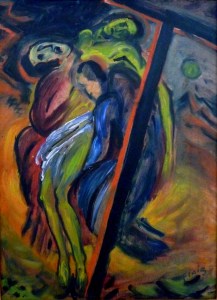
Haste

Meersburg_Neues_Schloss_April_2010_1020028aHaste, haste!
The storm clouds still obscure
The sky, but worse, the darkness
Of the Sabbath looms.

Haste, haste!
To pull the blood-slick nails
From flesh now unresisting,
Blood no longer flowing.

Haste, haste!
To lower the once-living form
And lay it in the waiting shroud:
No time for spices, they must wait.

Haste, haste!
To carry our beloved One observed
By soldiers and centurion who said,
“This man was truly God’s own son.”

Haste, haste!
The tomb at hand, the body placed
To wait two nights until
We may return with spice.

Haste, haste!
For now, all done which may
Be done, our eyes may stream
With our Good Friday tears.

The image is by Waldemar Flaig.

Really, Jesus?

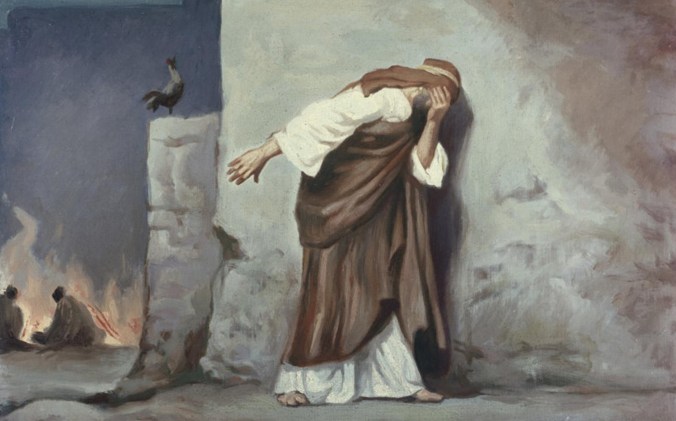
Robert_Leinweber_001

Really, Jesus?

Last Sunday, it was, “Go and find a donkey.
Then untie it, lead it here, so I may ride.”

Just anybody’s donkey, Jesus?
Don’t you know that they’ll object?

“Just say, ‘The Master needs it.’ That
Will do.” You think? You think it will?

How embarrassing for us, my friend:
It did.

So now, the festival at hand, it’s time
To take the lead for once, and ask:

“So Jesus? Do you have a plan,
And where should we prepare the meal?”

We ought to have known better. “Find
a man who bears a jug of water in

His arms, and follow him. The place
He enters is the place. The table

Will be in the upstairs room.
Prepare the feast; we’ll follow!”

Really, Jesus? Find a man and follow him
Because he bears a jug of water?

How embarrassing for us: it worked.
I guess we’ll have to trust you, Jesus, now.

Wherever you may go from here,
To all the dizzy heights of power, be

Assured we’ll go. We’re right with you.
I’ll not deny you once, nor let alone

This weird prediction of three times.
The rooster can withhold its cry

Until the crack of Doom, and still
I promise I will not deny.

Until, of course, I shout, “I do not know
The man!”

Then weep and weep and weep.

Really, Jesus.

The image is Peter’s denial by Anton Robert Leinweber. 

Christmas Eve 2017

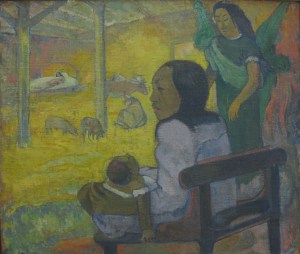
Bebe_(Nativity)_Gauguin_IMG_7276“If I had Gabriel here
I’d slam my fist upon his nose,”
she thought (though did not say).
“He promised me the King of Kings
and here I lie, exhausted,
in the courtyard of the noisy inn
with my newborn son
whimpering in his sleep
where the spear-tipped straw
of this poor manger cradle
has pierced the blankets once again.”
She thought, and thought again:
“Well, no, I wouldn’t hit him.
Angels aren’t for messing with.
He’d deserve it, though.”

The inn had settled down at last
from raucous greetings shouted by
familiar travelers to their regular
companions, settled down from
moaning of the mothers, ministrations
of the midwife, helpless loving
sounds from father inarticulate
with worry, settled down from newborn
baby’s wail soon smothered on
his mother’s breast, settled down from
traveler and sojourner and nosy neighbor
come to see exhausted mother,
anxious, wary father,
child outraged
to be deprived
the comforts of the womb.

The inn had settled down at last
when new uproar approached
and scattered Mary’s thoughts of angels
(impious though they be).
A band of men, their faces sleepy,
peeked through each courtyard gate
along the street, in search of… what?
the weary mother wondered.
She could not see expressions
shadow-shrouded, but could see the waves
with which they summoned all
their comrades through the crowded
courtyard and approached
the manger bed.

“Forget angels,” Mary thought,
“What good is Joseph if he cannot
keep these wandering herdsmen
from us and this child?”

Now words emerged from mouths
less agile than an angel’s,
words of (really?) angels
praising God upon a hillside,
dispatching them with messages
of God’s over-arching favor
into Bethlehem to see a child
(o come, they’ve seen a child before)
laid sleeping in a manger.

Once started speaking, they could not
be stopped, repeating in their
rasping voices promises of glory,
wonder, all the Earth’s salvation,
to all its peoples, peace.

Much later, when they had run long short
of words, had taken their eager
wishes of good fortune, their ragged habits
(if not the lingering smell of sheep)
out of the courtyard, back unto the hills,
Mary’s weary mind returned to thought.

They had not been the royal messengers
of old, like courtiers of David, no.
But they had brought the message
loud, and strong, and clear.
Emmanuel. God is with us.
Sleeping now, still fitfully,
still irritated by the straw.
Emmanuel. Yes, God is with us.
Even here in noisy Bethlehem.
Even now in this no-comfort place.

Emmanuel. Yes, God is with us.

Even here.

Even now.

The image is Paul Gauguin’s painting “Bebe” or “Nativity of Tahitian Christ.”

Fireworks

In my youth (as I recall through mists of swirling memory),

A fireworks show strolled at the pace of, oh, a baseball game. 

The pitch! A single rocket soars into the night

Its firey trail to mark ascension to the heights,

A swing! A hit! A long fly ball, or rather,

Globes of glowing color flash across the night. 

Then, pause: await the next deliberate pitch,

The next delightful glory in the sky. 

And now, as I survey the skies of Baltimore,

Where rockets climb in pageantry

Around the Inner Harbor, I see that we have changed

Our sport. Baseball has lost place to football

(Soccer to Americans) in the rapid pace 

Of these ascending spectacles.

Indeed, this fireworks show has paused not once,

As if the referee had never called offsides, 

That neither team had scored a goal,

That every track the ball had traced

Above the emerald turf had swerved,

Approaching not the boundary of play,

And summoning the players to chase it

Once again. 

I sigh. Is it just simple, pure nostalgia that

I find that I prefer my (granted, poor)

Old memories of fireworks shows “of yore?”

Or is it that I’ve come to value pauses,

And anticipation, and the poignant joy

Of wondering just where upon the rainbow

This next starburst will have found its flame?

Well, both, I’m sure, and more. 

For I have come to live much of my life

Uncertain of the rainbow’s hue ahead,

Of rocket’s shape, and whether it will sigh, or pop,

Or boom. 

Yes, I’ll watch this grand, frenetic fireworks show,

Appreciate it,

Glad that in the climb and soar of life,

I have the grace to pause from time to time

And breathe. 

After the Funeral

IMG_0008The sun was setting well behind my back
(And well behind the mountain)
As I stood for just a moment
And looked up upon the sky
As mourners made their way
From sanctuary’s words of comfort
To the kitchen’s comfort foods.

And there, upon the gray-clad cloud,
A crystal band a-glow.

Too small, this sight, to capture with
The sensors of the pocket camera.
I doubt too many noticed it at all.
It lacked the hues of saffron or of crimson:
Just a top-lit arc of argent, glowing
With reflected sunlight, in a corner
Of the sky.

I thought: It is no wonder
We imagine heaven in the clouds.

Wherever it might be you gather souls, O God,
Wherever you have welcomed this dear man,
And others dear, women and men and everyone,
May it be as glorious, or even more,
As this fair gleaming, beaming from the cloud.
And thank you for this brief reflection
Of a glory promising your grace.

Thank you, God, for light on clouds.
Thank you, God, for light in hearts. Amen.

In memory of Kenneth Susumu Tanouye, after whose funeral I saw this light upon the clouds, and with love for all those who have gone from our care to God’s.

The photo does not particularly resemble the light reflected in this poem. It’s more dramatic — which is a virtue of its own, and so it won its place here.

Easter Sunday, 4:00 AM

Moon - 1Dear rooster, if you mean to greet the dawn
You are two hours early. Rest your head
And wait for light. I grant you that the lamps
Above the streets, the passing beams of cars,
The rumble from the airport, these could cause
Confusion. Still, if on the other hand
Your purpose is to summon sleepy me
From out my bed to be a herald of
The Easter dawn that lies ahead I grant
You that your timing cannot be improved.

Or do you crow, remembering that Christ
Did not await a dawn to rise, but made
His hidden resurrection while the shades
Of night obscured his newly living steps
Into the yet-unknowing world? Quite right,
Dear rooster, you are right, to crow at this
Un-lightened hour, praising God who loves
At dawn, at noon, at close of day, and night.

A Happy Easter to you, rooster. Crow!

Jesus, I Hope Your Holy Saturday was More Restful Than Mine

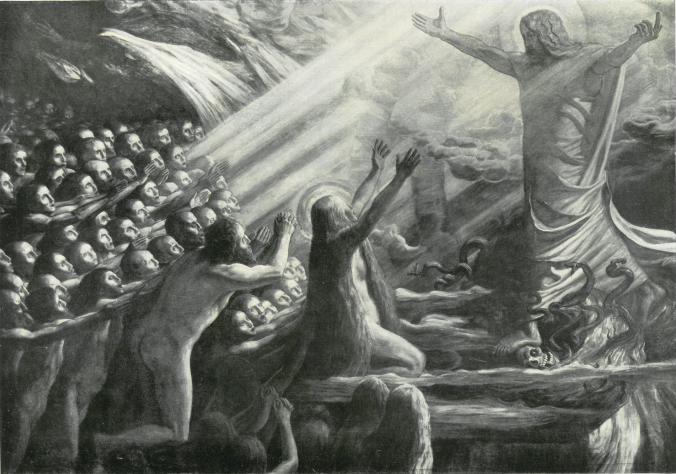
Skovgaard-ChristusImReicheDerTotenBut it probably wasn’t, was it?
Peter says you went and spoke to the “spirits in prison,”
And dear old Dante Alighieri
(Along with plenty others)
Deduced that that meant Hell.

My goodness, how we name your Holy Days.
“Good Friday” when you struggled, suffered, died;
And “Holy Saturday” for time you spent
In an unholy place, as far as you could travel
From the streaming light of God.

“No rest for the wicked,” runs the phrase,
And no rest for the good, it seems,
To take your harrowed soul, and harrow Hell,
Summon hopeless spirits from their separation
And restore them to the light of God.

Perhaps our naming instinct chooses
Better than I thought – it was a Holy Saturday
For spirits held in prison. O blest deliverance,
And blest Deliverer, to break their separation
And restore them to the light of God.

Come, Jesus, on another Holy Saturday
For there are spirits bound alive
By slavery, by wealth, by greed, by bondage to a drug or pride.
O blest Deliverer, come break their separation
And restore them to the light of God.

Before the Finish Line

IMG_2072Oh, what a night.
I shouldn’t be surprised
That they were so surprised
(My friends at last night’s supper).
A holy day is not a time, of course,
For breaking bodies with your bread,
For drinking blood instead of wine
(Hey, did you catch what I did there?
It’s like that plague of Egypt, where
God turned the water into blood?
Hey, anybody? No?).

So maybe telling everyone
That they would flee before the night was out
Was something of a downer.
Peter: Always first, you are
To give me the wrong answer
(Except that one most special time, you know,
Although I think that what you mean by “Christ”
And what I mean might be two different things).
Stay by me? “No, my friend, you won’t.
You will not even own that we are friends
Before the cock crows thrice.”

Oh, what a night. I guess I wore them out,
Or certainly they would have stayed awake
While I was praying, weeping, shaking
In anticipation of the end of night.
Night’s end! It should have been a rosy dawn
Whose colors summon promise, life, and joy!
But no, the day has brought me
No relief from woe.

Day has brought me no relief from woe.
Now they lay on questions.
Now they lay on whips.
Now they make a crown with thorns
(Now whose idea was that?)
And jam it hard into my brow.

It hurts.

It hurts, but less than when I saw my best friends run.
It hurts, but less than when I heard the rooster crow.
It hurts, but less than when I saw the face of Judas
Leaning toward me with a kiss.

It hurts.

Well, do your worst, you Romans.
You will; you always do!
Good luck to you, though, Romans,
Because you’ve broken my poor body
So my shoulders will not bear a cross
Up these stony streets. Take that!

I know you’ll find a way to get me there
And get the cross. You’ll fasten me upon the wood
And lift me up and watch and wait
Until my straining lungs exhale
A final time, my “It is finished.”
You’ll get me to my “finish line.”
(Ha! Foolish Romans! Beat me as you will,
You will not steal from me
A gallows humor even as I look
Upon the cross I cannot carry
Up to Calvary’s hill)

And, foolish Romans, do you think
My “It is finished” line is my finish line?
Not for a moment (Well, all right,
For more than just a moment:
For three days. But let that pass.).
I may not lift my cross, but I will lift my life
From out the grave you’d leave me.
No, Romans; and no, Judas;
No, kings and priests and others
Who would claim to speak for God:

You may drag me to a finish line
And claim I’m finished.
But I am never done, or gone,
And I will turn my finish line
Into a new beginning.

Holy Week: Palm Sunday Stones

IMG_2064Let the stones cry out, O Lord, for we are stunned to silence.
Let the cobbles of uneven paving end their reticence,
Break their stillness (does the shout of rock sound like a cracking?),
Raise their voices. Let the stones cry: “Save us! Lord, Hosannah!
Blessed are You who come to bring salvation of our God!”
Crackling praise. If loud enough, perhaps it might drown out
The heaving of our weeping.

We weep for children poisoned by the falling bombs in Syria.
We weep for warriors slain when missiles came to them with death.
We pray for people walking, standing, falling as the truck rolled on.
We pray for people worshiping, and waving palms, recalling You
And how devotion shattered in concussed reverberation.
Let the stones cry out, because your people’s voices
Have been called to weeping.

“Hosannah!” “Save us!” Cry it, stones, as Jesus makes his storied climb
Beneath the venerated gates, with steady step of his swift-borrowed steed,
The one he chose to honor Zechariah, “Humble, riding on a donkey,”
Yet still a declaration of his majesty. Cry it, stones, though your voice be muffled
By the palm leaves strewn upon your surfaces, by the cloth
That’s laid across your seams. Cry it, stones: “Hosannah! Save us!”
Because our voices have been lost to weeping.

Upon your humble mount, O Jesus, what comes to your ears?
The ears of One divine and human? Do you hear our sobs
Across the centuries, though muddled in the mix of cries,
“Hosannah! Save us! Bless us with salvation from our God!”
Their cry, the cry of stones, the cry of desperate humanity,
Is ours. Save us, Lord, from all the evil we would do:
Because our voices have been lost to weeping.

For Khan Sheikhoun

Aircraft circled in the sky, then turned.
The cylinders beneath their wings detached
And with the grace imparted by geometry
They traced their arc into the town.

What was the sound as they erupted?
Did explosions echo from the walls
Already fractured, crazed with crevices
From bombs and bullets previously struck?

Or was it silent, as the creeping poison
Exited the canisters and, carried on the very breath
Of air, passed softly through the lips
Of people, passed into their blood.

And then, and then, and then the cries
Of anguish, and of agony,
Of pain that wracks the body and
Of pain that wracks the soul.

And the world paused,

Afraid, perhaps, to breathe.

Then:

Unguided aircraft in the sky made descent
And in a mad cacophony of death
Erupted on the runways, in the hangars,
Tearing concrete, metal, wood, and flesh.

For the children of Khan Sheikhoun,
For the parents who will share their graves,
For the well-loved and the disregarded
Whose days ended in the poisoned air:

Justice.

So says the superpower.

But:

Tell me, children (and adults) of Khan Sheikhoun,
Has your life (too brief) been honored
With the blood that stained the taxi-ways
Of this airfield of your killers? Has it?

Tell me, children, do you know
If these explosions, this destruction
Will prevent another scene of horror?
For we have supped full of horrors…

Tell me, children, as I strain to hear:
What is your wish, as you breathe free
The scented air of God’s new life,
What is your wish? Your longing prayer?

More blood?

No?

Oh.

Weep, world, to know the will
Of these departed children:
“To live in peace and joy: No more.
To live in peace and joy: No less.”

Forgive us, children. We have failed.
We did not bring your long-for peace to you.
We have not brought your longed-for peace
To anyone. We have brought death and war.

Pause, world:

Fear to breathe

Until the planet’s children
Live in peace and joy.

No more.
No less.

On Tuesday, April 4th, a chemical attack on the village of Khan Sheikhoun in Syria killed over eighty people. Western leaders identified the Syrian government as responsible, and on Thursday, April 6th, United States forces attacked the Shayrat military airfield with cruise missiles, describing it as the source of the chemical bombing. 

The very next day, Syrian warplanes took off from the same base and carried out conventional air strikes. The war continued.

Syria 2001 what became of them by Willy Verhulst

2001 photo by Willy Verhulst, who asks, “What became of them?”