The Year of the Lord’s Favor

“[Jesus read from the scroll of Isaiah:] ‘The Spirit of the Lord is upon me, because he has anointed me to bring good news to the poor. He has sent me to proclaim release to the captives and recovery of sight to the blind, to set free those who are oppressed, to proclaim the year of the Lord’s favor.'”

“Today this scripture has been fulfilled
in your hearing.” Your own words, Jesus,
amazing them with graceful speech.
Until they turned upon you.

Remind us once again of what is grace.
I’m told that grace is strength, is force.
I’m told that power is right, and might is good.
I’m told that what we want we take.

Where is the news that sounds good to the poor?
Where is the vision for the ones who will not see?
Where is the freedom for the ones who are oppressed?
Where are the prisoners released into the light?

You did not speak the words of grace alone.
You needled them, you did, O Christ, until they burst
in rage, and nearly did the work of Pilate three years
earlier, by casting you to break upon a rock.

O, can we learn the lesson that you tried to teach?
We claim your name but do not tread your ways.
We leave the poor uncomforted, we close our eyes
to the oppressed, and those we free are those who’ve flattered us.

May there be good news for the poor.
May there be vision which will pierce the shade.
May there be freedom for those who have been bound.
Bring quickly, Jesus, the favored year of the LORD.

A poem/prayer based on Luke 4:14-21, the Revised Common Lectionary Gospel Reading for Year C, Third Sunday of the Epiphany.

The image is “The Rejection of Jesus in Nazareth” (“Prophets are not without honour, except in their hometown”); 18th-century tile panel by António de Oliveira Bernardes in the Igreja da Misericórdia, in Évora, Portugal, Public Domain, https://commons.wikimedia.org/w/index.php?curid=97133284.

Concerned

“And Jesus said to her, ‘Woman, what concern is that to me and to you? My hour has not yet come.'” – John 2:4

Now if I take a bird’s eye view of the world,
or if I try to see the Universe as from
the eye of its Creator, I have to ask,
What concern are we to You?

“What are humans that you are mindful of them,
mortals that you care for them?”

Other folk of other faiths discerned
their deities to be… not unconcerned,
but distant, focused on their own affairs,
but pleased by scent of sacrifice.

So when the hosts ran out of wine
what person would not ask, “Are we
concerned? We brought our contributions
to the feast. What more can we do now?”

How many deities would ask,
“What prayer is this? Do I make up
your deficits, the failures in your plans?
Take care of it yourselves, as you can do.”

As deity, as human being,
what else could Jesus say but this:
“This is not our concern. The things
I have to do come later and much larger.”

A mother’s love is such a funny thing.
One moment she protects her child
from senseless obligation, then the next
she thrusts them forward: “Go on, give.”

He said that they were not concerned,
but his mother thrust him forth,
and then he was concerned. They filled
the jars. They served the wondrous wine.

Was he concerned? He was, for host’s
embarrassment, but more for human souls
who languish in uncertainty and fright,
to lead them to a life beyond imagining.

“What are humans that you are mindful of them?” Still
we cannot fully clarify the poet’s ancient cry,
except to say, that Jesus is concerned, God is concerned,
the Holy Spirit is concerned:

For us.

A poem/prayer based on John 2:1-11, the Revised Common Lectionary Gospel Reading for Year C, Second Sunday of the Epiphany.

The illustration is from JESUS MAFA. The Wedding at Cana, from Art in the Christian Tradition, a project of the Vanderbilt Divinity Library, Nashville, TN. https://diglib.library.vanderbilt.edu/act-imagelink.pl?RC=48305 [retrieved January 17, 2025]. Original source: http://www.librairie-emmanuel.fr (contact page: https://www.librairie-emmanuel.fr/contact).

Spirit and Fire

Now when all the people were baptized and when Jesus also had been baptized and was praying, the heaven was opened, and the Holy Spirit descended upon him in bodily form like a dove. – Luke 3:21-22a

The water gently swirled about their legs
as John and Jesus stepped into the stream,
the echoes of John’s fierceness still
perceivable in those who stood upon the bank,
and those who dripped the water of forgiveness.

The water may be gentle, but the fire promised
by the Baptist came descending. Like a dove,
indeed, but doves are sharp of claw
and though they promise coming home
they promise nothing gentle on the way.

The river’s soft embrace receded, puddling on
the riverbank. The Holy Spirit’s fire ignited
in the eyes beneath the water-speckled lashes.
The one who had, with hardly any word,
descended peacefully, has risen purposefully.

Was there a word for John? Who knows.
Perhaps a hand to brush the drying skin
which shortly would be washed again
with washing someone else. The fire drove
him from the water to the wilderness.

O Gentle Spirit, how do humans dare
to call You gentle, source of prophets’ words,
apostles’ energy, and martyrs’ blood?
Indeed the Baptist said it true, that though he washed
with water, You baptize your followers with fire.

A poem/prayer based on Luke 3:15-17, 21-22, the Revised Common Lectionary Gospel Reading for Year C, Baptism of the Lord.

The image is a mosaic of the Baptism of Jesus in the Arian Baptistery, Ravenna, Italy (late 5th early 6th century). Photo by Flying Russian – Own work, CC BY-SA 3.0, https://commons.wikimedia.org/w/index.php?curid=21723466.

Light in a Stable

“The true light, which enlightens everyone, was coming into the world.” – John 1:9

The true light may now be at hand,
but the light is lit by flickering flame
and smoky wick. I watch that light
with anxious eye, for fear it spread
its burning oil on the straw below.

The light unsteady served to hide
the dark green sticky contents of
that first cloth barrier, wrapped
inexpertly by unaccustomed fingers round
the infant’s flailing hips,

But did not muffle his fierce cries
of outrage testifying that the light
has lungs! Re-swaddled, he subsides,
and sleeps re-laid into the feeding trough,
while grateful stable denizens rest, too.

The midwife gone, the man and I
trade naps, and watch, and wait
for his next cry. Will he be hungry?
Dirty? Lonely? Or just angry that
the borrowed cloth moves roughly on his skin?

“The light shines in the darkness,” they will write,
and I suppose it does. It murmurs sleepily,
then coos a moment, then subsides.
The crude light wavers at the breeze,
and shadows waver on incarnate light asleep.

I am too weary to compose a poem;
I ache in every muscle, every bone.
I cannot help but think that this poor babe,
in manger laid, could shine so bright
this stable would be taken for a star.

For now, the light is dimmed,
and in its dimness I, at least, can see
that lovelight shines most clearly here,
in common human form, and in
the dark.

A poem/prayer based on John 1:1-18, the Revised Common Lectionary Gospel Reading for Year C, Second Sunday after Christmas Day.

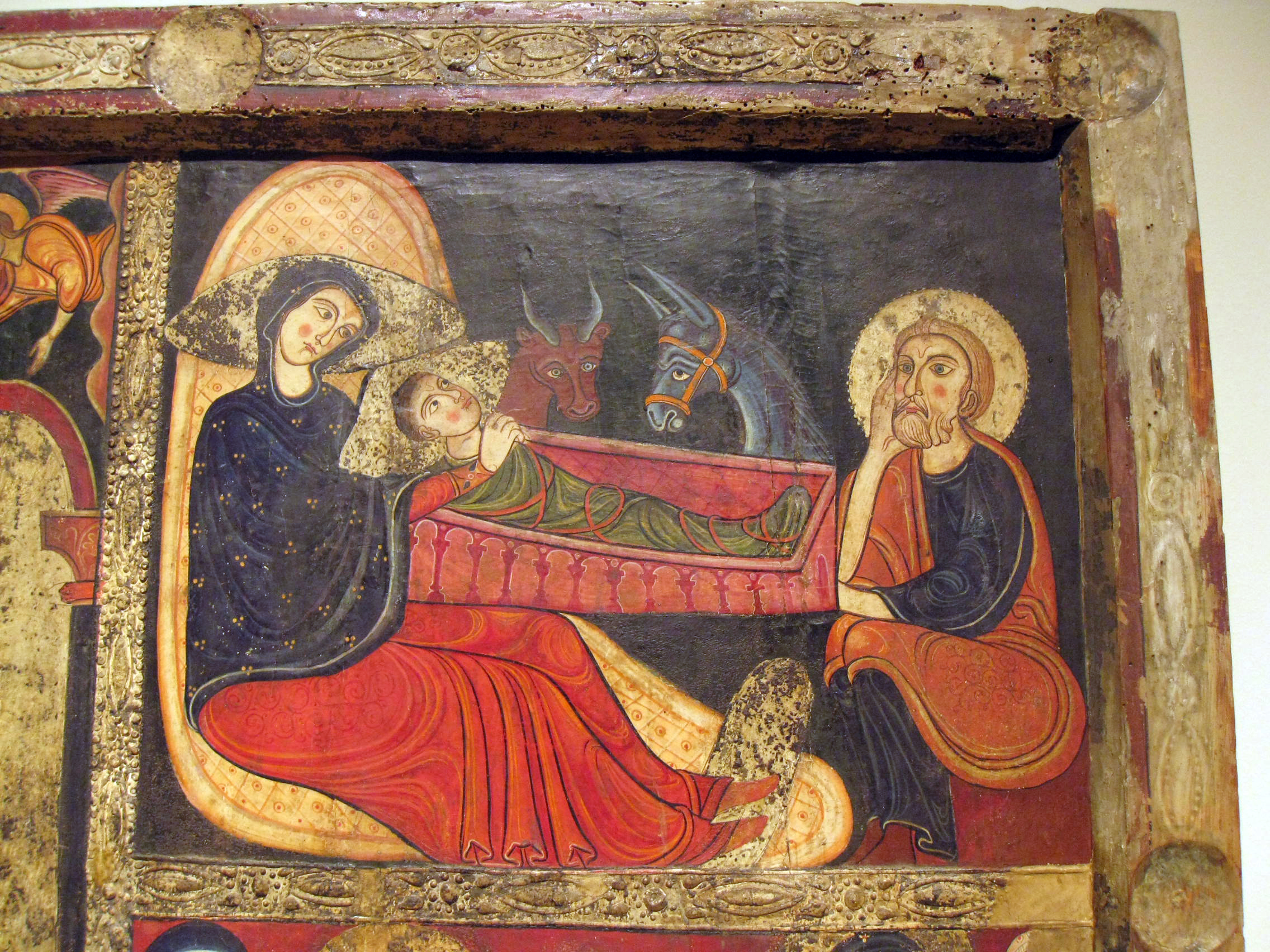
The image is The Nativity, a section of the 13th century altar frontal of St. Mary of Avia Church in Bergueda, Catalonia, Spain, by an unknown artist. The frontal itself is in the National Art Museum of Catalonia in Barcelona. Photo by Enfo – Own work, CC BY-SA 3.0, https://commons.wikimedia.org/w/index.php?curid=21384531.

Christmas Eve 2024

They summoned me, and so I rushed into the night,
my bag a-swinging from my hand. The city full
of census-driven travelers was mostly quiet, save
a corner of the stable of an inn, which groaned.

I knew these groans.

I swept the useless man aside, sent him for cloths
as if I hadn’t brought some with me, but what need
for men when birth is near? A glance alone told me
this girl had never birthed. “Be easy, child,” I sighed.

I knew this fear.

The man brought cloths, they fluttered down upon
the straw. “Stand there,” I ordered him, “and keep them out.”
The sounds had drawn the usual assortment of
the curious and well-meant helpers without skill.

I knew this crowd.

The hours wore away as the body of the woman did
its work, made straight a highway for the child
from womb to world, one built with heavy labor.
The gasps turned to deep growls as we neared the end.

I knew these growls.

The woman shrieked; the man choked on a sob.
The mothers in the crowd of curious made sounds
of sympathy, then held their breath to hear
the new-made mother’s gasping breaths and child’s cry.

I know those sounds, and I rejoice.

I lingered as the onlookers dispersed, to see
the squalling son find comfort in his mother’s arms.
Before I laid him there, his eyes looked into mine,
and shocked, I gasped, for they had pierced my soul.

I had not known that look.

I made my way on home, my lightened bag
a-swinging from my hand, and my heart
was lighter, too. “And is it you, Emmanuel?”
I asked. “Has God come down to Earth to us?”

I had not known such things before, but now:
I know.

A poem/prayer for Christmas Eve 2024.

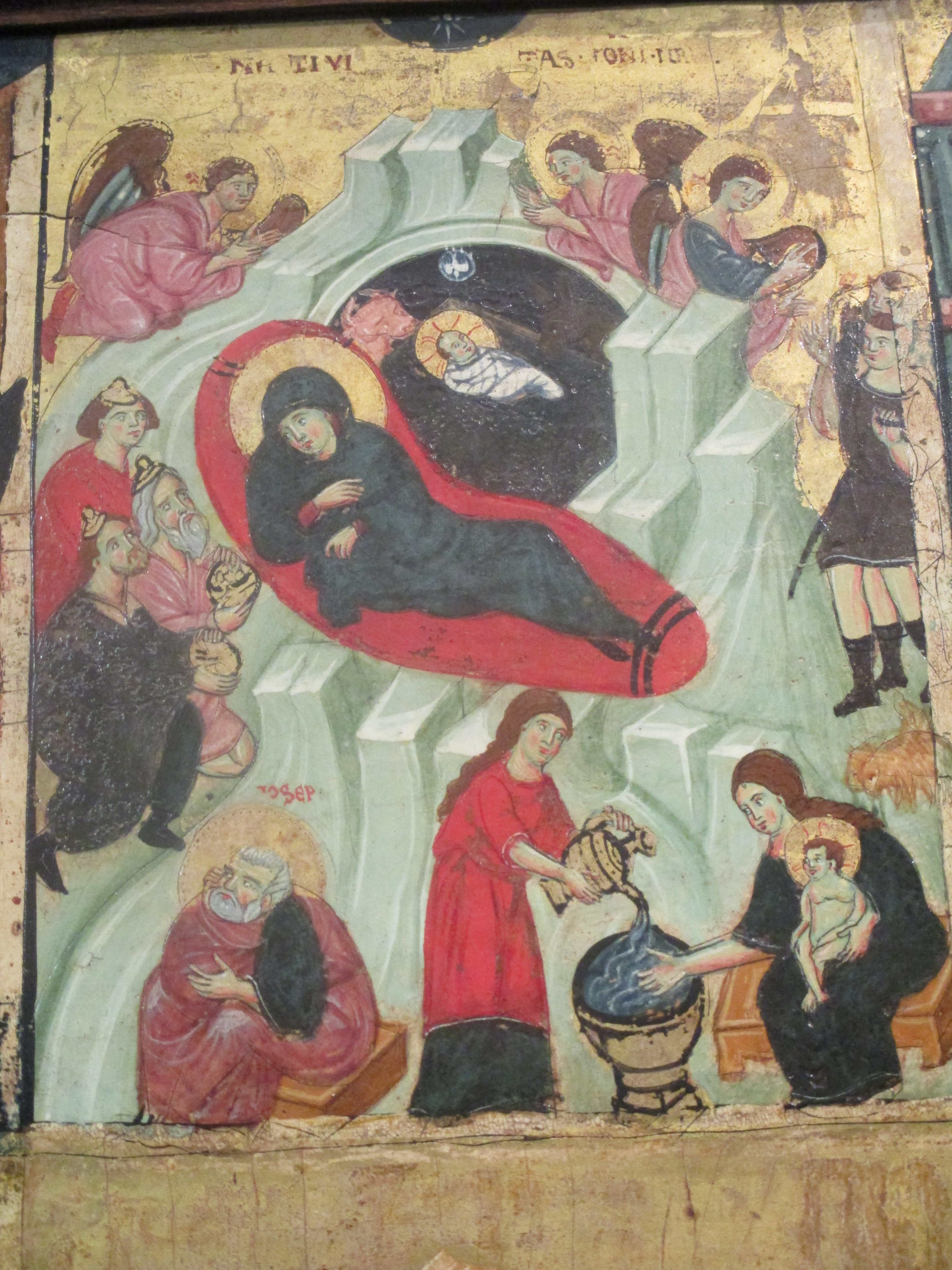
The image is The Nativity of Jesus, by an anonymous Roman artist (13th century). Photo by Thomon – Own work, CC BY-SA 4.0, https://commons.wikimedia.org/w/index.php?curid=82589118.

You Warned Us, John

John said to the crowds coming out to be baptized by him, “You brood of vipers! Who warned you to flee from the coming wrath?” – Luke 3:7

Who warned us, John? You did.
We heard your words through others,
much as those you called “a brood of vipers” heard
your words through rapid rumor’s run.

We heard your warning through
the memories and tongues and pens
of those you had impressed with word,
with deed, with baptism, with righteousness.

We heard because they passed along
your warning that to wash with water would
not cleanse the soul, but full repentance, all
enacted, would receive the nod of God.

They came to hear themselves.
They came to learn how they might change.
They came to leave upon a road that might look like
the one on which they had arrived, but was a road made new.

They came. They heard. They washed.
They went away and told the tale.
More came. More heard. More washed. More told.
Soon one would come to wash though you would tell him, “No.”

You warned us, John, across the years.
But tell me, we who follow him whom you baptized,
have we been heedful of your warning? Do
we bear the fruits of righteousness?

I fear, old harsh-voiced friend,
that you would find us heedless of your words
despite our claim to follow Christ. I fear you’d rail
once more at broods of serpents writhing in the dust.

I fear it would not only be
the ones I judge as frauds,
or casual extortionists,
or simply selfish souls withholding all their wealth,

But also me, secure in my
self-righteousness, and satisfied
with my reputed rectitude.
What sins do I ignore, refuse to cleanse?

Shout on, old Baptist friend.
Across the years, through others’ words
I hear your call. Shout on, and by the grace of God
may I repent, and wash, and bear good fruit.

A poem/prayer based on Luke 3:7-18, the Revised Common Lectionary Gospel Reading for Year C, Third Sunday of Advent.

The image is John Preaching in the Desert, a mosaic in the series of the Life of John the Baptist in the Florence Baptistery, Florence, Italy (ca. 1225-1330). Photo by Sailko – Own work, CC BY 3.0, https://commons.wikimedia.org/w/index.php?curid=41892069.

Stripped Down

A painting showing a man with a long white beard in a prison cell holding a book and quill and looking at a sheathed sword.

“And this is my prayer, that your love may overflow more and more with knowledge and full insight to help you to determine what really matters, so that in the day of Christ you may be pure and blameless, having produced the harvest of righteousness that comes through Jesus Christ for the glory and praise of God.” – Philippians 1:9-11

I am stripped down. I wait my fate.
What will it be? Will it be gain?
Will it be Christ? I will not choose,
except, of course, that I have chosen
by the words I’ve spoken,
by the things I’ve done.

I am stripped down.

I have been stripped of agency.
Another will decide my course.
I’ve lived in faith that God has set
my way, but set my way through me.
A crueler hand now rests upon the tiller
of my time. Does it grow short?

I am stripped down.

I struggle to bring influence,
to speak good news, for few
may hear me now. Is it hubris to
believe that they who hold me in
this place consider what I’ve said
and turn their souls toward Christ?

I am stripped down.

Thank God Epaphroditus has
recovered, though for him, like me,
to die is gain. For Jesus and for me
he’ll carry word to those I love
that… well, that I love them from the heart.
I am stripped down. What more to say?

Just that I love.

A poem/prayer based on Philippians 1:3-11, the Revised Common Lectionary Second Reading for Year C, Second Sunday of Advent.

The image is St. Paul in Prison by Rembrandt van Rijn (1627) – photo by anagoria, Public Domain, https://commons.wikimedia.org/w/index.php?curid=27638749.

Aren’t You?

“[Jesus said,] Then they will see ‘the Son of Man coming in a cloud’ with power and great glory.” – Luke 21:27

I’m looking, Jesus.
I’m looking for those terrible disasters.
I’m looking for the sun-signs, moon-signs, star-signs.
Where is the earth distressed?
Where are the nations fuddled by the roaring of the seas?

I’m looking, Jesus,
and I’m finding all those terrible disasters.
The sun burns warmer on the sands than once it did.
Distressed, the earth would wrap itself in coolness,
water rising, inundating coastlines of both continents and islands.

I’m looking, Jesus:
where to find you?
The clouds still float along without your figure
stepping down to earth in glory and in power.
Where are you, Jesus, when the seas are salt with tears?

I’m looking, Jesus,
as disciples have been looking
for two thousand years, to see the reign of God
in light and thunderclaps and incense-scented wonder, but…
You’re just behind my shoulder, aren’t you?

A poem/prayer based on Luke 21:25-36, the Revised Common Lectionary Gospel Reading for Year C, First Sunday of Advent.

The image is Christ Appears to Two Apostles in Emmaus by Duccio di Buoninsegna – The Yorck Project (2002) 10.000 Meisterwerke der Malerei (DVD-ROM), distributed by DIRECTMEDIA Publishing GmbH. ISBN: 3936122202., Public Domain, https://commons.wikimedia.org/w/index.php?curid=3799693.

Paragon

The God of Israel has spoken;
the Rock of Israel has said to me:
“One who rules over people justly,
ruling in the fear of God,
is like the light of morning,
like the sun rising on a cloudless morning,
gleaming from the rain on the grassy land.”
Is not my house like this with God?

– 2 Samuel 23:3-5

My eyes no longer see as far as they once did.
My hands are creaky, laid upon the strings.
My knees and elbows crack, and truth to tell,
I’d rather spend the day in memory than rule.

The time will surely shortly come when I
shall make my bed in Sheol rather than
within this palace of my grandeur. No more
shall Abijag console me with her warmth.

But then, no longer must I listen to
the not-so-welcome words of Nathan. There
are benefits to dying. Such as making peace
with shame and guilt (if not with those I slew).

And so:

Was not my reign a paragon of right?
(Ignore the tales of rape and sons’
rebellion, though another looms e’en now.)
Did I not shine as dew reflects the morn?

Who now will contradict my words? They’ll hold
them close and celebrate how wise I was
when, near the end, I sang the truth
that earthly power, even mine, is judged by God.

How will they know that as I played
my fingers caught upon the strings, my voice
was husky with the tears that streamed, because
I knew the truth and then composed the lie.

A poem/prayer based on 2 Samuel 23:1-7, the Revised Common Lectionary First Reading for Year B, Reign of Christ.

The image is King David by Peter Paul Rubens (by 1640) – Corel Professional Photos CD-ROM, Public Domain, https://commons.wikimedia.org/w/index.php?curid=10324682.

Hearts Sprinkled Clean… for?

“…Let us approach with a true heart in full assurance of faith, with our hearts sprinkled clean from an evil conscience and our bodies washed with pure water.” – Hebrews 10:22

There are mornings when I revel in the water
which cascades along my form and carries off
the aggravating dust and clinging grime.

In likewise do I cast my grateful soul
into refreshment of a loving God,
who takes away the grunge, the guilt, the shame.

And then I step upon the shower mat,
to towel off the residue of cleanliness,
prepare to wrap my form in clothing for the day.

In likewise does my soul release forgiveness’ bliss,
replenished to the work which lies ahead,
and clothed (we hope) in righteousness’ array:

Provoking those around to love, to acts
of doing good, to mercy shared, to meet and raise
the courage of those souls who’d do the same.

A poem/prayer based on Mark 12:38-44, the Revised Common Lectionary Gospel Reading for Year B, Proper 27 (32).

Photo by Eric Anderson