“[Jesus said,] ‘When the Spirit of truth comes, he will guide you into all the truth; for he will not speak on his own, but will speak whatever he hears, and he will declare to you the things that are to come.'” – John 16:13
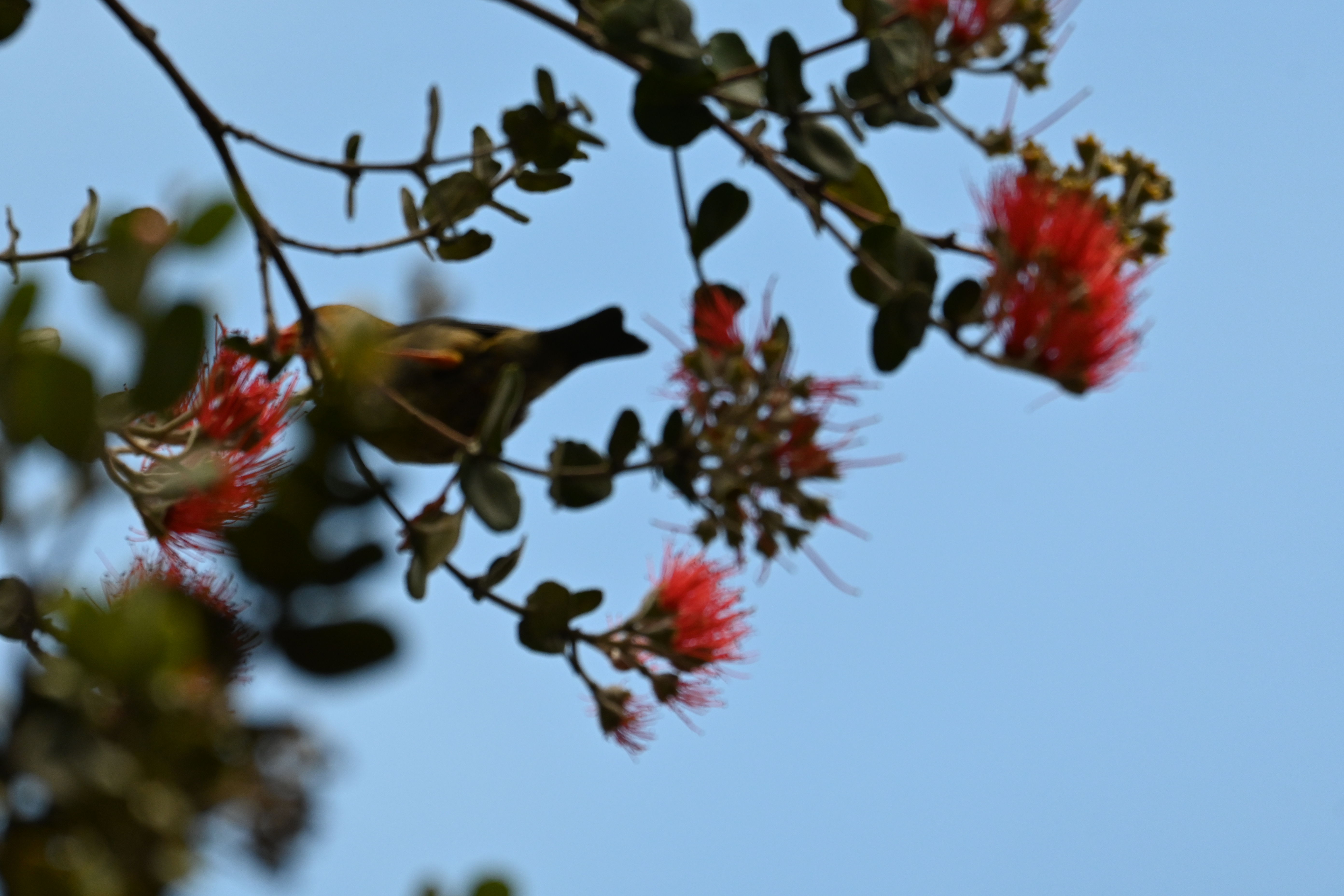
May the Spirit of Truth visit me, O Holy One, for I live squinting into trees, struggling to discern the movements of the Spirit’s wings from the motions of the tossing wind, a wind which might reflect the Spirit, too.
I strain to disentangle fern and feather, branch and beak, blossoming lehua from the nectar-feeder there. Through magnifying glass and brightening screens you’d think I’d recognize the truth above, but still I struggle to keep focus on the Truth.
Perhaps I should lay down the lenses and the sensors that record the light, set my ears to listen to the Spirit’s various calls, and find the Truth in other medium than sight.
A poem/prayer based on John 16:12-15, the Revised Common Lectionary Gospel Reading for Year C, Trinity Sunday.
Blurry photo of an i’iwi in juvenile plumage by Eric Anderson.
“In the last days it will be, God declares, that I will pour out my Spirit upon all flesh, and your sons and your daughters shall prophesy, and your young men shall see visions, and your old men shall dream dreams.” – Acts 2:17, quoting Joel 2:28
Assembling for the feast of Shavuot, the Spirit roared. No gentle breeze for us; a tempest howled there among our trembling circle, through our trembling souls. The flickering light upon our foreheads did not shed illumination, no. I saw it as a portent of our immolation. Not since the angel told me not to fear have I been so afraid.
My limbs have dragged my shivering frame into the streets, which teem with goggling worshipers. They fight their way upstream along the way my son last trod beneath the burden of a cross. How many know, how many care, that Jesus died abandoned by his follower-friends, attended by these women who, like me, recall dear Miriam, who danced before the Law.
The raucous streets resound with Babel sound, with accents I know well, and languages I don’t. To my astonishment, one voice is mine, another comes from Mary here, and Mary there, and from a hundred other throats. We praise our God, because when Jesus had been laid into his tomb, the Holy One rejected our rejection, called him back to life.
They scoff, of course, that we are drunk (how drunk, they do not know, for I am filled with Spirit I have never known). I draw my breath in deep. I plant my feet upon the unforgiving stones. I start to lift my arm to summon all to hear my words, and then I hear it: Simon’s voice, my son’s beloved Rock, against all expectation quoting from the prophet Joel. Who would have thought it? I rejoice, except: I wonder, when will faithful people hear a woman’s voice again?
A poem/prayer based on Acts 2:1-21, the Revised Common Lectionary First Reading for Year C, Pentecost Sunday.
The image is The Virgin surrounded by twelve apostles or Pentecost, by Master of the Crucifix of Pesaro (ca. 1380). Photograph by Rama, Wikimedia Commons, Cc-by-sa-2.0-fr, CC BY-SA 2.0 fr, https://commons.wikimedia.org/w/index.php?curid=11148957.
Many artists included Mary among the Twelve in their depictions of Pentecost.
Full inclusion of God’s people does not stop at men and women.
“One day as we were going to the place of prayer, we met a female slave who had a spirit of divination and brought her owners a great deal of money by fortune-telling. While she followed Paul and us, she would cry out, ‘These men are slaves of the Most High God, who proclaim to you the way of salvation.'” – Acts 16:16-17
My soul was heaped with chains.
A demon claimed my eyes, my mind, my tongue, to speak of things beyond a mortal’s ken. Or possibly to fill the air with lies.
Some businessmen had claimed my freedom. For as long as people paid to hear the demon’s truth or lies, the money went to them, and chains to me.
I still don’t know who claimed my legs and tongue those days. The demon knew, as I could not, that these strange men were also chained, but to the healing power of a god.
I followed, but I don’t know how. The demon’s words leapt from my lips, but would it risk its power in the face of God? Regardless, my legs pushed me after them.
I saw the look upon the speaker’s face, a look of one whose patience had been tried beyond its limited capacity. Beyond my hope, he spoke the words that broke the demon’s chains on me.
I fell into the street and saw the businessmen seize him and his companions, chain them for the magistrates’ displeasure. I looked down and found their chains bound me.
I am not fully free, but I am freer than before, and even though it cost them chains like mine, I would be pleased to wear the chains of God.
A poem/prayer based on Acts 16:16-34, the Revised Common Lectionary First Reading for Year C, Seventh Sunday of Easter.
[Jesus said,] “Peace I leave with you; my peace I give to you. I do not give to you as the world gives. Do not let your hearts be troubled, and do not let them be afraid.” – John 14:27
The world gave to you the way it gives, Lord: Resentment, suspicion, condemnation, violence. At the table you offered your peace to your friends. In the garden, at the cross, peace fell away.
I pray, give to me as you give, not the world. The world still loves to condemn and coerce. In your peace I just might be able to stand, my spirit unbowed by all evil’s power.
A poem/prayer based on John 14:23-29, the Revised Common Lectionary Gospel Reading for Year C, Sixth Sunday of Easter.
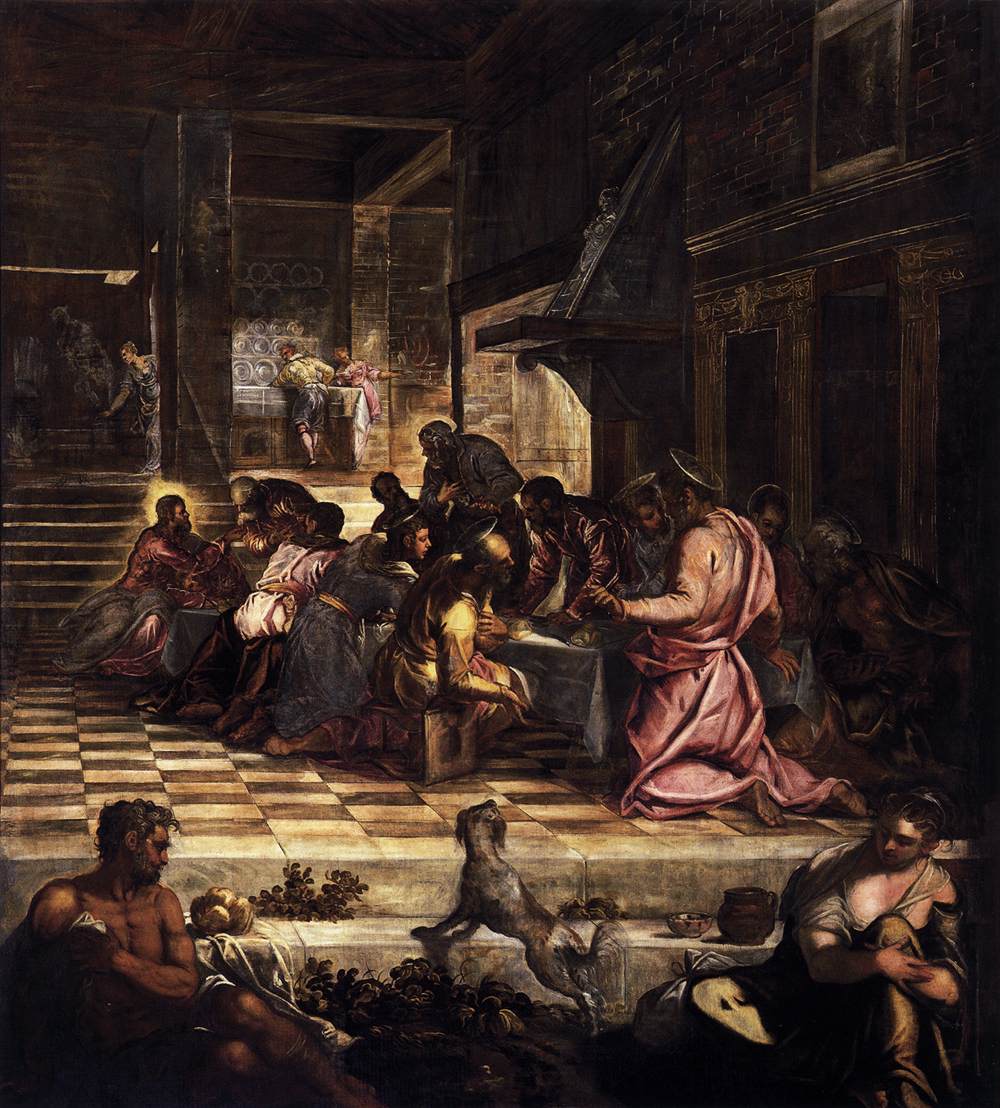
Tintoretto painted more than one Last Supper. The chaotic atmosphere of this image drew me in, even as I was writing about peace, because peace in the chaos is our great challenge.
So when Peter went up to Jerusalem, the circumcised believers criticized him, saying, “Why did you go to uncircumcised men and eat with them?” – Acts 11:2-3
You think I wanted to eat with them? I didn’t want to go at all. I was riding pretty high, you know, elated with a woman’s resurrection. OK, the only place they’d put me up was with a tanner, but a fisherman’s smelled worse.
Yes, I was riding high, and trying not to think about the things that happen when you’re riding high, the way success becomes a series of new challenges, new obligations. I was smelling those amidst the tannery. It came for Jesus; it would come for me.
I didn’t know that I could lie in dreams or visions, waking or asleep. I claimed I’d never eaten food that was unclean, and knew full well I’ve eaten shellfish when the Romans hadn’t purchased all my stock. And let’s ignore the grain I plucked on Sabbath Day.
A vision or a dream; regardless, it would summon me to something new I knew. I did not know what it would be, but who gets visions for a trivial thing? I didn’t know what that dream meant. I knew I’d go where I’d not wish to go.
The house of a centurion was not within my plan. Who knew what I would find when I reached there? Most likely was a naked sword to seek my naked gut. Why trouble with a cross when you can drain a troublemaker’s life without?
I had no plan to speak of Jesus there until they asked, but ask they did, and I pulled in my breath, and breathed it out, and spoke with sometimes trembling voice of Jesus, of his healing touch, his mercy to such fools and failures as I am.
I certainly did not expect the fire of the Spirit in a Roman house, of one who marshals military might against the people of this land. They said that he feared God, but this? The Holy Spirit, lit in him as it had been in me? Who knew?
And now, my friends, I have no plan for you. I didn’t want to go. I went. I didn’t want to speak. I spoke. I didn’t know the Spirit would appear. She did. I didn’t know that God had welcomed them, the Gentiles, just as openly as us. And now, I have no words for you, except
To tell my tale again.
A poem/prayer based on Acts 11:1-18, the Revised Common Lectionary First Reading for Year C, Fifth Sunday of Easter.
“Peter put all of them outside, and then he knelt down and prayed. He turned to the body and said, ‘Tabitha, get up.’ Then she opened her eyes, and seeing Peter, she sat up.” – Acts of the Apostles 9:40
“To sleep, perchance to dream – ay, there’s the rub, For in that sleep of death what dreams may come?” asked William via Hamlet in the play. In Joppa Tabitha had ceased her work.
She lay upon the cot unmoving as her friends displayed with streaming eyes the cloth and clothing she had made with loving hands for them, their families, and those in need.
She’d lived a life full well and full of grace, and if she’d died, a life reborn would come, so said the messengers who preached the Way, the Jesus Way she’d taken as her own.
What dreams moved through her soul as she lay still? What visions came to eyes of spirit now that those below her brow saw naught? What sight of welcome to a life eternally?
Somehow she heard the summons, “Tabitha, get up.” The dreams collapsed as her lids raised, to see an unfamiliar, anxious face, perhaps a little bit surprised, above.
She rose. She met her friends once more. What did she say? We’ll wonder, since the author left that out, and failed to write as well, what dreams she’d had, which we may have ourselves someday.
She rose, awoke to love and work, restored to life ephemeral, a life to end someday once more, a life she would lay down again, and dream the interrupted dreams.
A poem/prayer based on Acts 9:36-43, the Revised Common Lectionary First Reading for Year C, Fourth Sunday of Easter.
The image is the Tomb of Tabitha, Jaffa, Palestine by William H. Rau (1903) – This image is available from the United States Library of Congress’s Prints and Photographs divisionunder the digital ID ppmsca.10664.This tag does not indicate the copyright status of the attached work. A normal copyright tag is still required. See Commons:Licensing., Public Domain, https://commons.wikimedia.org/w/index.php?curid=18866918.
This poem includes quotes from Hamlet by William Shakespeare (ca. 1599 and 1601) and “Awake, Awake to Love and Work” by Geoffrey Anketel Studdert Kennedy (1921).
“He fell to the ground and heard a voice saying to him, ‘Saul, Saul, why do you persecute me?’ He asked, ‘Who are you, Lord?’ The reply came, ‘I am Jesus, whom you are persecuting.'” – Acts of the Apostles 9:4-5
He knew. He knew for certain, Jesus, that your followers were wrong, and more than wrong, were spreading tales that would do violence to souls.
He knew for certain, Jesus, so he brought force to body and to soul.
He knew. He knew for certain, Jesus, until a light his eyes could not endure cast him from beast to ground, his certainty undone to hear your voice.
He knew for certain, Jesus, that he’d persecuted you.
He knew. He knew for certain, Jesus, that he had heard your voice, and knew your will and way: certainty anew.
He knew for certain, Jesus, so he proclaimed you.
May I, like he, receive a thorn in flesh or soul to keep me from elation, from certainty that could transform glad proclamation to sad persecution.
A poem/prayer based on Acts 9:1-20, the Revised Common Lectionary Gospel Reading for Year C, Third Sunday of Easter.
“[Jesus read from the scroll of Isaiah:] ‘The Spirit of the Lord is upon me, because he has anointed me to bring good news to the poor. He has sent me to proclaim release to the captives and recovery of sight to the blind, to set free those who are oppressed, to proclaim the year of the Lord’s favor.'”
“Today this scripture has been fulfilled in your hearing.” Your own words, Jesus, amazing them with graceful speech. Until they turned upon you.
Remind us once again of what is grace. I’m told that grace is strength, is force. I’m told that power is right, and might is good. I’m told that what we want we take.
Where is the news that sounds good to the poor? Where is the vision for the ones who will not see? Where is the freedom for the ones who are oppressed? Where are the prisoners released into the light?
You did not speak the words of grace alone. You needled them, you did, O Christ, until they burst in rage, and nearly did the work of Pilate three years earlier, by casting you to break upon a rock.
O, can we learn the lesson that you tried to teach? We claim your name but do not tread your ways. We leave the poor uncomforted, we close our eyes to the oppressed, and those we free are those who’ve flattered us.
May there be good news for the poor. May there be vision which will pierce the shade. May there be freedom for those who have been bound. Bring quickly, Jesus, the favored year of the LORD.
A poem/prayer based on Luke 4:14-21, the Revised Common Lectionary Gospel Reading for Year C, Third Sunday of the Epiphany.
The image is “The Rejection of Jesus in Nazareth” (“Prophets are not without honour, except in their hometown”); 18th-century tile panel by António de Oliveira Bernardes in the Igreja da Misericórdia, in Évora, Portugal, Public Domain, https://commons.wikimedia.org/w/index.php?curid=97133284.
“And Jesus said to her, ‘Woman, what concern is that to me and to you? My hour has not yet come.'” – John 2:4
Now if I take a bird’s eye view of the world, or if I try to see the Universe as from the eye of its Creator, I have to ask, What concern are we to You?
“What are humans that you are mindful of them, mortals that you care for them?”
Other folk of other faiths discerned their deities to be… not unconcerned, but distant, focused on their own affairs, but pleased by scent of sacrifice.
So when the hosts ran out of wine what person would not ask, “Are we concerned? We brought our contributions to the feast. What more can we do now?”
How many deities would ask, “What prayer is this? Do I make up your deficits, the failures in your plans? Take care of it yourselves, as you can do.”
As deity, as human being, what else could Jesus say but this: “This is not our concern. The things I have to do come later and much larger.”
A mother’s love is such a funny thing. One moment she protects her child from senseless obligation, then the next she thrusts them forward: “Go on, give.”
He said that they were not concerned, but his mother thrust him forth, and then he was concerned. They filled the jars. They served the wondrous wine.
Was he concerned? He was, for host’s embarrassment, but more for human souls who languish in uncertainty and fright, to lead them to a life beyond imagining.
“What are humans that you are mindful of them?” Still we cannot fully clarify the poet’s ancient cry, except to say, that Jesus is concerned, God is concerned, the Holy Spirit is concerned:
For us.
A poem/prayer based on John 2:1-11, the Revised Common Lectionary Gospel Reading for Year C, Second Sunday of the Epiphany.