June 21, 2026
Genesis 21:8-21
Romans 6:1b-11
During the summer, some of the birds in the Hawaiian mountain forests like to gather into flocks. You’ve probably seen flocks of mynas around Hilo, and one evening I saw a big flock of cattle egrets, which was impressive, and I’ve also seen flocks of seven or eight nene flying about. Did you notice that those flocks have something in common?
They were all made up of the same kind of bird. Mynas with mynas. Cattle egrets with cattle egrets. Nene with nene.
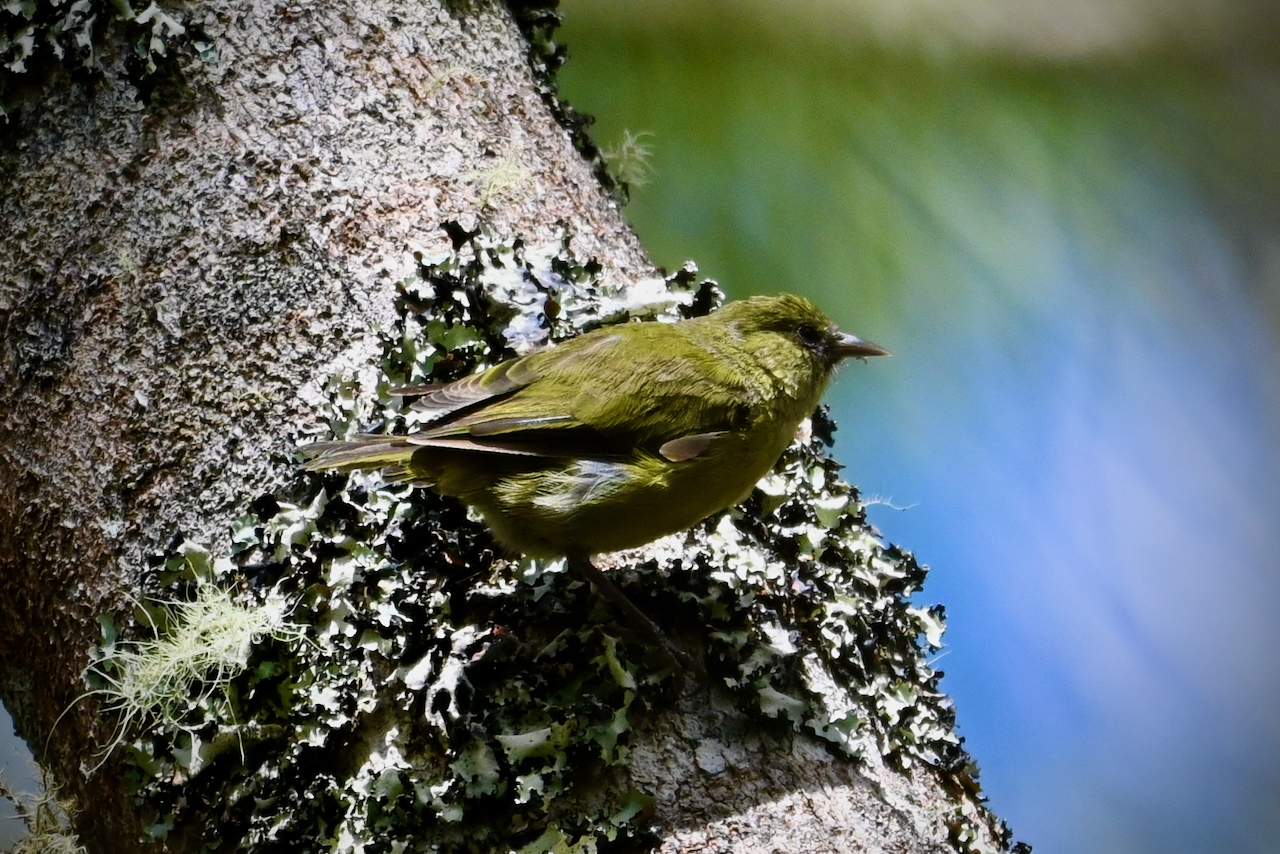
The mountain birds do their flocks differently. They gather birds of different kinds together, so you’ll have ‘apapane (probably the biggest number), ‘amakihi, ‘akepa, i’iwi (not all of them are solitary and territorial), and even mejiro. The funny thing is that the birds in these flocks don’t entirely share the same diet. Some of them mostly eat nectar and may eat a bug or two from time to time. Others, like the ‘alawi, don’t eat nectar at all and rely on bugs and caterpillars.
So when an ‘alawi joined the flock, one young ‘apapane got huffy about it. “What use is an ‘alawi?” he asked a friend. “They’re not like us. They won’t help us find flowers in blossom.”
“They’re good at finding bugs,” said his friend. “Just watch.”
“I like nectar better than bugs,” said the first bird, and while she watched the ‘alawi hunt along a tree branch – and find some tasty caterpillars – he flew off somewhere else.
“I don’t think we should allow them in the flock,” he told someone else on another day, who ignored him.
You see, the flock was having a rough time. It had been dry on the mountains, and the trees weren’t flowering much. That meant that nectar was in short supply, but it also meant that the bugs who ate the nectar weren’t available, either. The birds didn’t know where the bugs were, and they didn’t know where the flowers were, and they were feeling the pinch.
“Look at that ‘alawi,” said the grumpy ‘apapane again. “He can’t even find the bugs I don’t want to eat.” The other ‘apapane gave him a sad look and flew off without a word.
“What use is an ‘alawi to any of the rest of us,” he asked one morning amidst a group of ‘apapane, ‘amakihi, and a haughty i’iwi. “Let’s get rid of this one, I say. There will be more for us.”
“Oh, be quiet,” said the i’iwi. “We flock together to help one another. That doesn’t mean that every bird has to be helpful every day, or even every season. Heaven knows I haven’t helped anyone find any flowers this year, and neither have you, ‘apapane. Let the ‘alawi alone. He’s just living his life, the same as you.”
“When is he going to prove his worth?” demanded the ‘apapane.
“When are you going to prove yours?” replied the i’iwi.
There was silence for a moment, and then the rustle of wings. The ‘alawi, who they hadn’t noticed at the edge of the group, had taken off.
“For pity’s sake, you’ve offended him,” said the i’iwi, and flew off after him. The other birds followed, including the arrogant ‘apapane, who really hadn’t intended the ‘alawi to hear him.
To everyone’s surprise, the ‘alawi led them, straight as an arrow, to a grove of ohi’a trees in full blossom. Plenty of the nectar-feeding insects were there, too. They sent a couple birds back to fetch the rest of the flock, and then settled in for the best breakfast they’d had in days.
The ‘apapane hopped over to the ‘alawi and said, “I’m sorry for what I said.”
The ‘alawi turned him a bright eye and said, “I didn’t hear anything. I just realized I could smell flowers on the air.”
He hopped over to a neighboring branch and plucked away a tasty spider. “But don’t worry,” he told the ‘apapane. “You’ll show your worth someday, too. Not that you have to, of course.”
by Eric Anderson
Watch the Recorded Story
I write these stories in advance, but I tell them from memory and improvisation. The story I wrote does not precisely match the story I told.
Photo of an ‘alawi (Hawai’i Creeper) by Eric Anderson.


O!!!! Churches I’ve known like this flock!!!!!
It’s not a perfect flock by any means, but they’re trying.
Yes, indeed, most of them, but this last decade of supply preaching 45 weeks a year has introduced me to some who take “tightly knit” to the extreme … I want to yell “Drop a stitch why don’t you.”
Oh, dear. That’s a hard thing for sure!
But many, many, many, many beautiful churches.