Story: Worthy Birds

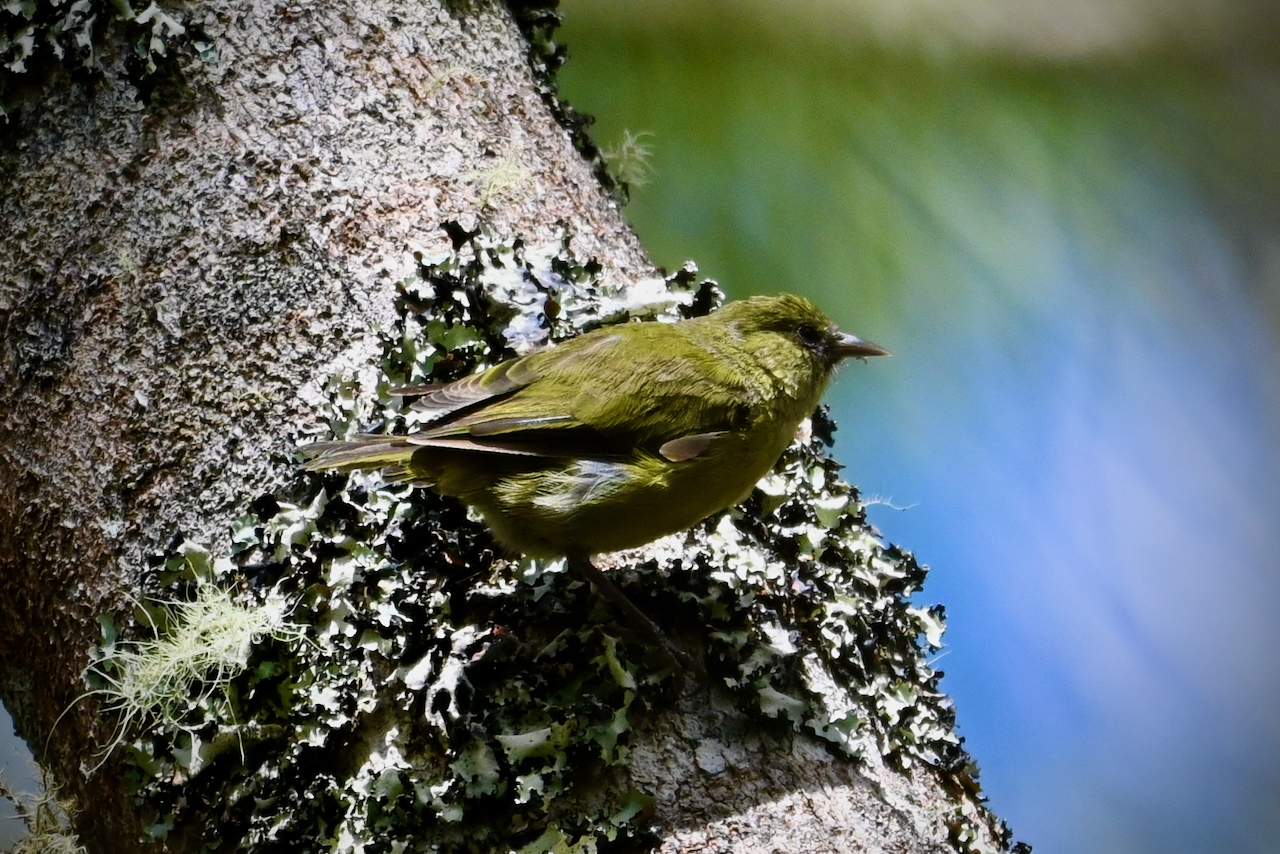
A small green bird perched on a larger tree branch.

June 21, 2026

Genesis 21:8-21
Romans 6:1b-11

During the summer, some of the birds in the Hawaiian mountain forests like to gather into flocks. You’ve probably seen flocks of mynas around Hilo, and one evening I saw a big flock of cattle egrets, which was impressive, and I’ve also seen flocks of seven or eight nene flying about. Did you notice that those flocks have something in common?

They were all made up of the same kind of bird. Mynas with mynas. Cattle egrets with cattle egrets. Nene with nene.

The mountain birds do their flocks differently. They gather birds of different kinds together, so you’ll have ‘apapane (probably the biggest number), ‘amakihi, ‘akepa, i’iwi (not all of them are solitary and territorial), and even mejiro. The funny thing is that the birds in these flocks don’t entirely share the same diet. Some of them mostly eat nectar and may eat a bug or two from time to time. Others, like the ‘alawi, don’t eat nectar at all and rely on bugs and caterpillars.

So when an ‘alawi joined the flock, one young ‘apapane got huffy about it. “What use is an ‘alawi?” he asked a friend. “They’re not like us. They won’t help us find flowers in blossom.”

“They’re good at finding bugs,” said his friend. “Just watch.”

“I like nectar better than bugs,” said the first bird, and while she watched the ‘alawi hunt along a tree branch – and find some tasty caterpillars – he flew off somewhere else.

“I don’t think we should allow them in the flock,” he told someone else on another day, who ignored him.

You see, the flock was having a rough time. It had been dry on the mountains, and the trees weren’t flowering much. That meant that nectar was in short supply, but it also meant that the bugs who ate the nectar weren’t available, either. The birds didn’t know where the bugs were, and they didn’t know where the flowers were, and they were feeling the pinch.

“Look at that ‘alawi,” said the grumpy ‘apapane again. “He can’t even find the bugs I don’t want to eat.” The other ‘apapane gave him a sad look and flew off without a word.

“What use is an ‘alawi to any of the rest of us,” he asked one morning amidst a group of ‘apapane, ‘amakihi, and a haughty i’iwi. “Let’s get rid of this one, I say. There will be more for us.”

“Oh, be quiet,” said the i’iwi. “We flock together to help one another. That doesn’t mean that every bird has to be helpful every day, or even every season. Heaven knows I haven’t helped anyone find any flowers this year, and neither have you, ‘apapane. Let the ‘alawi alone. He’s just living his life, the same as you.”

“When is he going to prove his worth?” demanded the ‘apapane.

“When are you going to prove yours?” replied the i’iwi.

There was silence for a moment, and then the rustle of wings. The ‘alawi, who they hadn’t noticed at the edge of the group, had taken off.

“For pity’s sake, you’ve offended him,” said the i’iwi, and flew off after him. The other birds followed, including the arrogant ‘apapane, who really hadn’t intended the ‘alawi to hear him.

To everyone’s surprise, the ‘alawi led them, straight as an arrow, to a grove of ohi’a trees in full blossom. Plenty of the nectar-feeding insects were there, too. They sent a couple birds back to fetch the rest of the flock, and then settled in for the best breakfast they’d had in days.

The ‘apapane hopped over to the ‘alawi and said, “I’m sorry for what I said.”

The ‘alawi turned him a bright eye and said, “I didn’t hear anything. I just realized I could smell flowers on the air.”

He hopped over to a neighboring branch and plucked away a tasty spider. “But don’t worry,” he told the ‘apapane. “You’ll show your worth someday, too. Not that you have to, of course.”

by Eric Anderson

Watch the Recorded Story

I write these stories in advance, but I tell them from memory and improvisation. The story I wrote does not precisely match the story I told.

Photo of an ‘alawi (Hawai’i Creeper) by Eric Anderson.
Cast Out This Slave Woman with Her Son

“But Sarah saw the son of Hagar the Egyptian, whom she had borne to Abraham, playing with her son Isaac. So she said to Abraham, ‘Cast out this slave woman with her son, for the son of this slave woman shall not inherit along with my son Isaac.'” – Genesis 21:9-10

They laughed, the boys at play.
How many mothers watched? But one
saw threat and dissolution of
the wealth expected for her own.

How precious was her Laughter! She
had laughed to hear an angel say
that she would bear a much-desired son,
for she had forced her maid already to

Her husband’s bed, there to conceive
the older laughing child. No wonder that
she laughed, not just at things that could not be,
but that she’d brought an heir to life.

But now, she finds that promises fulfilled
have made a change. The boy she forced
another human being to bear, what is his place?
She could not bear to share the wealth.

“Go, cast them out,” she said to Abraham.
“He cannot have a place beside my son.”
Now Abraham had argued with his God
to find a place for his first born, but no.

He would not argue with his wife. He cast
them out. He knew the skin of water would
not last, and neither would the food. He cast
them out to where the sun would bleach their bones.

They were disposable, these two,
to Sarah and to Abraham. They’d had
a purpose once, but it had flown.
No purpose in the camp? Then go.

Too often and too many people find
they have been named “disposable”
by others with the power to displace
them, cast them out, and let them die.

But God, despite a failure to tell Abraham
and Sarah, “No. You shall not kill,” at least
preserved the lives of Hagar and of Ishamael,
declared that they were not disposable.

How soon will our humanity see what
our sacred texts still strain to see: no people are
disposable. All souls have worth to God,
and if to God, then how much more to us?

A poem/prayer based on Genesis 21:8-21, the Revised Common Lectionary First Reading for Year A, Proper 7 (12).

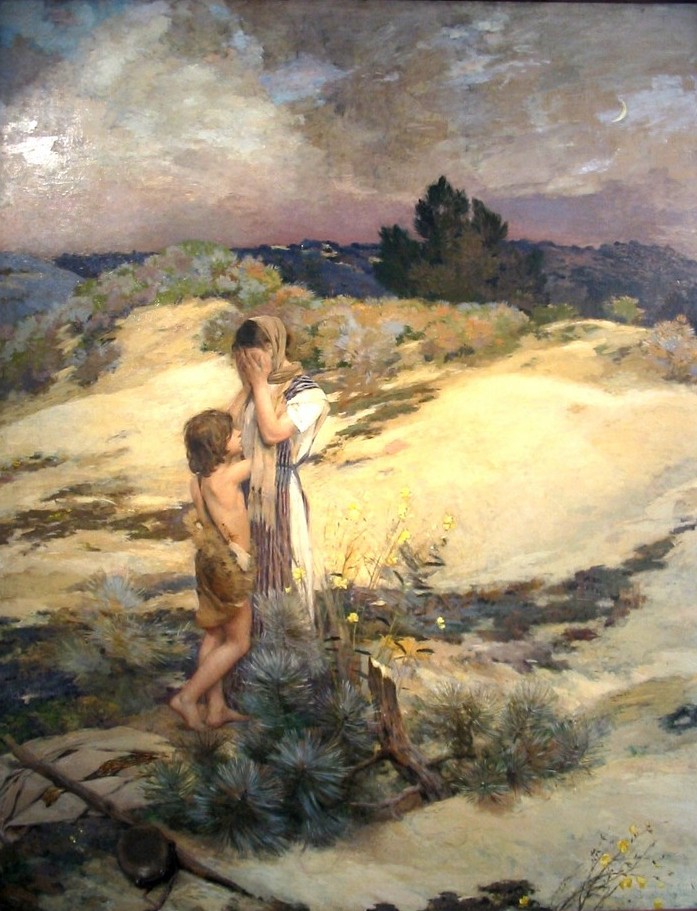
The image is Agar and Ismael (Hagar and Ishmael) by Jean-Charles Cazin (before 1880) – webmuseo.com, Public Domain, https://commons.wikimedia.org/w/index.php?curid=16403268.

Value

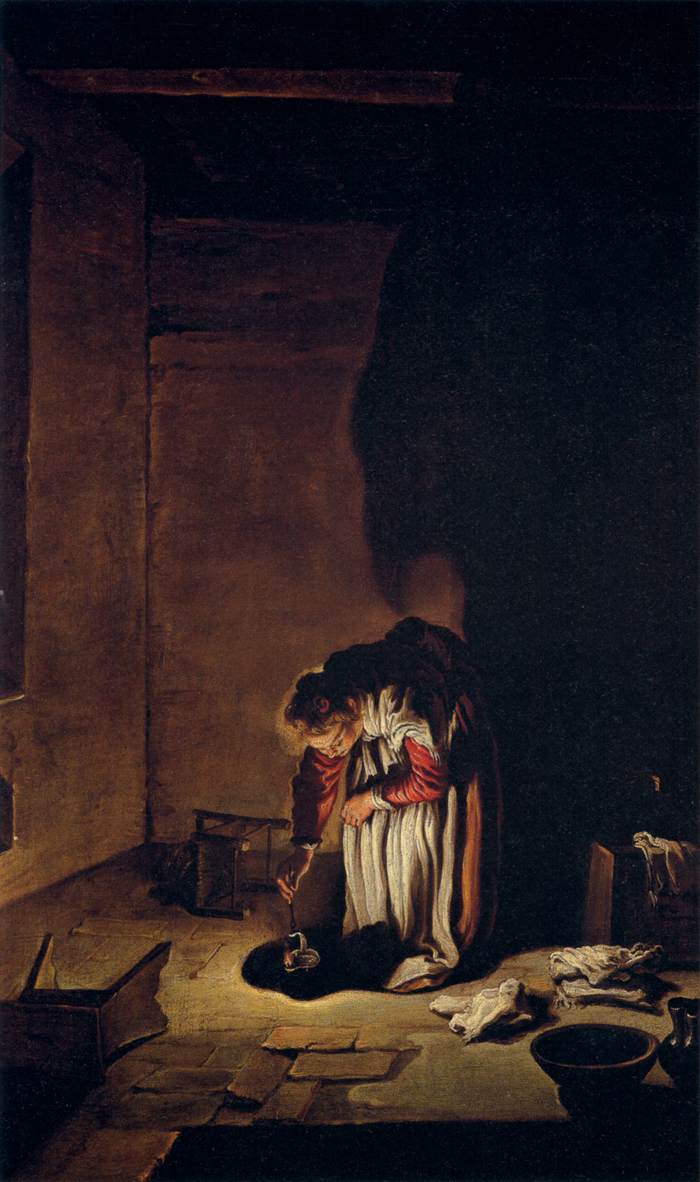
“[Jesus said,] ‘Or what woman having ten silver coins, if she loses one of them, does not light a lamp, sweep the house, and search carefully until she finds it?'”

What is the value of a single coin?
Not much today, when we make money
with printing upon paper, or with
electronic imagination.

What is the value of a single coin?
It might be little even in those ancient days,
unless, of course, it was a tenth
of everything she owned.

What is the value of a single coin?
It might be food to take me through the day,
or into a coming week,
or possibly next year.

What is the value of a single coin?
Enough to set me searching high and low,
to bear the cost of burning oil in the lamp,
to celebrate the sudden silver gleam amidst the dark.

What is the value of a single coin?
A better question might be this:
What is the value of a single human soul?
Enough, said Jesus, for the heavens to rejoice.

A poem/prayer based on Luke 15:1-10, the Revised Common Lectionary Gospel Reading for Year C, Proper 19 (24).

The image is Parable of the Lost Drachma by Domenico Fetti (1618) – Web Gallery of Art:   Image  Info about artwork, Public Domain, https://commons.wikimedia.org/w/index.php?curid=15453383.

Story: Rolling Stone

April 21, 2024

Acts 4:5-12
1 John 3:16-24

It looked like any other stone that had been tumbled around in the ocean. Not very big. Not very solid. In fact, it was noticeably speckled with holes. The edges of the holes had been smoothed by sand and water moving over it. Eventually, the waves had flung it up on a beach.

And the waves had grabbed it again, so many times, the stone simply couldn’t count them. Not that stones count that well anyway. It had been swept away in the receding waves, then tossed back by the flowing waves, then undermined by another wave going, and pitched up the beach by another wave coming. It was kind of dizzying.

It was also kind of musical. The stone had a lot of company rolling around in the waves, and they rattled against one another as the water pulled away and they rolled together. The music they made, of course, was rock and roll.

If they’d named themselves as a band, I suppose they’d have been the Rolling Stones.

Those days had been exciting, not as exciting as the day it was flung as a hunk of liquid rock into the ocean, but it had been rhythmic and musical and, of course, rock and roll.

With time, however, the beach had grown. New stones, new sand, and new rocks came in with the tides, and the beach expanded further out from where the stone would rest from time to time. Eventually the waves never reached it at all. The stone felt somewhat lost and sad. It felt small. It felt unimportant. It was surrounded by plenty of other stones, but what were they to do except bake in the sun and drip in the rain?

That’s when a seed found its way to the beach, and tumbled down into the space between this stone and the next. It took a rest for a while, and the stone, which had hardly noticed it, forgot all about it – until it began to sprout. A root went down. A shoot came up.

“What are you doing there?” asked the stone.

“I’m growing,” said the plant which had been a seed.

“Why grow next to me?” asked the stone.

“Why not?” asked the seed.

“I’m small and unimportant,” said the stone. “I don’t even make music any more.”

“If you were bigger,” said the plant, “I could never get around you. If you were bigger you’d keep me away from the light. If you were bigger, I’d never find the rain. For me, right now, you’re the most important stone in the world, because you’re here and you’re being exactly what I need.”

The stone started to feel better, but then said, “I’ll still miss the music.”

“Hold that thought,” said the plant.

When it grew tall enough, the wind blew through its leaves with a whistling tone. Below it, the stone’s heart sang.

by Eric Anderson

Watch the Recorded Story

I write these stories ahead of time, then tell them from memory during worship – and make changes as I do. In this case I think all the puns made it into the story when told.

Photo of stones on the beach in Pohoiki by Eric Anderson.