Transfiguration Sonnet

Upon the mountain’s height the stones reflect
the sudden glow, not gleaming from the skies
as ordinary light. They are bedecked
with sudden radiance that mystifies.

Now where there were four figures there are six,
and two did not come up the earthen trail.
Three faces wear astonishment transfixed
to see the ancient prophets so unveiled.

The ever-daring one proposes booths
until a booming voice imposes hush,
for listening is like to admit truths
far more than motion taken in a rush.

But were I there, I fear my faltering frame
would hardly dare pronounce Messiah’s name.

A poem/prayer based on Mark 9:2-9, the Revised Common Lectionary Gospel Reading for Year B, Transfiguration Sunday.

Studies of the Heads of two Apostles (St. Peter and St. John) and of their Hands by Raphael (1483–1520), at the University of Oxford’s Ashmolean Museum. Black chalk touched with white on greyish paper. http://www.wikipaintings.org/en/raphael/studies-for-the-transfiguration, Public Domain, https://commons.wikimedia.org/w/index.php?curid=23549943.

Gathered Around the Door

And the whole city was gathered around the door. – Mark 1:33

The city is outside my door, Jesus,
but they are not calling to come in.

They have not come en masse to seek a healer
or a prophet who could liberate their souls.

Oh, one or two, perhaps. From time to time.
If they found solace, they have kept the secret well.

There is enough, in truth, to drive a lesser one
like me to seek the solitude you sought

When morning had not wakened those
whose needs had not been satisfied.

I’m not sure how I’d handle all those people
seeking what I know to be beyond my power

And so confess with sadness that I’m glad
I lack the power, and the crowds stay home.

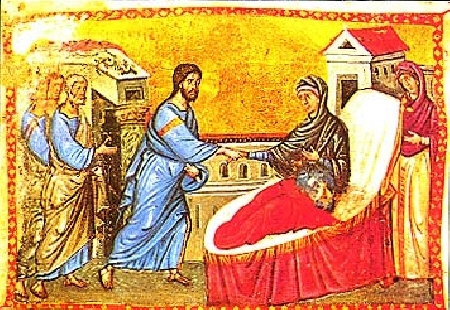
A poem/prayer based on Mark 1:29-39, the Revised Common Lectionary Gospel Reading for Year B, Fifth Sunday after the Epiphany.

The image is Healing Peter’s Mother-in-law, from a 13th century manuscript from the Athos monasteries by an unknown author – http://shop.liturgie.de/, Public Domain, https://commons.wikimedia.org/w/index.php?curid=5187185.

What Have You to Do with Us?

In my weary moments, I wonder:
What have you to do with us,
Jesus of Nazareth?

Your followers (including me)
have found some other path
than yours. You, after all, relieved
the pains of those you met, while we
who claim your name impose such pain
to “save” our comfort or our power or
this sad deluded shout of “righteousness!”
We shame the poor; we spread disease;
we wrap ourselves in violence.
Were I you, Jesus, I would think
to shed this ill-named Christianity,
to wash it away, perhaps,
and start anew.

In my lonely moments, I wonder:
What have you to do with us,
Jesus of Nazareth?

Oh, sometimes I can feel your breath
upon my shoulder, sometimes feel
your hand upon my arm, yes
sometimes feel you pulling me into
a new direction. But.
Sometimes when evening falls or sunrise lifts
I sense no company, no strong
companion, and I long to know
once more the certainty my memory’s
fragility retains so fitfully
of your once-lucent clarity.

In my awestruck moments, I wonder:
What have you to do with us,
Jesus of Nazareth?

You could dance among the stars;
perhaps you do. I would, I think,
if I were you. You could speak and all
the evils of this world would be resolved.
Yes, bring the braided cords and clear
the temple – well, unless you’d have to lay
your sternness upon me. I’d settle then
for mercy, thank you very much.
No, with the ancient poet I repeat:
What are human beings that you
hold us in your mind; what are
mortals that you care for us?

In truth, I have no ready answer
for my weariness, my loneliness,
or even for my awe.
I can only be grateful, Jesus,
that you have been with us – and are.

A poem/prayer based on Mark 1:21-28, the Revised Common Lectionary Gospel Reading for Year B, Fourth Sunday after the Epiphany.

The image is Christ heals the possessed by engraver Jan Luyken. In the Bowyer Bible in Bolton Museum, England. Print 4234. From “An Illustrated Commentary on the Gospel of Mark” by Phillip Medhurst. Section D. Jesus confronts uncleanness. Mark 1:21-45, 2:1-12, 5:1-20, 25-34, 7:24-30. Image courtesy Phillip Vere – http://wfurl.com/a6ea272 (.pdf) “An illustrated commentary on the Gospel of Mark”. By Phillip Medhurst. .pdf file, FAL, https://commons.wikimedia.org/w/index.php?curid=9393722.

In the Silence

“And immediately they left their nets and followed him.” – Mark 1:18

Here you come again, O Jesus,
striding on the (rocky? sandy? weedy?) shore
to where I’m busy – busy, Christ, I tell you! –
with the labor of your call.

And you – oh, you – you have another call,
I’m sure, to summon me away
from this old fishing style to some new one,
from catching those… well, catching… what?

For if I am a fisher, then I fish the ponds
of fish you’ve caught before, and rarely reach
the waves upon the beach, and never stretch
beneath the ocean billowing.

Instead, I try to show the long-caught fish
just what it is to be a fish of yours,
to be a fishing fish, a loving fish,
a sharing-of-your-loving fishing fish.

As dear Mark left unspoken your
persuasive words to Simon, Andrew, James and John,
I wait within the silence yet to hear
your summons to be…?

A poem/prayer based on Mark 1:14-20, the Revised Common Lectionary Gospel Reading for Year B, Third Sunday after the Epiphany.

The image is a painting of the call of Simon and Andrew in the La Barca de la Fé, Templo Parroquial de San Andrés Buenavista, Tlaxco, Tlaxcala, México. Photo by Enrique López-Tamayo Biosca – https://www.flickr.com/photos/eltb/8399897831/sizes/o/in/photostream/, CC BY 2.0, https://commons.wikimedia.org/w/index.php?curid=24055602.

Fig Tree

“Nathanael asked him, ‘Where did you get to know me?’ Jesus answered, ‘I saw you under the fig tree before Philip called you.'” – John 1:48

It was long ago, my Savior, that you called me
out from under my fig tree.
Neither then nor now do I pretend to understand
just what you saw.

I strive, Redeemer, to become a person without guile –
sometimes successfully.
I’ve found your awkward knowing words and silences
correct me more than praise.

Still, knowing what you know, you sent the call
to summon me from shelter, and
I came to come and see, and seeing, echoed those old words:
You are the Son of God.

A poem/prayer based on John 1:43-51, the Revised Common Lectionary Gospel Reading for Year B, Second Sunday after the Epiphany.

The image is Bartholomew the Apostle by El Greco – lAHToi0sj3MVQw at Google Cultural Institute, zoom level maximum, Public Domain, https://commons.wikimedia.org/w/index.php?curid=29844192. Nathanael, named only in John’s Gospel, has traditionally been identified with Bartholomew, one of the Twelve in Matthew, Mark, and Luke.

Repentance

John the baptizer appeared in the wilderness, proclaiming a baptism of repentance for the forgiveness of sins.” – Mark 1:4

I am more accustomed to proclaiming
a baptism of forgiveness, Jesus, a baptism
of the Holy Spirit, a baptism of renewal.

I am more accustomed to confining
the language of repentance to my own
inadequacies, imperfections.

But as the pictures flicker on the screens,
and as the lies continue multiplying, then
I know I must repent a frightened silence, and

I summon up the words of John. Repent, you brood
of vipers, shed delusion, accept truth, and turn
from violent desecration of the nation

that you claim to love.

A poem/prayer based on Mark 1:4-11, the Revised Common Lectionary Alternate Psalm Reading for Year B, First Sunday after the Epiphany, the Baptism of Christ.

The image is Preaching of John the Baptist by Rembrandt – Gemäldegalerie, Berlin, Public Domain, https://commons.wikimedia.org/w/index.php?curid=41608726.

Christmas 2020

Far from a barn in Bethlehem
in miles and in time,
remembering the stories passed
and wondering just how much
was forgot, and how much lost,
of Jesus’ birth that holy night.

Who will recall, in truth,
the circumstances of this year?
For though we think our times
“unprecedented,” it is just
a sign of swift forgetfulness,
a well-established human trait.

The griefs so hard to bear will not
be felt by our descendants, for we
did not recall the sorrows of
our ancestors, nor think to learn
from their successes or their failures to
protect ourselves from ill.

Nor will our children’s children hear
of ti leaves waving gently in the breeze
beyond the window’s Christmas glow.
Why should they? They will have their own
bedazzling sights and sounds at hand,
their own deep scents to breathe.

Now my tree’s glow (in echo of
ohi’a blossoming upon the slopes of
Kilauea) takes on the shades of stone
a-fountaining, a-flowing, and
a-pooling at the mountain peak.
This might be held in memory.

For this becomes a link between
the distant island of Hawai’i and the inn
of Bethlehem, the places where the Earth
grows thin, and from the deepest places
of the planet and the love of God
there flows the light a-glowing bright.

Yes, here we have the breaking-in of grace:
the one builds up the land and rises
from the seas. The other builds up love
and joy and peace, reclaiming souls
from greed and other-disregarding sin.
So come, Lord Jesus! Make the darkness bright.

Make this a holy Christmas.

Nothing Will Be…

“For nothing will be impossible with God.” – Luke 1:37

I am content with ordinary miracles:
the way my day speeds up and slows
as down or up my foot puts pressure on
the accelerator pedal.

I am content with ordinary miracles:
the way I skip from isle to isle,
sometimes a-soaring o’er the sea,
sometimes with figures on a screen.

I am content with ordinary miracles
compressing space and time, compressing this
small planet into yet a smaller sphere,
connecting over oceans, over time.

I am content with ordinary miracles
that God concerns God’s self with women’s lives,
in resolute rejection of self-centered males,
unlikely to embrace a Savior.

I am content with ordinary miracles
so like the one in which a woman played
her necessary part, to bear and raise and love
a child, a sage, a Savior.

I am content with ordinary miracles
that mean my vision of the future with
its frights and fears and failings is,
most likely, wrong.

A poem/prayer based on Luke 1:26-38, the Revised Common Lectionary Alternate Psalm Reading for Year B, Fourth Sunday of Advent.

Mosaic of the Annunciation from the Cathedral of San Marco, Venice, by unknown author – http://azbyka.ru/forum/blog.php?b=1579, Public Domain, https://commons.wikimedia.org/w/index.php?curid=34067815.

Mary, Can We Talk?

Mary, can we talk?

You sang your magnifying song
in present tense, with “is” and “is”
relieved, just here and there, by a “has done.”
Did all this grace go by, or is it still to come?

For truly Mary, as your soul rejoices still,
and as a planet calls you blessed,
the generations still cry out for mercy and
relief from our unholy strife and greed.

The arrogant are scattered only in
imagination and in heart-felt hope.
The powerful are happy on their thrones;
the lowly wonder when they will be lifted up.

The hungry still are hungry while the rich
are filled with comfortable certainty.
A servant nation – any servant nation – shrouds
the light of love with its “my people first.”

So Mary, can we talk, unhindered by
the sobs and weeping of the world?
Can I obtain your voice of confidence
without the growth of grace within?

If not, then let me sit here at your feet
a while to shut my eyes and listen to
your song that magnifies the LORD
rejoicing in our God, our Savior.

A poem/prayer based on Luke 1:46b-55, the Revised Common Lectionary Alternate Psalm Reading for Year B, Third Sunday of Advent.

The Virgin in the Garden by Unknown Master, German (active in 1490s in the Upper Rhineland) – Web Gallery of Art:   Image  Info about artwork, Public Domain, https://commons.wikimedia.org/w/index.php?curid=15465829.

Highway

“Make straight in the desert a highway for our God.” – Isaiah 40:3b

I hear the summons, Holy One, to lay aside
the poetry, the words and tunes, the voice,
and take up skills (I do not have) to build
a road, a path, a highway for your Way.

In my imagination, that highway would stream
across the plains into the setting sun
and I would squinting peer ahead
into the spreading light of glory.

My engineering skills, however, are more apt
to build a road that rolls and twists,
that dives precipitously down the hillsides, cracks
with perturbations of the Earth.

I am the grass, the flower of the field,
and with them I will grow and bloom,
then fall and fade. I cannot build a road
to match the word of God that stands forever.

A poem/prayer based on Isaiah 40;1-11, the Revised Common Lectionary First Reading for Year B, Second Sunday of Advent.

Photos by Eric Anderson.