In the Silence

DSC_0198

“After that no one dared to ask him any question.”
— Mark 12:34

What had you to say that was so special, Jesus?
Not much. Just: “Love your God,” and “Love your neighbor.”
Hardly original. Hardly profound. Hardly unheard,
or unthought, or unsaid, or unique.
Not much. Just: “Love your God,” and, “Love your neighbor.”
That. That is all.

And after that no one dared to ask you any question.

Ha! I’ve got questions, Jesus, yes, I’ve got questions.
Like: “What does it mean to love God?” After all,
this Blessed Creator needs nothing of me.
What have I to offer the Author of
Everything? “Love.” Love? Seriously, love?
That. That is all.

And after that no one dared to ask you any question.

Ha! I’ve got questions, Jesus, yes, I’ve got questions.
Like: “Who is my neighbor?” (Oh, wait, you answered
that one, so…) “What does it mean to love
my neighbor?” Got you there, now didn’t I?
Except, of course, I know when I’ve been loved…
That. That is all.

And after that no one dared to ask you any question.

Neither, then, my Savior, will I dare.
Why? I know the answers. All you did
was call me to the roots, the ground, the soil
of my faith, the seed which bears within it
the flower and the fruits of… love.
That. That is all.

A poem/prayer based on Mark 12:28-34, the Revised Common Lectionary reading for Year B, Proper 26. The commandment to love God is found in Deuteronomy 6, and the commandment to love the neighbor is found in Leviticus 19.

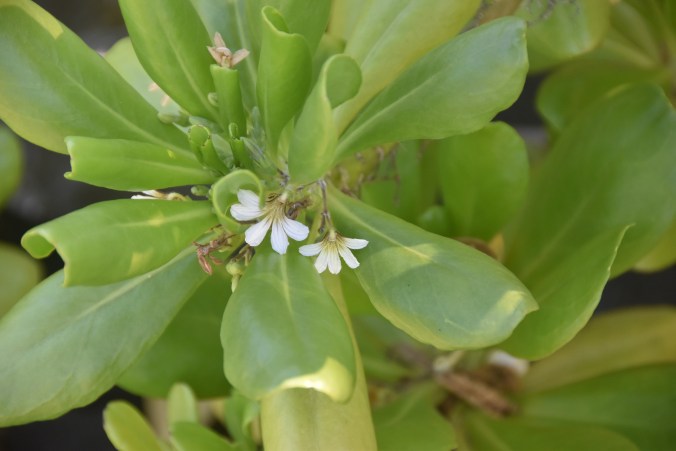
Photo of a seaside naupaka in blossom by Eric Anderson.

The Man Who Defined His Healing

DSC_0469

O, let me play God, God.
Or at least let me play Jesus
in homage to his own classic performance
as Jesus of Nazareth in:…
The Man Who Defined His Healing!

“Jesus, Son of David, have mercy on me!”
OK, that wouldn’t be my line, but what a line it is!
What better way to grab for Christ’s attention
(my attention, if I get the role)
than to use that risky title of Messiah?

And then, O God, I’ll hear the shushing crowd,
that doesn’t want to risk the Roman wrath
and refreshing lack of discrimination
in the application of most deadly force —
they’ll kill everybody —

with cool consideration wrinkling my brow.
I’ll let it build — “Have mercy!” “Oh, be silent!” —
and at the height of tension, stop, and say,
“Now call him here.” Take note, dear God:
“Now call him here.” He takes those steps himself.

As word arrives, he rises — leaps, perhaps
(You’re the director) — in my direction,
guided by the helpful (and confusing) shouts
of those around, in chaotic compensation
for the eyes that cannot lead him here.

And here he is, brought here himself.
He made it happen, instigated what’s to come,
cried out for me, cried my name,
cried my title, cried for mercy. And now,
what can I do but ask: “What do you want?”

It might be healing for his eyes,
it might be dinner for his family,
might be that someone remember his own name,
not just the patronymic
“Bar Timaeus.” “What do you want?”

As he names it, God, to see again,
You can let Your camera linger
on my softening eyes, compassion and
respect commingled, love in echo
of Your own. For power, though:

we’ll have to count on Your Most
Special Effects Department for its work.
And then, ’tis done. He has achieved
the goal for which he struggled, shouted, strode.
With his healed eyes, he’ll see the tears in mine.

I hope, director God, that You won’t choose
to pull the camera back to show the crowd,
but rather, as they cheer, let the picture linger
on this man, and me, and pan down to our feet
as, side by side, we take the Way together.

A poem/prayer based on Mark 10:46-52, the Revised Common Lectionary reading for Year B, Proper 25.

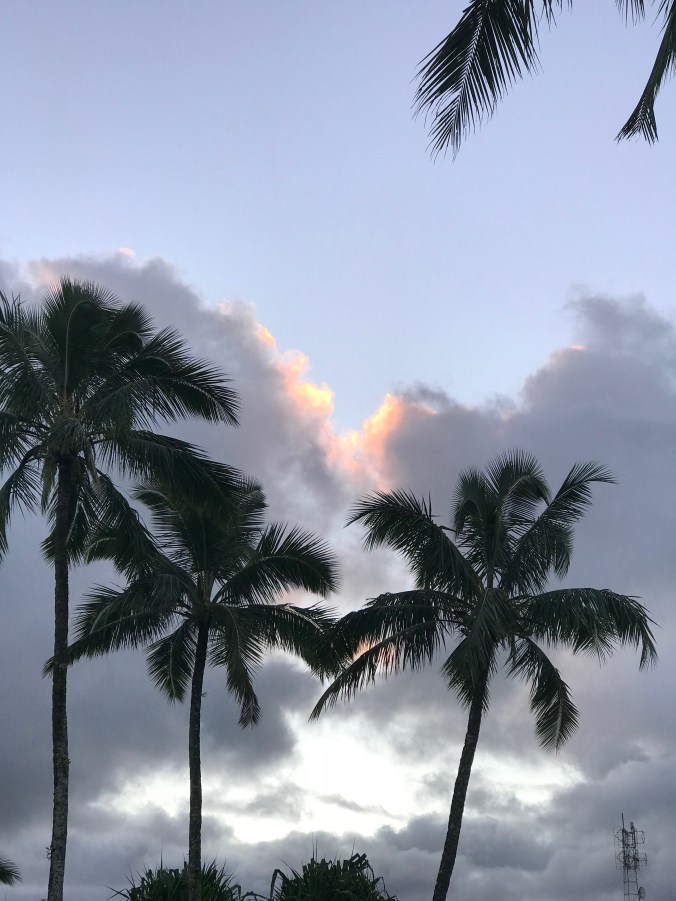
The underexposed photo of a sunset in Kona was taken by Eric Anderson on October 13, 2018.
Collapsed

DSC_0847

Summit summer-shaken
Rocks now resting
Like tumbled tumuli
Buried in basalt.

Lava languishes
Column cobble-choked
Yet vapor venting
Exhaust ethereal.

Caldera collapsed:
Like a soul subsiding,
Deeply dismayed,
Grieving and groaning.

“Give up your gifts,”
Unwelcomely uttered,
“Present to the poor,”
Displeasing decree.

You discourage discipleship,
Demanding Deliverer,
Boost bar to barrier,
from fracture to fence.

You ask all my all,
My self and my substance –
So my character crumbles,
And my features fall.

Just one hope for the helpless,
To comfort your companions:
The preposterous for people
Is the greatness of God.

A poem/prayer based on Mark 10:17-31, the Revised Common Lectionary reading for Year B, Proper 23.

Photo of the Kilauea caldera – showing rockfalls from the earthquakes and collapses of the summer of 2018 – was taken by Eric Anderson on October 8, 2018.

Hardness of Heart

Heart_of_stone_Israel“Because of your hardness of heart
he wrote this commandment for you.”

Where is my heart hard, O God?
I know, to my shame, of my hardness
of heart to one who I loved. Love ends
in pain: pain I inflicted on myself.

“Because of your hardness of heart
he wrote this commandment for you.”

Where is my heart hard, O God?
Am I so conditioned to suffering
and sighs that I turn away? A hard heart
would break at the wails of caged children.

“Because of your hardness of heart
he wrote this commandment for you.”

Where is my heart hard, O God?
Must I shout “Not me!” when they cry,
“Me, too!” No fingers point my way…
Unless they point toward a frozen heart.

“Because of your hardness of heart
he wrote this commandment for you.”

Let the little children come to me, you said.
Let the women come to me, you said.
Let the suffering and the sick come to me, you said.
Let the broken, the poor, the unprivileged.

Now I come, my Savior, to offer my hard heart.

A poem/prayer based on Mark 10:2-16, the Revised Common Lectionary reading for Year B, Proper 22.

The photo is of a beach sculpture in Israel. Photo by Peter van der Sluijs. Used by permission under Creative Commons license.

In My Imagination

IMG_4582In my imagination…

Without a foot, I take each step
with care, deliberation,
sensitive to balance,
cautious of my pain.

Without a hand, I feel my pulse
within my elbow, feel the zephyr
lift the hairs upon my arm,
feel the power of each embrace.

Without an eye, I turn my head
to see the full horizon, move about
to see each side in fullness,
to see attentively.

In my imagination…

In reality, O Lord, I know
I’d be as careless of your wonders
deprived of eye, or hand, or foot,
as I am careless with them.

Help me become, O Lord,
as my imagination.

A poem/prayer based on Mark 9:38-50, the Revised Common Lectionary reading for Year B, Proper 21.

Forced perspective photo by Eric Anderson, who does have a left hand.

Holy Mountain

IMG_0857

“I lift my eyes unto the hills
from whence comes my help…”
Did Isaiah read those words
when he looked upon Mount Zion
envisioning a peace so great
it changed the natural world?

Did the ragged stones still linger
from the decades-old destruction
of Solomon’s Temple, David’s city?
Or had the walls begun to rise?
Did they crown the mountain’s peak,
bathed with Ezra’s tears?

Did the lions prowl
the fallen stones of yesteryear,
was Zion’s limestone face
turned to the azure sky?
Did grasses wave, or cedar planks
rise from the sacred mount?

For both these worlds exist
in company within the prophet’s words:
the temple shaped by nature,
and the temple raised by people.
Which was, I wonder now, the vision,
and which the visioner’s reality?

A poem/prayer based on Isaiah 65:17-25, the Season of Creation Hebrew Bible reading for Year B, Mountain Sunday. The opening quote is from Psalm 121.

Photo (of Mauna Kea, not Mount Zion) by Eric Anderson.

Decide

IMG_4477

Oh, it’s an easy choice, O God.

“Because of this the earth shall mourn,
and the heavens above grow black…”

Now that’s what I call an
unattractive option, and since
the alternative before me is:
“The heavens are telling
the glory of God…”
I’ll take Your glory
any day.

Unless, of course, I need
to get from here to there,
in which case I’ll just depart, a bit,
from careful handling of Creation,
gentle dwelling on the Earth.
No, I will swaddle myself in bucket seats
and give my not-so-weary feet a rest
to make that not-so-difficult,
not-so-necessary,
oh-so-arbitrary journey.

And so I will add carbon’s sable
to the sky.

Yes, it’s an easy choice, O God.
Give my Your glory!
Unless it’s inconvenient…

For me.

A poem/prayer based on Jeremiah 4:23-28 and Psalm 19:1-6, the Season of Creation Hebrew Bible and Psalm readings for Year B, Sky Sunday. 

Photo by Eric Anderson.

Do You Wear Glasses, Too?

IMG_4537

I am just ecstatic to
be shaped in form divine of You.
Just answer me one question, do:
Do You wear glasses, too?

I’m great with male and female, yes,
community that founds God-ness,
yet my eyes fail a driver’s test:
Do You wear glasses, too?

Imago Dei, that’s for me,
to bulwark pride at royal tea,
and laugh when threatened by the sea:
(but) Do You wear glasses, too?

I’ve seen Your figure’s flowing locks,
seen You nursing, playing with blocks,
seen You carved from ancient rocks:
Do You wear glasses, too?

I’m just an image, oh that’s true,
not a duplicate of You,
so my mistakes will all break through,
(but) Do You wear glasses, too?

The question, really, (and You knew),
is not about Your sight or view
but whether I am part of You

with sight bedimmed
or limbs belabored,
mind bewildered
or heart beset,
with irregularities
too many to name:

Do You wear glasses, too?

A poem/prayer based on Genesis 1:26-28, the Season of Creation Hebrew Bible reading for Year B, Humanity Sunday. For more consideration of what it means to consider disability in divinity, read “Lessons from a Deviation” by Rebekah Anderson.

Photo by Eric Anderson.

Is It? Is It, Really?

DSC_0566

“And God saw that the light was good…”
“And God saw that it was good.”

Is it? Is it really?

There are plenty of religious systems, Holy One,
who look out at the world and see a mess.
I mean, a mess: cacophony of sight and scent
and sound (and fury) and taste and touch.
The lingering odor of fading floods, the itchy
pull of drying mud along my hairy arms,
the dreary sight of muddy water, marked
by echoes of a terrifying roar.

Then there’s those annoying birds, who
sing in an unrelenting cackle, or the coqui frogs
whose endless searching for their mates confounds
the quest for rest. My hearts leaps from its place
to hear the canine growl. And God, just don’t, please don’t
let me get started on the bugs. And creeping things
that bite and sting and munch on grain
and ferry our disease (just as a start).

And need I mention hurricanes, and searing stone,
and deathly droughts, and flowing floods,
and howling winds, and mounting waves,
and driving snow, and shaking earth?
This, all this, you see as good?
And oh, for just a moment, would that I
could contemplate with your embracing eye:
to see Creation’s web connected.

For just a moment, to embrace the flood
that nourishes the ground, welcome the fire
that clears for new-sprung grasses, taste
the cleansing of organic rot, hear the crackling heat
as new stone finds its shape, to see
the lonely tree that stands above the flood,
drinks its spreading waters and declares:
“I, too, see and know that it is good.”

Perhaps then I would know that it is good.

A poem/prayer based on Genesis 1:1-25, the Season of Creation Hebrew Bible reading for Year B, Planet Earth Sunday.

The photo is of a monkey pod tree standing above the inundated Hilo bay front parks on Saturday, August 25, 2018, flooded by four feet of rain from Hurricane Lane. Photo by Eric Anderson.

Difficult Diet

Eucharistic_bread

“This teaching is difficult;
who can accept it?”
Difficult indeed.
Whether it be calculus,
biology, the language
that I didn’t speak before,
the nuances of history,
the cadences of poetry:
What learning isn’t difficult?

Well, yes, I confess,
to eat your flesh and drink your blood is…
Creepy. It’s just creepy, Jesus.
So I don’t blame those followers
who found another road than yours
those centuries ago.
Or those who look today to find
a road more traveled, better paved,
maintained to modern tastes.

To tell you truly, Jesus, though,
it’s not demands (or sacramental symbols)
of our deepest faith which drive
your children from your Body.
It’s the judgement. It’s the carping.
It’s the Generation-Then which makes
the Generation-Now feel small.
So how do we, your fallible followers,
share your words of life?

A poem/prayer based on John 6:56-69, the Revised Common Lectionary Gospel reading for Year B, Proper 16.

The photo is of a painting of in the catacomb of San Callisto, believed to be of “eucharistic bread.” I found the body postures to be… well, in the same spirit as this poem. The photo is by David Macchi – Romapedia, Public Domain, https://commons.wikimedia.org/w/index.php?curid=566679